
How Penn State Reshaped its Struggling Run Game During the Bye Week
In this story:
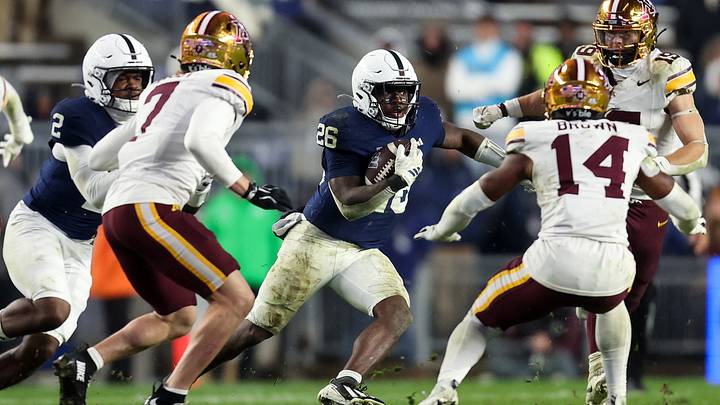
Penn State offensive coordinator Taylor Mouser wants his team to be just as desperate to improve the run game Saturday against Rutgers as it was during the bye week. Before that, Penn State averaged 2.5 yards rushing in four Big Ten losses. Since then, the Nittany Lions have averaged 5.2 in three straight victories.
And yet, Mouser said this week that the run game has “to get better fast.”
“There has to be an urgency and attack to continue to grow and get better, because it's not good enough,” Mouser said of the run game. “It's better than it was, which, I mean, it couldn't have gotten worse necessarily. But I'm not gonna sit here and feel like we've arrived at all.”
Penn State strained hard to generate production on the ground the first four weeks against Big Ten competition. The Nittany Lions ran for 300 total yards in those games, and the backs didn’t register a single carry over 10 in that span. Then everyone took a breath during the bye week in October.
The run blocking improved, the running backs hit gaps faster and that group finally made defenders miss in the open field. Then it was just explosive run after explosive run. The Nittany Lions have made 18 rushes of 10+ yards since the bye week.
Three of those have gone for at least 45 yards, one for at least 40, and two more for 34 and 36. In total, Penn State has generated nine rushes of at least 20 yards in the past three games.
Which prompts the question about Penn State’s run game: What happened during the bye week?
Figuring out the run game

After Penn State’s 21-18 loss at Michigan, where the offense ran for 65 yards, Mouser dissected every inch of the run game with his offense. Quarterback Rocco Becht said they stripped out unproductive plays and focused on what worked.
“I think we just started to figure out what the runs we were good at, the runs that the O line loved, the ones that they blocked well and which ones that the running backs read correctly,” Becht said. “And I think that's what we worked on throughout the bye week, and that's really all we worked on. And I think it's been showing the past three weeks.”
Penn State also streamlined the backfield to Carson Hansen and Cam Wallace, who have spearheaded the turnaround. And that’s fitting given Mouser’s recent comments.



Hansen and Wallace seem to exemplify the mentality that Campbell and Mouser want: hard-working, composed, intense players who don’t get too high or low. Campbell specifically mentioned Hansen after his 119-yard performance in Penn State’s win at Washington, telling young players to watch how “21,” among other leaders, carries himself during a game.
“I still think a lot of the growth that we've had offensively on the ground is just like the mentality and the mindset that it takes to be good at running the football,” Mouser said. “A lot of the stuff is still kind of the same as what we went through, and we struggled with it. But for us, and even the way that we practice… there has to be an urgency and attack to continue to grow and get better because it's not good enough.”
Wallace started the turnaround with his 135-yard performance against Purdue, and Hansen was the key driver in wins over Washington and Minnesota. Wallace is averaging 91 yards per game (6.2 per carry) over the last three, and Hansen has run for 100 yards in back-to-back games and has scored touchdowns in six straight contests.
Hansen is fresh off a 126-yard performance (all in the first half) against Minnesota, where he sustained an injury in the final minute of the second quarter. Campbell said Hansen has been "really super limited so far" at practice this week and is questionable for Saturday’s game against Rutgers.
“We hope Carson can come back sooner than later and be able to play for us on Saturday,” Mouser said. “And if he can't, we have to be able to go rush the ball.”
‘It’s not good enough’
CARSON HANSEN TAKES IT 46 YARDS TO THE HOUSE 🤯 @PennStateFball
— Big Ten Network (@BigTenNetwork) November 15, 2026
Watch on FS1 pic.twitter.com/HkP95TZ4x1
Mouser is still finding faults. He pointed to Hansen’s 46-yard touchdown run against Minnesota, citing multiple missed assignments from the offensive line. Hansen sidestepped four Minnesota defenders for his longest touchdown run of the season.
“But we got lucky that that happened,” Mouser said. “And I don't forget that on that play. That might as well have been a play for minus two yards, in my mind, so that needs to be better. How can we make sure that doesn't happen again?”
Which is why Mouser continues to impress upon his offense that its recent successes in the run game aren’t the finish line.
“I'm not gonna sit here and feel like we've arrived at all,” Mouser said. “And I don't want our guys [to feel that]. And like for us, like I told the offensive coaches, we have to have our best week coaching these guys and demand more this week when it's colder, practices are shorter, and there's only a week left of practice left. So for us, like, how can we suck the juice out of everything we do?
“... We need to let the guys know that it's not good enough, and we'll redo it and go back and do it again, and it has to be this way versus this front, and it's not good enough.”
Sign up to our free Penn State Nittany Lions newsletter, follow us on social media and add Penn State on SI as a Preferred Source on Google.
 Add us as a preferred source on Google

Chase Fisher is a student at Penn State University who has covered men's hockey and baseball for The Daily Collegian. He is covering football for Penn State on SI. Follow him on X @chase_fisher4.
Follow chase_fisher4