%20%20--%3E%0A%3Csvg%20version%3D%221.1%22%20id%3D%22Layer_1%22%20xmlns%3D%22http%3A%2F%2Fwww.w3.org%2F2000%2Fsvg%22%20xmlns%3Axlink%3D%22http%3A%2F%2Fwww.w3.org%2F1999%2Fxlink%22%20x%3D%220px%22%20y%3D%220px%22%0A%09%20width%3D%2239px%22%20height%3D%2240px%22%20viewBox%3D%220%200%2039%2040%22%20enable-background%3D%22new%200%200%2039%2040%22%20xml%3Aspace%3D%22preserve%22%3E%0A%3Cpath%20fill%3D%22%23FFFFFF%22%20d%3D%22M38.5%2C7H28.2v26h10.3V7z%22%2F%3E%0A%3Cpath%20fill-rule%3D%22evenodd%22%20clip-rule%3D%22evenodd%22%20fill%3D%22%23FFFFFF%22%20d%3D%22M26.1%2C25.5c0%2C5.8-4.1%2C7.5-12.9%2C7.5C3.9%2C33%2C0%2C31.2%2C0%2C25.2v-1.1h11.6%0A%09v2.4c0%2C0.7%2C0.1%2C1.4%2C1.2%2C1.4c1%2C0%2C1.2-0.4%2C1.2-1.3v-0.9c0-1.6-0.9-1.6-3.5-2.2C2.2%2C21.7%2C0%2C19.7%2C0%2C15.3v-0.9C0%2C9.3%2C5.5%2C7%2C12.9%2C7%0A%09c10.2%2C0%2C12.8%2C2.6%2C12.8%2C7.4v1.8h-11v-2.9c0-0.6-0.4-1.1-1.2-1.1c-0.6%2C0-1.2%2C0.4-1.2%2C1.1v0.9c0%2C1.5%2C0.9%2C2%2C3.3%2C2.5%0A%09c8%2C1.6%2C10.5%2C3.3%2C10.5%2C7.5V25.5z%22%2F%3E%0A%3C%2Fsvg%3E%0A)
College Football: Ranking the Top 25 Playing Careers of Current FBS Coaches
In this story:
The 2026 college football season features 138 teams competing at the FBS level. All but 15 programs are helmed by coaches who, years ago, suited up at the college level themselves.
Some were superstars—though a surprising few went on to play in the NFL to any extent, and only one has a gold jacket and his visage enshrined in Canton, Ohio. Far more were role-players and walk-ons, plus a fair number competed in the Division II, III and NAIA ranks, only experiencing the sport’s premier level once they entered coaching.
Forde: Vanderbilt Coach Clark Lea’s Biggest Breakthrough Had Nothing to Do With Football
Sports history has some examples of great players who became great coaches, though it is fairly rare. North Carolina’s Bill Belichick is regarded as the greatest NFL coach of all time, but his playing career was fairly humble, as he played center and tight end at D-III Wesleyan, a small private school in Connecticut. His former assistant and longtime friend (and arguably his best college comparison point) Nick Saban played safety in the MAC at Kent State, but was not a standout. That is one area in which he inarguably did not one-up fellow former Alabama legend Paul “Bear” Bryant—a third-team All-American end for the Crimson Tide in 1935.
Most current FBS coaches were closer to Saban and Belichick than Bryant as players, though there are some obvious standouts. Sports Illustrated reviewed the playing stats, records and accolades of all 138 current FBS coaches. These 25 stand above the rest:
25. Brent Venables (Oklahoma coach; Garden City linebacker 1989–90, Kansas State ’91–92)
Venables’s college career with the Wildcats began as so many K-State greats’ have: at the junior college level. He was a dominant linebacker at Garden City Community College, recorded 276 tackles in two seasons with the Broncbusters before matriculating to Manhattan, Kans., where he kept an impressive college career going in the Big Eight. Venables was an all-conference honorable mention as a senior in 1992, finishing the season with 124 total tackles. He remained at Kansas State the following year as a graduate assistant, beginning his coaching career under program legend Bill Snyder. —Dan Lyons
24. Matt Campbell (Penn State coach; Pittsburgh defensive lineman 1998, Mount Union ’99–2002)
Campbell returns to Pennsylvania this season as coach of the Nittany Lions, the same state where he began his college football life—albeit, fleetingly. Campbell attended Pitt for one season before transferring down to the Division III powerhouse Purple Raiders, a fruitful move. Campbell won three consecutive D-III national titles with undefeated teams at Mount Union from 2000 to ’02, and finished with a four-year record of 54–1. Campbell was a first-team D-III All-American as a junior and senior and was the back-to-back winner of the Paul Hoernemann Award, given to the Ohio Athletic Conference’s top defensive lineman. —D.L.
23. P.J. Fleck (Minnesota coach; Northern Illinois wide receiver 1999–03)
Fleck is amazingly the second-longest tenured coach in the Big Ten entering the 2026 season with the Golden Gophers, but MACtion runs in his veins. Before leading Western Michigan to a 13–1 season and a Cotton Bowl berth in his first head coaching stop, Fleck was a standout wide receiver for the Huskies (two-plus decades before their stunning departure for the Mountain West this offseason).
Fleck first broke out as a junior in 2001, with 59 receptions for 732 yards and five scores. Injuries limited him to just three games as a senior, but he received a waiver to play a fifth season in ’03, and he took full advantage, catching 77 passes for 1,028 yards and six touchdowns, earning him a spot as a first-team All-MAC player. He was superhuman in an overtime win over Ohio at the start of October, catching 14 passes for 234 yards and a 15-yard touchdown catch on fourth down late in the fourth quarter to tie the game (and earning him a photo in the following week’s Sports Illustrated). NIU would spend much of that season in the Top 25. —D.L.

22. Brian Hartline (South Florida coach; Ohio State wide receiver 2005–08)
Never quite the capital-G Guy in the Buckeyes’ mid-to-late 2000s receivers room—he finished fourth on the team in receiving yards in 2006, and trailed wide receiver Brian Robiskie in ’07 and ’08—Hartline nonetheless proved a quiet riser. He ended his career with 12 receiving touchdowns, including four in ’08 at a 22.8 yards per catch clip. His hard work paid off in the form of a seven-year NFL career spent mostly with the Dolphins—a career that included a pair of 1,000-yard seasons. —Patrick Andres

21. Barry Odom (Purdue coach; Missouri linebacker 1996–99)
Odom, a two-sport star at Ada High School in Oklahoma, was initially signed to remain in town and play Division II football at East Central University. Instead, he was offered a late opportunity to play at Missouri and worked his way into immediate playing time at linebacker. Odom finished his career with 362 career tackles, five sacks, three interceptions and two forced fumbles, logging over 100 total tackles as both a sophomore and senior. He earned honorable mention All–Big 12 honors twice and earned third-team all-conference honors once during his Tigers career. —D.L.
20. Jeff Brohm (Louisville coach; quarterback 1989–93)
Brohm was actually not the regular starter for the Cardinals’ first great football team in 1990—that was Browning Nagle—but he absorbed the team’s lessons and forged a rock-solid career. In 1993, a year where there were still 10 Division I-A independents, Brohm racked up 20 touchdown passes against nine interceptions and led the cohort with a 149.2 passer rating. Before college football, he was a two-time MLB draftee for the Expos and Cleveland; after it, he played eight games for the 49ers and enjoyed a memorable season with the XFL’s Orlando Rage. —P.A.
19. Will Hall (Tulane coach; Northwest Mississippi quarterback 1999–2000, Murray State ’01, North Alabama ’02–03)
Hall, a native of Amory, Miss., had a unique path through college football that began at Northwest Mississippi Community College—where he was an NJCAA All-American quarterback, setting multiple records at that level—before making the jump up to FCS at Murray State and then down to Division II at North Alabama. He was near unstoppable with the Lions, throwing for over 6,000 yards across two seasons, including school records with 3,531 yards and 30 touchdowns in 2003. That season, he led UNA to a 13–1 record, with the sole loss coming in the D-II semifinals, and captured the Harlon Hill Trophy, D-II’s equivalent of the Heisman Trophy, along with unanimous first-team All-American honors. —D.L.
18. Brent Key (Georgia Tech coach; offensive lineman 1997–2000)
The four-year run from 1997 to 2000 was an incredibly successful one for George O’Leary’s Yellow Jackets program. Georgia Tech went 34–14 with an ACC title, four consecutive AP Top 25 finishes (and one at No. 9, after the 1998 season culminated in a 10–2 record and Gator Bowl win over Notre Dame—the team that then attempted to hire O’Leary before he was caught with lies on his résumé.) Perhaps most importantly, to those in Atlanta at least, the Ramblin’ Wreck beat rival Georgia three consecutive years from 1998 to 2000, something the program hadn’t done since the early 1960s and hasn’t done since.
Lined up at guard during that stretch was Key, a four-year starter for the Yellow Jackets offense who finished his career with a first-team All-ACC nod in 2000. Key would enter coaching as a graduate assistant as his alma mater the next year, and after beginning a stint as assistant coach in 2019, now leads the program and is seeking to lead it to a fourth straight bowl game in ’26. —D.L.
17. Mario Cristobal (Miami coach; offensive lineman 1989–92)
While the 2001 Hurricanes may lay claim to the best team in program (and college football) history, the peak of Miami football came in the late 1980s and early ’90s, when the Canes captured three national titles in five years. Cristobal was a key member of that run, winning national titles as an offensive tackle in 1989 and ’91 and earning All–Big East honors in ’92. Miami was a remarkable 44–4 in Crisotbal’s four years as a player, including a 12–0 run in ’91. —D.L.
16. Luke Fickell (Wisconsin coach; Ohio State defensive lineman 1993–96)
Born and raised in the Buckeyes’ Columbus backyard, Fickell was a mainstay of Ohio State’s most fertile four years under coach John Cooper. He made two All–Big Ten teams playing alongside stars like defensive end Matt Finkes and linebacker Mike Vrabel, and famously played the 1997 Rose Bowl against Arizona State on a torn pectoral muscle. A torn ACL in the Saints’ ’97 training camp led him to go the graduate assistant route for Ohio State in 1999, and he hasn't looked back. —P.A.
15. Marcus Freeman (Notre Dame coach; Ohio State linebacker 2004–08)
Freeman, who turned 40 in January, cut his teeth on several ferocious defenses overseen by Buckeyes coach Jim Tressel. Jumping headfirst into the regular lineup in 2006, he piled up 71 tackles in 13 games and also picked off a pair of passes. His tackle total ballooned to 109 in ’07 (eighth in the conference), and he garnered All–Big Ten honors that year and the year after. The Bears drafted him 154th in ’09, but he didn’t stick, and an enlarged heart hastened his 2010 retirement and move to the sidelines. —P.A.

14. Kirby Smart (Georgia coach; defensive back 1995–98)
A number of coaches on this list have forged coaching careers to eclipse their playing accomplishments, and Smart is no exception, but his stint with the Bulldogs is also overlooked because of his more successful defensive backfield-mate (Hall of Fame cornerback Champ Bailey). No matter: Smart was a gifted ballhawk in his own right, picking off five passes in 1998 to lead the SEC. An NFL training camp stint with the Colts ended quickly, and it was off to coaching for the Montgomery, Ala., native. —P.A.
13. Scott Frost (UCF coach; Stanford quarterback 1993–94, Nebraska ’95–97)
Before he set off on his coaching career, Frost was the last of legendary Cornhuskers coach Tom Osborne’s endless parade of option quarterbacks, and the architect of one of college football’s most controversial plays. The son of an Olympic discus thrower authored a rocky start to his career with the Cardinal, but Nebraska—where his father had played—proved a much better fit. In 1997, he steered Nebraska to a national championship with 1,095 yards on the ground (and the unforgettable flea-kicker pass against Missouri through the air). The Jets drafted him in the third round and immediately moved him to defensive back, where he played five years for three teams. —P.A.

12. Sonny Cumbie (Louisiana Tech coach; Texas Tech quarterback 2000–04)
Mike Leach’s Red Raiders program built an impressive legacy of quarterbacks putting up video game numbers, and Cumbie—a walk-on who ultimately earned a scholarship after a year with the program—was no different. The Abilene, Texas, native sat behind Kliff Kingsbury and B.J. Symons before earning the starting nod in 2004. He became the third consecutive Texas Tech gunslinger to lead the nation in passing, throwing for 4,742 and 32 touchdowns with 18 interceptions. The Red Raiders finished the season by winning a shootout against Aaron Rodgers and No. 4 Cal in the Holiday Bowl, 45–31. Cumbie threw for 520 yards and three touchdowns in the upset, handing the Golden Bears just their second loss of the season. —D.L.

11. GJ Kinne (Texas State coach; Texas quarterback 2007, Tulsa ’08–11)
Kinne, just 37 and one of college football’s top rising offensive minds, put together an accomplished career for the Golden Hurricane during an exciting era of Conference USA football. The Longhorns transfer became Tulsa’s starter in 2009, and passed for 81 touchdowns against 32 interceptions in 38 career games. The Golden Hurricane rode their star to a No. 24 AP poll finish in ’10, their highest since 1991. He bounced around the professional ranks for five years before entering coaching. —P.A.
NEXT: Ranking the 50 Best College Football Players of All Time
10. Kyle Whittingham (Michigan coach; BYU linebacker 1978–81)
Whittingham may be the winningest coach in Utah history, but he played on the other side of the Holy War, as a standout linebacker for the Cougars in the late 1970s and early ’80s. Whittingham was an impactful player for the legendary LaVell Edwards, earning second-team All-WAC honors as a junior in 1980 before breaking into the first team the following year. He was an honorable mention AP All-American selection as a senior, and won the WAC’s defensive player of the year award. Whittingham was a team leader during the first great peak of Edwards’s tenure in Provo, Utah; the Cougars were 43–8 during his career, winning double-digit games in each of his final three seasons, finishing in the top 13 of both the AP and coaches polls each year. —D.L.
9. Morgan Scalley (Utah coach; defensive back 2001–04)
Before he went on to become the intense and aggressive defensive coordinator, and now head coach, of the Utes, Scalley was a key piece of Utah’s secondary in the early 2000s. The ball-hawking defensive back picked off six passes while helping the BCS-buster Utes go 12–0 and win the Fiesta Bowl. Scalley, whose father also played for Utah, has a chance to continue adding to the family legacy as he takes over for longtime Utah coach Whittingham. —Tim Capurso

8. Major Applewhite (South Alabama coach; Texas quarterback 1998–2001)
Applewhite was riding high for three seasons with the Longhorns, owning as many as 44 program records while throwing for 7,900-plus yards and earning Big 12 Offensive Player of the Year honors in 1999 before a knee injury forced him to the bench in favor of upstart Chris Simms in 2000. Applewhite lost his job to Simms in ’01, then found himself the starter again after Simms imploded in a four-interception game in a Red River Rivalry loss. Applewhite, seizing his chance in the last game of his career, threw for 473 yards and four touchdowns to help the Longhorns score 27 fourth-quarter points and erase a 19-point deficit in the Holiday Bowl vs. Washington. —T.C.

7. Steve Sarkisian (Texas coach; El Camino quarterback 1993–94, BYU ’95–96)
Originally committed to play baseball at USC, Sarkisian, with his path to playing time with the Trojans murky, pivoted to play football at El Camino, a junior college where he enjoyed two standout seasons. He transferred to BYU, where he helped the Cougars soar to its winningest season in program history in 1996 while throwing for 4,027 yards and 33 touchdowns. In the season’s opening game, Sarkisian carved up Texas A&M’s “Wrecking Crew” defense to the tune of 536 yards and six touchdowns. The Aggies would, of course, become one of his primary rivals once his coaching career brought him to the Longhorns. —T.C.
6. Timmy Chang (Hawai’i coach; quarterback 2000–04)
In one of the biggest flexes of any coach on this list, Chang authored a record-breaking career at quarterback for the Rainbow Warriors in the early 2000s playing in the program’s up-tempo, run-and-shoot offense, then installed the same offensive system when he became the program’s coach in the 2020s. Regularly chucking the ball over 600 times in a season—unheard of back then—Chang thrived in Hawai’i’s aerial attack, exceeding 4,000 passing yards and 25 touchdowns three times while ending his five-year career in 2004 as the FBS’s career passing yards leader. —T.C.

5. Collin Klein (Kansas State coach; quarterback 2008–12)
Before signing on to coach current dual-threat starting quarterback Avery Johnson, Wildcats coach Collin Klein was a dynamic, dual-threat signal-caller himself for K-State. One of the greatest players in program history, Klein led the Wildcats to a 21–5 record in two years as the starter, becoming the first quarterback from a Power 5 school to throw for at least 10 passing touchdowns and rush for at least 20 in consecutive seasons (2011, ’12) since 1998. His playing career peaked in 2012, finishing third in the Heisman Trophy vote while leading the Wildcats to an 11–2 record and a Big 12 title. —T.C.

4. Josh Heupel (Tennessee coach; Weber State quarterback 1996–97, Snow ’98, Oklahoma ’99–2000)
Heupel might coach for an SEC rival now, but warm feelings remain for him in Norman, Okla., considering all he’s done for the Sooners. Heupel arrived at Oklahoma a little-known journeyman who suffered a season-ending injury at Weber State and spent a year with junior college Snow, and left a national champion and Heisman-caliber quarterback. Playing in the early versions of Mike Leach’s Air Raid offense, the accurate Heupel led the Big 12 in passing yards (3,460) and touchdowns (30) in 1999, then followed that up by finishing second in the Heisman Trophy vote while leading Oklahoma to a national championship in 2000. —T.C.

3. Pat Fitzgerald (Michigan State coach; Northwestern linebacker 1993–96)
While Fitzgerald’s tenure as Northwestern coach came to a bitter end, his tenure as a Wildcats player is nestled firmly atop the annals of the sport. Once described by Sports Illustrated as a “more brainy than barbarian” version of Bears legend Dick Butkus, Fitzgerald in 1995 helped lead the Wildcats to their first winning season since 1971, as well as a Big Ten title. He tallied 299 total tackles, five forced fumbles and three interceptions while becoming the only two-time winner of the Bronko Nagurski and Chuck Bednarik Awards. —T.C.
2. Eddie George (Bowling Green coach; Ohio State running back 1992–95)
A man of many talents who’d one day appear in Chicago on Broadway, George sharpened his showmanship skills with the Buckeyes as one of their all-time greatest players. Slowly building from limited action as a freshman, George capped his senior year in 1995 with 1,826 rushing yards, 23 rushing touchdowns and a Heisman Trophy. He didn’t miss a beat after being drafted by the Oilers, making four Pro Bowls and helping smooth the franchise's relocation from Houston to Memphis to its current home in Nashville. —P.A.

1. Deion Sanders (Colorado coach; Florida State cornerback 1985–88)
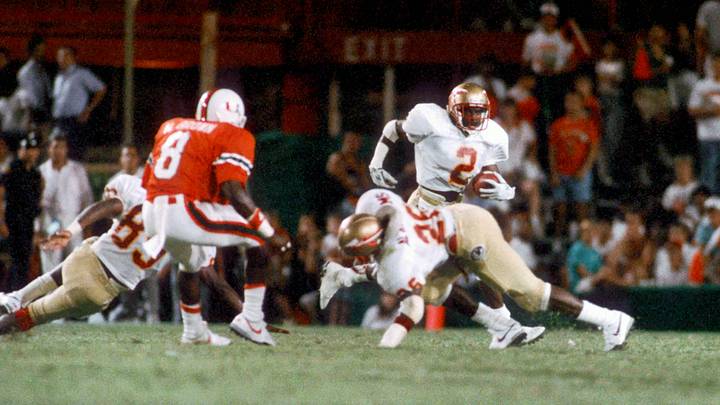
The No. 1 player on our list is one of the greatest players to ever put on a pair of cleats. Before Sanders was Coach Prime in Boulder, Colo., he was Neon Deion, lighting it up for the Seminoles in the late 1980s before a legendary pro career that saw him star for the Falcons, 49ers and Cowboys, among others. Sanders was a two-time All-American at Florida State, took home the Jim Thorpe Award as the nation’s top defensive back and has been enshrined in both the College and Pro Football Halls of Fame. —D.L.
SI writers Pat Forde and Bryan Fischer contributed to these rankings.
PODCAST: Listen to SI’s college sports podcast, Others Receiving Votes, hosted by Pat Forde, below or on Apple and Spotify. Watch the show on SI’s college YouTube channel or on SI TV.
 Add us as a preferred source on Google
Dan Lyons is a staff writer and editor on Sports Illustrated's Breaking and Trending News team. He joined SI for his second stint in November 2024 after a stint as a senior college football writer at Athlon Sports, and a previous run with SI spanning multiple years as a writer and editor. Outside of sports, you can find Dan at an indie concert venue or movie theater.

Patrick Andres is a staff writer on the Breaking and Trending News team at Sports Illustrated. He joined SI in December 2022, having worked for The Blade, Athlon Sports, Fear the Sword and Diamond Digest. Andres has covered everything from zero-attendance Big Ten basketball to a seven-overtime college football game. He is a graduate of Northwestern University's Medill School of Journalism with a double major in history .
Follow PAndres2001
Tim Capurso is a staff writer for Sports Illustrated, primarily covering MLB, college football and college basketball. Before joining SI in November 2023, Capurso worked at RotoBaller and ClutchPoints and is a graduate of Assumption University. When he's not working, he can be found at the gym, reading a book or enjoying a good hike. A resident of New York, Capurso openly wonders if the Giants will ever be a winning football team again.
Follow TimCapurso