
Questions About Purdue's Frontcourt? Boilers Have Handled That Before
In this story:
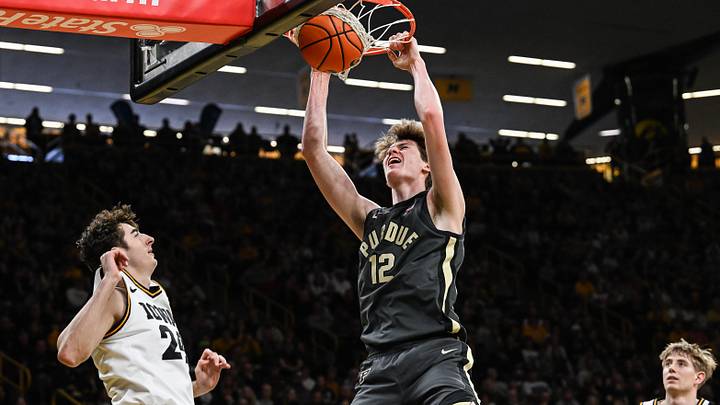
If there's been a consistent concern seeping out of West Lafayette early this summer, it's regarding the frontcourt's physicality and depth. Oscar Cluff and Trey Kaufman-Renn leave behind some large shoes to fill for Purdue's bigs heading into a new season.
Purdue has a unique collection of big men on this year's roster. The Boilers have a pair of seven-footers at the five in junior Daniel Jacobsen and freshman Sinan Huan. The four spot is a bit undersized with senior transfer Caden Pierce, sophomore Jack Benter and freshman Rivers Knight, none of whom are taller than 6-foot-8. Then there's Raleigh Burgess, a 6-foot-11 sophomore who can fill in at both frontcourt positions, depending on what Matt Painter needs.
The one glaring deficiency, at least on paper? Purdue lacks a proven physical presence at the four and five positions. How will this eclectic mix of frontcourt players handle the bullies in the post? How can the Boilermakers survive on the glass?
Both are legitimate concerns, but it might be premature to assume Purdue's frontcourt is going to be a weakness this coming season. This isn't the first time Painter has faced this type of situation.
Purdue has found ways to have success without having players like Zach Edey, Isaac Haas, Caleb Swanigan or Oscar Cluff on the roster before.
Purdue's 2024-25 team battled post concerns ...

The most recent example of Purdue finding success without a bully down low came just two seasons ago. The Edey era ended following the 2024 run to the National Championship Game, leaving the Boilermakers with Jacobsen, Kaufman-Renn, Will Berg and Caleb Furst on the roster.
Initially, Jacobsen won the starting job at the five, but his freshman year ended early because of an injury. Berg then took over in that role briefly before Painter opted to go with a small-ball lineup that included Kaufman-Renn and Furst as the starters in the frontcourt.
Purdue struggled to rebound the basketball that season, finishing with just a plus-2.1 differential on the glass. That mark ranked 130th nationally, but was seventh in the Big Ten.
Still, the Boilermakers had a 24-12 record and reached the Sweet 16 round of the NCAA Tournament. They were just a play away from upsetting No. 1 seed Houston, too.
How did Purdue counter its lack of size and physicality? Obviously, the Boilers had a top-15 team in terms of offensive efficiency, which helps tremendously. But they also pressured the basketball, thanks to Furst's ability to defend the perimeter.
Purdue's defense was particularly effective during a 12-game stretch from Dec. 29 through Feb. 7, going 11-1 and forcing an average of 15.2 turnovers per contest.
... So did the 2018-19 Boilermakers

As hard to believe as it is that this season is now nearly a decade old, Purdue dealt with some serious questions along its front lines during the 2018-19 campaign. That frontcourt featured Matt Haarms, Evan Boudreaux, Grady Eifert and Trevion Williams, only a freshman at that time.
Nobody on that team averaged more than 5.5 rebounds per game, yet the Boilers still averaged 36.8 boards per contest and owned a plus-5.1 rebound differential, good enough for 29th nationally.
The biggest key for that team? Everybody crashed the glass. Eight players averaged at least 2.9 rebounds per game, and the Boilers were led by Nojel Easter, a 6-foot-5 guard, who grabbed 5.5 rebounds per game.
Purdue's 2018-19 squad was a co-Big Ten regular-season champion and reached the Elite Eight round of the NCAA Tournament.
This is still "Big Man U"

Most of the noise about Purdue's lack of depth and physicality in the frontcourt stems from what we know. We saw Jacobsen wear down late during the 2025-26 season. Burgess had his highs and lows as a freshman two seasons ago and hasn't played a college game in over a year.
Benter is a fighter on the glass, but he stands just 6-foot-6. Pierce proved himself as one of the top rebounders in the Ivy League, but will that translate to the Big Ten, especially with a year off? Knight and Huan are only freshmen.
That's what we know about this roster. What we don't know — and won't until at least the exhibition games in October — is how much assistant coach Brandon Brantley can develop this group.
Numerous examples exist of players making massive leaps from one year to the next under Brantley's tutelage. He transformed Swanigan into the Big Ten Player of the Year, Edey into a two-time National Player of the Year and Kaufman-Renn into a third-team All-American.
Who's to say Jacobsen, Burgess or someone else can't take a big step this summer? In other words, it's too early to start pressing any panic buttons.
How could Purdue find success without a "dominant" big man

Even if Purdue doesn't have that bull in the post this season, it can find ways to counter. It would take a mixture of what the 2024-25 and 2018-19 teams did in order to find success.
First, Purdue's defensive pressure should be in better shape than it has been in previous years. Not only did Painter bring in Kenny Lowe to assist Paul Lusk on that end of the floor, but the Boilers get bigger and more athletic around the perimeter.
Forcing turnovers would obviously help Purdue's cause, but so would keeping opponents out of the paint. If the Boilers can prevent penetration into the painted area and force teams into tough, contested field goals, it's going to help.
Rebounding will require a complete team effort. The Boilers can't solely rely on the bigs to get every missed shot; they're going to depend on their guards for help.
Plus, with a more athletic and versatile frontcourt, it may be easier for the Boilermakers to chase down some of those long rebounds. At times last season, that was a concern.
Having an Edey-like player in the post would certainly be the best option for Purdue. But, even if that guy doesn't reside in West Lafayette this year, there are ways the Boilers can continue to have success.
It's happened before, why would this season be any different?
Get top Boilermakers stories, expert analysis, and can't-miss moments straight to your inbox for free by signing up for the Purdue Boilermakers on SI newsletter!
 Add us as a preferred source on Google
Dustin Schutte is the publisher of Purdue Boilermakers on SI and has spent more than a decade working in sports journalism. His career began in 2013, when he covered Big Ten football. He remained in that role for eight years before working at On SI to cover the Boilermakers. Dustin graduated from Manchester University in Indiana in 2010, where he played for the men's tennis team.
Follow SchutteDustin