
B.T. Breakdown: Three Reasons Why UCF Couldn't Keep Up With No. 18 Oklahoma State
In this story:
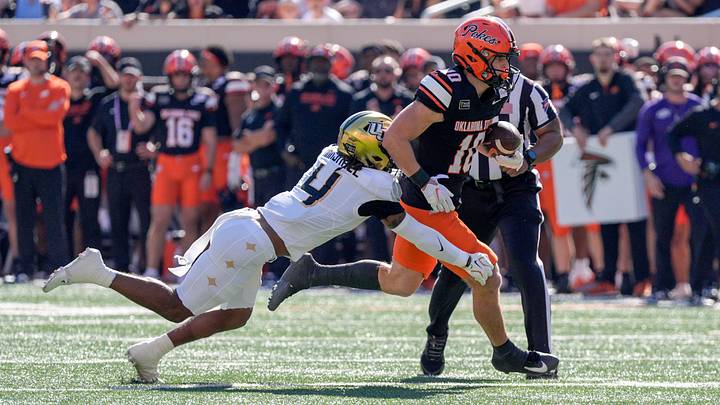
The UCF Knights' road woes continued on Saturday after they could not keep up with No. 18 Oklahoma State, 42-28.
The loss, which is the largest margin of defeat for the Knights (3-3, 1-2 Big 12) this season, extends their losing streak away from Orlando to 12 games. It also brings the first half of UCF's 2026 season to a close.
So, as coach Scott Frost and his team prepare to go on their bye week, here are the three things that went wrong for them on Saturday in Stillwater:
1. A Tale of Two Halves
The Knights came out swinging in the first 30 minutes, even getting on the board first after an Oklahoma State fumble.
During the first half, UCF leaned more towards the run as it outrushed the Cowboys, 80-57. Oklahoma State quarterback Drew Mestemaker's passing ultimately put the home team on top going into the locker room when it came to total yards gained, 222-198. Yet, thanks to that fumble, taking advantage of some Oklahoma State penalties and a completed deep pass to Waden Charles, the Knights pulled even with the No. 18 team in the nation at halftime.
The second half, however, was a different story. Of course, Oklahoma State played a cleaner game, but it also better contained the Knights' rushing attack, which only averaged 1.7 yards with 18 carries, while the Cowboys stayed close to consistent with 53 yards.
However, even with that kind of limitation and punting on their first drive of the half, UCF still managed to hold the ball for over seven minutes on a 13-play, 48-yard drive that got into field goal range. However, that's when another issue for the Knights reared its head.
2. Made Too Many Mistakes
scoop, there it is
— OSU Cowboy Football (@CowboyFB) October 10, 2026
📺: ESPN2 | @TheEvanJackson pic.twitter.com/LPQaiVpggM
Thanks to Oklahoma State's air raid offense, which averaged 16 yards per completion, the Knights had the opportunity to be the team with a long time of possession. They even had an opportunity to score on their longest drive of the day in terms of time spent. However, kicker Will Stone ended up sending what would have been a game-tying field goal wide right in his first miss of the season.
However, while that miss may have provided the opportunity for the Cowboys to go up multiple scores, the UCF defense held them to another field goal to keep it a one-score game. Just five plays later, quarterback Keyone Jenkins threw a backwards pass that got away from the receiver, leaving it open for Oklahoma State to scoop it up and officially go up by two scores.
"We can't have a catastrophic play like that, particularly on the road against a good team, and if you take that one away, I don't know what the game looks like," Frost said.
In the span of about five in-game minutes, a pair of mistakes became the catalysts between the Knights tying the game and being down two touchdowns with just over 10 minutes left. This was then followed up with UCF going four-and-out, with running back Landen Chambers coming up short after getting the ball from the shotgun on fourth and one.
In the first half, it was Oklahoma State's mistakes that helped keep the Knights in the game. In the second half, it was the Knights' mistakes that allowed the Cowboys to ride off into the sunset with a multi-score win.
3. Can't Reliably Pass Deep
Jenkins has been an overall high-percentage passer with the Knights. However, his performance in Stillwater, contrasted with Mestemaker, showed just how limited his skillset as a passer could be.
Give Jenkins a single-digit-yard pass, and more often than not, he completes it, even clutch ones like the fourth-down grab by tight end Caden Piening. However, call for a deep ball, and the FIU transfer ends up heaving a pass that is, more often than not, off target. Even when a receiver does catch it, it came on a 50-50 ball or the receiver had to dive for it.
Mestemaker, meanwhile, played further downfield with his throws. In fact, he only threw a short pass six times on Saturday compared to Jenkins' 22. However, the two's most crucial difference comes with their deep passing. While Mestemaker connected on 71.4% of his deep passes, plays that could make a drive, Jenkins connected on just 30%.
Pass Distance | Keyone Jenkins | Drew Mestemaker |
|---|---|---|
Short (Less than 5 yards) | 19/22 | 5/6 |
Medium (5 to 15 yards) | 5/5 | 7/11 |
Deep (15 or more yards) | 3/10 | 5/7 |
So, even though Jenkins was a higher-efficiency passer who actually completed more passes than Mestemaker attempted all game, the Oklahoma State quarterback made the most of each of his completions to help turn what was a close game into a multi-score lead that locked down the win by the time 7:30 remained on the clock.
Following their bye week, which Frost said comes at "at a really good time" to emphasize getting players back healthy, the Knights embark on the second half of their season on Oct. 24 as they host No. 8 BYU for Homecoming.
"We have a plan," Frost said. "I don't know if I want to share it publicly. All I'll really say is, I think we'll gain more on the field by having a fresh team in the second half than we will by grinding them out over the bye week."
Catch up on more UCF news below:
What UCF's Offensive Line Has Gotten Right (And Wrong) in 2026
B.T.'s Breakdown: Where it All Went Wrong For UCF Against No. 20 Houston
What Riley Kugel Could Bring to the 2026-27 UCF Knights
 Add us as a preferred source on Google
Bryson Turner is a sports journalist who covers UCF Athletics. Turner has contributed to the Black and Gold Banneret, the home for UCF Athletics on SB Nation. He has called the Orlando area home since the age of 8 and received his bachelor's and master's degrees from UCF.
Follow itsBrysonTurner