
Everything Vanderbilt Baseball Coach Tim Corbin Said After SEC Tournament Win Over Kentucky
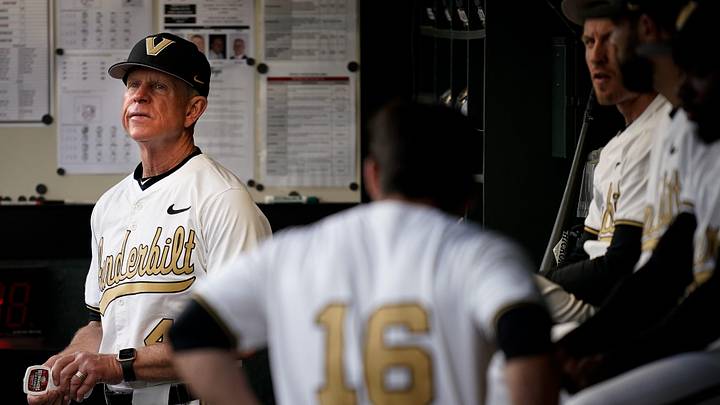
Vanderbilt baseball gets to see its season live for at least one more day.
That was the most important takeaway of the Commodores 4-1 come from behind victory to beat No. 13 seed Kentucky 8-5 in the first round of the SEC Baseball Tournament.
It was a night and day difference from the Vanderbilt offense from the sixth inning and onward. The first five innings, Vanderbilt trailed 4-1 and was on pace to see its 2026 season come to an end. But the Commodores fought back to take their first lead of the game in the sixth inning before scoring three more runs in the eighth inning to pull away.
After the game, Vanderbilt baseball head coach Tim Corbin spoke to the media. Here is everything Corbin said postgame.
Opening Statement
TIM CORBIN: It was a good win for our ballclub. Tough win. We knew what the challenge was on the mound for certain. And he was good. And he kept us down for halfway through the game.
Obviously the sixth inning was a big breakthrough for us because he got two quick outs and it just shows you how the game can change in an instant, and it did. We got some very good hits one right after another with Waite and Rigdon. I guess first, Logan got on with the walk and then Goodin and then Waite and Rigdon with two strikes and then Barz.
And we put a nice inning together, kind of broke through and then added on with Ruster manufacturing a run by himself and Brodie's big knock.
But the difference was the ability to stop the game offensively for them, and that was Kranzler. Kranzler came in just doing a nice job of settling in, throwing strikes and turning the momentum to our side.
We've talked about it during the course of the year how oftentimes offense can get going because of a pitcher. And he certainly did that.
Yeah, it was a fun game because of the ABS. It was good to play with that. But funner just because of the win, so good for our boys.
Q. You mentioned it was fun with the ABS. How do you feel like the implementation and execution of the first day of the tournament has been with the ABS?
TIM CORBIN: Good. From what I saw in the first game, I think the biggest adjustment's going to be the umpire, to be honest with you, because they've called strikes and balls according to how they see it. And now it's that 2D box, which, or a hitter, because of machines and what you train with, it might be a little bit easier for them to understand where the ball is.
But I think it's just going to take a little bit of time. But I like it. I like it a lot. I think it helps both sides. I think it's clear. Anything that takes the emotion out of the game from a call is a good thing for baseball. And I'm not concerned with the time element whatsoever. We've got to do a job on picks, that's probably what we've got to do. We've got to get rid of that. That's for another day. But I think it's good.
Q. You moved Brodie Johnston to the lead-off spot today and he had three RBIs. What prompted you to make that change and what did you see from him responding to that change as well?
TIM CORBIN: We wanted to shake things up for him, and also put him at the top where he's done pretty good damage against right-handed pitching, and he's pretty good with no people on as well. He is with people on, but he's done a good job of getting on base to start things.
We just felt like it was the right move. And other than that, it kind of flipped the same. It just moved Ryker to the 6. But we just thought it was a good move for the team.
Q. You talked the other day about not wanting guys to feel the pressure of what's at stake this week. Given how this game went today, how encouraging is that in terms of how they responded and what it could be in terms of something to build off of?
TIM CORBIN: Well, the first game of a tournament is always tough, regardless of whether it was last year, year before, I think. I think you win the first one, and it kind of relieves a little bit.
They've been loose. And we've talked about it. It's like the elephant in the room. They're trying to play for Vanderbilt, and play to do something, and what I really asked them to do was get away from that and remove that from it.
I said, if they want to do something for the program, do something for the coaches and themselves, then you can't carry the program. All you can do is just play the game and enjoy what you're doing.
So they've had a lot of fun, and to Colin's point, we really enjoyed coming down here. This is a tremendous event. There's nothing like it. And going back to 2003, we find so much fulfillment in coming down here and playing in front of people. They care. They spend a lot of money. They make the kids feel special. This is something I never thought I would have been a part of when I was a young kid growing up in New Hampshire, but to see these kids enjoy what they're doing and play baseball, Vanderbilt has a good time here.
Q. Along those lines, when you heard Ryker say that a couple of days ago, or you did hear him say it, you seemed to have a visible reaction to it. Could you just go back and tell us what was going through your head and maybe how that influenced the way you approached the team in the next couple days?
TIM CORBIN: I approached the team differently even before he said that. I think when he did say that, it made me -- I don't know -- it's almost like a parent where you're thinking, you're applying too much pressure to your kids.
And I didn't want him to feel that, or the team. So, yeah, I just didn't want them to feel that way. But we talked about it, and hopefully you can relieve some of that to some degree.
But I think they're in a pretty good place right now. It's easy to say after a win, but I do. I think the conversations, and when Jelkin was going through the lineup, I thought it was very positive. The kids were good.
It felt like that game, we were going to come back at some point in time. I didn't know if we would put up a four-spot, but in order to do that, you have to have pretty good energy in the dugout. If you don't have energy in the dugout, you're not making a comeback like that with two outs.
Q. On the topic of ABS, what was the strategy that you employed in when to challenge and when to allow your players to challenge?
TIM CORBIN: We talked about it at length yesterday and again today. We just talked about scenarios that you could challenge. I think it's more instinctual. I think you know when the game is in the balance where a pitch could potentially make a difference and you know when it's not. You just have to be wise. I trust these guys. They're smart.
And the guy behind the plate is very good at what he does. He's very intelligent. He's a military kid. So I feel like if he makes a choice, I'd ride with him every day.
We just talked about the defensive side of things, with the catcher and the pitcher, and the hitter was more about the timing of it and the guys on base and that type of thing.
Q. Question on Alex, I feel his fastball has ticked to 96. I feel like he was sitting maybe 92, 93 early in the year. First of all, is that correct? And second, what have you guys been able to do to just flip a switch with him because he just looks like a completely different guy the last few weeks?
TIM CORBIN: Yeah, I think you're right. I think the velocity is certainly up. There's movement to his ball and cutter. But I think he's slowed himself down. I think that's the thing. I believe his rhythm to how he pitches, it looks easier. It doesn't look as forced. It doesn't look like grunt work. It's letting the ball do the work. And he's a very hard worker, so he demands a lot out of himself. I think he's let himself go in some ways and he's throwing more strikes. There's no doubt about it. His strike percentage has elevated in the last three weeks.
Q. What does it mean to see what you guys did in the bottom of the sixth inning, seeing Waite, Rigdon have quality at-bats, and then later in the bottom of the eighth Johnston going yard, how did you feel like that's a big component of your offense heading into tomorrow against Florida alongside saving up your bullpen?
TIM CORBIN: We played offense like that this past weekend against South Carolina. We did not hit the long ball. There were a lot of singles, there were a lot of two-strike balls, and I thought that that was kind of the case with that.
They rarely bared down and had good at-bats, because it looked like Ryker was out of his at-bat and he poked it through the hole. It looked like Rigdon was out of the at-bat. He poked it through the hole. Barczi jumped on the ball after a timeout with Esposito (phonetic), poked it through the holes. I just thought they were courageous tough at-bats.
Yeah, a little bit of fighting. It wasn't pretty. But they were well-hit balls and there was a commitment to what they were doing. I think that matters most.
Q. Coach, this is the time of year where everybody talks about RPI. Last year your RPI helped you out. This year, it's not. What's your view of that as a tool being used to select a field?
TIM CORBIN: Well, I think it's a tool. I think it's for scheduling, mathematics, it's a tool. But I don't think it's the whole tool. I think common sense prevails. When you look at a bucket of work, I think you look at a team from start to finish, what they've done.
I know we start off 13-12 and now we're 20-12 in the last half. We played on the road a little bit more. We scheduled tournaments tough, and we didn't get off to a good start. We've had our challenges, obviously, with health. And we've overcome them to some degree.
It hasn't been easy at all, and Barczi is your starting catcher, he's not playing. And Korbin Reynolds, a freshman, who I didn't think would play at all this year is 30-for-31 in the SEC counting today.
So I think we're a pretty damn good team. We're judged by the best conference and the best teams in college baseball, but there's also a lot of precedent for a team that's 14-16.
But obviously sitting in this seat, it's not about talking, it's about doing. But at the same time, I don't think the RPI is just the one indicator. It may speak to what you have done, but it doesn't speak to how you've done it and the body of work that exists with what we've done.
Our margins have been small in some of the series we lost, whether it's Oklahoma or Texas, but we've played pretty good baseball down this stretch, and usually the committee takes that into effect in terms of where a team is moving, and our trajectory has been pretty good.
Follow us on Twitter/X, Facebook, YouTube, Instagram, Threads and Blue Sky for the latest news.
 Add us as a preferred source on Google
Graham Baakko is a writer for Vanderbilt Commodores On SI, primarily covering football, basketball and baseball. Graham is a recent graduate from the University of Alabama, where he wrote for The Crimson White, WVUA-FM, WVUA 23 as he covered a variety of Crimson Tide sports. He also covered South Carolina athletics as a sportswriting intern for GamecockCentral.
Follow GrahamBaakko