
Emmert Interview Answers Some Questions, Raises Others
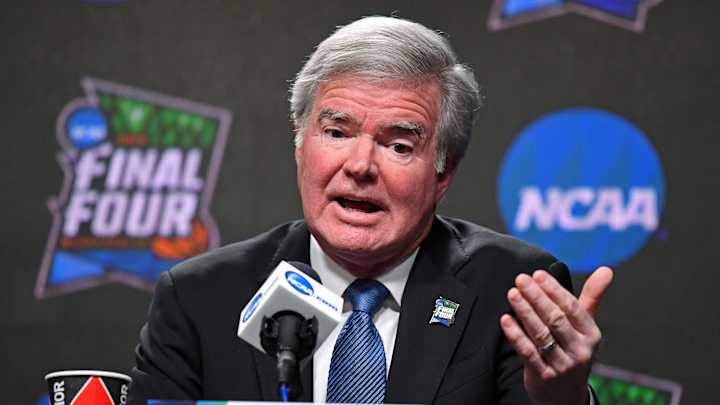
Things are crazy all over in almost every avenue of our world. So it's no surprise that when on Friday evening, NCAA president Mark Emmert finished an interview with NCAA.com's Andy Katz, some questions received answers while causing new ones to arise.
Emmert made one thing clear; there will be no college football for schools that are open only to online classes. Nothing at all wrong with that, and I would agree that if the schools themselves aren't operating as close to normal as possible, then athletics should wait.
"All of the commissioners and every president that I've talked to is in clear agreement: If you don't have students on campus, you don't have student-athletes on campus," Emmert said. "That doesn't mean [the school] has to be up and running in the full normal model, but you have to treat the health and well-being of the athletes at least as much as the regular students. If a school doesn't reopen, then they're not going to be playing sports. It's that simple."
That statement is clear, precise, and simple, but with it comes other questions that are not as simple to answer.
Among those questions is how schools in states with different shelter-in-place policies are treated in regards to competitive advantages. Emmert conceded that the issue could "create some inequities."
Our world remains clouded by the Coronavirus, with each state handling their situation differently. Some like Georgia have reopened while others are in the process while some remain locked in.
How exactly would it work for those schools and athletics programs which are back open to the satisfaction of Emmert's comments to be impacted by those others who are not open?
Alabama is scheduled to open their season versus USC in Dallas, but California will likely be one of the last states to begin reopening. What happens if the Trojans are still out of school and sheltering in place while the Tide is ready to roll?
Then there are the individual conferences, where you might have 12 of 14 schools open and ready, while two schools are not and can't meet the requirements to play?
NCAA chief medical officer, Dr. Brian Hainline, via Twitter, emphasized the importance of testing for COVID-19 and tracing the contacts of those with the virus.
"There has to be a good sense of surveillance, and that has to be at the campus level, the regional level," Hainline said. "So if we're going to start opening up society, we need to know that means. That's what surveillance is all about. We need to improve the infrastructure for that.
"And then finally the testing is going to be really important. ... What does testing really mean? How often does it have to be done -- especially if you're in a contact sport where the athletes are close to one another. So the testing component -- especially getting a rapid-diagnostic test on the one hand and then understanding immunity on the other -- that's going to have to really improve over the next several weeks."
The guideline of what it will take for individual universities to allow their football teams to play is clear, the waters around them are still just as murky and uncertain and are likely to remain that way for the very near future.
Follow Greg on Twitter @GregAriasSports and @SIVanderbilt or Facebook at Vanderbilt Commodores-Maven.
 Add us as a preferred source on Google
A 29 year veteran of radio in the Middle Tennessee area and 16 years in digital and internet media having covered the Tennessee Titans for Scout Media and TitanInsider.com before joining the Sports Illustrated family of networks.