
How Clark Lea, Vanderbilt Football Bounced Back From Historic ETSU Loss On The Way To A Program Turnaround
In this story:
NASHVILLE—To Clark Lea’s right, a paneled football sits on the second row of shelving alongside another game ball with silver sharpie inscribed in honor of a 2025 Vanderbilt win. Behind the footballs are a credential from Vanderbilt’s 2024 win over Kentucky. Across the shelf is, guess what, another game ball from a Vanderbilt win.
Those mementos are merely scratching the surface of Lea’s collection–which is as vast as it’s ever been in the fallout of Vanderbilt winning a program-best 10 games in 2025.
The brown, natural finish of Lea’s office bookshelves are nearly entirely covered in memorabilia from Vanderbilt football’s rise these days and are displayed alongside a modernized Vanderbilt V logo in the back of every Zoom call he takes from Vanderbilt’s McGugin Center.
When he took the Vanderbilt job in Feb. 2021, the shelves hadn’t yet been installed. Instead, there was a background graphic of cars and Nashville streets covering it. In his estimate, the backdrop Lea has these days is dramatically improved relative to what he had when he took the drop. At the very least, he says, it’s filled out much more than it was in a past life.
That feels like a microcosm of his program, right?
“That’s right,” Lea said in regard to the assertion. “It’s changed dramatically.”
When Lea first moved into this office, he didn’t quite know what he was in for. He knew he had a challenge ahead of him and a big vision to lean on as he dealt with them, but he likely couldn’t imagine what it would take for him to get to the point where he can look back at how far his program has come.
If Lea thought this was going to be easier than expected, though, he was greeted by a loss that stacks up with the worst in Vanderbilt football history. It happened in his first game and was intense enough to cripple a weaker man. Lea and company lost 23-3 to ETSU in the wake up call to end all wake up calls.
That early-September night effectively ended Lea’s honeymoon stage as the head coach of his alma mater. His program was exposed. In a way, he also was.
“I think when you're taking over a program, where Vanderbilt was at the time, your deficiencies are just out there for the world to see,” Lea told Vandy on SI. “One of the things that I was learning in that moment was the result of a lag effect.”

Lea is nearly staring a hole through his computer screen as he opens a press conference that he knows will be grueling. It’s late at night and Vanderbilt football’s world has just been rocked. It’s not as if ETSU merely beat Vanderbilt. No, it ran it off its own field. Lea said it was an indicator of where this program was.
He may have been understating it.
And in this moment, Lea couldn’t do anything about it. He was left to sit there in his office facing a group of media that was scattered throughout the FirstBank Stadium press box and their homes waiting to ask questions. In a way the visual indicates as much about the state of the program in those days as the result does.
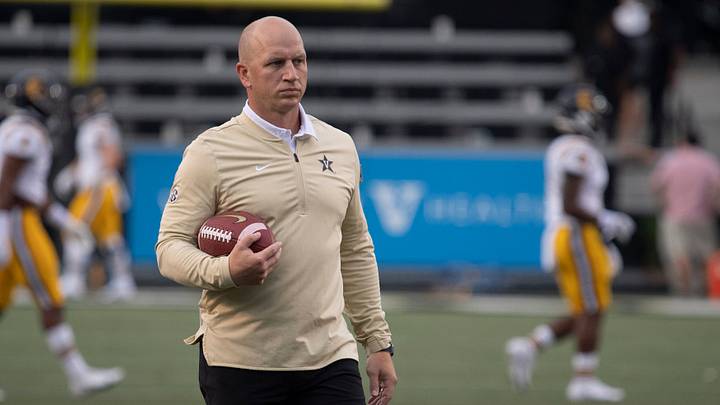
Lea was wearing a light-gold Vanderbilt quarterzip with a star V covering his chest and another big one on the wall behind him. Through the blurry computer camera, the walls surrounding the logo plastered on the wall showed empty space that was waiting to be filled with symbols of Lea’s accolades as Vanderbilt’s head coach. In that moment, he likely knew that he wouldn’t be filling them anytime soon.
The road ahead was long and difficult–particularly after Vanderbilt lost 62-0 to Georgia in the weeks following the ETSU loss. Lea knew that when he took the job, but he was confident that he could turn this thing. His belief didn’t waver on this September night, but it didn’t come quite as naturally. He took that night hard. He took it personally.
All these years later, Vanderbilt special teams coach and tight ends coach Jeff LePak–who was also a quality-control assistant–commends Lea for never blaming his coaches or players for the result that night. LePak says his boss never showed signs of flinching after the loss, but there were some mental battles that he wasn’t privy to.

“The worst part to me believed it to be an indictment of my ability to be a head coach,” Lea said. “I had mentors and people and a wife, thankfully, who told me that ‘that's actually why you're here. You’re not responsible for that in the sense that the result was the culmination of a lot of other things that happened before we had gotten here.’”
Vanderbilt finished the season prior to Lea’s arrival with an 0-9 record and was in turmoil in every regard in the months prior to his arrival. It had players quit. It didn’t finish the season. It sparked big-picture discussion in regard to whether Vanderbilt really belonged at his level, in this league.
Lea was a beacon of hope for a program that hadn’t had any in a number of years, but he was a first-time head coach. He hadn’t yet shown the general public any indication of that prior to that opening night, but he did by the time his Sports Information Director logged him into the press conference. Lea knew that 10-3 seasons like Vanderbilt had in 2025 were possible, but he was as far away as he’d ever been as he addressed the media for those 13 minutes and 55 seconds.
There had to be some grace built in for Lea because of the situation he inherited–particularly because the NIL era hadn’t yet overtaken college football–but he still had a role in this. His team wasn’t near talented enough–and it probably wasn’t even in the ball park of being talented enough.
Vanderbilt tight ends coach Brendan Flaherty–who was a quality control assistant at the time–said the program had a sense of entitlement that it had to flush at that point. It believed that because it was an SEC team and ETSU was an FCS team, it was going to cruise to a win no matter what.
Clearly, it was wrong.
“It was my job to take that as an indication of where we are,” Lea said, “And then to plot a course where we needed to go. And part of that growth had to be my growth.”

For a second, Vanderbilt’s coaching staff takes a break from talking about progress and future aspirations to talk about something painful. For a second, they don’t hide anything from the recruits on campus.
Lea has often viewed recruiting more as a process in which high schoolers and transfers get to know Vanderbilt as a program more than it is a sales pitch, and this action by his staff aligns with that theory. For a second, everyone involved recalls what happened September 5, 2021.
They recall the pain. They recall what went wrong. They recall where the program was and why this happened. They remind each other that something like this can’t–and won’t–happen again. The visuals are easier to stomach now that Lea and company have effectively turned Vanderbilt around in a way that appeared to be far off that night, but they’re still memories that evoke some feelings from those who were around.
“When we want to put salt in that wound [we show them],” LePak jokes. “We show recruits that just to let them know about our story and where we came from and how far we’ve come. We let them know that isn’t something that was built overnight and that there are a lot of people that have worked really hard and gone through a lot of stuff to get that.”
All these years later, Lea says nobody spends enough time talking about the players on that team who signed up to take on the challenge of his first season. Vanderbilt has moved on to more talented players across the board and has flushed the mentality of its past, but Lea isn’t hiding from history.

Lea appears to believe that his program is better off now because of what it went through and learned on that fateful September night. As a result, Vanderbilt doesn’t ignore it as if it never happened. Instead, in a series of wide-ranging interviews with Lea, Flaherty and LePak, the longest answers of all relate to ETSU. Lea says he talks about it often.
From the moment Lea stood at the door of Vanderbilt’s locker room and greeted every player in the moments following the loss, the program decided to embrace this. It decided that the only way to move forward from rock bottom was to acknowledge that it was there, to acknowledge that something had to change.
“That moment really helped me to understand that you have to work to win,” Vanderbilt pass rusher Miles Capers–who is the only player on its 2026 roster that was on the sideline for that 2021 loss–said. “It’s hard to win.”
On the other end, though, Capers and company know that Vanderbilt isn’t defined by its worst losses anymore. Perhaps that’s why Lea and company so casually discuss a moment that could be labeled the worst of his tenure and how to bury it properly.
“We have to have a clear vision of what we're after,” Lea said. “We have to be methodical in the way we pay attention to the day in and day out, and impact intentionally day in and day out to bring to life with things coming out in our hearts and in our minds and that's what we've done here.”

Before Lea took him from Boston College ahead of his first season, Flaherty saw the academics and the city Vanderbilt was in and couldn’t understand it. How was that program not winning?
When Flaherty joined Vanderbilt in 2021, he found out. He still appeared to believe that Vanderbilt was capable of winning and should be winning, but he says he never felt farther away from professional success than he was after what he refers to as an embarrassing loss to ETSU. He says he’d never been in that low of a place professionally.
That feels like a different life now. It feels like a different program, too.
“Everything has changed,” Flaherty said. “The facilities are way better. The actual roster is better. The systems and schemes have changed.”
Perhaps the biggest difference in the way Vanderbilt operated when Flaherty was in quality control and the way it operates these days is the way it’s platformed to talk. Perhaps Vanderbilt believed it could do things that others counted it out from back then, but it had no proof of concept to back up its words.
As it enters 2026, it’s on the back of two winning seasons and returns a number of key players on both sides of the ball. As a result, Flaherty says it talks about winning the whole thing often.
Need proof?

“Obviously we want to make the playoffs and go to the natty,” Capers said, “And win it.”
“I think an All-Conference player, an All-SEC player, All-American, all those big tag words are at the forefront of my mind as well as winning 17 or 18 games,” Vanderbilt offensive lineman Cade McConnell said.
Perhaps a different program, a different head coach would be too haunted by its bottom-dwellar past to allow for declarations like that. Not this one, though. This one believes that one of the worst losses in program history is merely an enhancer of what will end as one of college football’s best stories.
As for Lea, the wound no longer has the same sting it once did.
“It feels great to be on this side of the result,” Lea said. “Everything we've done at this point is now in our past, and we have an opportunity to do something even better in our present, but it's going to take every ounce of energy and every ounce of focus to get there.”
Follow us onTwitter/X,Facebook,YouTube,Instagram,ThreadsandBlue Skyfor the latest news.
 Add us as a preferred source on Google
_(1)-b3e453dfe426b2dd4b83a12540ebdb37.jpeg "Joey Dwyer")
Joey Dwyer is the lead writer on Vanderbilt Commodores On SI. He found his first love in college sports at nearby Lipscomb University and decided to make a career of telling its best stories. He got his start doing a Notre Dame basketball podcast from his basement as a 14-year-old during COVID and has since aimed to make that 14-year-old proud. Dwyer has covered Vanderbilt sports for three years and previously worked for 247 Sports and Rivals. He contributes to Seth Davis' Hoops HQ, Basket Under Review and Mainstreet Nashville.
Follow joey_dwy