
The Comeback Years in the Making: Ally Bollig’s Journey Back to the Soccer Field
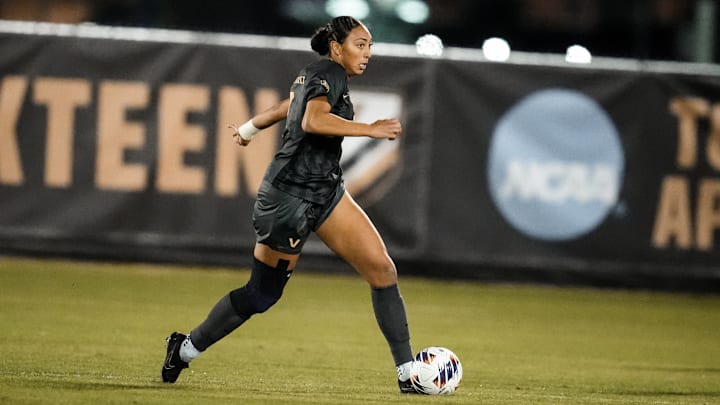
Ally Bollig took the ball off a corner kick that was kicked from the bottom right corner of Vanderbilt’s soccer field at “The Plex” and landed just to the right of Georgetown goalie Cara Martin. Bollig fought for the ball as she got it past a Georgetown defender, kicked the ball while sliding to the ground and saw the ball go past Martin and into the back right corner of the net in the goal. It was more than just a goal in an early September regular season game. It was a moment that was years in the making.
Bollig’s journey to making a game-altering impact in a game where her team was taking on a top 20 team was unlike any other. It all started back in high school, where Bollig was in practice during her junior year of high school. Practice was nearing the end. Then, Bollig felt something in her right knee. Though there was no official diagnosis immediately, Bollig feared she sustained an injury that a family member had in the past.
“My sister also had an ACL injury. So when it happened, it was kind of like, ‘Okay, oh crap. I hope it's not that, but it very likely might well be,'” Bollig said as she recounted her immediate reaction on the fateful October evening in 2019.
At first there was optimism. Maybe the injury was not what she initially thought it was. In fact, she passed the testing trainers did testing for an ACL injury. The next day, Bollig went to an orthopedic doctor, who diagnosed the injury as an LCL sprain, something that takes maybe a month or two to recover from.
The Aiken, South Carolina native had already committed to Vanderbilt to play soccer at the time of the injury. Her dreams of playing collegiately in the SEC were going to be realized. But then Vanderbilt head coach Darren Ambrose called, recommending Bollig to get further imaging done on the injury. About 20 days after the practice where the injury occurred, her worst fear became her new reality: the additional testing revealed Bollig sustained a torn ACL.
Her father, Brian Bollig, experienced a dad’s worst nightmare. He had already seen his other daughter go through the process of ACL surgery and recovery and was now reliving it with Ally. When the ACL diagnosis came in, Brian passed out from an anxiety attack to the news.
“It was just a combination of a lot of things. But when I heard that, I woke up in a pool of blood on their floor,” Brain Bollig said. “After my oldest went through it, and you saw the strain it put on her and mentally, the amount of work it takes to come back from one. You just always hope that she doesn't have to go through that. It’s like a dad’s worst nightmare. You have two kids that are heavily involved in the sport, love the sport, and end up having to go through that challenge.”
For Ally, it was the start of a long road. The injury would eventually lead her to miss the rest of her junior season and sit out the season her senior year of high school for precautionary reasons and to stay as healthy as possible before going off to Nashville. But later surgeries also led her to miss her first three seasons of college soccer.
The thoughts in the back of her mind did not disappear. Was her soccer career over from this injury? Would she even get to keep her scholarship to Vanderbilt? And even so, how much would she even get to play?
“I thought the absolute worst. You just hear about a lot of people that don't come back as the same type of person. It's talked about in the professional setting as well. And I kind of hid the fact that I tore my ACL from a lot of people I went to school with,” Bollig said.
Ambrose talked with Bollig and assured her that her scholarship was not going anywhere. After all, it was not her fault she tore her ACL. The focus was to get healthy and when that time came, she would end up playing for Vanderbilt.
But the recovery time was much longer than expected. After sitting out her freshman season with the injury, Bollig had an arthroscopic surgery on her meniscus the spring of her freshman year. Even after the meniscus surgery, there was always something that would happen in practices with the Vanderbilt team. After countless more doctor appointments and conversations with coaches and trainers, Bollig and the supporting cast around her decided she needed another surgery on her ACL in the spring of her sophomore year. This time, it was to fix the ACL graft from her first surgery after doctors told her the one from the original surgery had “failed.”
The mental toll it takes on an athlete to go through not just one, but multiple different ACL surgeries is a lot. There are days where athletes may feel like giving up on coming back. But Bollig had a different mentality. The problem was discovered. It was just a matter of climbing up the mountain of recovery.
“It was very upsetting. But there was some part of it that was very refreshing, in the sense that I knew that I was more capable of what I was giving previously. I knew I could play soccer. It's just physically something was inhibiting me to do so,” Bollig said as her mentality shifted to a more optimistic outlook ahead of her second ACL surgery. “So it was almost like, ‘Okay, now we know the problem. Let's fix the problem, and let's go from there.’ My mentality was then, ‘There's only one way up.’”
Along with all the surgeries is a long process of recovery through rehab. When Bollig got to Vanderbilt, she trained with Sara Melby, the athletic trainer for Vanderbilt soccer. The two spent countless hours together every week doing exercises ranging from time on the underwater treadmill to time on the exercise bike, pushing through the knee pain. The two spent roughly 30 hours together per week, training for about three or four hours each day. It was essentially a full-time job, but it had to be if Bollig wanted to get back onto the field as soon as possible.
“I like to say that Melby’s like my second mom. I feel like she knows me better than some people in my family might know me at this point because I spent so much time with her,” Bollig said. “It was just early mornings with Melby twice a day. There were twice a day rehab at times and just fully transparent, trying to figure out what's wrong and what can make me better.”
For Brian, the day-to-day emotions of watching his other daughter go through hours of rehab and the highs and the lows of the years-long process to get Ally back onto the field was not easy, especially with Bollig being in college out-of-state. Even things as simple as answering the phone when she would call would worry Brian, fearing she was calling to tell him about a setback in the rehab process. But through it all, Brian remained strong on the outside, as he would always go back to his faith in God to keep a sense of optimism.
“My anxiety was always through the roof. I hated to answer the phone, especially if it was from her. I had the same issue when it was my oldest, because you always feel like it's just going to be bad news. It was very mentally draining,” Brian said. “It really wore on me, but I'm very strong in my faith. I always knew if it was God's plan for her to play, eventually she would play. If it wasn't in the cards for her, then that's just what it was going to be. But in the end, I just wanted my kid to be able to be healthy, and that is my same mindset today.”
Coming back from an ACL injury is not easy to do, let alone multiple surgeries on the ACL along with surgeries on the meniscus. In the NFL, ACL surgeries are season-ending injuries that take an entire year to come back from if they even do return the next season. In soccer, ACL injuries are among the worst kinds of injuries that players can go through due to the demand the sport puts on the knees and legs of athletes.
Medically speaking, coming back from everything Bollig endured is not something an athlete could have done even just a decade ago. Thanks to the development of medical technology, coming back from multiple surgeries on the knee is possible.
“It's hard, very hard. And then you add another two procedures where you're going into the knee. Because every time you go on the knee, you're disrupting that joint, you're disrupting the flow, you're disrupting her anatomy, you're disrupting the neurological response. You're disrupting that normal feel, so it's hard,” Melby told Vandy On SI of how difficult it is for any athlete to come back from multiple surgeries on the ACL and the meniscus.
“Probably 10 years ago, people wouldn't recruit a kid who has torn their ACL. But I feel like now it's like, ‘Okay, so you had an ACL. How's the knee doing? How's it holding up? Oh, you have petal tendonitis. Well, let's make sure we treat that and we do proper screening.’”
Nowadays, there are better testing measures and better equipment such as the anti-gravity treadmill that have allowed athletes who suffer ACL injuries to get back to running again and produce testing numbers that give accurate feedback on how close the athlete is to getting back.
In a case like Ally Bollig’s, some athletes just may call it quits or give up playing the sport they dreamed of playing due to the amount of time and energy it takes to come back from surgeries that are spread out over the course of a few years. But Bollig never quit. She always loved soccer growing up and it has always been a part of her. Giving up on playing soccer would be giving up on part of who she was.
“I tell people all the time that soccer is one of the best things that's ever happened to my life. It happened to me in my entire life. It brought me my closest friends. It's taken me so many places I never thought I would ever go,” Bollig said. “I tell people all the time that if I had to do it again, I would, because I love the game so much, and also my family has been really supportive.”
Since the very beginning of the rehab process up to now, a lot has changed in terms of her growth as a person and as a player. After the early mornings and late nights of training seven days a week since the beginning of her time in Nashville, Melby has seen Bollig’s growth first-hand on campus. Bollig has gone from more than just a patient to Melby, but a close friend that resembles family.
From an athletic standpoint, Melby recounted the times during rehab where Bollig was set to do something that even Melby would consider difficult for an athlete rehabbing an ACL to do. But every time, Bollig’s determination shined through, clearing every obstacle along the way. Throughout the whole process, Melby has seen Bollig grow from a young lady into a leader.
“She’s probably the third kid that's come in my life, and I've been doing this for 25 years, where I'm like, ‘Oh, were you able to do all that?’ And she did it. I mean, there's no growth without how hard she works,” Melby said.
Bollig’s father has been with her by her side long before the injury even first occurred. As a former club soccer coach himself, he has seen Bollig’s development as a person and as an athlete through the lens of a coach and as a parent.
From a coach’s perspective, he would always analyze and talk about the games with Bollig afterward to the point where Ally turned into a little bit of a coach herself as she supported her teammates from the sidelines during her time off the field. As she was able to cheer her teammates on from the sidelines, it allowed her to find her own role on the team and impact the game despite not being on the field, which led to her growth mentally, fighting her way through adversity and becoming a leader on the team.
But as a parent, Brian has seen her love for people that she has always had continue to shine and grow.
“She was taking on a different type of role with a team. I think it definitely helped develop enough relationships with players and coaches. She’s always been a very personal person. She loves people in a supportive way, like a mother hen type of mindset. But I think it took that and it just kind of grew into an even bigger role of support. So it's been very satisfying from that aspect for me to see that,” he said.
Everything that Bollig fought through, from the night she tore her ACL in October 2019 all the way up to the 2025 season, where she returned to the field and achieved her lifelong dream of playing college soccer all led up to her first regular season goal on Sep. 4, 2025.
After the ball landed in the back of the net, all Bollig could think to do was throw her hands up in celebration. A moment that she had been waiting such a long time for had finally happened as her parents and her boyfriend were in attendance to watch the person they love so much make what has turned out to be one of the more important goals of Vanderbilt’s soccer season.
“I told myself I was gonna have a celebration after I scored. I couldn't think of anything else, but throw my hands up and be like, ‘Oh my gosh. I actually scored,’” Bollig said. “ It felt very rewarding. It was the most surreal moment. I think that moment specifically, was like, ‘Okay, I'm back.’”
The goal was symbolic of the phrase “hard work pays off.” The hours put into rehab from all the surgeries were worth it. The blood, sweat and tears she had to go through between missing practices and missing games because of the injury were all worth it because Bollig put in the time. Her commitment never wavered. Her dream of playing college soccer was never thrown away. It was a well-earned goal five years in the making.
“I wanted to run on the field and say ‘Dude, you did it. I knew you could do it.’ But you also go, ‘You should have, you put the work in.’ you know? So I felt proud,” Melby said.
Watching from the stands, Brian saw the goal both as a coach and as a parent. He knew that if Ally were to get in the opponent’s goalie box, she would be a threat to score. And that is precisely what happened. Then, sheer excitement for her took place.
“I was super excited for her,” Brian said. “I recorded it and played it back right after it happened just to kind of see what happened, because of all the congestion of players in front of the goal. But yeah, I mean pure excitement. I felt really good for her because after missing three years of college and two years of high school, you just don't know what to expect, especially that quick. So for me, it was kind of like, ‘Okay, she's back.’”
Bollig feels like she owes her comeback all to her family. On the days where she felt unmotivated, her family was there to pick her up. It was her parents and her sister that were the driving force to making her lifelong aspirations come true.
“There were some days I wasn't motivated, but my dad would be like, ‘Oh, it's just another day. Treat it like another day.’ Or my mom would be like, ‘It's okay. You're a great soccer player. We all know you're a great soccer player, and you love doing it. You're going to be back to playing.’ My sister, at the time, was also playing college soccer, so she was very much a testament to what I can do,” Bollig said. “So it's just that constant, motivational factor for me, when I lacked motivation myself. They're the ones that kept me going. And I say it till this day, I owe a lot to my family.”
Vanderbilt Commodores On SI:
 Add us as a preferred source on Google
Graham Baakko is a writer for Vanderbilt Commodores On SI, primarily covering football, basketball and baseball. Graham is a recent graduate from the University of Alabama, where he wrote for The Crimson White, WVUA-FM, WVUA 23 as he covered a variety of Crimson Tide sports. He also covered South Carolina athletics as a sportswriting intern for GamecockCentral.
Follow GrahamBaakko