
History of the SEC: Tennessee Volunteers
In this story:
When most people think of the University of Tennessee, what usually comes to mind is the trademark “T”, the bright orange color that the Volunteers wear, and a gameday setting that may be second to none.
But what they should be thinking about is the general.
When he took the job in 1926, Robert Neyland (pronounced NEE-land) was also an ROTC instructor who had graduated from West Point and served in France during World War I. Twice he was called upon to leave the football team, for a peacetime tour in Panama followed by a tour of duty as a brigadier general in the Pacific theater during World War II. Twice he came back to Knoxville.
As a coach, Neyland was known for organization, discipline and teamwork. He had a fondness for tough defensive play in particular, and helped put Tennessee at the forefront of college football over and over again.
“If Neyland could score a touchdown against you, he had you beat,” said Herman Hickman, one of Neyland’s players who went on to join the original staff of Sports Illustrated. “If he could score two, he had you in a rout.”
The essence of Neyland’s success boiled down to seven basic principles, which he called his “Maxims.” Part of the Volunteers’ pregame ritual is to recite them before taking the field:
Neyland's Maxims
1. The team that makes the fewest mistakes will win.
2. Play for and make the breaks and when one comes your way, score.
3. If at first the game _ or the breaks _ go against you, don’t let up ... put on more steam.
4. Protect our kickers, our QB, our lead and our ball game.
5. Ball, oskie, cover, block, cut and slice, pursue and gang tackle ... for this is the winning edge.
6. Press the kicking game. Here is where the breaks are made.
7. Carry the fight to our opponent and keep it there for 60 minutes
FYI, oskie is when a Tennessee player intercepts the pass he hollers “Oskie score,” thus alerting teammates to turn and block because now “we have the ball.”
Tennessee football dates all the way back to 1891, months before Neyland was born, when it lost to Sewanee 24-0 under less than ideal conditions in Chattanooga. Tennessee wouldn’t score its first victory until the following year, 25-0 over Maryville, and it took another turn of the calendar to 1893 before the first win at home, 32-0, again over Maryville.
After finishing 2-4 that season, including losses of 70-0 at Trinity (today known as Duke), 64-0 at Wake Forest, 60-0 at North Carolina, and 56-0 at home to Kentucky A&M, only two players returned to campus in 1894. In October, the athletic Association decided to drop football and the practice field was deemed unusable (it was being graded and improved).
Senior W.B. Stokely, who had transferred from Wake Forest, organized a club team to keep interest going until the sport was re-instated in 1896, when Tennessee finished 4-0. After the 1898 season was canceled due to the Spanish-American War, J.A. Pierce was hired as the first full-time coach. His team finished 5-2 in 1899 and 3-2-1 the following year. Still, the program produced lackluster results, going through seven head coaches between 1899 and 1911.
Former Pennsylvania player George Levene (1907-09) was the first coach to win seven games in a season, doing so twice, but it was Z.G. Clevenger, a former Indiana player who introduced the Volunteers to a straight T formation, who led Tennessee both to its first victory against Vanderbilt, 16-14 for homecoming, and first championship in the Southern Intercollegiate Athletic Association. Outscoring opponents 374 to 37, it finished 9-0 in 1914 (Clevenger returned to Indiana in 1923 and remained there until he retired). His replacement, John Bender, nearly matched the mark with an 8-0-1 season in 1916, which featured six shutouts, and 7-2 finish in 1920.
M.B. Banks took over in 1921, the same year Tennessee first played in the Southern Conference. During his five-year reign, the team participated in its first game at Shields-Watkins Field (which later became better known as Neyland Stadium) and posted an eight-win season in 1922.
Inspired by the thriving daisies that grew in the area near the stadium known as the hill, Tennessee’s official school color became orange in 1891. The football team didn’t wear it until the first game of the 1922 season, when the Volunteers crushed Emory & Henry, 50-0.
But then came the man who changed everything at Tennessee, which had lost 18 of its first 21 games against cross-state rival, Vanderbilt. Dean Nathan Daugherty, the faculty chairman of athletics, went from proclaiming: “Even the score with Vanderbilt; do something about our terrible standing in the series,” to calling Neyland’s hiring, “The best move I ever made.”
Neyland’s first stint with the Vols was from 1926-34, when he held the military rank of captain, and posted an incredible record of 76-7-5.
The Volunteers lost to Vanderbilt in his debut season and finished 8-1, but the real turnaround came against Alabama the following year. Sparked by Tennessee’s first All-American tailback Gene McEver, the “Bristol Blizzard,” returning the opening kickoff 98 yards for a touchdown, the Volunteers held on for a 15-13 victory in Tuscaloosa. Buddy Hackman did the same thing the following week against Washington & Lee, and Tennessee went to have an unbeaten season, 8-0-1 (with the tie coming against Vanderbilt), and win the Southern Conference championship.
Tennessee didn’t lose again until Oct. 18, 1930, 18-6 at Alabama, a span of 33 games, but failed to secure another title due to a tie in each of the three seasons the streak encompassed. However, the Volunteers played in their first postseason game on Dec. 5, 1931, the New York Charity Bowl at Yankee Stadium. Beattie “Big Chief” Feathers scored on a 65-yard run and Deke Brackett had a 75-yard touchdown, while Herman Hickman keyed the defense in a 13-0 shutout of New York University.
In the midst of a 28-game unbeaten streak, Neyland secured his second Southern Conference championship in 1932 after finishing 9-0-1. Naturally, the tie came against Vanderbilt, but Tennessee had also developed a knack for tying Kentucky in three of the previous four seasons.
“I’m still trying to figure out those Wildcat games,” McEver said while shaking his head years after finishing his career 27-0-3.
When 1932 team captain Malcolm Aitken was asked what he remembered most about Tennessee football, he replied: “The infectious germ of being a winner.”
After being dispatched to Panama, with Bill Britton taking his place for a 4-5 season in 1935, the major returned and put together the nucleus of a team that would dominate college football from 1938-40, winning three Southeastern Conference championships and two national titles, through not consensus (Texas Christian had that honor in 1938 and Minnesota in 1940).
The first title came following a perfect 10-0 season in which the Volunteers outscored opponents 293-16. Ranked No. 2, Tennessee received an invitation to play a much bigger Oklahoma squad in the Orange Bowl. Though the two sides combined for more than 200 yards in penalties, the Vols recorded their eighth shutout of the season. Bowden Wyatt, Bob Foxx and Babe Wood ran in touchdowns to highlight the 17-0 victory.
Led by George “Bad News” Cafego, Ed Molinski and Bob Suffridge, the 1939 team shut out all 10 opponents in the regular season, including Alabama and Vanderbilt, with tailback Johnny Butler making a memorable 56-yard touchdown run that took him from sideline to sideline against the Crimson Tide.
Neyland called it a “modern major miracle,” and no team has repeated the accomplishment since. He also called Cafego a “practice bum. On the practice field he couldn’t do anything right, but for two hours on a Saturday afternoon he did everything an All-American is supposed to do.”
Undefeated in 23 games, unscored upon in 15, and with an edge in points of 212-0 that season, Tennessee was off to face Southern California in the Rose Bowl. But without Cafego, who had sustained a knee injury in the 34-0 victory against The Citadel, or Suffridge, the Trojans controlled the game, racking up 229 yards for a 14-0 victory.
Undaunted, Neyland’s team had another championship run in it. However, when Alabama scored a touchdown in the second quarter of their 1940 meeting, it ended a streak of 71 consecutive quarters in the regular season without yielding a point, dating back to second quarter of the 1938 LSU game. The streak still stands as an NCAA record (FYI, the Volunteers defeated the Crimson Tide 27-12).
Despite being heavily favored against Boston College in the Sugar Bowl, undefeated No. 4 Tennessee had two first-half drives stopped deep in Golden Eagles territory. When Boston College tailback Charlie O’Rourke raised his arm to pass and then ran, a play coach Frank Leahy said he had seen Tennessee run, he scored from 24 yards out for the game-winning touchdown and 19-13 victory.
At the conclusion of the 1940 season, Neyland was called back into military service, with John Barnhill, a former Tennessee player who would later coach at Arkansas, taking over. The winning ways continued with an 8-2 finish in 1941, followed by a 9-1-1 season that ended with a 14-7 victory over Tulsa in the Sugar Bowl. With the Hurricanes led by quarterback Glenn Dobbs, they were out-gained in rushing 208 yards to minus-38.
It was still under Barnhill when Tennessee had a chance to redeem itself in the 1945 Rose Bowl after a 7-0-1 season that included its first night game (a 13-0 win at LSU). But just like five years previous, the Volunteers couldn’t keep pace against Southern California, and lost 25-0.
When General Neyland returned from the China-Burma-India front in 1946, it initially appeared that the program hadn’t skipped a beat. Led by tackle Dick Huffman, Tennessee defeated Alabama 12-0 en route to a 9-1 record to win the SEC championship. Yet thanks to two blocked punts, an 83-yard drive and a fourth-down interception, Tennessee lost 8-0 to Rice in the Orange Bowl.
“It will take us five years put Tennessee back on top,” Neyland predicted, and he wasn't far off.

When the Volunteers followed with lackluster 5-5 and 4-4-2 seasons, whispers began to be heard in Knoxville that maybe Neyland’s best was behind him. His single-wing offense appeared to have been passed by in favor of the popular T-formation, and besides, the coach, born on Feb. 17, 1982 in Greenville, Texas, was advancing in years.
But with another collection of impressive sophomores, Neyland came back strong in 1949, finishing 7-2-1. The Volunteers took another step in 1950, with a memorable 7-0 victory against Kentucky after 17 inches of snow fell in Knoxville during the 36 hours leading up to kickoff. A 7-0 loss to Mississippi State in Week 2 was the only blemish. Against favored No. 3 Texas in the Cotton Bowl, Hank Lauricella’s 75-yard run, in which he changed directions three times, set up a 5-yard touchdown pass from Herky Payne to Herb Gruble. Two fourth-quarter touchdowns by fullback Andy Kozar completed the 20-14 upset by No. 4 Tennessee.
Although the Volunteers were again voted the national champion by one organization, they didn’t win their first consensus title until 1951 (when various services also listed Georgia Tech, Illinois, Maryland and Michigan State as No. 1).
Tennessee recorded its first victory on television, 27-13 against Alabama, and went on to finish the regular season 10-0. Led by 6-foot-8 defensive lineman Doug Atkins, the defense posted five shutouts and the Vols outscored the opposition 386-166. Playing behind guard John Michels, Lauricella finished second in voting for the Heisman Trophy.
“The general was always in complete control,” Michels said. “He never got excited. He was highly organized and a great disciplinarian.”
Already voted the national champion, Tennessee played undefeated Maryland in the Sugar Bowl, where a surprise was awaiting. Facing an eight-man front, the Volunteers could only muster 81 rushing yards and 75 passing yards. Meanwhile, Maryland scored 21 points in the first 16 minutes, and returned an interception 46 yards for a touchdown en route to a 28-13 victory.
While Atkins finished off an impressive 29-4-1 record during his three years, an even bigger era came to a close when just before the 1953 Cotton Bowl when Neyland announced that he was stepping down from coaching due to health reasons (he stayed on as athletic director until his death in 1962). When No. 7 Tennessee could only get six first downs and was held to minus-14 rushing yards in the 16-0 loss to No. 11 Texas, the Volunteers finished 8-2-1.
Neyland’s final stint as the head coach produced a 54-17-4 record, adding up to a career mark of 173-31-12. In those 216 games, the opponent failed to score in 112 of them.
“The general was not the easiest guy to work with Monday through Friday, but on Saturday he was a fatherly figure,” Payne said. “On Saturday, he was a warm man who gave you a lot of confidence.”
Harvey Robinson, who had been a tailback for Tennessee, had the unenviable task of replacing Neyland, and after seasons of 6-4-1 and 4-6 was dismissed in favor of Wyatt, the former Tennessee player who had won championships at Arkansas and Wyoming. Neyland called it the “the hardest thing I’ve ever had to do.”
“Once the paint orange on you, it never washes off,” said Robinson, who after a stint at Florida returned to Tennessee in 1960 as an assistant coach.
What Wyatt’s teams may have lacked in pizzazz, they more than made up for in winning prowess, and in 1956 Tennessee ran the table, finishing the regular season 10-0 to capture the SEC championship and earn a No. 2 national ranking behind Oklahoma. Highlighting the season was a 6-0 victory against Georgia Tech, which was coached by another Neyland protégé, the dynamic Bobby Dodd, who had been Tennessee’s quarterback from 1928-30.
“We may have a horse-and-buggy offense, but we’ve got a dashboard and a TV set added,” Wyatt said.
The School
Location: Knoxville, Tenn.
Founded: 1794.
Enrollment: 30,564.
Nickname: Volunteers.
Colors: Orange and white.
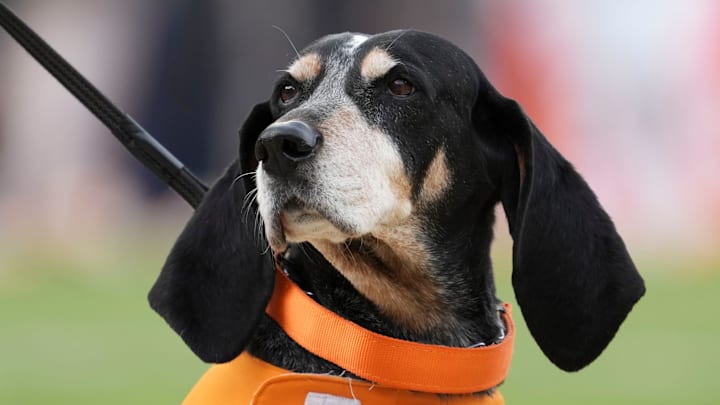
Mascot: Smokey.
Stadium: Neyland Stadium/Shields-Watkins Field (101,915).
Although tailback Johnny Majors was named the SEC Player of the Year for a second time and placed second in Heisman voting (won by Notre Dame’s Paul Hornung), Baylor spoiled the season, taking advantage of four interceptions and a Majors fumble on a punt return for a 13-7 victory in the Sugar Bowl.
Tennessee was able to play in one more bowl under Wyatt (1955-62), the 1957 Gator Bowl. The game was remembered both for the collision between the Volunteers' Bobby Gordon and Heisman Trophy winner John David Crow, and that it was Paul “Bear” Bryant’s last game at Texas A&M before taking over rival Alabama. Tennessee won, 3-0.
From 1958 through the 1964 season, the Volunteers were unable to win more than six games in a season and didn’t make a single bowl appearance. When Chattanooga football coach Scrappy Moore defeated Tennessee for the first time in 51 years, 14-6 at Knoxville in 1958, he said, “I’ll live today the rest of my life.”
On March 28, 1962, Neyland died at the Oescher Clinic in New Orleans. In his memory, the football stadium, with the addition of 5,837 seats on the west side bringing capacity up to 52,227, was named in his honor along with an academic scholarship fund.
Perhaps fittingly, Doug Dickey, a top assistant coach under Frank Broyles at Arkansas, brought the “T” formation to Tennessee when he was hired as head coach in 1964. Although the Volunteers lost close games to Alabama and Auburn en route to a 4-5-1 season, the record wasn’t reflective of the team’s success. It tied No. 7 LSU at Baton Rouge and two weeks later upset No. 7 Georgia Tech 22-14. Middle guard Steve DeLong won the Outland Trophy and the coaching staff recruited a number of players who doubled as track stars, including a wide receiver from Montgomery, Ala., named Richmond Flowers, the self-described “the fastest white boy alive.”
[Note: Flowers’ father was Alabama’s attorney general from 1963 to 1967 while segregationist George Wallace was governor. He condemned and prosecuted members of the Ku Klux Klan, and in doing so incurred upon himself and his family death threats and burning crosses. He was convicted in 1969 of extorting money from savings and loan operators and applicants who sought licenses to sell securities, serving 18 months of an eight-year federal sentence before being paroled. Eventually, President Jimmy Carter pardoned him, but Flowers Sr. insisted he was framed by his political enemies. Flowers set off a lot of local outrage when he spurned Bryant’s overtures and headed to rival Tennessee, and then again as a senior in 1968 when he scored a touchdown in a 10-9 win over the Crimson Tide. “I really wanted to get out of Alabama and get it behind me,” Flowers told ESPN Classic’s SportsCentury series in 1997. “I didn’t want all that heavy stuff laid on me about politics and segregation and civil rights. I was a kid who wanted to be a kid.”]
However, during the following season the unthinkable occured. The night after a hard-fought 7-7 tie at Alabama, line coach Charley Rash put a note in each of the players’ mailbox that read: “Play like that every week and you’ll go undefeated.” Two days later, Rush, Bill Majors and Bob Jones were killed in an early-morning car accident involving a train. Somehow, the Volunteers kept winning, capping off the regular season with a dramatic 37-34 victory against UCLA when quarterback Dewey Warren rolled around the left end for the winning score. Advancing to the Bluebonnet Bowl, Tennessee took advantage of three fumbles and four interceptions in a downpour to defeat Tulsa, 27-6.
The addition of 5,895 seats, increasing capacity to 58,122, brought in more fans to see the Volunteers crank out an 8-3 season in 1966, setting up a 18-12 victory against Syracuse, led by Floyd Little and Larry Csonka, in the Gator Bowl. Warren completed 17 of 29 passes for 244 yards and two touchdowns.
Tennessee lost its opener in 1967, 20-16 at UCLA, but tore through the SEC schedule, including its first victory against Alabama (24-13) since 1960, and Ole Miss (20-7) for the first time since 1958, to win the conference title.
“They’re good all right,” said Tulane coach Jim Pittman, who took a 35-14 loss to UT. “They even look strong in the huddle,”
Although one service had the 9-2 Volunteers winning the national championship, they were the consensus No. 2 team behind Southern California. Against Oklahoma in the Orange Bowl, the Sooners jumped out to a 19-0 lead. Jimmy Glover returned an interception 36 yards for a touchdown only to see Oklahoma match the points with a 25-yard interception return of its own. After being stopped on fourth-and-1, Tennessee’s last chance ended with a missed field goal and the Sooners held on, 26-24. After the game, Oklahoma coach Chuck Fairbanks was quoted as saying: “If the Russians had a football team, maybe I’d rather beat them than Tennessee.”
Artificial turf was installed in Neyland Stadium (64,429) for the 1968 season (it switched back in 1994), with the first game on the carpet also featuring Lester McClain, Tennessee’s first black player in an SEC game. Tennessee tied Georgia 17-17, and led by quarterback Bobby Wade and linebacker Steve Kiner went on to finish 8-2-1 due to a 36-13 loss to Texas in the Cotton Bowl. The Longhorns outgained the Volunteers in rushing yards 279 to 83, and had 513 yards of total offense.
Before leaving to take over his alma mater, Florida, Dickey won a second SEC title at Tennessee with a 9-1 record, and ironically faced his future players in the Gator Bowl. While Tennessee had trouble to scoring inside the 10 and had to settle for two short field goals, Florida scored on a blocked punt to win 14-13.
Dickey, who would later return and serve as athletic director for 18 years, didn’t leave the Volunteers lacking on talent though, and when Bill Battle became the country’s youngest coach at age 28, he took Tennessee to five straight bowl games — but somehow never won an SEC title.
Despite a loss to Auburn (36-23) in Week 2, Battle became the first Division I coach to win 11 games during his first year. Capping the season was a 24-point first quarter against Air Force in the Sugar Bowl. Tailback Don McLeary scored two touchdowns and Gary Theiler caught a 10-yard touchdown pass from game-MVP Bobby Scott. Even more impressive was the defense, which limited Air Force to minus-12 rushing yards to go with four recovered fumbles and four interceptions in the 34-13 rout.
Battle backed it up with back-to-back 10-2 seasons, during which the stadium was expanded to 70,650. In 1971, Tennessee beat Arkansas 14-13 in the Liberty Bowl when, after taking advantage of a late fumble, quarterback Jim Maxwell’s pass to tight end Gary Theiler set up Curt Watson’s 17-yard touchdown run.
“The Artful Dodger” Condredge Holloway, the first black quarterback in SEC history, topped LSU All-American Bert Jones in the 1972 Bluebonnet Bowl, completing 11 of 19 passes for 94 yards and rushing for 74 yards on 19 carries. With All-American cornerback Conrad Graham breaking up a late fourth-down pass, Tennessee won 24-17.
Although the 1972 senior class graduated with a 31-5 record, and Battle never had a losing season — with a 28-18 loss to Texas Tech in the 1973 Gator Bowl and a 7-3 win over Maryland and All-American tackle Randy White in the 1974 Liberty Bowl — he was fired following the 1976 season (after waking up one morning to find a moving van a fan had dispatched parked in front of his house). To replace him, Tennessee looked to one of its own, Majors, who had just won the national championship at Pittsburgh.
“Follow me home to Tennessee” took a couple of years to produce results, but Tennessee won four of its last five games in 1978, and the following season had eventual national champion Alabama down 17-0 in the second quarter before finally succumbing 27-17. However, two weeks later, Majors had his first big coaching win with the Volunteers when Hubert Simpson ran for 117 yards and four touchdowns to trounce Norte Dame at home, 40-18. Despite 270 passing and rushing yards by quarterback Jimmy Streater, and All-American defensive back Roland James’ eight unassisted tackles, UT's late comeback in the Bluebonnet Bowl came up short, with Purdue winning 27-22.
A capacity crowd of 95,288 saw Tennessee open the 1980 season against Georgia, which won 16-15 and went on to win the national championship. The following year they witnessed a pair of horrendous losses to start the season (44-0 to No. 10 Georgia and 43-7 to No. 5 Southern California), only to see Majors turn things around, with narrow 10-7 victories against Auburn and Georgia Tech snowballing into an eight-win season. Steve Alatorre completed 24 of 42 passes for 315 yards and one touchdown and Willie Gault returned a kickoff 87 yards for a touchdown to lead a 28-21 victory against Wisconsin in the last-ever Garden State Bowl.
With the 1982 World’s Fair in town, the Volunteers snapped an 11-game losing streak to Alabama in Bryant’s last appearance at Neyland Stadium, 35-28. However, against quarterback Chuck Long in the Peach Bowl, Tennessee's last effort was stopped at the Iowa 7 for a 28-22 final score and 6-5-1 finish.
Johnnie Jones scored the game-winning 66-yard touchdown against Alabama in 1983, a 41-34 decision, and had one of two fourth-quarter touchdowns, along with Alan Cockrell, to lead a 30-23 victory against No. 17 Maryland in the Citrus Bowl. Linebacker Alvin Toles recovered a fumble and had an interception in that game, with the Terrapins limited to 95 rushing yards. But Tennessee’s leader for the 9-3 season was the “Minister of Defense,” defensive end Reggie White. Once dubbed a “moving nightmare” by a sportswriter, White set all the school sack records, including four in a game, 15 in a season and 32 during his career. The season mark still stands.
“There won’t be any way to estimate what Reggie meant to us,” Majors said. “It’s inestimable. He provided humor, leadership, morale.”
The Program
National Championships (2): 1951, 1998.
The “Other” Four: The Official NCAA Football Records Book also recognizes Tennessee as producing national champions in 1938, 1940, 1950 and 1967.
SEC Championships (13): 1938, 1939, 1940, 1946, 1951, 1956, 1967, 1969, 1985, 1989, 1990, 1997, 1998.
Bowl appearances: 56 (31-25).
First season: 1891.
College Football Hall of Fame (25): Doug Atkins, 1950-52; tackle, inducted 1985; Eric Berry, 2007-09, safety, 2023; George Cafego, 1937-39, halfback, 1969; Steve DeLong, 1962-64, middle guard, 1993; Doug Dickey, 1964-69, coach, 2003; Bobby Dodd, 1928-30; quarterback, 1959; Nathan Dougherty, 1906-09, guard, 1967; Frank Emanuel, 1963-165; linebacker, 2004; Beattie Feathers, 1931-33, halfback, 1955; Phillip Fulmer, 1992-2008, coach, 2012; Herman Hickman, 1929-31, guard, 1959; Bob Johnson, 1965-67, center, 1989; Steve Kiner, 1967-69, linebacker, 1999; Hank Lauricella, 1949-51, halfback, 1981; Johnny Majors, 1954-56, halfback, 1987; Peyton Manning, 1994-97, quarterback, 2017; Gene McEver, 1928-29, 1931; halfback, 1954; John Michels, 1950-52, guard, 1996; Ed Molinski, 1938-40, guard, 1990; Bob Neyland, 1926-52, coach, 1956; Joe Steffy, 1944, guard, 1956; Bob Suffridge, 1938-40, guard, 1961; Reggie White, 1980-83, defensive tackle, 2002; Bowden Wyatt, 1936-38, end (coach 1955-62), 1972.
Heisman Winners: None.
National Honors: Bob Suffridge, 1940 Knute Rockne Memorial Trophy (outstanding lineman); Steve DeLong, 1964 Outland Trophy (outstanding interior lineman); Peyton Manning, 1997 Maxwell Award (outstanding player), Davey O’Brien Award (best quarterback), Johnny Unitas Golden Arm Award (best senior quarterback); John Henderson, 2000 Outland Trophy; Eric Berry, 2009 Jim Thorpe Award (top defensive back); Jalin Hyatt, 2022 Fred Biletnikoff Award (best receiver).
Consensus First-Team All-Americans (* unanimous): 1929 Gene McEver, B; 1933 Beattie Feathers, B; 1938 Bowden Wyatt, E; 1939 George Cafego, B; Ed Molinski, G; 1940 * Bob Suffridge, G; 1946 Dick Huffman, T; 1951 * Hank Lauricella, B; 1952 John Michels, G; 1956 * John Majors, B; 1965 Frank Emanuel, LB; 1966 Paul Naumoff, LB; 1967 * Bob Johnson, C; 1968 Steve Kiner, LB; * Charles Rosenfelder, G; 1969 Chip Kell, G * Steve Kiner, LB; 1970 * Chip Kell, G; 1971 * Bobby Majors, DB; 1975 Larry Seivers, E; 1976 Larry Seivers, SE; 1979 Roland James, DB; 1983 * Reggie White, DL; 1984 Bill Mayo, OG; 1985 Tim McGee, WR; 1989 * Eric Still, OL; 1990 * Antone Davis, OL; 1991 Dale Carter, DB; 1997 Peyton Manning, QB; 1998 Al Wilson, LB; 1999 Cosey Coleman, OL; Deon Grant, DB; 2000 John Henderson, DL; 2001 John Henderson, DL; 2003 Dustin Colquitt, P; 2004 Michael Munoz, OL; 2008 * Eric Berry, DB; 2009 * Eric Berry, DB; 2015 Evan Berry, KR/AP; 2016 Derek Barnett, DL; 2022 * Jalin Hyatt, WR
First-Team Academic All-Americans (CoSIDA): Charles Rader, T, 1956; Bill Johnson, G, 1957; Mack Gentry, DT, 1965; Bob Johnson, C, 1967; Tim Priest, DB, 1970; Timothy Irwin, T, 1980; Mike Terry, DL, 1982; Peyton Manning, QB, 1997; Paxton Brooks, P, 2021
First-round NFL draftees: 47.
Retired Jerseys: 16 Peyton Manning; 32 Bill Nowling; 45 Johnny Majors; 49 Rudy Klarer; 61 Willis Tucker; 62 Clyde Fuson, 91 Doug Atkins, 92 Reggie White.
All- Centennial Team (selected by fan vote and a panel of school officials):
Offense _ G Harry Galbreath, 1984-87; G Eric Still, 1988-89; T Tim Irwin, 1978-80; T Bruce Wilkerson, 1983-86; C Bob Johnson, 1965-67; WR Stanley Morgan, 1973-76; WR Larry Seivers, 1974-76; WR Willie Gault, 1979-82; QB Condredge Holloway, 1972-74; B Hank Lauricella, 1948-51; B Johnny Majors, 1954-56; RB Curt Watson, 1969-71; RB Reggie Cobb, 1987-88; K Fuad Reveiz, 1981-84. Defense _ DE Doug Atkins, 1950-52; DE Dale Jones, 1983-86; DT Reggie White, 1980-83; DT Marion Hobby, 1986-89; G Steve DeLong, 1962-64; LB Steve Kiner, 1967-69; LB Jack Reynolds, 1967-69; LB Keith DeLong, 1985-88; DB Bobby Majors, 1969-71; DB Eddie Brown, 1971-73; DB Roland James, 1976-79; DB Bill Bates, 1979-82; P Craig Colquitt 1975-77.
Majors didn’t win his first of three championships at Tennessee until 1985, when the Volunteers, unranked in the preseason polls, tied No. 10 UCLA (26-26), shocked No. 1 Auburn (38-20), and won at No. 15 Alabama (16-14) to secure the SEC title. It set up an Orange Bowl meeting with Miami, with Daryl Dickey, Doug Dickey’s son, having replaced injured quarterback Tony Robinson down the stretch.
“They’re not going to beat us because their fans make a lot of noise,” Miami quarterback Vinny Testaverde said.
He was right. Instead, Tennessee (9-1-2) beat No. 2 Miami because its defense recorded six turnovers, seven sacks and five tackles for a loss en route to a 35-7 trashing. Pollsters ranked UT fourth.
Thanks to a late-season rally, the Volunteers (7-5) were invited to the 1986 Liberty Bowl, where quarterback Jeff Francis’ three touchdowns bested Minnesota’s Rickey Foggie for a 21-14 victory. The following year, it took a come-from-behind effort against another Big Ten team to top off a 10-2-1 season. Francis threw two touchdown passes, but running back Reggie Cobb’s second touchdown of the game, on a 9-yard-carry, sealed the 27-22 victory against Indiana at the Peach Bowl. Also on that team was DeLong’s son, Keith, a linebacker who became a team captain and All-American in 1988.
Majors won back-to-back SEC titles in 1989 and 1990 and the Volunteers spent most of both seasons ranked in the Top 10. In ’89, only a 47-30 loss at Alabama kept No. 5 Tennessee from running the table. A 78-yard touchdown run by Chuck Webb, who finished with 250 rushing yards on 26 carries, and an 84-yard pass from Andy Kelly to Anthony Morgan highlighted an intense 31-27 victory against Arkansas in the Cotton Bowl, which wasn’t decided until Alvin Harper recovered an on-side kick in final moments.
Two ties and narrow losses to Alabama (9-6) and Notre Dame (34-29) didn’t sidetrack the 1990 team, which pulled out a 23-22 comeback victory against Virginia in the Sugar Bowl. With Tony Thompson, who had 154 rushing yards on 25 carries, scoring his second touchdown on a 1-yard run, it capped a 20-point fourth quarter for the No. 8 Volunteers. Scoring another key touchdown was wide receiver Carl Pickens, who a year previous was named the defensive MVP of the Cotton Bowl.
The 1991 season saw perhaps Tennessee’s greatest comeback. Down 31-7 at Notre Dame, a blocked kick by Jeremy Lincoln returned for a touchdown sparked the Volunteers, who pulled out a 35-34 victory when the Irish missed a game-winning 27-yard field goal as time expired.
Majors was able to post nine-win seasons in 1991 and 1992, thanks to a 42-17 win against Penn State in the Fiesta Bowl, and a 38-23 victory over Boston College in the Hall of Fame Bowl (with quarterback Heath Shuler completing 18 of 23 passes for 245 yards and two touchdowns, while running in two as well), respectively, but heart surgery led to his turning the team over to offensive line coach Phillip Fulmer, who served as interim head coach for the final four games of 1992. He stayed at the helm for the next 16 seasons.
After Fulmer was named head coach prior to the start of the 1993 season, Shuler led the Vols to a 10-win season, resulting in the quarterback finishing second in voting for the Heisman Trophy behind Florida State’s Charlie Ward. He had 205 passing yards to go with Charlie Garner’s 89 rushing yards and Cory Fleming’s 101 receiving yards in a 31-13 victory against Penn State at the Citrus Bowl.
When starting quarterback Jerry Colquitt suffered an injury in the opening minutes of the first game of the 1994 season, Tennessee got off to a 1-3 start. Against Washington State, the Volunteers turned to freshman Peyton Manning, who went on to pass for more than 11,000 yards and 89 touchdowns, while setting 33 school, seven SEC and two NCAA records. He compiled a 39-5 record as a starter, but could never top one rival school: Florida.
Tennessee finished 8-4 in 1994 and with three James Stewart touchdowns beat Virginia Teach 45-23 in the Gator Bowl. The Vols went 11-1 in 1995 and aided by 154 rushing yards from Jay Graham and 107 receiving yards by Joey Kent defeated Ohio State 20-14 in the Citrus Bowl to finish ranked third (No. 2 in the coaches’ poll). In 1996, it was a 48-28 victory against Northwestern, again in the Citrus Bowl, with Manning passing for 408 yards. His top two targets were Kent (five catches, 122 yards) and Peerless Price (six catches, 110 yards).
In 1997, Manning finally got a title when Tennessee defeated Auburn 36-29 in the SEC Championship Game. However, the Volunteers went on to lose 42-17 to national champion Nebraska in the Orange Bowl.
“He’s raised everyone’s play around him to another level because of his competitive spirit, ability and leadership,” Fulmer said about Manning.
Like his father, Archie, at Ole Miss, Manning wasn’t able to win a national championship or Heisman Trophy (he finished second in 1997), but in 1,381 attempts was only intercepted 33 times. Fittingly, a road leading to Neyland Stadium was renamed Peyton Manning Pass.
“I’ll be a Volunteer the rest of my life,” said Manning, who left school as the SEC’s all-time leader in total offense (11,020 yards).
Without Manning, many expected Tennessee to plummet in 1998, but the opposite occurred. During the second week of the season, Florida came calling to Knoxville, where 107,653 fans, the largest crowd ever to see a football game in the South, awaited. For the first time since 1992, Tennessee was able to pull out a win against Steve Spurrier's Gators, 20-17 in overtime. Energized, the Volunteers rolled through the regular season, with Auburn (17-9) and Arkansas (28-24) coming closest to pulling off an upset.
“I knew we were going to win the Arkansas game,” linebacker Raynoch Thompson said. “I was trying to figure out how when their quarterback dropped the ball.”
Thanks to quarterback Tee Martin throwing touchdown passes to Peerless Price and Cedric Wilson 32 seconds apart in the fourth quarter, Tennessee defeated pesky Mississippi State 24-14 in the SEC Championship Game.
“Sometimes you’ve just got to win ugly,” Fulmer said.
The coaches
J.A. Pierce, 1899-1900, 8-4-1; George Kelley, 1901, 3-3-2; H.F. Fisher, 1902-03, 10-7; S.D. Crawford, 1904, 3-5-1; J.D. DePree, 1905-06, 4-11-3; George Levene, 1907-09, 15-10-3; Andrew A. Stone, 1910, 3-5-1; Z.G. Clevenger, 1911-15, 26-15-2; John R. Bender, 1916-20, 18-5-4; M.B. Banks, 1921-25, 27-15-3; Robert R. Neyland, 1926-34, 1936-40, 1946-52, 62-15-5; W.H. (Bill) Britton, 1935, 4-5; John H. Barnhill, 1941-45, 33-6; Harvey L. Robinson, 1953-54, 10-10-1; Bowden Wyatt, 1955-62, 49-29-4; Jim McDonald, 1963, 5-5; Doug Dickey, 1964-69, 46-15-4; Bill Battle, 1970-76, 59-22-4; Johnny Majors, 1977-92, 115-62-8; Phillip Fulmer, 1992-2008, 151-52; Lane Kiffin. 2009, 7-6; Derek Dooley, 2010-12, 15-21; Jim Chaney (interim), 2012, 1-0; Butch Jones, 2013-15, 34-27; Brady Hoke (interim), 2017, 0-2; Jeremy Pruitt. 2018-20, 16-19; Josh Heupel, 2021-present, 37-15.
National Coach of the Year: Bowden Wyatt 1956; Phillip Fulmer 1998.
SEC Coach of the Year, AP: Robert Neyland 1951; Bowden Wyatt 1956; Doug Dickey 1967; Johnny Majors 1985; Phillip Fulmer 1998. Coaches: Robert Neyland 1936, 1938, 1950; John Barnhill 1944; Bowden Wyatt 1956; Doug Dickey 1965, 1967; Johnny Majors 1985; Phillip Fulmer 1998; Josh Heupel 2022.
SEC Championships: Robert Neyland 5, Johnny Majors 3, Doug Dickey 2, Phillip Fulmer 2, Bowden Wyatt 1.
National Championships: Robert Neyland 1, Phillip Fulmer 1.
In the first year of the controversial Bowl Championship Series, which aimed to pair No. 1 vs. No. 2 for the national title, the final obstacle was Florida State at the Fiesta Bowl. With Vice-President Al Gore looking on, an “oskie” for a 54-yard touchdown by defensive back Dwayne Goodrich gave the Volunteers a lead they would never relinquish. A third-down sack by Darwin Walker of Florida State quarterback Marcus Outzen early in the fourth quarter (what Seminoles coach Bobby Bowden called “a killer”) set up Price’s reception of a Tee Martin pass in stride for a 79-yard touchdown. Price finished with 199 receiving yards on four catches in the 23-16 victory.
“It wasn’t pretty early this year for Tee,” Manning told Sports Illustrated after watching Martin complete 11 of 18 passes for 278 yards and two touchdowns. “He kept plugging and plugging. He’s gotten confidence.
“We roomed together on the road. A couple of times he got phone calls telling him that friends had been killed. I’m thinking, Jiminy, this is unbelievable, but Tee is such a strong person, mentally and spiritually.”
Although Tennessee was seemingly always close, it couldn’t repeat the championship form over the years to follow. In, 1999, nemesis Spurrier at Florida found a way to beat Tennessee again, 23-21. Despite a solid 38-14 victory against Notre Dame, another stumble against Arkansas resulted in a return to the Fiesta Bowl. Twelve months after celebrating the championship, the Volunteers were out-gained on the ground, 321 yards to 44, as Nebraska won 31-21. Tennessee dropped to No. 9.
Quarterback Casey Clausen earned the nickname “The Comeback Kid,” and defensive tackle John Henderson won the Outland Trophy as the nation’s best interior lineman in 2000, but despite Travis Henry’s 180 rushing yards on 17 carries a 35-21 loss to Kansas State at the Cotton Bowl resulted in an 8-4 season.
Despite an early 26-24 defeat to Georgia, Volunteers fans thought they were making another championship run in 2001 when Tennessee closed the regular season with a 34-32 victory over Florida (the game had been rescheduled due to the September 11th terrorist attacks), for a return to the SEC Championship Game as the nation’s No. 2 team.
However, against No. 21 LSU, which it defeated earlier in the season 26-18, the Tigers proved to be more inspired and pulled out a 31-20 victory for second-year head coach Nick Saban. Instead of playing Miami for the national championship in the Rose Bowl, Tennessee had to settle for the Citrus Bowl, where it crushed Michigan 45-17. Clausen completed 26 of 34 passes for 393 yards and three touchdowns, and nearly had two more with wide receiver Donte Stallworth twice tackled at the 1.
“It’s been a while since we’ve played a team as good as Tennessee,” said Michigan running back Chris Perry, echoing a sentiment felt countless times throughout the years.
The Records
Rushing yards, game: 294, Chuck Webb vs. Ole Miss, Nov. 18, 1989 (35 carries).
Rushing yards, season: 1,491, Dylan Sampson, 2004 (258 carries).
Rushing yards, career: 3,078, Travis Henry, 1997-2000 (556 carries).
Passing yards, game: 530, Tyler Bray vs. Troy, Nov. 3, 2012, (29 of 47).
Passing yards, season: 3,819, Peyton Manning, 1997 (287 of 477).
Passing yards, career: 11,201, Peyton Manning, 1994-97 (863 of 1,381).
Receiving yards, game: 256, Kelley Washington vs. LSU, Sept. 29, 2001 (11 receptions)
Receiving yards, season: 1,298, Robert Meachem, 2006 (71 receptions).
Receiving yards, career: 2,814, Joey Kent, 1993-96 (183 receptions).
Points, game: 30, Gene McEver vs. South Carolina 1929; Jalin Hyatt vs. Alabama, 2022.
Points, season: 130, Gene McEver, 1929 (21 touchdowns, four PATs).
Points, career: 371, Jeff Hall, 1995-98 (61 field goals, 188 PATs).
The wheels started to fall off the Fulmer run in 2000 when three times Tennessee went from being ranked high in the preseason polls to finishing entirely outside the AP Top 25. Specifically, it had been No. 12 in 2000, No. 5 in 2002, and No. 3 in 2005 when the Volunteers finished with a losing record at 5-6. Tennessee gave him a contract extension after a 10-win season in 2007, but a 3-6 start in 2008 led to his dismissal. The week Fulmer announced that he had agreed to step down at the end of the season, Wyoming stunned the college football world and pulled off a 13-7 upset.
Little did anyone know, it was just the beginning of a very rocky time for the Volunteers. In included Lane Kiffin being hired, and nearly pulling off a dramatic upset at No. 1 Alabama, only to see the Crimson Tide escape with a 12-10 thanks to its second blocked field goal of the game at time expired. When Kiffin resigned after one season to accept the job at Southern California, a riot broke out on camps.
Derek Dooley subsequently had three losing seasons from 2010-12. Butch Jones had three straight winning seasons from 2014-16, but was fired with a 4-6 record in 2017. Jeremy Pruitt came next and during his three seasons as head coach (with Fulmer back as the athletic director) the NCAA found that Tennessee football had committed 18 Level I violations — encompassing more than 200 individual infractions — leading to five years of probation.
Out of the mess, though, Tennessee turned to former Oklahoma quarterback Josh Heupel, fresh off having taken UCF to the Fiesta Bowl in just his third season as a head coach. In 2022, Tennessee snapped its 15-game losing streak to rival Alabama (52-49), reached No. 1 in the College Football Playoff rankings, and finished No. 6 in the AP Top 25 after defeating Clemson in the Orange Bowl. In 2024, the Volunteers played in the first expanded 12-team playoff.
It was an impressive turnaround by anyone's standards, and one few thought possible so quickly.
"If you don't hate to lose, you're in the wrong game, the wrong environment, wrong building," Heupel said during his first season at Tennessee, 2021. "That's important to me. It's important that we take ownership of the things that we certainly can control, could have controlled last week. Everybody wants to (win), and is going to try during the course of the game, but your habits leading up to it — we've gotten be better but we're not where we need to be. I think that ownership is really important."
This is the 12th part of an extended series about the history of SEC football. Some of the material was used in the book "Where Football is King," by Christopher Walsh. For more, check out Tennessee Volunteers On SI.
Passion, Tradition and Pride: Why the SEC says 'It Just Means More'
Conference of Champions? SEC Covets Title, Reputation
The History of the Southeastern Conference
Alabama Crimson Tide
Auburn Tigers
Georgia Bulldogs
LSU Tigers
Ole Miss Rebels
South Carolina Gamecocks
Texas Longhorns
Vanderbilt Commodores
Three things that stand out about Tennessee football:
1. The Volunteer Navy

Game days are something to behold in Knoxville. Tennessee has the Vol Walk, where thousands of fans gather to wish the players good luck, the checkerboard end zones, and the running through the marching band’s “T” while entering the field. But the tradition of getting to the game by boat on the Tennessee River, started by broadcaster George Mooney, is unique. The floating tailgate party has been known to include a couple hundred vessels.
2. Rocky Top

Though not the official Vols fight song, Tennessee fans can’t get enough of hearing it played by the Pride of the Southland Band. But it’s the exact opposite for anyone else. Hearing 40 to 50 variations, some longer than others, during a game is not uncommon.
3. Smokey

Several coonhounds were introduced during halftime of the 1953 Mississippi State game, with fans voting on which would serve as the official mascot of the football team. When the last dog, a blue tick named Blue Smokey, was introduced and cheered, he barked. After more cheering, and more barking, he won the job. Nowadays, not only will the latest Smokey be on the sideline, so will a costumed version of the mascot.
 Add us as a preferred source on Google
Christopher Walsh is the founder and publisher of Alabama Crimson Tide On SI, which first published as BamaCentral in 2018, and is also the publisher of the Boston College, Missouri and Vanderbilt sites . He's covered the Crimson Tide since 2004 and is the author of 27 books including “100 Things Crimson Tide Fans Should Know and Do Before They Die” and “Nick Saban vs. College Football.” He's an eight-time honoree of Football Writers Association of America awards and three-time winner of the Herby Kirby Memorial Award, the Alabama Sports Writers Association’s highest writing honor for story of the year. In 2022, he was named one of the 50 Legends of the ASWA. Previous beats include the Green Bay Packers, Arizona Cardinals and Tampa Bay Buccaneers, along with Major League Baseball’s Arizona Diamondbacks. Originally from Minnesota and a graduate of the University of New Hampshire, he currently resides in Tuscaloosa.
Follow BamaCentral