
History of the SEC: Texas Longhorns
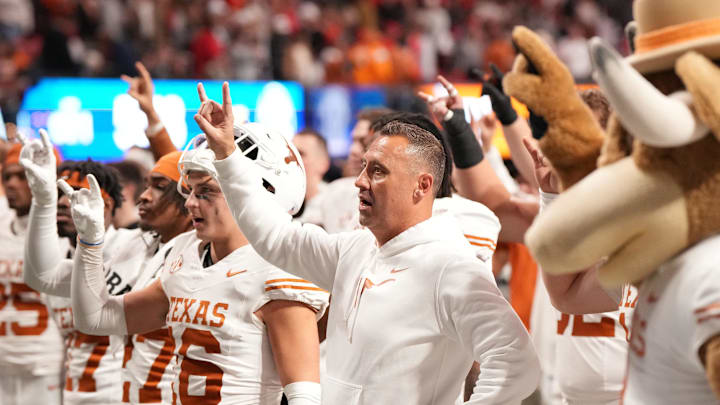
In this story:
Obviously the Texas Longhorns don't have much of a history yet in the Southeastern Conference since joining the league in time to compete for the 2024-25 academic year. But they do have an extensive timeline in regards to college football, with numerous notable achievements.
So that's what we're doing for this part of the History of the SEC series, a Texas timeline.
The program tradition dates back to Thanksgiving Day 1916, the final game of the football season and also when Robert Vinson became the new University of Texas president. Some 15,000 fans had packed the stands at Clark Field to watch the Longhorns (which was still an informal term and wouldn’t become the school’s official nickname for four more years) play rival A&M College of Texas, only to see the teams finish the first two quarters tied, 7-7.
During the break, a skinny and frightened longhorn steer was brought out on to the field and presented to the student body as the school’s first live mascot. The idea had been the brainchild of former team manager Stephen Pinckney, who had collected $1 from 124 other alumni to purchase the animal.
According to Jim Nicar, the Director of the UT Heritage Society, Pinckney had spent most of the year in West Texas working for the U.S. Attorney General’s office assisting with raids on cattle rustlers. During one such raid near Laredo in late September, he found a steer with orange fur that was almost an exact match for the school color. The longhorn was loaded onto a boxcar without food or water and arrived just in time for the game.
Texas went on to win, 21-7.
The steer was subsequently moved to a stockyard for a formal photograph, where it proved to be more ornery than the Aggies, and after the camera flash went off charged the photographer.
In the subsequent issue of the "Texas Exes Alcalde" magazine, editor Ben Dyer gave a full description of the day’s numerous events, and regarding the steer simply wrote: “His name is Bevo. Long may he reign!” (Note: The origin of the Bevo name is still very much in doubt).
While students debated about what to do with the wild animal, "The Texan" newspaper suggested branding the longhorn with a large “T” on one side and “22-7” on the other as a permanent reminder of the Texas victory. Instead, it prompted some A&M fans to break into the stockyard and brand Bevo with “13-0,” the score of the Aggies’ victory at College Station in 1915. A week later the longhorn was moved to a ranch 60 miles west of Austin, and mostly forgotten about during World War I.
After the 1919 season, with food a bit scarce and Bevo deemed not worth the money his care cost, the longhorn was barbequed and served at the January football banquet, with the Aggies invited and served the side they had branded.
Of course, something on that order would be almost unheard of today, although after the tradition was restored in 1936 the stories of the following mascots were just as colorful. Bevo II changed an SMU cheerleader, and Bevo III broke loose and ran free on campus for two days. Bevo IV attacked a parked car, while Bevo V went after the entire Baylor marching band.
Nowadays, only champion steers are considered for the job and as of this writing Bevo XV, originally named Sunrise Spur, was being tended to by the student group known as the Silver Spurs.
He’s 1,800 pounds of pure Texas pride, with horns measuring 72 inches, and just as much of UT tradition as Big Bertha, “The Eyes of Texas,” and the Hook ’Em Horns hand signal that arose in part from the mascot -— and will get you in trouble in some European countries, where it means something completely different.
But as former student Walter Chronkite chimed in a series of commercials to promote a fund-raising effort in 1998, “We’re Texas!”
The School
Location: Austin, Texas
Founded: 1881 (opened 1883)
Enrollment: 53,082 (42,444 undergrad)
Nickname: Longhorns
Colors: Burnt orange and white.
Mascot: Bevo
Stadium: Darrell K Royal-Texas Memorial Stadium (100,119 capacity).
1893: Texas’ first game was considered upset against the Dallas Foot Ball Club, which had been undefeated for several years. Approximately 2,000 fans were on hand, the most to see a Dallas game at that point. The game was played on Thanksgiving Day at Fairgrounds Park. … The team was formed by students and managed by Albert Lefevre, who was secretary-treasurer of The University of Texas Athletic Association.
1894: R.D. Wentworth accepted a salary offer of $325 to become the first head coach in Texas history. He departed after one season.… Texas hosted Texas A&M for the first time, a 38-0 victory.
1898: Coach David Farragut Edwards essentially forced a decision on the school colors because he didn’t like the orange and white combination, which had been worn since streamers with those colors were purchased for use at a baseball game. He preferred orange and maroon. Two years later, a vote was held on the school colors.
1900: The Texas Marching Band was organized. Supposedly some of the instruments were purchased from a pawnshop, and uniforms from a downtown department store … Texas played Oklahoma for the first time and won 28-2.
1903: D.A. Frank, a writer for the school newspaper, The Daily Texan, nicknamed the team the Longhorns. It stuck. … “The Eyes of Texas,” which would become the school’s official alma mater, was written by John Sinclair in response to a request that a song be written for the Cowboy Minstrel Show.
1908: A brawl resulted with a Texas fan being stabbed three times in the head, and put the Texas A&M series in jeopardy. However, the come-from-behind 28-12 victory prevented Texas from enduring its first losing season.
1911: Coach William S. “Billy” Wasmund held the program’s first preseason training camp. However, six days before the season opener he was found unconscious near his apartment apparently due to a fall while sleepwalking. He died days later. The Texas Christian game was cancelled and Wasmund’s former Michigan teammate David Allerdice hired. … The 6-0 victory against Texas A&M was so violent that Texas guard Marion Harold broke his leg on the first play. Arnold Kirkpatrick scored the game’s only points on a 15-yard fumble recovery for a touchdown.
1912: Texas cancelled the series against Texas A&M due to bad blood between the schools. The series didn’t resume until Coach Charlie Moran left Texas A&M.
1914: Halfback Len Barrell scored 14 touchdowns and kicked 34 extra points and one field goal to tally 121 points for the Longhorns. He held the UT record for points in a season for 83 years before Ricky Williams broke it in 1997 and again in 1998. … Texas played Oklahoma in Dallas for the first time. It won 32-7.
1915: Texas was a charter member of the Southwest Conference.
1918: Former guard Louis Jordan was one of three former Texas players to be killed during World War I. … The Texas A&M rivalry became a traditional Thanksgiving holiday game.
1920: Berry McClure who founded the intramural program, was told he was the new football coach after Bill Juneau’s resignation. He brought prominence to the football program, which had been in Texas A&M’s shadow with Coach Dana X. Bible. . … The rivalry with Texas A&M, which had not been scored upon in two years, was elevated to new heights. Texas set up its lone touchdown on a fourth-down tackle-eligible play with Tom Dennis making the leaping reception, and Francis Domingues plunging the ball over the goal-line on the subsequent play. The estimated 20,000 at Clarke Field was the largest crowd in state history. … Texas won its first Southwest Conference championship.
1923: E.J. Stewart was named head coach, and his best move may have been convincing back Oscar Eckhardt not to quit. Eckhardt led the victory against Vanderbilt at the Fairgrounds. The Fort Worth Star-Telegram said of his touchdown: “Eckhardt, knocked to earth, rose like a phoenix and blazed down the line until he crossed the thin white marker. In all, he drove 20 yards through the gold and black to put his named in the Texas Varsity hall of fame.” … Oil was discovered on the land set aside by the state to fund public education.
1924: The Athletics Council announced on March 1 that $165,357.47 had been pledged by more than 3,500 students, faculty and Mr. and Mrs. Lutcher Stark “as guarantee that Texas will have the first stadium in the entire south and one of the best in the country.” The initial cost for Memorial Stadium was $275,000, with a seating capacity 27,000. The first game at Memorial Stadium was the 28-10 loss to Baylor. Temporary bleachers had to be added for the dedication ceremonies to accommodate 33,000 for the Texas A&M game.
1928: The Longhorns first wore burnt orange, or “Texas orange” jerseys. The change was made because the bright orange uniforms kept fading in the wash. Texas went back to bright orange in the 1940s because if a wartime dye shortage, but Darrell Royal brought back the darker orange prior to the 1962 season.
1929: Texas had been playing games in Dallas for years, but the Cotton Bowl became the permanent home of the Oklahoma showdown.
The Program
National Championships (4): 1963, 1969, 1970, 2005.
Conference Championships (29): 1920, 1928, 1930, 1942, 1943, 1945, 1950, 1952, 1953, 1959, 1961, 1962, 1963, 1968, 1969, 1970, 1971, 1972, 1973, 1975, 1977, 1983, 1990, 1994, 1995, 1996, 2005, 2009, 2023.
Bowl appearances: 57 (31-24-2).
First season: 1893.
Retired jerseys: Vince Young 10; 12 Colt McCoy; Earl Campbell 20, 22 Bobby Layne; Ricky Williams 34; Tommy Nobis 60.
Major national honors: Heisman Trophy: Earl Campbell 1977, Ricky Williams 1998; Butkus Award (best linebacker): Derrick Johnson 2004; Doak Walker Award (best running back): Ricky Williams 1997, 1998; Cedric Benson 2004; D'Onta Foreman 2016; Bijan Robinson 2022; Draddy Trophy (academic Heisman): Dallas Griffin 2007, Sam Acho 2010; Manning Award (best quarterback): Vince Young 2005, Colt McCoy 2009; Maxwell Award (outstanding player): Tommy Nobis 1965, Ricky Williams 1998, Vince Young 2005, Colt McCoy 2009; Nagurski Trophy (top defensive player): Derrick Johnson 2004, Brian Orakpo 2008; Davey O'Brien Quarterback Award: Vince Young 2005; Colt McCoy 2009; Outland Trophy (outstanding interior lineman): Scott Appleton 1963; Tommy Nobis 1965; Brad Shearer 1977; T'Vondre Sweat 2023, Kelvin Banks, Jr., 2024; Jim Thorpe Award (best defensive back): Michael Huff 2005; Aaron Ross 2006; Jahdae Brown 2024; Bronko Nagurski Award: Brian Orakpo 2008; Vince Lombardi Rotary Award: Kenneth Sims 1981, Tony Degrate 1984, Brian Orakpo 2008, Kelvin Banks Jr. , 2024; Ted Hendricks Award (best defenisive end): Brian Orakpo 2008; Jackson Jeffcoact 2013; Walter Camp Award (player of the year): Ricky Williams 1998; Colt McCoy 2008, 2009; Chuck Bednarik Award (Defensive Player of the Year): None; Johnny Unitas Golden Arm Award (outstanding senior quarterback): Colt McCoy 2009; Disney Spirit Award (most inspirational): Nate Boyer 2012; Ray Guy Award (best punter): Michael Dickson 2017; Wuerffel Trophy (community service): San Acho 2010.
College Football Hall of Fame
Hub Bechtol, end, 1944-46 (Inducted 1991); Mack Brown, coach, 1998-2013, 2018; Dana X. Bible, coach, 1937-46 (1951); Earl Campbell, running back, 1974-77 (1990); Doug English, defensive tackle, 1972-74, 2011; Chris Gilbert, running back, 1966-68 (1999); Jerry Gray, defensive back, 1981-84, 2013; Derrick Johnson, linebacker, 2001-04, 2023; Johnnie Johnson, defensive back, 1976-79 (2007); Malcolm Kutner, end, 1939-41 (1974); Bobby Layne, quarterback, 1944-47, (1968); Roosevelt Leaks, running back, 1972-74, (2005); Bud McFadin, guard, 1948-50 (1983); Bob McKay, offensive tackle, 1968-69, 2017; Steve McMichael, defensive tackle,1976-79, 2009; Tommy Nobis, Linebacker, Guard, 1963-65 (1981); Darrell Royal, coach, 1957-76 (1983); James Saxton, running back, 1959-61 (1996); Harley Sewell, guard, 1950-52 (2000); Kenneth Sims, defensive tackle, 1978-81, 2021; Jerry Sisemore, offensive tackle, 1970-72 (2002); Mortimer “Bud” Sprague, tackle, 1923-24 (1970); Harrison Stafford, halfback, 1930-32 (1975); Ricky Williams, running back, 1995-98, 2015; Vince Young, quarterback, 2003-05, 2019.
Consensus First-Team All-Americans
(Source: NCAA; * unanimous selection)
1945 Hubert Bechtol, E; 1946 Hubert Bechtol, E; 1947 Bobby Layne, B; 1950 * Bud McFadin, G; 1953 Carlton Massey, E; 1961 * Jimmy Saxton, B;
1962 * Johnny Treadwell, G; 1963 * Scott Appleton, T; 1965 Tommy Nobis, LB; 1968 Chris Gilbert, B; 1969 Bob McKay, T; 1970 Bill Atessis, DE; Steve Worster, B; Bobby Wuensch, T; 1971 * Jerry Sisemore, T; 1972 * Jerry Sisemore, T; 1973 Roosevelt Leaks, B; * Bill Wyman, C; 1975 Bob Simmons, T; 1977 * Earl Campbell, RB; * Brad Shearer, DL; 1978 * Johnnie Johnson, DB; 1979 * Johnnie Johnson, DB; * Steve McMichael, DL; 1980 Kenneth Sims, DL; 1981 * Kenneth Sims, DL; Terry Tausch, OL; 1983 Doug Dawson, OL; Jerry Gray, DB; Jeff Leiding, LB; 1984 Tony Degrate, DL; * Jerry Gray, DB; 1995 Tony Brackens, DL; 1996 Dan Neil, OL; 1997 * Ricky Williams, RB;
1998 * Ricky Williams, RB; 2000 Leonard Davis, OL; Casey Hampton, DL; 2001 * Quentin Jammer, DB; Mike Williams, OL; 2002 Derrick Dockery, OL;
2003 Derrick Johnson, LB; 2004 * Derrick Johnson, LB; 2005 * Michael Huff, DB; * Jonathan Scott, OL; Rodrique Wright, DL; Vince Young, QB; 2006 Justin Blalock, OL; 2008 Colt McCoy, QB; * Brian Orakpo, DL; 2009 * Colt McCoy, QB; Jordan Shipley, WR; Earl Thomas, DB; 2013 Anthony Fera, PK; Jackson Jeffcoat, DL; 2014 Malcom Brown, DL; 2016 D’Onta Foreman, RB; Connor Williams, OL; 2017 * DeShon Elliott, DB; * Michael Dickson, P; 2020 Joseph Ossai, LB; 2022 * Bijan Robinson, RB; 2023 * T’Vondre Sweat, DL; 2024 * Kelvin Banks, OL; Jahdae Brown, DB
Academic All-Americans
Maurice Doke, guard, 1959; Johnny Treadwell, guard, 1961; Pat Culpepper, linebacker, 1962; Johnny Treadwell, guard, 1962; Duke Carlisle, quarterback/defensive back, 1963; Gene Bledsoe, offensive tackle, 1966; Mike Perrin, defensive end, 1967; Corby Robertson, linebacker, 1967; Scott Henderson, linebacker, 1968-69; Corby Robertson, linebacker, 1968; Bill Zapalac, defensive end, 1969; Scott Henderson, linebacker, 1970; Bill Zapalac, defensive end, 1970; Mike Bayer, defensive back, 1972; Tommy Keel, defensive back, 1972-73; Steve Oxley, offensive tackle, 1972; Doug Dawson, offensive guard, 1983; Lee Brockman, linebacker, 1988; Pat Fitzgerald, tight end, 1995-96; Dusty Renfro, linebacker, 1997; Dallas Griffin, center, 2007; Derek Lokey, defensive tackle, 2007; Sam Acho, defenive lineman, 2009; Adam Ulatoski, offensive lineman, 2009; Sam Acho, defensive lineman; Nate Boyer, offensive lineman, 2013; Bert Auburn, K, 2024; Jake Majors, OL, 2024
1930: Clyde Littlefield became the first coach to win two SWC championships. … Harrison Stafford and Ernie Koy donned Longhorn varsity uniforms for the first time during their sophomore years and became one of the nation’s best backfield combinations. Usually, that featured Stafford making low, crushing blocks to open holes for Koy. Stafford played a key role in clinching the SWC title, scoring the lone touchdown against Texas Christian. In 1969 he was named to the Southwest Conference 50-year team, covering the years 1919-1968.
1933: After the first losing season in 40 years, calls for Clyde Littlefield’s dismissal resulted in his resignation. His 44-18-6 record still stands as one of the best in program history. He remained as track coach, where he served for 41 seasons and won 25 league championships.
1934: Former Notre Dame standout Jack Chevigny, who scored the winning touchdown after Knute Rockne’s famous “Win One for the Gipper Speech” and became an assistant coach, left South Bend after Rockne’s death and was named head coach. … The 7-6 victory at Notre Dame was considered by many to be the one that brought Texas to national prominence. Jack Gray recovered a fumble on the opening kickoff and UT scored four plays later on Bohn Hilliard’s 8-yard touchdown run.
1936: Jack Chevigny asked not to be retained, which Texas was more than happy to do. He remains the only coach in program history not to have a winning record. He eventually died as a first lieutenant in the battle of Iwo Jima during World War II.
1937: Despite still being in the midst of the depression, Texas went after, and hired away Dana X. Bible away from Nebraska. He was paid $15,000, more than the university president who eventually got a raise for the move. After having a successful run at both Nebraska and Texas A&M, he laid the foundation for Texas becoming a national power despite winning just three games his first two seasons. He was credited for “The Bible Plan,” which placed emphasis on education as well as success on the field.
1939: A last-second 14-13 win against Arkansas revitalized the program, which hadn’t enjoyed a winning season since 1934. Fullback R.B. Patrick’s 67-yard touchdown pass to Jack Crain capped the 76-yard rally and gave Texas its first season-opening win since 1933. It’s known as the “Renaissance” game of the Dana X. Bible era at Texas.
1940: Texas was ranked for the first time in the Associated Press poll, No. 14 on Oct. 14 after a 3-0 start. It moved up to No. 12, but then fell out of the top 20 after losing to Rice. … Noble Doss’ over-the-shoulder reception on the third play of the game set up Pete Layden’s 1-yard touchdown run in the 7-0 victory against Texas A&M. It snapped the Aggies’ 19-game winning streak, prevented A&M from playing in the Rose Bowl and any chance of repeating as national champions.
1941: After being snubbed for a Rose Bowl invitation, Texas took it out on Oregon with a 71-7 victory. Less than 24 hours later, the Japanese attacked Pearl Harbor, bringing the United States into World War II. … Versatile end Malcolm Kutner was the first Texas player chosen to compete in the Chicago Tribune’s collegiate all-star game, matching an all-star collegiate team against the NFL champions. He also played tackle and halfback for the Longhorns. Coach Dana X. Bible described him as “the best balanced, perhaps most versatile ever developed in the cow country, if not the nation.” ….The Longhorns were featured on the cover of Life Magazine … Texas enjoyed its first No. 1 standing, and the first time being ranked in the season-ending polls.
1942: Texas played in its first bowl game. Backs Roy Dale McKay and Jackie Field led a 14-7 victory against No. 5 Georgia Tech in the Cotton Bowl. Before the game, International New Services’ Lawton Carver said: “Texas doesn’t belong in the same league with Georgia Tech.”
1943: The legend of Rooster Andrews was born when Coach Dana X. Bible had the team’s water boy, who was only 4-foot-11, 130 pounds, kick four extra points in the second half against Texas Christian. After the game, TCU Coach Dutch Meyer accused Bible of rubbing it in and dared him to use Andrews the next week against rival Texas A&M. Bible did, with Andrew making an extra point, but had a field goal blocked in the 27-13 victory. Andrews’ other job in the team was to try and keep his roommate, quarterback Bobby Layne, out of trouble.
1945: After spending part of the season in the Merchant Marines, Bobby Layne returned in time to help Texas win the SWC title. He completed 11 of 12 passes and figured in all six Texas touchdowns as the Longhorns routed Missouri in the Cotton Bowl, 40-27. Originally recruited as a baseball pitcher, Doak Walker once said of him, “Layne never lost a game. Time just ran out on him.”
1946: Dana X. Bible’s coaching career came to an end with 201 victories over 33 years, 63-31-3 at Texas. He was the third-winningest coach ever when he retired, trailing only Amos Alonzo Stagg and Pop Warner. … The night before he pitched a baseball game against Texas A&M, Bobby Layne put his foot through a plate-glass window, causing a severe cut. He taped it and, aided by 18 cans of Falstaff beer drank between innings to ease the pain, threw a no-hitter in the 2-1 victory.
1947: Blair Cherry was hand-picked by D.X. Bible to be successor, and became the first Texas-born head coach. At Amarillo High School his teams went 84-5. … The football team used air travel for the first time, a chartered DC-4, for the Oregon game. Although the flight wasn’t smooth, the game proved to be, with Bobby Layne out-dueling Ducks sophomore Norm Van Brocklin in the 38-13 victory. … Layne left Texas with 11 school records after passing for 3,145 yards on 210 completions and 400 attempts.
The Coaches
Name Years Records
No coach 1893 4-0-0
R.D. Wentworth 1894 6-1-0
Frank Crawford 1895 5-0-0
Harry Robinson 1896 4-2-1
Mike Kelly 1897 6-2-0
David F. Edwards 1898 5-1-0
Maurice G. Clarke 1899 6-2-0
Shy Thompson 1900-01 14-2-1
J.B. Hart 1902 6-3-1
Ralph Hutchinson 1903-05 16-7-2
H.R. Schenker 1906 9-1-0
W.E. Metzenthin 1907-08 11-5-1
Dexter Draper 1909 4-3-1
W.S. Wasmund 1910 6-2-0
Dave Allerdice 1911-15 33-7-0
Eugene Van Gent 1916 7-2-0
Bill Juneau 1917-19 19-7-0
Berry Whitaker 1920-22 22-3-1
E.J. Stewart 1923-26 24-9-3
Clyde Littlefield 1927-33 44-18-6
Jack Chevigny 1934-36 13-14-2
D.X. Bible 1937-46 63-31-3
Blair Cherry 1947-50 32-10-1
Ed Price 1951-56 33-27-1
Darrell Royal 1957-76 167-47-5
Fred Akers 1977-86 86-31-2
David McWilliams 1987-91 31-26-0
John Mackovic 1992-97 41-28-2
Mack Brown 1998- 2013 158-48
Charlie Strong 2014-16 16-21
Tom Herman 2017-20 32-18
Steve Sarkisian 2021-present 38-17
Major Coaching Awards
Paul W. “Bear” Bryant Award: Mack Brown 2005
Eddie Robinson Award: Darrell Royal 1961, 1963
Bobby Dodd Award: Mack Brown 2008
AFCA: Darrell Royal 1963, 1971 (tie with Charle McClendon, LSU);
Frank Broyles Assistant Coach of the Year: Greg Davis, 2005
1950: Coach Blair Cherry (32-10-1) announced at midseason that he was leaving to enter the oil business. … Bud McFadin was a two-time All-American as an offensive guard and defensive tackle, and named MVP of the 1951 Cotton Bowl. He was also named MVP of the Southwest Conference. … No. 7 Texas held running back Kyle Rote to minus-3 yards on seven carries in the 23-20 victory against No. 1 Southern Methodist. … Safety Bobby Dillon’s 84-yard punt return for a touchdown keyed the victory against Baylor in the pivotal game for the conference title.
1952: Two-way guard Harley Sewell was named defensive MVP of the Cotton Bowl victory over Tennessee, a rematch of the 1951 game. He helped the defense limit Tennessee to six first downs and minus-14 rushing yards. Incidentally, it was the first Cotton Bowl to be nationally televised. … Billy Quinn capped a 74-yard drive with a 1-yard touchdown run with 39 seconds remaining in the 35-33 victory against Baylor.
1953: Texas fans pulled out their biggest “hex” before facing No. 3 Baylor. It dated back to the 1941 Texas A&M game, when students consulted a local fortuneteller, Mrs. Augusta Hipple, who told them to “burn red candles.” The hex was rekindled in 1950 prior to beating No. 1 Southern Methodist, and then for Baylor. Carlton Massey and Charley Brewer led the 21-20 victory. “Spirit makes you play better than you can,” fullback Dougal Cameron said.
1955: Cheerleader Harley Clark devised the Hook ’Em Horns gesture.
1957: Darrell Royal came to Texas as one of the youngest head coaches in America. Despite being just 32, the former All-American at Oklahoma was hired away from Washington. After inheriting a 1-9 program, Royal took Texas to the Sugar Bowl and never had a losing season in 20 years of leading the Longhorns.
1959: Coach Darrell Royal won his first conference title at Texas. … The national championship was on the line in the Cotton Bowl. Future Heisman Trophy winner Ernie Davis caught an 87-yard touchdown pass to open the scoring, had a 1-yard run to give No. 1 Syracuse a 15-0 halftime lead, and intercepted a pass to set up another score (and caught his second two-point conversion pass).
1961: Darrell Royal tabbed running back James Saxton, who finished third in Heisman Trophy voting, the “quickest player in America.” Saxton led the Southwest Conference in rushing with 846 yards on just 107 carries. He also scored nine touchdowns and had runs of 80, 79, 66, 56, 49 and 45 yards. Saxton set a Texas single-game rushing record against Southern Methodist with 173 yards. A week later he tallied 171 yards against Baylor. His 7.9 yards per carry was the highest recorded in SWC history. Sexton’s 74-yard touchdown on a punt return led the 12-7 victory against Ole Miss in the Cotton Bowl. … The victory against SMU launched Texas into the No. 1 spot thanks to upsets of Michigan State and Ole Miss.
1962: Coach Darrell Royal installed the first of his two great offensive innovations, the “Flip-Flop Winged-T.”
1963: At the time, No. 1 Oklahoma vs. No. 2 Texas was dubbed “The Game of the Century.” Scott Appleton made 18 tackles, but sophomore linebacker Tommy Nobis proved to be the catalyst to the undefeated season. “I knew Tommy was a good one, but I had no idea a sophomore could come up and play as well as he has,” Darrell Royal said. … With 29 seconds remaining, Duke Carlisle’s leaping interception against Baylor preserved Texas’ drive to the national championship. “Thank you Duke. You saved my life,” said Joe Dixon, who got beat on the play by receiver Lawrence Elkins. … Texas had another 1 vs. 2 matchup against Navy and Heisman Trophy winner Roger Staubach in the Cotton Bowl. Duke Carlisle had 213 passing yards and 267 total yards to highlight the 28-6 victory.
1964: The defense stopped Joe Namath, who otherwise completed 18 of 37 passes for 255 yards, on fourth-and-inches at the goal-line to preserve the controversial 21-17 victory in the Orange Bowl, the first major bowl game played at night. Texas outgained Alabama on the ground, 212-49, with Ernie Koy leading all players with 113 rushing yards on 24 carries.
1965: Darrell Royal called linebacker Tommy Nobis the best two-way lineman he ever coached, and Sports Illustrated dubbed him “the best defender in College Football.” He averaged nearly 20 tackles per game, though a knee injury slowed him during the second half of his senior season. … Texas was down 17-0 to Texas A&M at halftime, when Coach Darrell Royal wrote “21-17” on the blackboard and walked out. Sure enough, that ended up being the final score.
1966: Chris Gilbert was Texas’ first 1,000-yard rusher, and would become the first player in NCAA history to gain 1,000 yards in each of his first three seasons he was eligible. He had 245 rushing yards against Baylor, and had a 96-yard run against Texas Christian. Gilbert was voted Outstanding Back of the Bluebonnet Bowl, a 19-0 victory against Ole Miss.
1967: Chris Gilbert recorded the longest run from scrimmage in school history with a 96-yard touchdown run against Texas Christian. He finished with 1,019 yards one year before Darrell Royal implemented the wishbone offense.
1968: In the initial year of the wishbone offense, Chris Gilbert had a record 1,132 rushing yards and 13 touchdowns. He finished his career as the Southwest Conference’s and Texas’ all-time leading rusher with 3,231 yards, which at the time ranked third in NCAA history. …. The turning point for the wishbone may have come against Oklahoma, when down 20-19 with 2:37 remaining Texas drove 85 yards for the winning touchdown, a 7-yard run by fullback Steve Worster.
1969: Behind quarterback James Street, Texas converted two 4th-and-2 plays on its final drive to beat No. 9 Notre Dame in the Cotton Bowl, and secure both the national championship and the 500th win in school history. … It was Notre Dame’s first postseason appearance since the 1925 Rose Bowl. … Before the season, ABC had Texas at Arkansas moved from October 18 to the end of the regular season. It wound up being a No. 1 vs. 2 matchup, dubbed the Big Shootout, with President Richard Nixon in attendance “It makes them look wiser than a tree full of owls,” Coach Darrell Royal quipped. Although the Razorbacks held a 14-0 lead heading into the fourth quarter, Street broke a 42-yard touchdown run and the subsequent two-point conversion. On fourth-and-3 at the Texas 43 with 4:47 remaining, Street hit double-covered tight end Randy Peschel (“53 veer pass”) for a 44-yard gain to set up Jim Bertlesen’s touchdown for the 15-14 victory.… The 1969 Longhorns were the last all-white team to win the national championship.
1970: Despite a rash of preseason injuries, Texas destroyed Cal in its opener to vault to No. 1 in the UPI poll, but dropped back to No. 2 after defeating Texas Tech. … After UCLA shut down the wishbone, and quarterback Dennis Demmitt passed for 340 yards and two touchdowns, split end Cotton Speyrer scored a 45-yard touchdown on an Eddie Phillips pass with 12 seconds remaining to steal the victory. The play was “86 pass, Ted crossing, Sam post.”… The 24-11 loss to Notre Dame in the Cotton Bowl snapped a 30-game winning streak. … Guard Julius Whittier was UT’s first black athlete to letter in football.
The Records
Rushing
Game: Ricky Williams, 350, vs. Iowa State (37 attempts) Oct. 3, 1998,
Season: Rickey Williams, 2,124, 1998 (361 attempts).
Career: Ricky Williams, 6,279, 1995-98 (1,011 attempts).
Passing
Game: Major Applewhite, 473 yards, vs. Washington, 2001 Holiday Bowl Dec. 28, 2001 (37 of 55).
Season: Colt McCoy, 3,859, 2008.
Career: Colt McCoy, 13,253, 2006-09.
Receiving Yards
Game: Jordan Shipley, 273, vs. UCF, Nov. 7, 2009 (11 receptions)
Season: Jordan Shipley, 1,485, 2009
Career: Roy Williams, 3,866, 2000-03
Points scored
Game: 36, Ricky Williams, vs. New Mexico St. (Sept. 5, 1998); Rice (Sept. 26, 1998).
Season: 168, Ricky Williams, 1998
Career: 452, Ricky Williams, 1995-98
1972: During his three years, tackle Jerry Sisemore lost only one game in Southwest Conference play, won three consecutive league championships and played in three straight Cotton Bowls. … The scoreboard was dedicated in the memory of Freddie Steinmark. … During the preseason, Coach Darrell Royal called the team “average as a day’s wash.” It went 10-1, captured the SWC title, and finished No. 3 in the final Associated Press Poll.
1973: Running back Roosevelt Leaks finished third in Heisman Trophy voting, and was named the Southwest Conference MVP after setting the SWC record for rushing yards with 1,415. The first black Texas player to be named All-American, Leaks had 2,923 rushing yards and 26 touchdowns in three seasons. His bid for 3,000 career yards fell short due to a knee injury.
1974: Running back Roosevelt Leaks became the first black athlete to earn All-American and All-Conference honors for the Longhorns … Earl Campbell accumulated 928 rushing yards as a freshman.
1975: As a sophomore, Earl Campbell ran for 1,118 yards and 13 touchdowns as a wishbone fullback.
1976: Darrell Royal’s 20-year run as Texas’ head coach included 11 teams that finished in the nation’s Top 10 and three national championships. He had 11 Southwest Conference titles, 16 bowl berths, 26 All-Americans and 77 All-Southwest Conference players. Royal won 176 games, including 109 against conference foes.
1977: New coach Fred Akers installed the I-formation offense and moved Earl Campbell from fullback to tailback. He accumulated for 1,744 yards (an Southwest Conference record that stood for 16 years) and 19 touchdowns to lead the nation in rushing and scoring. Tyler Rose posted 200-yard rushing games against Texas A&M (222) and Southern Methodist (213), both on the road, and set a school record with 10 100-yard rushing games. He finished his career with Texas rushing records of 4,443 yards and 41 touchdowns. … … Safety Johnny Johnson’s fourth-down tackle inside the Texas 5-yard line preserved the victory against Oklahoma, which it hadn’t defeated since 1970. … Texas was No. 1 when it faced No. 2 Texas A&M.
1978: Johnnie Johnson was named the nation’s top defensive back by the Downtown Athletic Club. He finished his career with 13 interceptions, 282 tackles and led a defense that surrendered an average of only nine points per game. On special teams, he set Texas records for single-season (44), and career punt returns (114). … Because there were two players named Johnny Jones on the roster, Darrell Royal came up with the idea of using their hometowns to distinguish between them. Jones, from Hamlin, became Johnny “Ham” Jones, while Johnny “Lam” Jones was from Lampasas (FYI, A.J. Jones doesn’t know where the “Jam” came from, he was from Ohio). Johnny “Ham” Jones ran for 104 yards against Maryland, and Johnny “Jam” Jones had 100.
1987: Quarterback Bret Stafford led Texas on a 11-play, 56-yard drive to beat Arkansas with an 18-yard touchdown pass to Tony Jones with no time left on the clock. It was the first game in Texas history to be decided on the final play of the game.
1990: For the second consecutive year, a late fourth-quarter drive by Texas beat No. 4 Oklahoma, this time 14-13.. The Longhorns had roughly 100 yards of total offense when it got the ball at its own 9 with 7:12 remaining. UT drove until it had fourth-and-7 at the Sooners’ 16, when, thanks to a great block by Phil Brown, Keith Cash caught the decisive touchdown pass. The Sooners countered, but R.D. Lasher’s 46-yard field-goal attempt was wide left. ... The Longhorns went on to finish 10-2 and atop the SWC league standings.
1995: Phil Dawson became the first Texas kicker to win a game on the final play with his 50-yard kick into a 20 mph headwind to beat No. 14 Virginia. It sparked a six-game winning streak that sent the Longhorns to the Sugar Bowl. … Led by true freshman Ricky Williams’ 163 rushing yards and two touchdowns, UT snapped Texas A&M’s 31-game home winning streak. Texas had 246 rushing yards and the defense forced six turnovers. … During the days leading up the Sugar Bowl, The Californian newspaper revealed that Texas defensive back Joel Ron McKelvey was really 30-year-old Ron Weaver, who had already played six years of college football and assumed the name of a younger person in order to write a book.
1996: Texas crushed Texas A&M to claim the first Big XII South Division title. Quarterback James Brown passed for 336 yards and four touchdowns and running back Ricky Williams had 145 rushing yards. … Texas won the first Big XII title by upsetting No. 3 Nebraska in the inaugural championship game. Despite the Cornhuskers being 21-point favorites, Brown told a reporter, “I think we’re going to win by three touchdowns.” He was 19-for-28 and 353 yards, while running back Priest Holmes had 120 rushing yards and three touchdowns against the two-time defending national champions. Tight end Derek Lewis had the key play on fourth-and-inches, a 61-yard reception … The football stadium was renamed Darrell K Royal-Texas Memorial Stadium. The dedication game was the 27-24 loss to Notre Dame.
1997: Ricky Williams struck up a friendship with Doak Walker, for whom the national running back of the year award is named. After Walker was paralyzed in a skiing accident 10 days after Williams won it, he stayed in contact with Walker and his wife. Prior to his senior season, Williams hung a photo of the former Southern Methodist star in his locker. After Walker died on September 27, 1998, Williams dedicated his senior season to his memory. He wore a decal with Walker’s No. 37 on his helmet against Iowa State when he had 350 rushing yards and set or tied six NCAA records. He also wore No. 37 in the Cotton Bowl (dubbed “The House that Doak Built.”). Walker’s family was presented the game ball and the jersey in an emotional locker room. … John Mackovic (41-28-2) was relieved of his coaching duties.
1998: After his North Carolina team finished No. 4, Mack Brown was hired as head coach. … Ricky Williams’ 2,124 rushing yards was a school record. He also broke Tony Dorsett’s 22-year old NCAA record for career rushing yards with 6,279. He set the mark on a 60-yard touchdown run against Texas A&M with Dorsett on the sideline cheering him on. However, the record lasted only one year when it was toppled by Wisconsin’s Rod Dayne (6,397).… Texas ended Nebraska’s 47-game home winning streak. Williams had 150 yards on 37 carries, Major Applewhite completed 14 of 26 passes for 269 yards and two touchdowns, and linebacker Anthony Hicks had 13 tackles, two sacks and five tackles for a loss.
1999: Major Applewhite’s 39-yard touchdown pass to Mike Jones with 5:51 remaining capped the victory against No. 3 Nebraska, and possibly cost the Cornhuskers a shot at the national championship. However, Nebraska got even in the Big XII title game, 22-6 …The Texas A&M rivalry softened when 12 current and former students were killed when the bonfire annually lit before the Texas game collapsed in College Station. The Aggies won the emotional contest eight days later, with the Texas marching band playing tribute with “Amazing Grace.”
2001: Texas overcame its biggest deficit in program history, 19 points in the third quarter, to beat Washington in the Holiday Bowl. Quarterback Major Applewhite set a UT bowl record by passing for 473 yards and four touchdowns. Wide receiver Roy Williams had 11 catches for 134 yards, and B.J. Johnson had six catches for 157 yards. Freshman linebacker Derrick Johnson made the fourth-quarter interception to set up the drive that gave Texas a 40-36 lead with six minutes remaining. With Johnson making 25- and 32-yard receptions, UT went 80 yards on seven plays in 1:11 to win the game. … Cedric Benson’s 1,053 rushing yards on 223 carries were both freshman records for the Longhorns.
2004: Texas made its first-ever appearance in the Rose Bowl, where it faced Michigan for the first time. The game went down to the final play with the Longhorns pulling out a 38-37 victory on a 37-yard field goal by Dusty Mangum as time expired. Sophomore quarterback Vince Young accounted for 372 yards of total offense and all five Longhorn touchdowns. He passed for 180 yards and one score, and ran 21 times for 192 yards (9.1 yards per carry), including touchdown carries of 20, 60, 10 and 23 yards. … Cedric Benson scored five touchdowns and quarterback Vince Young completed 12 straight passes and finished with 401 yards of total offense as Texas pulled off the biggest comeback in school history to beat No. 19 Oklahoma State 56-35. UT rallied from 28 points down to score 49 unanswered points.
2005: Texas and Southern California met at the Rose Bowl for the national championship in a game that exceeded the hype. The combined 79 points made it the second-highest scoring Rose Bowl game in history and the teams combined to set bowl records for most yards (1,130) and most first downs (60). Longhorns quarterback Vince Young had 467 yards of total offense as he completed 30 of 40 passes for 267 yards, and averaged 10.5 yards per carry for 200 yards and three touchdowns. After the Trojans, which boasted two Heisman Trophy winners with Matt Leinart and Reggie Bush, took a 38-26 lead with 6:42 remaining, Young led the decisive drive and scored an 8-yard touchdown run on fourth down with 19 seconds left on the clock.
2008: By defeating No. 1 Oklahoma, Texas rose to the top spot in the polls, but while playing its fourth ranked team in four weeks lost to Texas Tech on a last-second touchdown. It put the Longhorns into a three-way tie for the division title, but the Sooners advanced due to a controversial tiebreaker. … Quarterback Colt McCoy was 332-of-433 for 3,859 yards and 34 touchdowns with eight interceptions for a passer rating of 173.8, which ranked third nationally. His 76.7 completion percentage set the NCAA single-season record (Central Florida’s Daunte Culpepper, 73.6, 1998). He also set a Texas single-season passing record against Texas A&M, bettering Major Applewhite's 3,357 yards in 1999.
2009: After quarterback Colt McCoy returned for this senior season, Texas had an undefeated regular season and edged Nebraska 13-12 in the Big 12 Championship Game. However, McCoy was lost to an injury early in the BCA Championship Game at the Rose Bowl and Alabama running backs Mark Ingram and Trent Richardson both had 100-yard games and two touchdowns as the Crimson Tide won 37-21.
2013: After 16 years leading the Longhorns, Mack Brown was forced out after going 158–48 overall, 98-33 in the Big 12.
2020: Texas fired Tom Herman after a 32-18 record over four seasons. It instead turned to Alabama offensive coordinator Steve Sarkisian, who had previously been a head coach at Washington and Southern California.
2023: Playing for the final time in the Big 12, Texas won the league title with a 49-21 victory against Oklahoma State and secured a spot in the final four-team College Football Playoff. However, the Longhorns lost to Washington in the Sugar Bowl semifinal, 37-31.
2024: During its first season in the Southeastern Conference, Texas both played in the SEC Championship Game and in the first 12-team College Football Playoff, where it won two games before bowing out to eventual championship Ohio State, 39-31. The Longhorns finished fourth in the final AP 25.
This is the 10th part of an extended series about the history of SEC football. Some of the material was used in the book "Texas Football: Huddle Up," by Christopher Walsh. For more, check out Texas Longhorns On SI.
Passion, Tradition and Pride: Why the SEC says 'It Just Means More'
Conference of Champions? SEC Covets Title, Reputation
The History of the Southeastern Conference
Auburn Tigers
Georgia Bulldogs
LSU Tigers
Ole Miss Rebels
South Carolina Gamecocks
Vanderbilt Commodores
Three "Big" Things That Stand Out About Texas Football
You already know about Bevo, Hook'em Horns and the Showband of the Southwest. So check out:
1. The Big Names

The Austin American-Statesman named an all-time University of Texas football team in Sept. 2005. Even without anyone from the last 20 years, it's still an impressive list.
Offense
QB Vince Young, 2002-05
RB Earl Campbell, 1974-77
FB Steve Worster, 1968-70
RB Ricky Williams, 1995-98
SE Hub Bechtol, 1944-46
WR Roy Williams, 2000-03
LT Bobby Wuensch, 1968-70
LG Bud McFadin, 1948-50
OC Bill Wyman, 1971-73
RG Harley Sewell, 1950-52
RT Jerry Sisemore, 1970-72
PK Jeff Ward, 1983-86
Defense
DE Bill Atessis, 1968-70
DT Scott Appleton, 1961-63
DT Kenneth Sims, 1978-81
DE Kiki DeAyala, 1979-82
LB Derrick Johnson, 2001-04
LB Tommy Nobis, 1963-65
LB Johnny Treadwell 1960-62
CB Nathan Vasher, 2000-03
CB Raymond Clayborn, 1973-76
FS Jerry Gray, 1981-84
SS Johnnie Johnson, 1976-79
P Russell Erxleben, 1975-78
Coach Darrell Royal, 1957-76
Honorary captain: Louis Jordan, 1911-14.
2. Big Bertha

Simply put, Big Bertha is a drum. A really, really big drum that no one could carry on his or her own, at least not far. The original drum was built for the University of Chicago and used against Princeton in 1922. It was 8 feet in diameter and 44 inches deep, and weighed more than 500 pounds. Hailed as being the world's largest drum, it was retired in 2022. Big Bertha II is 95. feet in diameter, and 55 inches deep.
3. The Big Tower

Located at the heart of campus, the tower is lit in various ways to celebrate milestones and accomplishments. A burnt orange top reflects football victories, and an all-orange facade usually means a big win or one against a rival like Texas A&M. A national championship is usually marked with all-orange lighting except for a #1 down the sides.
 Add us as a preferred source on Google
Christopher Walsh is the founder and publisher of Alabama Crimson Tide On SI, which first published as BamaCentral in 2018, and is also the publisher of the Boston College, Missouri and Vanderbilt sites . He's covered the Crimson Tide since 2004 and is the author of 27 books including “100 Things Crimson Tide Fans Should Know and Do Before They Die” and “Nick Saban vs. College Football.” He's an eight-time honoree of Football Writers Association of America awards and three-time winner of the Herby Kirby Memorial Award, the Alabama Sports Writers Association’s highest writing honor for story of the year. In 2022, he was named one of the 50 Legends of the ASWA. Previous beats include the Green Bay Packers, Arizona Cardinals and Tampa Bay Buccaneers, along with Major League Baseball’s Arizona Diamondbacks. Originally from Minnesota and a graduate of the University of New Hampshire, he currently resides in Tuscaloosa.
Follow BamaCentral