
Midseason Quarterback Report Card: What Grade Does Kyron Drones Earn?
In this story:
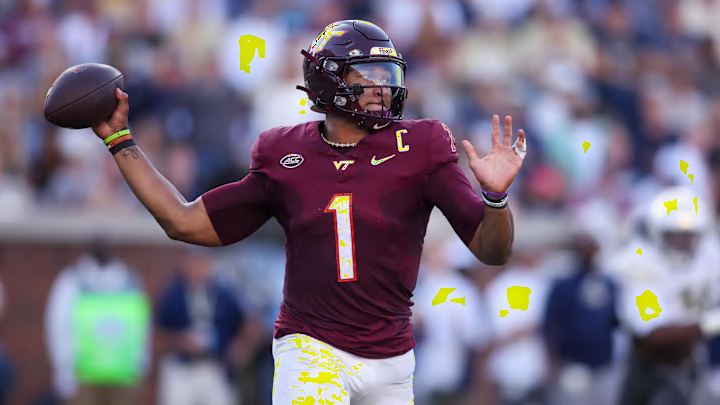
Through seven games of the 2025 season, Virginia Tech’s quarterback play has been a rollercoaster of inconsistency, flashes of promise, and growing frustration. Save for a brief stretch vs. Wofford and one play (and sack) vs. Georgia Tech from backup William "Pop" Watson III, Kyron Drones, the Hokies’ redshirt senior and Day 1 starter for the second consecutive year, has been at the heart of it all: both the fleeting highs and the recurring lows.
Just taking a stroll around the turf 🤩#ThisIsHome pic.twitter.com/XNcjRAodts
— Virginia Tech Football (@HokiesFB) October 11, 2025
When Drones transferred from Baylor ahead of the 2023 season, he was billed as a dual-threat quarterback capable of energizing a stagnant offense. His mobility and toughness were undeniable in his first campaign as a starter, when he tallied just over 2,000 passing yards and 17 passing touchdowns. However, that first campaign hasn't materialized into anything further.
2025 Season

Statistically, Drones’ production is respectable. He’s thrown for roughly 1,400 yards, completing 60.7% of his passes, with 11 touchdowns and five interceptions. However, those numbers don’t fully capture the inconsistency that’s plagued Virginia Tech’s offense.
Drones’ best performances, like his efficient outing against FCS Wofford in Week 4 and a solid showing in the win over NC State, showed glimpses of what he can be: decisive, confident and creative when plays break down.
But those moments have been too few, separated by stretches of stagnation where the Hokies struggle to move the ball at all. In conference losses to Wake Forest and Georgia Tech, Drones’ timing was off, reads came late, and the passing game never developed rhythm. Too often, Drones is holding onto the ball too long while waiting for something to develop, leading to unnecessary sacks or forced throws.
One of the biggest disappointments in Drones’ development has been his inconsistency as a decision-maker. The turnover numbers aren’t astronomical, but the timing and nature of his mistakes have been costly. Interceptions often come in critical situations: third-and-mediums deep in his own territory, or red-zone possessions where points are at a premium.
Part of the issue stems from his tendency to lock onto his first read. Opposing defenses have keyed in on that habit, disguising coverages and baiting him into throws that aren’t there. The result is a passing attack that lacks unpredictability. Through seven games, Drones has failed to eclipse 200 yards on four occasions.
There’s also the question of comfort in the pocket. Drones thrives on the move — rolling out, improvising, and extending plays with his legs. But when forced to operate from a clean pocket and deliver quick and anticipatory throws, his accuracy drops. His footwork occasionally lapses under pressure, leading to off-target passes even when the protection holds up.
Drones’ legs remain his most reliable weapon. He’s a bruising runner who can pick up chunk yardage on designed keepers or scramble for first downs when protection breaks down. His mobility forces defenses to account for him on every play, and when the Hokies lean into that aspect of their offense, they generally find success.
However, Virginia Tech’s reliance on his running ability has created a double-edged sword. It keeps drives alive but also exposes Drones to more hits.
What’s missing is the complementary element: a consistent short-to-intermediate passing game that punishes defenses for overcommitting to the run. Until Drones proves he can hit those throws regularly, opposing defenses will likely continue to crowd the box and challenge him to beat them through the air.
The tools are still there: arm strength, size, athleticism. However, Drones’ not elevating the passing game, combined with recurring mental lapses and inconsistent accuracy, has kept Virginia Tech’s offense stuck in neutral. He’s not solely to blame for the Hokies’ midseason struggles — protection issues, a leaky and oft-injured offensive line and an uneven playbook share responsibility — but as the quarterback, the spotlight naturally falls on him.
At this point, a C- feels appropriate. Drones has shown effort and flashes of talent, but he hasn’t delivered the growth or command that was expected from a returning starter. Through seven games, that’s still missing.
If Drones can regain confidence and settle into a rhythm over the final stretch, he could salvage both his season and Virginia Tech’s offensive identity. But for now, the grade reflects what the tape shows: a quarterback caught between promise and performance.
More Virginia Tech Football News:
 Add us as a preferred source on Google
Hughes serves as Virginia Tech On SI's lead editor, a position that he has held since July 2025. Hughes is a junior at Virginia Tech majoring in sports media and analytics. He also serves as the open-wheel correspondent for the motorsports outlet Steering Wheel Nation, where he has written on Formula 1, the NTT IndyCar Series, the NASCAR Cup Series and the NASCAR CRAFTSMAN Truck Series. Hughes has previously authored bylines in 3304 Sports, Virginia Tech's multimedia student journalism outlet.
Follow thomashughes_05