
Midseason Wide Receivers Report Card: How Do The Receivers Stack Up?
In this story:
Tech’s passing attack has been a riddle through seven games. The wide receivers have found themselves caught somewhere in the middle, showcasing flashes of promise but being far from consistent. Much like the Hokies’ running backs, the receivers have faced injuries and shifting roles, but while the tailbacks’ ceiling has been capped by health and depth, the wideouts’ story has been one of chemistry, timing and a variable output under center.
Game ready. #ThisIsHome pic.twitter.com/1XNDI8uu27
— Virginia Tech Football (@HokiesFB) October 11, 2025
The group hasn’t been decimated by injuries, but a few key absences have certainly shaped its rhythm. Takye Heath and Cam Seldon have each worked through absences, and while their losses haven’t eviscerated the depth chart, they’ve forced Virginia Tech to shuffle its starting personnel. That’s left the Hokies searching for continuity, and in an offense already struggling to find its footing through the air, that lack of stability has shown.
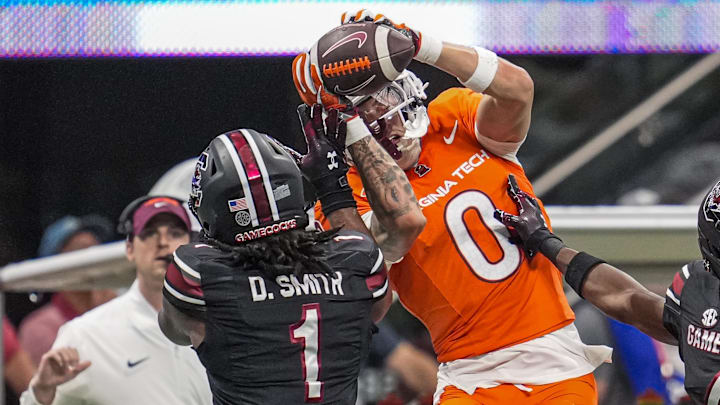
If there’s been a bright spot, it’s been the emergence of third-year Hokie Ayden Greene and Wake Forest transfer Donavon Greene, two receivers who have given the Hokies legitimate playmaking ability on the perimeter.
Ayden Greene has looked the part of a go-to option, using his combination of size, body control and catch radius to win contested balls and stretch defenses vertically. He’s displayed improved confidence and sharper route-running, and when signal-caller Kyron Drones has been on time with his reads, Greene has made defenses pay. His breakout moments have provided a glimpse of what the offense could become if the passing game ever clicks with consistency.
Donavon Greene, the transfer addition from Wake Forest, has been a steady complement. His experience and route polish have brought maturity to a position group that needed it. While he hasn’t produced eye-popping numbers every week, his presence alone has helped balance the field. Defenses can’t shade all their coverage toward Ayden, and Donavon’s ability to find soft spots in zone coverage has created much-needed rhythm on intermediate routes.
Together, the Greenes have formed a capable duo, one that has, at times, masked the inconsistencies beneath the surface.
Unlike the running backs, who’ve been hampered primarily by lingering injuries to Terion Stewart, the receivers’ struggles have more to do with establishing a consistent chemistry than lacing bodies. The passing game still lacks fluidity, and that’s not entirely on the wideouts. Timing between Drones and his targets has been spotty; that lack of synchronization has turned open opportunities into missed connections.

Drones’ athleticism makes him dangerous when plays break down, but his tendency to hold the ball or bail early has often neutralized the structure of several passing concepts. The receivers have done well enough to get open in spurts, but it hasn’t always resulted in catchable passes.
When the timing works, the Hokies’ receiving corps looks like a solid ACC unit. Greene and Greene give the group a dependable top-end duo, while Heath and Seldon, when available, have added depth and situational reliability. The Hokies have shown they can move the chains through the air, just not consistently enough to sustain drives against top-tier defenses.
At midseason, Virginia Tech’s wide receiver unit sits in a familiar spot to the running backs: flashes of capability, limited by circumstances around them. The difference lies in why the limitations exist. The running backs have been held back by injuries and workload management. The receivers have been held back by timing, rhythm and quarterback inconsistency.
If Drones can settle into quicker reads and the offense can stay on schedule, the receivers have the potential to elevate their grade in the second half. For now, though, the evaluation from my end is clear: a B — a group that’s done enough to keep Virginia Tech competitive at points, but not enough to truly take over a game. The Greenes have set the standard; if the chemistry follows, the Hokies’ passing attack could finally find the spark it’s been missing.
More Virginia Tech Football News:
 Add us as a preferred source on Google
Hughes serves as Virginia Tech On SI's lead editor, a position that he has held since July 2025. Hughes is a junior at Virginia Tech majoring in sports media and analytics. He also serves as the open-wheel correspondent for the motorsports outlet Steering Wheel Nation, where he has written on Formula 1, the NTT IndyCar Series, the NASCAR Cup Series and the NASCAR CRAFTSMAN Truck Series. Hughes has previously authored bylines in 3304 Sports, Virginia Tech's multimedia student journalism outlet.
Follow thomashughes_05