%22%3E%0A%3Cpath%20d%3D%22M0%205.12903H12.8817C17.559%205.12903%2020.5268%206.30107%2022.3762%208.13977C23.9569%209.7204%2024.7848%2011.6881%2024.7848%2014.3978V14.4731C24.7848%2018.3118%2022.7848%2020.9892%2019.5805%2022.5375L25.7203%2031.5052H15.6558L10.6774%2023.9676H8.79565V31.5052H0V5.12903ZM12.6236%2017.6773C14.7311%2017.6773%2016.0107%2016.7311%2016.0107%2015.1182V15.043C16.0107%2013.344%2014.6881%2012.5161%2012.6558%2012.5161H8.81716V17.6773H12.6236Z%22%20fill%3D%22white%22%2F%3E%0A%3Cpath%20d%3D%22M25.8506%2021.3008V21.2256C25.8506%2015.4191%2030.6785%2010.4514%2037.4527%2010.4514C44.2268%2010.4514%2048.9795%2015.3546%2048.9795%2021.1503V21.2256C48.9795%2027.032%2044.1516%2031.9997%2037.3774%2031.9997C30.6032%2031.9997%2025.8506%2027.0965%2025.8506%2021.3008ZM40.7752%2021.3008V21.2256C40.7752%2019.1933%2039.2699%2017.5697%2037.3882%2017.5697C35.5064%2017.5697%2034.0763%2019.1933%2034.0763%2021.1503V21.2256C34.0763%2023.2578%2035.5817%2024.8814%2037.4634%2024.8814C39.3451%2024.8814%2040.7752%2023.2578%2040.7752%2021.3008Z%22%20fill%3D%22white%22%2F%3E%0A%3Cpath%20d%3D%22M50.4629%2021.3762V21.301C50.4629%2014.7849%2054.3768%2010.4516%2059.237%2010.4516C62.3661%2010.4516%2064.0972%2011.8064%2065.4198%2013.2795V4H73.9681V31.5052H65.4198V28.9784C64.022%2030.4837%2062.4413%2031.9891%2059.3123%2031.9891C54.3338%2031.9891%2050.4629%2027.6558%2050.4629%2021.3655V21.3762ZM65.6133%2021.258V21.1827C65.6133%2019.1505%2064.1402%2017.4945%2062.1833%2017.4945C60.2263%2017.4945%2058.7532%2019.1182%2058.7532%2021.1827V21.258C58.7532%2023.3332%2060.2263%2024.9461%2062.1833%2024.9461C64.1402%2024.9461%2065.6133%2023.3225%2065.6133%2021.258Z%22%20fill%3D%22white%22%2F%3E%0A%3Cpath%20d%3D%22M76.0537%2021.3333V21.2581C76.0537%2015.1183%2080.4623%2010.4409%2086.6451%2010.4409C93.9569%2010.4409%2097.3439%2015.5269%2097.3439%2021.7849C97.3439%2022.2366%2097.3439%2022.7634%2097.3009%2023.215H84.0752C84.6773%2025.0215%2086.1074%2025.9677%2087.9569%2025.9677C89.5053%2025.9677%2090.7848%2025.2473%2092.1397%2023.8602L96.731%2027.5161C94.6988%2030.1505%2091.7956%2031.9999%2087.344%2031.9999C80.6021%2031.9999%2076.043%2027.7419%2076.043%2021.3333H76.0537ZM89.5375%2019.4516C89.344%2017.4946%2088.1827%2016.3656%2086.6773%2016.3656C85.172%2016.3656%2084.2257%2017.5699%2083.9677%2019.4516H89.5483H89.5375Z%22%20fill%3D%22white%22%2F%3E%0A%3Cpath%20d%3D%22M98.7305%2021.3008V21.2256C98.7305%2015.4191%20103.558%2010.4514%20110.333%2010.4514C117.107%2010.4514%20121.859%2015.3546%20121.859%2021.1503V21.2256C121.859%2027.032%20117.031%2031.9997%20110.257%2031.9997C103.483%2031.9997%2098.7305%2027.0965%2098.7305%2021.3008ZM113.655%2021.3008V21.2256C113.655%2019.1933%20112.15%2017.5697%20110.268%2017.5697C108.386%2017.5697%20106.956%2019.1933%20106.956%2021.1503V21.2256C106.956%2023.2578%20108.462%2024.8814%20110.343%2024.8814C112.225%2024.8814%20113.655%2023.2578%20113.655%2021.3008Z%22%20fill%3D%22white%22%2F%3E%0A%3Cpath%20fill-rule%3D%22evenodd%22%20clip-rule%3D%22evenodd%22%20d%3D%22M131.368%204.36764C137.191%20-1.45588%20146.632%20-1.45588%20152.456%204.36764C158.279%2010.1912%20158.279%2019.6324%20152.456%2025.4559L141.912%2036L131.368%2025.4559C125.544%2019.6324%20125.544%2010.1912%20131.368%204.36764ZM134.009%207.55761C133.948%207.86849%20133.916%208.39718%20133.916%209.14566V10.4189C133.916%2011.1832%20133.948%2011.7198%20134.013%2012.0267C134.078%2012.3317%20134.278%2012.6168%20134.617%2012.8762C134.956%2013.1376%20135.403%2013.3316%20135.958%2013.4623C136.512%2013.593%20137.1%2013.6583%20137.837%2013.6583C138.573%2013.6583%20139.217%2013.591%20139.769%2013.4524C140.322%2013.3158%20140.761%2013.1178%20141.086%2012.8604C141.411%2012.6029%20141.605%2012.3178%20141.666%2012.0069C141.728%2011.6961%20141.759%2011.1674%20141.759%2010.4189V9.14566C141.759%208.38134%20141.728%207.84473%20141.662%207.53781C141.597%207.23287%20141.397%206.94972%20141.058%206.68834C140.72%206.42696%20140.272%206.23291%20139.718%206.10223C139.163%205.97154%20138.536%205.90619%20137.839%205.90619C137.102%205.90619%20136.459%205.97352%20135.906%206.11213C135.352%206.24875%20134.914%206.44677%20134.589%206.70418C134.265%206.9616%20134.071%207.24673%20134.009%207.55761ZM139.276%2024.8638C142.876%2024.8638%20144.557%2024.2064%20144.557%2021.862V21.858V21.3155C144.557%2019.6581%20143.516%2018.971%20140.252%2018.3136C139.278%2018.1136%20138.908%2017.9136%20138.908%2017.3136V16.9414C138.908%2016.6543%20139.177%2016.5117%20139.413%2016.5117C139.749%2016.5117%20139.918%2016.7137%20139.918%2016.9414V18.1136H144.391V17.3988C144.391%2015.4563%20143.347%2014.4266%20139.177%2014.4266C136.15%2014.4266%20133.896%2015.3414%20133.896%2017.3711V17.7433C133.896%2019.5155%20134.805%2020.3155%20138.201%2021.0303C138.28%2021.0472%20138.355%2021.063%20138.427%2021.0781C139.329%2021.2674%20139.647%2021.3341%20139.647%2021.9174V22.2897C139.647%2022.6619%20139.546%2022.8045%20139.142%2022.8045C138.67%2022.8045%20138.637%2022.5471%20138.637%2022.262V21.2897H133.894V21.7471C133.894%2024.149%20135.476%2024.8638%20139.276%2024.8638ZM145.424%2024.5569H149.925V14.7355H145.424V24.5569ZM146.955%2013.5019H149.925V6.06064H147.092V9.411L145.193%206.06064H142.359V13.5019H145.193V10.1199L146.955%2013.5019ZM138.269%2012.152C138.204%2012.2688%20138.055%2012.3262%20137.825%2012.3262L137.827%2012.3282C137.604%2012.3282%20137.459%2012.2767%20137.398%2012.1757C137.336%2012.0748%20137.305%2011.8074%20137.305%2011.3758V7.90068C137.305%207.51852%20137.352%207.28684%20137.445%207.20962C137.538%207.13239%20137.675%207.09279%20137.851%207.09279C138.059%207.09279%20138.198%207.14031%20138.265%207.23734C138.332%207.33239%20138.366%207.55416%20138.366%207.90068V11.3203C138.366%2011.7579%20138.334%2012.0352%20138.269%2012.152Z%22%20fill%3D%22white%22%2F%3E%0A%3C%2Fg%3E%0A%3Cdefs%3E%0A%3CclipPath%20id%3D%22clip0_15247_3552%22%3E%0A%3Crect%20width%3D%22157%22%20height%3D%2236%22%20fill%3D%22white%22%2F%3E%0A%3C%2FclipPath%3E%0A%3C%2Fdefs%3E%0A%3C%2Fsvg%3E%0A)
Boots On, Guitars Up: Jon Pardi Keeps the Party Going
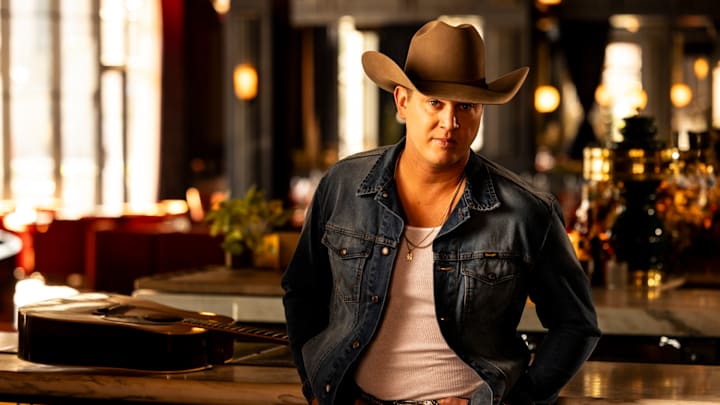
For more than a decade, Capitol Records Nashville artist Jon Pardi has been blazing his own trail, reshaping honky-tonk with electrifying guitars and an unstoppable, high-energy spirit.
With four Top 5 albums under his belt—including 2016’s Platinum-certified chart-topper California Sunrise—Pardi has built a reputation for bold, against-the-grain bravado. Fourteen RIAA-certified singles, including six #1 hits like the back-to-back 6x-Platinum smash “Head Over Boots” and “Dirt On My Boots,” have helped fuel his rise. After years of relentless touring and grassroots dedication, the California native has earned global headlining status and amassed an incredible 9.3 billion streams. Yet, despite his achievements—or maybe because of them- Jon Pardi remains restless and ready for more.
Enter Honkytonk Hollywood, Pardi’s most uninhibited, genre-defying album yet—the sound of collisions and limitless possibilities. Stepping outside his typical boundaries and chasing long-held dreams, Pardi proudly calls it his “rock and roll record,” charging forward with no set destination, only a passion for exploration. A natural extension of his fearless breakthrough hits, this new chapter proves that staying true to himself doesn’t mean standing still, it means igniting his signature style with fresh energy.

Rodeo On SI had the opportunity to sit down with Pardi. Enjoy.
SI: Tell us a little about you latest album, Honky-Tonk Hollywood.
JP: A lot of the songs have a fun, lively energy, but there's also a balance with some more sentimental pieces. On this record, a lot of the tracks seem to capture the essence of summer—like Boots Off, Love the Lights Out, and Rush. Then, there's also a deeper, introspective side. Some songs reflect on self-awareness and the choices we make—like Who I Don’t Wanna Be, which seems to be a reflection on avoiding paths we know aren't right for us. We've all been in that moment of questioning our direction. Then, of course, She Drives Away adds another layer to the story. I want to write that song, but sometimes I feel like, why write it when I can just sing it? It’s amazing how songwriters often create with a broader audience in mind rather than tailoring it to a specific artist. That universality is what makes their work resonate with so many people. If you look at some of the biggest names in music, many weren’t singer-songwriters, yet they became massive stars.
SI: You've been writing your whole life, but what specifically influenced this album? Were there particular themes or ideals that shaped it?
JP: I write a lot of the fun stuff if you look at the songs I’ve written. But, for me as a writer, I’ll admit—I can get a little lazy. Sometimes I think, No need to write about that topic, I’ve already got a song on the album that covers it. I'll just sing that one instead. But when I connect deeply with a song emotionally, recording it and making it my own feels like I had a hand in creating it—it’s like I’m part of the songwriting process in my own way.
SI: Do you typically start with certain ideas, or where does your songwriting inspiration come from? I know you started writing around age twelve, right?
JP: Yes! Back then, it was all about what was popular—what everyone was singing about. I hadn’t experienced heartbreak or drinking beer at twelve or fourteen, but at least knew what beer was! I think, in many ways, that hasn’t changed. A lot of us are still writing about the same themes, just finding ways to reinvent them.
There are some topics I haven’t sung about yet. I always joke that most of the songs I’ve written are about making love and summer—and that’s pretty awesome. Then I married her, so now it’s like making babies and summer! That theme is all over this album. Of course, there are lighter songs too. Boots Off is more fun—about leaving the party and heading home. The idea actually came from a simple thought: Sometimes, I struggle to get my boots off fast enough! That moment turned into a song.
SI: I know you're a fan of the classic crooners like Sinatra and appreciate artists like Ray Price, but your style is so unique and distinctly your own. Who have been some of your biggest influences?
JP: Oh, I’ve got to give a shoutout to Tom Petty—he definitely played a role in shaping my sound. Switching things up on this record has been interesting, especially after working with some of my closest friends on past albums. Ryan Gore and Bart Butler have been key collaborators, and Bart actually wrote Honky-Tonk Hollywood. We agreed that with a title like Honky-Tonk Hollywood, that’s a great place to start for this album.
For me, when I hear Honky-Tonk Hollywood, I immediately think of Nashville. The way country music has grown, it’s like Nashville has become its own version of Honky-Tonk Hollywood. You’ve got movie stars settling in the outskirts of Nashville, and it just keeps getting more and more glamorized. I don’t even know if that’s a word, but I’m using it anyway! And honestly, it fits—Nashville is turning into Honky-Tonk Hollywood. When I think of Nashville, my mind immediately goes to downtown, the luxury hotels popping up everywhere. It’s crazy how much has changed. There was a time when the downtown Hilton was one of the nicest spots, besides the Hutton. Now, it’s like, where do you even stay with all these new high-end places?
You know, when you put the vibe out of the record, and the universe just throws you bones. You get the songwriters, the inspiration and it all starts falling into place. When we first kicked off this project, we booked Jay, we knew the date, and locked in four weeks. The entire album came together in that window, which isn’t typical for me—I usually take my time tracking. I’m usually on tour while trying to make a record, traveling across different climates, getting sick, and returning to Nashville—only to find your voice isn't cooperating and that is tough. But this time, I stayed put in the studio the entire time. No mowing lawns, no working the tractor, no tending to the cows—just fully locked in on making this record. It was such a cool experience to really buckle down and focus just on making this record. We made the whole album in just four weeks and that was crazy! By July 24, we were done, and I’ve been waiting almost a whole year to put this record out. I kept telling Capitol Records, I want a release date. I don’t care if it’s two years from now—I just want to know exactly when to finish the record. But of course, that’s not how it works."
SI: In addition to celebrating a milestone birthday this year—happy early birthday! —you’ve got your new tour coming up, and of course, a growing family with two little ones at home. What is touring like for you now?
JP: Well, we haven’t been touring too hard lately, especially with Summer’s pregnancy, and then she had Sienna. She’s really holding things down at home right now, we have some great nannies, which really helps.
We are building a new bus to make it more baby-suave, which is awesome. Summer will have the flexibility to decide when she wants to hit the road, but it won’t be all the time.
SI: That balance is important. Touring is tough even for adults, so factoring in kids makes it an even bigger challenge, right?
JP: Shoot, it’s hard just getting on an airplane right now. Someone asked me recently what’s changed now that I have kids, and I just said, the fear of dying. That’s like a new fear unlocked. Not to scare people, of course—you can’t live life consumed by fear. But still, every time I see those flight crash videos popping up on Instagram, I think, why do they keep showing this stuff? It’s hard not to let it get in your head. Honestly, I think it’s just too many people glued to their phones. No phones in the tower anymore (laughs). But that’s a whole different conversation.
SI: Do you have a favorite track off Honky-Tonk Hollywood?
JP: Honestly, no. I love them all. Each song is unique, but they all flow together in a way that makes the album feel immersive. You can really lose yourself in it, letting the emotions hit you as different songs bring up different feelings.
Take Gamblin’ Man and Hey, California, for example. Hey, California has such a cool vibe as it paints a picture of this golden goddess of a woman who escaped to California while you're still at a bar in Tennessee. The contrast is striking, and it captures a distinct feeling. There’s a lot of West Coast country-rock influence on this record, which is cool. I really love how the album turned out, especially getting to work with Jay Joyce to craft a true country record. Some parts even pushed Jay in new directions, but nothing too far from home. She Drives Away, especially from the perspective of a new father, carries a deep emotional weight. Some people skip over it because it hits a little too close to home. After all, they don’t want to cry, but that just speaks to how powerful and personal the song really is."
SI: Tell us about The Starlight Fund, the foundation you and your wife started. I know that in every town you play in, you give back, donating money to local organizations.
JP: Yes, part of our ticket sales we use to give back to charities. Like our Christmas tour, we went and found a lot of these local charities in the towns we played. I know folks do so much for St. Jude, which is incredible, but there are also smaller charities out there where even a ten-thousand-dollar donation can completely transform their entire year. I mean, they are such small organizations in such small towns. I remember one in New Mexico, and though I can't recall exactly where, it was clear how tough things can be out there. When we made that donation, their reaction was overwhelming and felt like I’d given them a million dollars when in reality, it was just ten grand. You see other artists donating half a million dollars, and I think, man, I can’t afford that—at least not yet! So here’s ten thousand, but everything counts. It was really cool, and they even gave me a humanitarian award, which meant a lot. We always try to put our donations into places that aren’t as widely recognized but still need that support.
SI: Is there anyone you haven't collaborated with yet but would love to?
Collabs are everywhere these days, but I try to make them feel personal. Right now, I’m hoping to write with Riley Green and we’re getting closer to making it happen. We’ll either just sit down and write or see where things go naturally. We’ve talked about teaming up, and he’s even sent me songs. As of now, Riley’s the guy I’m looking forward to working with. I should probably hit the gym first—maybe we’ll do a song about hunting or just kicking back with some beers.
But when it’s two male artists collaborating, you truly need the right song. Cowboys and Plowboys with Luke Bryan was one I loved, but some people didn’t fully catch the plowboys reference—it ended up meaning something else entirely.
Luke was always someone we talked about working with, and Cowboys and Plowboys really captured the contrast between farmers and cowboys. Given his background, it felt like the perfect fit, but somehow, that song just didn’t get the attention it deserved.
SI: Where do you see yourself five years down the road?
JP: Where do I see myself in five years? Hopefully still making badass records and keeping things rolling. At the same time, I’ll be navigating school choices for the girls, like kindergarten will be here before I know it. It’s crazy to think about. Back in my small town, there was never much of a decision—you just went to the local school. But in Nashville, it’s a whole different situation. Private? Public? It’s something we’ll have to figure out. Public schools aren’t quite the same as they used to be, which makes the decision harder. But one thing I do know—my personal goal is to focus more on writing and less on touring. I want to make music, really dive into the creative process, and let that be my priority.
SI: If you had not been a musician, what would your career choice have been?
JP: If I hadn’t gone into music, I’d probably be working in construction—or honestly, I don’t know. It’s a tough question because I’ve always been drawn to so many different things. If I didn’t have the music bug, I’ve always thought firefighting would be a really cool job. A couple of my buddies are firefighters, and I’ve admired their work and schedule: you help people, but you also get time to do other things. One of my friend’s families were cowboy firefighters, so on their days off, they worked cattle ranches. It was such a unique setup, balancing both worlds. I’ve always thought that would be a great gig if I weren’t in music. It’s a job that makes a difference, has a strong sense of community, and still allows time for other passions.
Recommended Articles
 Add us as a preferred source on Google
Tresha Glowacki grew up on a dairy farm in East Tennessee, where hard work and storytelling went hand in hand. Now living in Texas, she’s a devoted writer with a love for all things Western-horses, rodeos, and music. Her writing reflects the life she lives: grounded, spirited, and full of heart. When she’s not riding or writing, she’s spending time with her kids and animals that keep her world turning.