%22%3E%0A%3Cpath%20d%3D%22M0%205.12903H12.8817C17.559%205.12903%2020.5268%206.30107%2022.3762%208.13977C23.9569%209.7204%2024.7848%2011.6881%2024.7848%2014.3978V14.4731C24.7848%2018.3118%2022.7848%2020.9892%2019.5805%2022.5375L25.7203%2031.5052H15.6558L10.6774%2023.9676H8.79565V31.5052H0V5.12903ZM12.6236%2017.6773C14.7311%2017.6773%2016.0107%2016.7311%2016.0107%2015.1182V15.043C16.0107%2013.344%2014.6881%2012.5161%2012.6558%2012.5161H8.81716V17.6773H12.6236Z%22%20fill%3D%22white%22%2F%3E%0A%3Cpath%20d%3D%22M25.8506%2021.3008V21.2256C25.8506%2015.4191%2030.6785%2010.4514%2037.4527%2010.4514C44.2268%2010.4514%2048.9795%2015.3546%2048.9795%2021.1503V21.2256C48.9795%2027.032%2044.1516%2031.9997%2037.3774%2031.9997C30.6032%2031.9997%2025.8506%2027.0965%2025.8506%2021.3008ZM40.7752%2021.3008V21.2256C40.7752%2019.1933%2039.2699%2017.5697%2037.3882%2017.5697C35.5064%2017.5697%2034.0763%2019.1933%2034.0763%2021.1503V21.2256C34.0763%2023.2578%2035.5817%2024.8814%2037.4634%2024.8814C39.3451%2024.8814%2040.7752%2023.2578%2040.7752%2021.3008Z%22%20fill%3D%22white%22%2F%3E%0A%3Cpath%20d%3D%22M50.4629%2021.3762V21.301C50.4629%2014.7849%2054.3768%2010.4516%2059.237%2010.4516C62.3661%2010.4516%2064.0972%2011.8064%2065.4198%2013.2795V4H73.9681V31.5052H65.4198V28.9784C64.022%2030.4837%2062.4413%2031.9891%2059.3123%2031.9891C54.3338%2031.9891%2050.4629%2027.6558%2050.4629%2021.3655V21.3762ZM65.6133%2021.258V21.1827C65.6133%2019.1505%2064.1402%2017.4945%2062.1833%2017.4945C60.2263%2017.4945%2058.7532%2019.1182%2058.7532%2021.1827V21.258C58.7532%2023.3332%2060.2263%2024.9461%2062.1833%2024.9461C64.1402%2024.9461%2065.6133%2023.3225%2065.6133%2021.258Z%22%20fill%3D%22white%22%2F%3E%0A%3Cpath%20d%3D%22M76.0537%2021.3333V21.2581C76.0537%2015.1183%2080.4623%2010.4409%2086.6451%2010.4409C93.9569%2010.4409%2097.3439%2015.5269%2097.3439%2021.7849C97.3439%2022.2366%2097.3439%2022.7634%2097.3009%2023.215H84.0752C84.6773%2025.0215%2086.1074%2025.9677%2087.9569%2025.9677C89.5053%2025.9677%2090.7848%2025.2473%2092.1397%2023.8602L96.731%2027.5161C94.6988%2030.1505%2091.7956%2031.9999%2087.344%2031.9999C80.6021%2031.9999%2076.043%2027.7419%2076.043%2021.3333H76.0537ZM89.5375%2019.4516C89.344%2017.4946%2088.1827%2016.3656%2086.6773%2016.3656C85.172%2016.3656%2084.2257%2017.5699%2083.9677%2019.4516H89.5483H89.5375Z%22%20fill%3D%22white%22%2F%3E%0A%3Cpath%20d%3D%22M98.7305%2021.3008V21.2256C98.7305%2015.4191%20103.558%2010.4514%20110.333%2010.4514C117.107%2010.4514%20121.859%2015.3546%20121.859%2021.1503V21.2256C121.859%2027.032%20117.031%2031.9997%20110.257%2031.9997C103.483%2031.9997%2098.7305%2027.0965%2098.7305%2021.3008ZM113.655%2021.3008V21.2256C113.655%2019.1933%20112.15%2017.5697%20110.268%2017.5697C108.386%2017.5697%20106.956%2019.1933%20106.956%2021.1503V21.2256C106.956%2023.2578%20108.462%2024.8814%20110.343%2024.8814C112.225%2024.8814%20113.655%2023.2578%20113.655%2021.3008Z%22%20fill%3D%22white%22%2F%3E%0A%3Cpath%20fill-rule%3D%22evenodd%22%20clip-rule%3D%22evenodd%22%20d%3D%22M131.368%204.36764C137.191%20-1.45588%20146.632%20-1.45588%20152.456%204.36764C158.279%2010.1912%20158.279%2019.6324%20152.456%2025.4559L141.912%2036L131.368%2025.4559C125.544%2019.6324%20125.544%2010.1912%20131.368%204.36764ZM134.009%207.55761C133.948%207.86849%20133.916%208.39718%20133.916%209.14566V10.4189C133.916%2011.1832%20133.948%2011.7198%20134.013%2012.0267C134.078%2012.3317%20134.278%2012.6168%20134.617%2012.8762C134.956%2013.1376%20135.403%2013.3316%20135.958%2013.4623C136.512%2013.593%20137.1%2013.6583%20137.837%2013.6583C138.573%2013.6583%20139.217%2013.591%20139.769%2013.4524C140.322%2013.3158%20140.761%2013.1178%20141.086%2012.8604C141.411%2012.6029%20141.605%2012.3178%20141.666%2012.0069C141.728%2011.6961%20141.759%2011.1674%20141.759%2010.4189V9.14566C141.759%208.38134%20141.728%207.84473%20141.662%207.53781C141.597%207.23287%20141.397%206.94972%20141.058%206.68834C140.72%206.42696%20140.272%206.23291%20139.718%206.10223C139.163%205.97154%20138.536%205.90619%20137.839%205.90619C137.102%205.90619%20136.459%205.97352%20135.906%206.11213C135.352%206.24875%20134.914%206.44677%20134.589%206.70418C134.265%206.9616%20134.071%207.24673%20134.009%207.55761ZM139.276%2024.8638C142.876%2024.8638%20144.557%2024.2064%20144.557%2021.862V21.858V21.3155C144.557%2019.6581%20143.516%2018.971%20140.252%2018.3136C139.278%2018.1136%20138.908%2017.9136%20138.908%2017.3136V16.9414C138.908%2016.6543%20139.177%2016.5117%20139.413%2016.5117C139.749%2016.5117%20139.918%2016.7137%20139.918%2016.9414V18.1136H144.391V17.3988C144.391%2015.4563%20143.347%2014.4266%20139.177%2014.4266C136.15%2014.4266%20133.896%2015.3414%20133.896%2017.3711V17.7433C133.896%2019.5155%20134.805%2020.3155%20138.201%2021.0303C138.28%2021.0472%20138.355%2021.063%20138.427%2021.0781C139.329%2021.2674%20139.647%2021.3341%20139.647%2021.9174V22.2897C139.647%2022.6619%20139.546%2022.8045%20139.142%2022.8045C138.67%2022.8045%20138.637%2022.5471%20138.637%2022.262V21.2897H133.894V21.7471C133.894%2024.149%20135.476%2024.8638%20139.276%2024.8638ZM145.424%2024.5569H149.925V14.7355H145.424V24.5569ZM146.955%2013.5019H149.925V6.06064H147.092V9.411L145.193%206.06064H142.359V13.5019H145.193V10.1199L146.955%2013.5019ZM138.269%2012.152C138.204%2012.2688%20138.055%2012.3262%20137.825%2012.3262L137.827%2012.3282C137.604%2012.3282%20137.459%2012.2767%20137.398%2012.1757C137.336%2012.0748%20137.305%2011.8074%20137.305%2011.3758V7.90068C137.305%207.51852%20137.352%207.28684%20137.445%207.20962C137.538%207.13239%20137.675%207.09279%20137.851%207.09279C138.059%207.09279%20138.198%207.14031%20138.265%207.23734C138.332%207.33239%20138.366%207.55416%20138.366%207.90068V11.3203C138.366%2011.7579%20138.334%2012.0352%20138.269%2012.152Z%22%20fill%3D%22white%22%2F%3E%0A%3C%2Fg%3E%0A%3Cdefs%3E%0A%3CclipPath%20id%3D%22clip0_15247_3552%22%3E%0A%3Crect%20width%3D%22157%22%20height%3D%2236%22%20fill%3D%22white%22%2F%3E%0A%3C%2FclipPath%3E%0A%3C%2Fdefs%3E%0A%3C%2Fsvg%3E%0A)
Will Bull Riding Be the Next Frontier in Women’s Sports?
In the late 1990s, Gatorade ran a groundbreaking commercial that placed a top female athlete on par with a male superstar widely considered the GOAT.
In the campaign, Mia Hamm, leader of the U.S. Women’s National Soccer team, took on Michael Jordan, then the world’s most popular sports figure on his way to winning a fifth NBA title. They went head-to-head in their respective sports – basketball and soccer. Then as equals they faced off in tennis, fencing and track. Hamm held her own, matching Jordan in every frame.
Set to Irving Berlin’s 1946 Broadway tune “Anything You Can Do (I Can Do Better)” from the musical Annie Get Your Gun, that emboldening phrase became a rallying cry for female empowerment.
The ad was revived in 2021 with Abby Wambach and Usain Bolt going head-to-head.
For a third version of the lighthearted battle of the sexes campaign, bull riding could serve as the perfect vehicle for earning permission to attempt anything in life that’s frowned upon.
Today’s “anything you can do, I can do better” conversation could factor in the limits of mental and physical strength, inextinguishable determination, and damn-the-torpedoes go-for-it moxie. Throw in the ability to overcome the fear of guaranteed pain – how far is one willing to lean in when bones will eventually be broken – and it would be time to cowgirl up on top of an explosive bull.
That’s because bull riding – the only no-timeouts lightweight vs. heavyweight sport – is the ultimate proving ground for any athlete.
In Western sports, PBR is the zenith, the apex, the final stop for all who dream of the big leagues. It stands for one thing: riders face nothing but oh-sh** bulls. There is no walk-in-the-park bull, never a pay-window gimme. A consistently rank pen of stock filters out scores of hard-working riders. And in more than three decades, those making it to the top of PBR have all been men.
Initially, I was sure that cross-gender IQ comparisons are not needed. This proves once and for all that women are much smarter than men.
I was wrong. Women are riding today, inspired by trailblazers of yesteryear, tracing back to Tad Lucas, the youngest of 24 children born on a Nebraska ranch. Lucas started competing professionally at 14 years old and during World War I, she reportedly rode bulls down the streets of Cody, Nebraska to raise money for the Red Cross.
Women’s bronc and bull riding, however, faced significant barriers after the Rodeo Association of America banned women’s competition in 1929, a trend that expanded when major promoters like Gene Autry removed women’s events from prominent rodeos.
In response, in 1948 women organized to form the Girls Rodeo Association (later the WPRA – Women’s Professional Rodeo Association) to create sanctioned competition. Despite decades spent lobbying for recognition, women’s bull riding was limited while disciplines like barrel racing eventually became the primary avenue for female participation and visibility.

In 2023, with the WPRA no longer running rough stock events, Jorden Halvorsen, an Air Force brat who grew up in North Carolina, felt a calling to give women riders a league of their own. She launched Elite Lady Bull Riders, recruiting nearly two dozen riders.
While ELBR grew to more than 30 points events in a half dozen states, most were tagged onto existing rodeos due to a lack of qualified riders to support standalone events. Sponsors yawned. Global revenue for red-hot women’s sports was topping $2 billion but very few of those dollars were directed at women’s bull riding.
There are strong indications that may change.
Women’s rodeo is benefitting from the recent surge in overall attention and popularity of women’s sports. More money and competitive opportunities are available to the cowgirls, and new organizations like PWR (Premier Women’s Rodeo) launched in 2025 under PBR are ensuring bull riding has a shot at riding the wave.
Under the direction of PWR Commissioner Linsay Rosser-Sumpter, the 2026 PWR World Championship held in May at Cowtown Coliseum in Fort Worth included rough stock – the first time since 2008 that a major rodeo association staged a women’s bull riding.

At the same time, media is catching on. Scripps Sports carried the 2026 PWR Championship from Cowtown Coliseum in Fort Worth. The two-hour watershed broadcast averaged more than half a million viewers across ION and GRIT, outperforming several established sports broadcasts across major networks including NWSL as well as the PWHL Finals game 2.
Scripps heads toward its first full year carrying women’s rodeo with momentum from the Texas championship and high expectations for interest in the athletes’ personal stories.
That storytelling approach is reflected in recent programming highlighting women bull riders, including Hulu’s docuseries Not Her First Rodeo, released in June 2025.
Additionally, a riveting feature documentary, Jonnie, covering the improbable, nearly impossible-to-believe life of Jonnie Jonckowski, who in the late 1980s took on the men, and sometimes won, premiered in Billings in April and will have a wide release later this year.
The stakes will get even higher for up-and-coming riders this weekend when a PBR team hosts women at its annual scouting event, providing an opportunity for one rider to earn a provisional roster spot for the 2026 season.
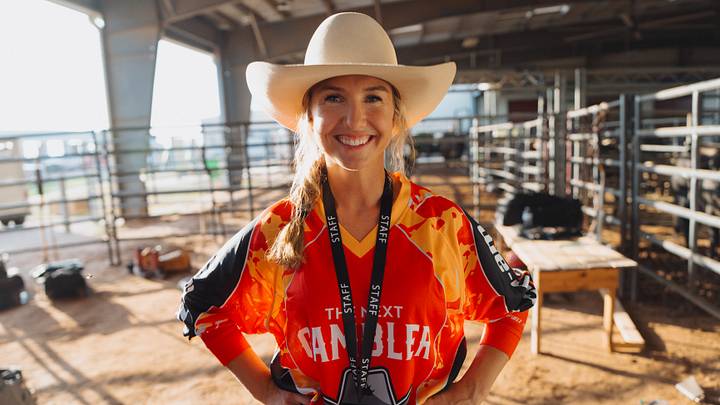
At the third annual “The Next Gambler” competition, the Austin Gamblers, league champions in 2024, will host the OptiWize Women’s Bull Riding Challenge, an all-women competition spotlighting elite female talent in the sport.
The event will be led by Halvorsen, a four-time women’s bull riding world champion whose determination to draw notice to women’s bull riding has made her an influential figure across women’s rodeo.
Other riders participating are Emily Crowder, Raven McCallum, Samantha Sullivan, Lilli Woods, and Renata Nunes – daughter of 2010 PBR World Champion Renato Nunes.

After walking out of the historic Alberta Bair Theater following the debut of Jonnie, JJ Gottsch, CEO of the Austin Gamblers, asked, “How did I not know this story?” He scored a master stroke by securing Jonckowski as honorary coach of the women’s bull riding challenge.
“I rode for 23 years, the last 10 were to promote the lady rough stock riders and to give them a platform that would last,” Jonckowski said. “We rode in Cheyenne and Pendleton, and it still didn’t stick. Now 26 years after my last ride, the Gamblers have given the ladies a platform to show their salt, and that they have the stuff. To say I am grateful is not strong enough. My heart is so happy, and I look forward to sharing with these ladies everything I learned along the way.”
Equally excited to hear about the Austin Gamblers’ belief in women’s bull riding is PWR Commissioner Rosser-Sumpter, who sees the event as aligning with the organization’s accelerating plans to integrate bull riding into its competition framework.
The winner of the women’s challenge at The Next Gambler will automatically qualify for the 2027 PWR Championship next May and have a guaranteed entry to compete at the Road to the PWR Championship on December 17–20, 2026. The made-for-TV event will air exclusively on ION/Grit, as a key part of the Scripps Sports commitment to air at least 18 hours of dedicated women's rodeo programming in the next year.
Before that, The Next Gambler, a partnership with Taylor Rodeo Association, will take place on Saturday, June 27 at 6 p.m. at the Wilco Events Center in Taylor, Texas. Beyond the arena action, fans can enjoy a full evening of entertainment, including a performance by country music artist Dylan Wheeler following the competition.

In one of the many memorable scenes in Jonnie, a bull riding star of the day proclaims, “There’s a certain thing for women to do and there’s a certain thing men should do. And rodeo’s a man’s event.”
Jonckowski routinely heard doubts, criticism and skepticism. Usually in the language not heard at church socials.
Bull riding is certainly one of the most physically challenging sports, like dancing with a schizophrenic tornado you’re supposed to stay attached to, which puts women at a biological disadvantage. Men, on average, have more than 40 percent more upper-body strength than women.
While balance, timing, spatial awareness amid violent chaos, and instinctual movement are as important as God-given or gym-built muscles (no slight cowboy who’d blow over in a windstorm will overpower an 1800-pound bull), without substantial core, grip, forearm and shoulder strength, none of those matters. You’re dispatched: sayonara, adios, arrivederci, shalom, how’s that dirt taste?
Jonckowski, called the “Billie Jean King” of the sport, understood all of this.

Before attempting her first bull, she was a star track athlete from Montana headed toward the Montreal Olympics. In a qualifying event, she clipped a hurdle and trashed her back.
With her Olympics dreams dashed, once she recovered and began to consider bull riding, she knew she had to get ripped to have a chance to compete with the men.
After deciding to ride full time, she “lived in a gym seriously building my body.” She ran through high-intensity cardio routines, lifted weights, and created her own exercises, like putting a basketball between her knees, turning her toes out, and jumping around. She boasted bulging biceps, showing them off regularly along with a six-pack stomach that comes with 7 percent body fat.
“You gotta be strong through the middle to ride bulls, and my abs were ridiculous,” Jonckowski said. “I was a tough son of a gun. A big part of bull riding is reflexes to counteract the bull. As an athlete, I knew that reflex doesn’t go through fat well. Other girls were flapping all over the place. I was in control, so I’d get the points.”
Bull riding is also said to be 90 percent mental. Matching Jonckowski’s physical prowess was a never-quit mentality. “I was going to win, or die trying,” she said.
For riders like Halvorsen, who was stomped by a bull, flatlined, died twice on the operating table, and came back to life to ride again, nobody can seriously question her mental toughness. Each of the athletes in The Next Gambler scouting event have had their share of injuries.
The question is if physical strength will be a barrier to conquering the world’s fastest, most powerful bulls.
Whether anyone can show she has the full package – physical and mental – to earn a spot on the Gamblers roster is irrelevant.
What’s most important is the opportunity and exposure. The ladies will be getting on and trying their guts out; the bulls won’t know or care about the chromosomes in the human on their back. And the Gamblers are shining a spotlight on a group of athletes with so much promise and potential.
The cherry on top? Jonnie Jonckowski helping coach the next generation of badass women riding shoulder to shoulder with the men.
To borrow from another memorable ad campaign, “You’ve come a long way, baby.”
 Add us as a preferred source on Google
Andrew Giangola, who has held high-profile public relations positions with Pepsi-Cola, Simon & Schuster, Accenture, McKinsey & Co., and NASCAR, now serves as Vice President, Strategic Communications for PBR. In addition to serving in high-profile public relations positions over the past 25 years, Andrew Giangola is the author of the critically acclaimed books The Weekend Starts on Wednesday: True Stories of Remarkable NASCAR Fans and Love & Try: Stories of Gratitude and Grit in Professional Bull Riding, which benefits injured bull riders and was named the best nonfiction book of 2022 at the 62nd Annual Western Heritage Awards. Giangola graduated from Fordham University, concentrating in journalism, when he was able to concentrate. He lives in Brooklyn with his wife Malvina.