%20%20--%3E%0A%3Csvg%20version%3D%221.1%22%20id%3D%22Layer_1%22%20xmlns%3D%22http%3A%2F%2Fwww.w3.org%2F2000%2Fsvg%22%20xmlns%3Axlink%3D%22http%3A%2F%2Fwww.w3.org%2F1999%2Fxlink%22%20x%3D%220px%22%20y%3D%220px%22%0A%09%20width%3D%2239px%22%20height%3D%2240px%22%20viewBox%3D%220%200%2039%2040%22%20enable-background%3D%22new%200%200%2039%2040%22%20xml%3Aspace%3D%22preserve%22%3E%0A%3Cpath%20fill%3D%22%23FFFFFF%22%20d%3D%22M38.5%2C7H28.2v26h10.3V7z%22%2F%3E%0A%3Cpath%20fill-rule%3D%22evenodd%22%20clip-rule%3D%22evenodd%22%20fill%3D%22%23FFFFFF%22%20d%3D%22M26.1%2C25.5c0%2C5.8-4.1%2C7.5-12.9%2C7.5C3.9%2C33%2C0%2C31.2%2C0%2C25.2v-1.1h11.6%0A%09v2.4c0%2C0.7%2C0.1%2C1.4%2C1.2%2C1.4c1%2C0%2C1.2-0.4%2C1.2-1.3v-0.9c0-1.6-0.9-1.6-3.5-2.2C2.2%2C21.7%2C0%2C19.7%2C0%2C15.3v-0.9C0%2C9.3%2C5.5%2C7%2C12.9%2C7%0A%09c10.2%2C0%2C12.8%2C2.6%2C12.8%2C7.4v1.8h-11v-2.9c0-0.6-0.4-1.1-1.2-1.1c-0.6%2C0-1.2%2C0.4-1.2%2C1.1v0.9c0%2C1.5%2C0.9%2C2%2C3.3%2C2.5%0A%09c8%2C1.6%2C10.5%2C3.3%2C10.5%2C7.5V25.5z%22%2F%3E%0A%3C%2Fsvg%3E%0A)
NFL VP of Officiating: Controversial calls affecting 49ers, Patriots were correct
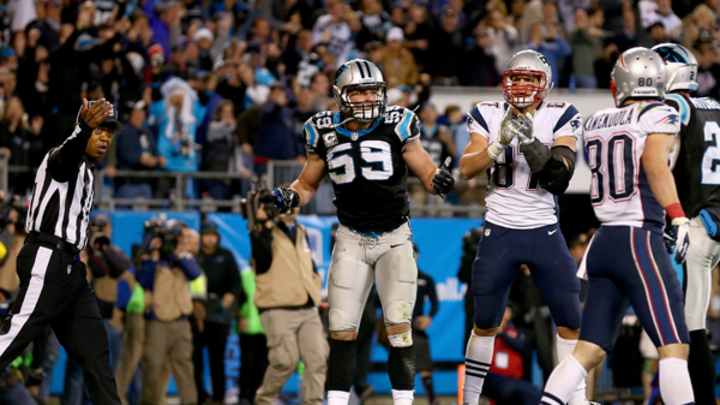

Back judge Terrence Miles' original call on Panthers linebacker Luke Kuechly was reversed. (Streeter Lecka/Getty Images)
There is controversy regarding officiating every NFL season, but Week 11 of this season brought us two key calls affecting games that could alter the playoff picture in both conferences. On Sunday, San Francisco 49ers linebacker Ahmad Brooks was flagged for a personal foul when he sacked New Orleans Saints quarterback Drew Brees with 3:18 left in the game. The 49ers were up, 20-17, the penalty negated a sack and fumble, and the Saints continued a drive that ended with a game-tying field goal from Saints kicker Garrett Hartley. On their next drive, New Orleans grabbed another field goal, and pulled the game out, 23-20.
Brooks was penalized by Tony Corrente's crew because he hit Brees around the collarbone area with his arm, and that seemed to be outside the realm of the "head and neck" rule defenders must watch when quarterbacks are in the pocket.
“I felt like I hit him with my chest, like I basically bear-hugged him kind of hard,” Brooks said after the game. "I’m going full speed and he [Brees] is going full speed. And at the last second, he ducked his shoulder. So I don’t think I could’ve done anything differently.”
And on Monday, the New England Patriots were rather unhappy when Carolina Panthers safety Robert Lester's last-second interception was upheld despite the fact that Panthers linebacker Luke Kuechly certainly seemed to be mugging New England tight end Rob Gronkowski as the ball was thrown. Back judge Terrence Miles originally threw a flag to indicate a penalty on Kuechly, but after further review, the flag was picked up and the penalty did not stand.
Former NFL official Gerry Austin, acting as an analyst for ESPN during the Monday Night Football telecast, said that the no-call was correct, because if the ball is knocked down or intercepted on its way to the receiver, it's not interference. However, former NFL VP of Officiating Mike Pereira said on Twitter that “Since the flag was thrown they should have stayed with the call. There was clear contact before the ball was intercepted. You could make a case that the pass might have been uncatchable, but the flag was thrown and you should stay with it.”
Current NFL VP of officiating Dean Blandino gave the official league view on both calls on the NFL Network during an NFL Network appearance on Tuesday. Regarding the no-call from Blakeman's crew, it was Blandino's determination that the call was correct ... or, at the very least, it was a judgment call that could be excused.
[si-nfl-player id=923af4945cc44267b92d41d1ee07a4fa]
“Let’s go through the play. Here is Gronkowski in the formation," Blandino said, while going through the video. "The back judge in the middle of the field – he’s on the end line – that’s his key. We have [receiver Aaron] Dobson down here; the side judge who is on the goal line – that’s his key. Let’s watch the play develop. The back judge is going to see restriction right there and he’s going to throw his flag for that restriction. The side judge who had Dobson, his mechanics are once the ball is in the air he’s going to go to the ball and he’s going to focus on the interception. After the play – you’ll see the flag come out – the back judge is going to signal to the side judge and they’re going to get together and have a discussion. What they’re going to talk about is when did the restriction occur in relation to the ball being touched? Because once the ball is touched, you cannot have pass interference. This is a judgment call; the officials don’t have the use of replay. They don’t have slow motion replay and ultimately they ruled that the restriction occurred simultaneously with the ball being touched. When you watch it at full speed, you could see why they would make that call on the field.”
Host Amber Theoharis asked Blandino if the flag should have been picked up, and that's where things started to sound less convincing.
"Again, it's a judgment call. There was contact, but there is contact on a lot of passing plays downfield. The issue isn't the contact; the issue is the restriction. Does it occur prior to the ball being touched? At full speed, the officials made a tight judgment call and they determined that the restriction occurred just as the ball was being touched. Again, at full speed you could see why they made that call."
Asked if the officials were wrong, Blandino seemed to waver a bit.
"I wouldn't say that they were wrong. Again, they have to make this call. They used proper mechanics. They got together after the play. They determined that in their judgment the contact occurred simultaneous with the ball being intercepted, and that's why the officials did what they did.
[si-nfl-player id=1f0ec09afffd4579a89a28494421147d]
Blandino sounded more sure about the penalty on Brooks, though it's easy to argue that when Brees dropped down as he was about to be hit, he lowered his target area to a place that was impossible for Brooks to hit correctly.
"You can't make forcible contact to the head or the neck area, even if the contact starts below the neck and rises up," Blandino said. "If there's force to that contact, it's a foul. Watch the initial contact, maybe around the shoulder, but it rides up into the neck area and brings the quarterback down with force.
"That's why the flag was thrown for unnecessary roughness."

SI.com contributing NFL writer and Seattle resident Doug Farrar started writing about football locally in 2002, and became Football Outsiders' West Coast NFL guy in 2006. He was fascinated by FO's idea to combine Bill James with Dr. Z, and wrote for the site for six years. He wrote a game-tape column called "Cover-2" for a number of years, and contributed to six editions of "Pro Football Prospectus" and the "Football Outsiders Almanac." In 2009, Doug was invited to join Yahoo Sports' NFL team, and covered Senior Bowls, scouting combines, Super Bowls, and all sorts of other things for Yahoo Sports and the Shutdown Corner blog through June, 2013. Doug received the proverbial offer he couldn't refuse from SI.com in 2013, and that was that. Doug has also written for the Seattle Times, the Washington Post, the New York Sun, FOX Sports, ESPN.com, and ESPN The Magazine. He also makes regular appearances on several local and national radio shows, and has hosted several podcasts over the years. He counts Dan Jenkins, Thomas Boswell, Frank Deford, Ralph Wiley, Peter King, and Bill Simmons as the writers who made him want to do this for a living. In his rare off-time, Doug can be found reading, hiking, working out, searching for new Hendrix, Who, and MC5 bootlegs, and wondering if the Mariners will ever be good again.