
Ted Lindsay Fought for NHL Players' Rights Long Before They Had a Voice
In this story:
Today's NHL players have opportunities that previous generations could scarcely imagine. Lucrative contracts, free agency, salary arbitration and representation through a powerful players' association have fundamentally changed the relationship between players and team management.
But those freedoms didn't come without a fight.
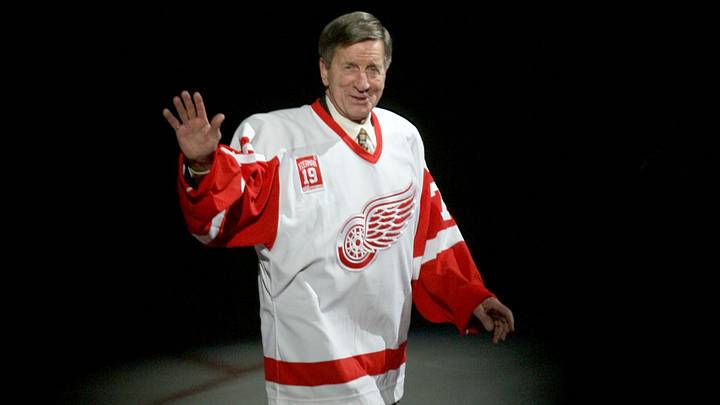
Long before NHL players had the bargaining power they enjoy today, Detroit Red Wings legend Ted Lindsay was willing to challenge the people who controlled their careers. It was a decision that ultimately cost him his place with the franchise he helped turn into a dynasty.
Lindsay was already one of hockey's biggest stars when he began questioning how the league treated its players. Playing alongside Gordie Howe and Sid Abel on Detroit's famed Production Line, the hard-nosed winger helped the Red Wings win four Stanley Cups between 1950 and 1955.
Despite standing 5-foot-8, Lindsay earned a reputation as one of the toughest players in hockey. His physical style earned him the nickname "Terrible Ted," but he was considerably more than an intimidating presence.
He won the Art Ross Trophy in 1949-50 after recording 78 points in 69 games, adding 141 penalty minutes for good measure. By the end of his career, Lindsay had amassed 379 goals and 851 points in 1,068 games.
His accomplishments on the ice were impressive enough to earn him a place in the Hockey Hall of Fame. What he accomplished away from the rink, however, would prove just as important.
During the 1950s, NHL owners exercised enormous control over their players. The reserve system severely restricted a player's ability to choose where he played, while salaries, pensions and working conditions were largely determined by management.
Lindsay believed players deserved something better.
As Liz Mullen detailed in a 2017 Sports Business Journal feature, Lindsay began meeting with New York attorneys Nelson Lewis and Milton Mound in 1956 to explore ways of improving players' rights.
Working alongside Montreal Canadiens defenseman Doug Harvey and representatives from other NHL teams, Lindsay helped establish the original NHL Players' Association on February 11, 1957.
It was a major undertaking for its time. Players were challenging the same owners and executives who controlled their livelihoods, and there was no guarantee their efforts would succeed.
According to Mullen's reporting, Lindsay and other players secretly organized and contributed their own money to secure legal representation.
The consequences were swift.
Red Wings general manager Jack Adams was furious over Lindsay's involvement. As Bob Verdi and Harvey Wittenberg recounted in 2019, Lindsay's union activities created considerable tension with Detroit management.
On July 23, 1957, the Red Wings traded Lindsay and goaltender Glenn Hall to the Chicago Blackhawks.
The trade came after Lindsay had produced 85 points during the 1956-57 season, including a league-leading 55 assists.

One of the Red Wings' most accomplished players had been sent to a struggling franchise, with his union activities playing a central role in the decision.
For Lindsay, the message was unmistakable. Challenging hockey's establishment could carry a heavy personal price.
The original association eventually collapsed under pressure from NHL ownership. The players' antitrust lawsuit was settled in 1958, bringing concessions that included a minimum salary, increased playoff compensation and moving expenses for traded players.
It wasn't the sweeping victory Lindsay had envisioned.
But the movement he helped start didn't disappear.
According to the NHL Players' Association's official historical account, the organization was formally reestablished in 1967, giving players a collective voice that would grow considerably stronger over the following decades.
Over time, players gained additional protections and greater negotiating leverage, eventually securing rights that would have seemed unimaginable during Lindsay's playing career.
Those developments did not happen overnight, nor were they the accomplishments of one individual. But Lindsay helped show that players could organize and challenge the system governing their careers.
The connection to today's NHL is difficult to ignore.
Modern players and their representatives negotiate contracts worth millions of dollars, while the NHLPA participates directly in negotiations over the league's economic structure and working conditions.
In July 2025, the NHL and NHLPA ratified a new collective bargaining agreement extending through the 2029-30 season, another chapter in a relationship that has evolved since Lindsay's initial efforts.
Individual contract negotiations and collective bargaining are different matters, but both exist within a system in which players possess rights and protections their predecessors fought to establish.
Lindsay eventually returned to the Red Wings for one final season in 1964-65. As Dave Bartkowiak Jr. recounted on ClickOnDetroit, former teammate Sid Abel played an important role in bringing Lindsay back to the Red Wings.
At age 39, Lindsay scored 14 goals and had 28 points in his final NHL season. He retired permanently afterward and was inducted into the Hockey Hall of Fame in 1966.
In 2010, the NHLPA renamed its annual most outstanding player award, voted on by the players themselves, in Lindsay's honor.
It was an appropriate tribute to someone who had spent so much of his career fighting to give those same players a voice.
Lindsay died in 2019 at age 93, leaving behind a legacy that extends far beyond his four Stanley Cup championships.
His number 7 hangs in the rafters in Little Caesars Arena, a reminder of one of the greatest players to ever wear the winged wheel.
But perhaps his most enduring contribution cannot be measured in goals, assists or championships.
Every time NHL players collectively negotiate for better working conditions or exercise rights previous generations lacked, they're benefiting from a movement Lindsay helped begin nearly 70 years ago.
And that may be Ted Lindsay's greatest victory.
 Add us as a preferred source on Google

Jason Fink is an NHL writer and lifelong hockey fan who fell in love with the game when he watched Wayne Gretzky’s Edmonton Oilers defeat the Philadelphia Flyers in the 1987 Stanley Cup Final. When he’s not writing, Jason enjoys spending time with his wife Michelle and their son Theo and daughter Stella. Whether he’s following the latest NHL news or cheering from the rink, his passion for the sport has been a constant throughout his life.