
The Hidden but Vital Mission Behind Success in F1 [Exclusive]
Another Formula 1 season is drawing to a close with teams and drivers in Lusail for the Qatar Grand Prix, the penultimate round of the campaign.
2026 has been a year of change for the championship, especially on the power unit side of the technical regulations, with electrical energy taking an almost 50% share of the propulsion, along with the traditional internal combustion unit.
A huge part of that challenge falls on the various fuel suppliers across the 11 teams, with partnerships forced to marry the power units with effective fuel and lubrication solutions to optimize performance and chase success.
At Red Bull and Racing Bulls, that partner is ExxonMobil and the Mobil1 brand. Grand Prix on SI sat down with Matti Alemayehu, Mobil1's global motorsport technology manager, to dive into the world of high-performance fuels.
Starting from scratch with F1's new mandate

Alongside changes to the mechanical components that make up an F1 power unit, sustainable fuels have also been introduced to the championship as it continues its quest to become net-zero by the end of the decade.
All of that combined created a challenge for those at Mobil1 as it aimed to provide the new Red Bull Powertrains-Ford unit with a winning product.
"The 2026 regulation was one of the most significant mandates when it came to the fuel. So the FIA requirement was to derive the fuel fully from advanced sustainable sources. Basically, that means waste," explains Alemayehu.
"So imagine you're really kind of starting from scratch, almost, so you know how to develop the fuel from fossil-based. So for us, what we did as ExxonMobil was step back and look at what are the expertise that we have across the organization. So, looking at our fuels organization, our catalyst team, our lubricant side, really it took us about three years to develop the fuel and about 75 people across and a dozen scientists to answer the question.
"So it was a significant engineering question and challenge, which we were able to tackle and really deliver on. So a big mandate, but also an exciting opportunity for us to showcase our technology prowess."
The challenge of developing fuels with the requisite performance comes from the fact that chemical properties differ between energy sources: "So you do have to derive the fuel from what's prescribed to be advanced sustainable sources. So one of the challenges is really getting the components for that. Again, it's a new supply chain you have to think about.
"You have to get the molecules for... and then look at how do you optimise for performance. And that all ties back to the power unit as well. So you're really working the fuel with the power unit adjustments that's being worked for that specific regulation.
"So definitely different types of chemistry had to be explored to get there, but we were able to get there."
While those at Ferrari and Mercedes had previous knowledge to build upon when creating the new power units, RBPT was in a different boat entirely.
When Honda officially left the sport at the end of 2021 - only to return for 2026 with Aston Martin - Red Bull's hierarchy opted for the risky, more challenging path. It would become an official power unit manufacturer, shying away from its previous customer status.
A technology deal with Honda allowed previous IP to be utilized through to the end of 2025, but for the new regulatory set, RBPT and Ford were on their own.
That's a process that Mobil1 has been a part of throughout: "Yeah, the collaboration between Red Bull Powertrains and ourselves is we're one team, right? So we were really part of the team at the startup of RBPT when there were about six people there.
"So now there are hundreds. So when you think about really being on the ground when the team was created and creating the power unit, and the fuel, and the lubricant that goes with it, it was a joint effort. So that was actually a great opportunity to be at the startup at the ground to create an engine with the team.
"So that was a good opportunity. We saw it as a positive."
Developing fuels alongside Red Bull and Racing Bulls
Alemayehu pointed out the significance of having four data sets across the cars of the two teams in helping to gather data for the development of their product.

"The feedback comes from throughout the race," she says.
"The development cycle is typically a year ahead. So when you're looking at what you're developing for the fuel, you're looking at it, let's say, for the 2027 season; you're developing it in '26. So you have dyno time with the engine team. You're iteratively changing componentry molecules to really optimize for combustion and to really get to the power that you're looking for.
"So really the name of the game in motorsports is performance and reliability, right? Balance that you're working on. So that's really what you're doing. And then at the end of the season, you do get the fuel and the lubricant approved by the FIA.
"And that's what you will use for the rest of the next season. So you're not really changing that throughout the season, or you're not changing it race by race. So that's really how your development cycle works in F1.
"We do have embedded engineers for trackside, right? So we are taking samples for every race for both the fuels as well as the lubricant. Think about it as almost like a hundred samples get taken over the weekend.
"And that really feeds back into the development that you're doing for the next season. So anything we're seeing from the engineers, the mechanics, anything we're hearing from the drivers really allows us to optimize performance.
"So think about performance in F1 being very incremental, right? So everything matters in terms of how closely you work within the team to gain you that advantage.
"So that's really how it works in terms of how iterative the process is. And our embedded engineers in the trackside are key to that success of how far we get for the next cycle of the season."
A grueling campaign
One of the tasks for any vital component in F1 is to work within an acceptable window across a number of different climates and altitudes across the season and this is no different for the fuels.
Conditions can be in single digits at the Las Vegas GP weekend, while the sun beats down on cars throughout the European summer - and the temperature drop in the Middle Eastern races may be negligible when floodlights are turned on for the night races.
Then there's the high-altitude Mexico City GP that is so often taxing on power units, while the Azerbaijan round takes place around the city streets of Baku, which is below sea level.
"When you think about really the engine, the fuel, the lubricant, it's in a sealed system. So one of the advantages and really the key thing you're trying to achieve as a team, is to make sure the fuel and the lubricant works in every condition," Alemayehu explains.
"That's what makes it special is you're optimizing it within for every scenario that could happen - high altitude and all that.
"It's in a sealed system, so you're making sure you're hitting performance that allows you to achieve top performance, but also ensures there's reliability balance to it. So that's what makes the offer on the lubricant and the fuel side special is it works in every scenario.
"So that's really what the team targets because you're not really changing it across races like you're doing for car setups or things like that."
What is the significance of being in F1?

ExxonMobil is active across the motorsport spectrum, having been involved with F1 since its inception. But what does the organization get from that presence?
"ExxonMobil has been part of global motorsports for about 110 years and we've been part of F1 from the beginning. So really, we have a diverse portfolio when you think about racing across Formula 1, NASCAR, IMSA.
"We participate everywhere, and that is to build understanding. It is a proving ground for technology that helps us really extract insight for the commercial side of the lubricant and the fuel that we offer. So we always take learnings because when you think about the operation in motorsports, we were talking about 15,000 rpm-type engines. You don't really have that on a day-to-day, right? So you're testing componentry in extreme conditions.
"So we have lubricants that we've used in races that we use now in commercial road cars. We also gain understanding of hybrids, for example. So we have a hybrid product that's out there that has insights derived from motorsport.
"So we extract those insights to really help our commercial side on both the fuel and the lubricant side."
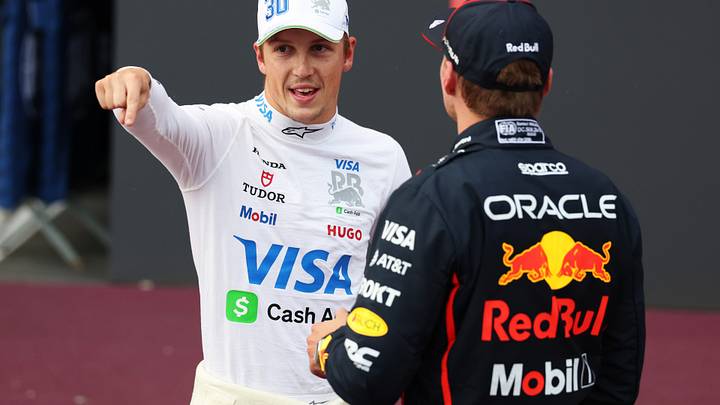
With just one round remaining in the F1 season after the Qatar GP, the RBPT-Ford-Mobil1 partnership has been a success. Red Bull is in the fight for second in the constructors' championship, with Max Verstappen having won four races - a tally beaten only by world champion Kimi Antonelli - while Racing Bulls looks set for its best finish in F1 in any guise, with fifth in the standings, thanks to Liam Lawson and Arvid Lindblad.
"It's amazing, really, to see, you know, both teams doing amazing," Alemayehu beams.

"So if you think about, as I said, you know, how we start development process a year ahead, right? So when you're in this season, you're almost a year and a half into the work that's been put into it. And, you know, there's a lot of people behind the scenes, you know, developing the fuel technology, developing and working day and night on trackside.
"So when you see, you know, the team on the podium and when you see the team winning, it is such a satisfying feeling, right? Because our teams are really united by that drive to win.
"And to get there, it really shows how well we're working together. So it's an indescribable feeling, honestly, to see the team achieve success."
 Add us as a preferred source on Google

Ewan is a motorsport journalist covering F1 for Grand Prix On SI. Having been educated at Silverstone, the home of the British Grand Prix, and subsequently graduating from university with a sports journalism degree, Ewan made a move into F1 in 2021. Ewan joins after a stint with Autosport as an editor, having written for a number of outlets including RacingNews365 and GPFans, during which time he has covered grand prix and car launches as an accredited member of the media.
Follow ewangale