
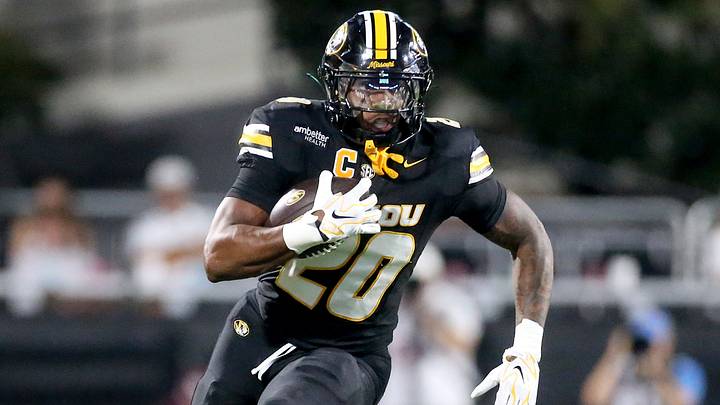
Jamal Roberts Headlines the Biggest College Fantasy Football Winners & Losers From Week 5
In this story:
Week 5 revealed critical shift indicators in player usage, separating real role growth from fake box-score spikes. By evaluating snap counts, high-value touches, and route participation, we can isolate the College Fantasy Football players with expanding workloads, and the ones whose value is disappearing. These underlying metrics uncover which recent trends reflect genuine lineup stability moving forward.
The Backfield Breakouts You Can't Ignore
Turbo Richard/RB/Indiana Hoosiers
Statline: 13 carries, 204 rushing yards, 1 TD, 1 catch, 12 receiving yards Opportunities: 14 touches (37% team carry share) High-Value Touches: 2 red-zone carries, 1 goal-line TD

Role Trend & Outlook: Richard returned to Indiana's starting lineup following an ankle scare in Week 4 and delivered a dynamic performance against Rutgers. While maintaining a 15.0+ YPC average is unrealistic long-term, his explosive big-play profile is supported by high-value volume.
Jamal Roberts/RB/Missouri Tigers
Statline: 22 carries, 211 rushing yards, 3 TDs, 2 receptions, 18 receiving yards Opportunities: 24 total touches (58% team carry share) High-Value Touches: 5 red-zone carries, 2 goal-line TDs

Role Trend & Outlook: Roberts staged a full-fledged backfield takeover against Florida, seizing over half of the team's rushing volume and commandeering all primary red-zone snaps. Unlike explosive performances driven by a single broken play, Roberts' production stemmed from sustained, high-volume usage across all four quarters.
The Quarterback Who Changed His Fantasy Outlook
Tayven Jackson/QB/North Texas Mean Green
Statline: 31/44 passing (70.5%). 412 passing yards, 4 TDs, 1 INT, 6 carries, 24 rushing yards

Role Trend & Outlook: Jackson has established one of the most bankable volume ceilings in College Fantasy Football over the last two weeks. Proving that Week 4's 57-attempt explosion was a strategic shift rather than a single-game fluke, North Texas continues to run an uptempo air-attack that funnels fantasy production directly through his arm. Averaging over 400 passing yards and 4 touchdowns per game across AAC conference play, Jackson's sheer passing attempts gives him elite QB1 upside regardless of game script.
The Wide Receivers Turning Volume Into Fantasy Points
Jeremiah Smith/WR/Ohio State Buckeyes
Statline: 11 receptions, 206 receiving yards, 2 TDs Opportunities: 14 targets (38.8% target share)

Role Trend & Outlook: Smith's record-setting output against Iowa was the direct result of dominant target command. Drawing 38.8% target share against a defensive system designed to limit big plays demonstrates that Smith is the focal point of Ohio State's entire game plan. He command target share across alll areas of the field, operating as a target funnel on third-down conversions, a threat in the deep passing game, and the top option in the red zone.
Malachi Toney/WR/Miami Hurricanes
Statline: 9 receptions, 148 receiving yards, 2 TDs Opportunities: 12 targets (31.5% target share)

Role Trend & Outlook: Toney expanded his presence in Miami's high-powered passing attack during Week 5, evolving from a rotational big-play threat into a primary high-volume option. Operating with a 31.5% target share and running routes on 84% of dropbacks, Toney commanded high-leverage usage across all depths of target.
The Players Whose Stock Took a Hit
Bryce Underwood/QB/Michigan Wolverines
Statline: 12/22 passing (54.5%) 101 passing yards, 0 TDs, 2 INTs, 14 rushing yards (2.4 Fantasy Points) Efficiency: 4.59 YPA, 3 sacks taken Previous Week: 215 passing yards, 2 TDs, 49 rushing yards

Role Trend & Outlook: Underwood suffered a severs efficiency crash in a 20-14 loss against Minnesota, where opposing defenses consistently chocked off his primary reads and limited his rushing lanes. With Michigan's passing game struggling to generate downfield explosive plays, Underwood's absolute passing volume and yardage ceiling remain dangerously low for standard fantasy leagues. Until the offense opens up the vertical passing game or increases his designed QB rushing share, he carries a low baseline that makes him risky as a fantasy starter.
Nyck Harbor/WR/South Carolina Gamecocks
Statline: 2 receptions, 18 receiving yards, 0 TDS Opportunities: 3 targets (11% target share), 0 red-zone targets Target Trend (Week 3): 7 targets

Harbor's target share has decreased for three consecutive weeks as South Carolina's passing game continues to struggle with rhythm and protection. Operating primarily as the downfield vertical threat, his lack of high-volume intermediate routes leaves him reliant on home-run plays. Without consistent target design or targets inside the 20-yard line, his weekly baseline makes him difficult to trust in active lineups.
Kamario Taylor/QB/Mississippi State
Statline: 14/31 passing (45%), 142 passing yards, 0 TDs, 2 INTs, 8 carries, 11 rushing yards, 2 rushing TDs Efficiency: 4.58 YPA, 5 sacks taken Previous Game: 280 yards, 3 TDs, 62 rushing yards

Taylor suffered a severe crash in efficiency during Mississippi State's 56-23 blowout loss to Alabama. Facing heavy pass-rush pressure and tight coverage schemes, his usually robust dual-threat baseline evaporated, resulting in 5 sacks taken and a sub-50% completion percentage. While his red-zone rushing usage remains intact, his inability to sustain drives through the air significantly lowers his weekly floor against disciplined defenses.
What Week 5 Actually Changed
Jamal Roberts is a True Workhorse: Roberts' 24 touches and goal-line control confirm a complete backfield takeover in Missouri.
Jeremiah Smith's Target Funnel is Matchup-Proof: A 39% target share against Iowa proves that Smith's volume and high-value involvement remains secure regardless of defensive scheme.
Turbo Richard is an High-Upside FLEX Option: While his 15.0+ YPC will normalize, his schemed red-zone involvement ensures he retains valuable fantasy upside even on moderate touch counts.
 Add us as a preferred source on Google
Daniel Outerbridge covers the NBA, NFL, WNBA, and MLB with an emphasis on the numbers behind the game. His work breaks down player performance, team strategy, and emerging statistical trends to provide actionable insights for fans and fantasy players. Outerbridge has written for a myriad of other outlets including Anubis Sports and FanSided.