
Week 10 NFL Fantasy Football Start 'Em, Sit 'Em: Stefon Diggs vs. Jameson Williams
In this story:
On paper, Washington Commanders wide receiver Stefon Diggs and speedster Jameson Williams look like identical scoring threats through the first half of the 2026 regular season as both players enter Week 10 sitting on five receiving touchdowns. Look past the end zone and you are staring at two completely different assets heading in opposite directions: an aging veteran surviving on red-zone life support versus a human highlight reel waiting to detonate your league's playoffs.
Do you cling to the comfortable illusion of veteran name value and unsustainable touchdown luck, or do you stomach the week-to-week volatility of a big-play burner who can win a matchup on three targets?
The Touchdown Trap: Are Managers Putting Too Much Trust In Stefon Diggs?
Touchdowns are the most volatile currency in fantasy football, and Diggs' 2026 stat line is a textbook example of scoring inflation masking declining per-play efficiency.

Across seven appearances, Diggs has caught 30 passes for just 303 yards, a modest 43.3 yards per game and 10.1 yards per catch. He has topped 50 receiving yards twice all season (55 yards in Week 1 and 51 yards in Week 9) and was held completely off the stat sheet in Week 5 against the New York Giants. Without his five trips to the end zone, Diggs' weekly yardage totals would leave him firmly as an WR4/flex.
Writing Diggs off as a regression candidate ignores how Washington uses him. Diggs operates as a reliable chain-mover and trusted red-zone option on intermediate and underneath concepts. While his 16.7% touchdown-per-reception rate (five scores on 30 grabs) is virtually impossible to sustain over a full 17-game season, his steady target floor in PPR formats keeps him as a locked-in WR2.
The Big-Play Problem: Can Jameson Williams Offer Weekly Dependability?
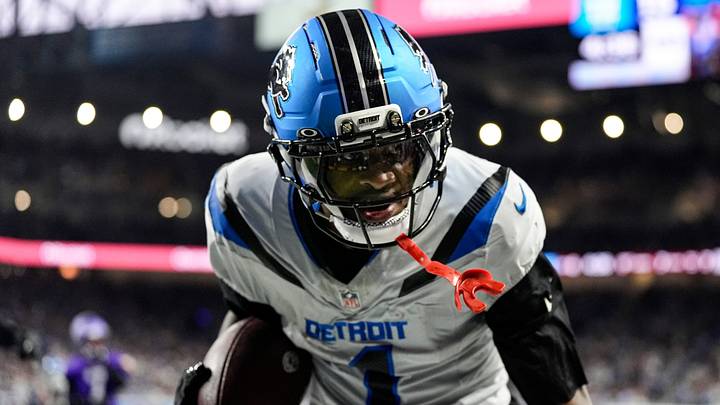
Where Diggs wins with short-area volume, Williams thrives on vertical concepts and stretching the field. Averaging 16.7 yards per reception with an average depth of target north of 16 yards, Williams has generated 165 more receiving yards than Diggs on two fewer catches.

Through eight games, Williams has drawn 46 targets (5.8 per game) and has caught four passes or fewer in six of those eight outings. Because he shares a crowded Detroit passing tree with target hog Amon-Ra St. Brown, tight end Sam LaPorta, and dynamic running back Jahmyr Gibbs, Williams rarely commands the double-digit target volume that insulates elite fantasy receivers from low scoring fantasy performances.
When the deep shots connect, Williams is a week-winner. From Weeks 4 through 8, he posted four straight top-20 PPR finishes, piling up 310 yards and all five of his touchdowns. When defenses take away the explosive play, his floor vanishes. Until Williams consistently earns seven-to-eight targets per game, managers must accept boom-or-bust volatility as the cost of doing business.
The Quarterback Factor: Jayden Daniels vs. Jared Goff
Comparing their quarterbacks highlights the contrast between the scrambling playmaker and a timing-based distributor:

Washington Commanders (Jayden Daniels): Daniels has been efficient through the air in 2026, throwing seven touchdowns without an interception across six starts (97.2 passer rating) while adding 252 rushing yards and two scores on the ground. Daniels' mobility and Washington's willingness to lean on the run, combined with offensive line protection issues, have kept passing volume relatively concentrated. Diggs benefits from Daniels' poise in the red zone and on third downs, yet Washington's offense hasn't consistently produced the high-yardage aerial shootouts needed to elevate Diggs' ceiling.

Detroit Lions (Jared Goff): Goff operates one of the league's most efficient, play-action-heavy passing attacks. While Goff's ball distribution means Williams will occasionally get squeezed out when game scripts turn run-heavy, Detroit's scheme is engineered to create explosive one-on-one opportunities downfield off play-action. Williams doesn't need 12 targets from Goff to return WR2 value. He only needs two or three high-value deep shots per game.
The Verdict: Goff's downfield efficiency and Detroit's ecosystem gives Williams the higher weekly ceiling, whereas Daniels' playmaking sustains Diggs' red-zone relevance.
The Playoff Question: Who Delivers When Championships Are on the Line?
Looking ahead to the standard fantasy postseason (Weeks 15-17), schedule dynamics tilt the scales toward Detroit's explosive playmaker.

Stefon Diggs (WAS): Washington faces the Atlanta Falcons (Week 15) at home before hitting the road for back-to-back games at the Minnesota Vikings (Week 16) and the Jacksonville Jaguars (Week 17). Facing aggressive, blitz-heavy defensive fronts like Minnesota's on the road in December puts heavy pressure on Washingtons' pass protection and short-area timing.

Jameson Williams (DET): Detroit plays at the Minnesota Vikings (Week 15), returns indoors to Ford field against the New York Giants (Week 16), and closes at the Chicago Bears (Week 17). Two of those three contests (Minnesota and Detroit) are played on fast indoor turf, ideal conditions for a receiver whose game is built on vertical speed and yards after the catch.
The Bottom Line
Diggs offers the safer short-term floor for rosters desperate to avoid a zero, kept afloat by veteran savvy and red-zone usage. Over the final stretch of the 2026 season, Williams is the receiver worth betting on. His combination of explosive yardage efficiency, play-action deep shots, and favorable indoor playoff matchups gives him the league-winning upside that Diggs can no longer match.
 Add us as a preferred source on Google

Daniel Outerbridge covers the NBA, NFL, WNBA, and MLB with an emphasis on the numbers behind the game. His work breaks down player performance, team strategy, and emerging statistical trends to provide actionable insights for fans and fantasy players. Outerbridge has written for a myriad of other outlets including Anubis Sports and FanSided.