%22%3E%0A%3Cpath%20d%3D%22M-0.00012207%2027.4428L4.82746%2021.6883C7.76264%2023.9283%2011.1226%2024.8552%2014.2702%2024.8552C15.8923%2024.8552%2016.5875%2024.4303%2016.5875%2023.6965V23.6193C16.5875%2022.8469%2015.7378%2022.4221%2012.8413%2021.8428C6.77781%2020.6069%201.46746%2018.869%201.46746%2013.1724V13.0952C1.46746%207.95862%205.48401%204%2012.9185%204C18.1323%204%2021.975%205.23586%2025.1033%207.70759L20.7006%2013.8097C18.1516%2011.9559%2015.1006%2011.1448%2012.6095%2011.1448C11.2578%2011.1448%2010.6399%2011.6083%2010.6399%2012.2648V12.3421C10.6399%2013.0759%2011.3737%2013.5393%2014.2316%2014.08C21.1447%2015.3545%2025.7599%2017.3628%2025.7599%2022.789V22.8662C25.7599%2028.5434%2021.0868%2032%2013.8454%2032C8.36126%2032%203.43712%2030.4552%20-0.00012207%2027.4428Z%22%20fill%3D%22white%22%2F%3E%0A%3Cpath%20d%3D%22M26.9569%2021.0702V20.9929C26.9569%2014.6978%2031.4755%209.9281%2037.79%209.9281C45.2824%209.9281%2048.739%2015.1419%2048.739%2021.5336C48.739%2021.9971%2048.739%2022.5378%2048.7004%2023.0012H35.1638C35.7817%2024.855%2037.2493%2025.8205%2039.1417%2025.8205C40.7252%2025.8205%2042.0383%2025.0867%2043.4286%2023.6578L48.1404%2027.404C46.0548%2030.1074%2043.081%2031.9998%2038.5431%2031.9998C31.63%2031.9998%2026.9762%2027.6357%2026.9762%2021.0895L26.9569%2021.0702ZM40.7638%2019.1391C40.5707%2017.1309%2039.3735%2015.9722%2037.8286%2015.9722C36.2838%2015.9722%2035.3183%2017.2081%2035.0479%2019.1391H40.7638Z%22%20fill%3D%22white%22%2F%3E%0A%3Cpath%20d%3D%22M50.6707%2010.4298H59.4182V14.678C60.6155%2011.8201%2062.5465%209.9663%2066.0224%2010.1208V19.4091H65.0955C61.3879%2019.4091%2059.4182%2021.456%2059.4182%2026.1291V31.4973H50.6707V10.4298Z%22%20fill%3D%22white%22%2F%3E%0A%3Cpath%20d%3D%22M66.2151%2010.4296H75.3875L78.7861%2020.9923L82.2234%2010.4296H91.2799L82.7447%2031.6516H74.7309L66.2151%2010.4296Z%22%20fill%3D%22white%22%2F%3E%0A%3Cpath%20d%3D%22M90.5847%2021.0702V20.9929C90.5847%2014.6978%2095.1033%209.9281%20101.418%209.9281C108.91%209.9281%20112.367%2015.1419%20112.367%2021.5336C112.367%2021.9971%20112.367%2022.5378%20112.328%2023.0012H98.7916C99.4095%2024.855%20100.877%2025.8205%20102.77%2025.8205C104.353%2025.8205%20105.666%2025.0867%20107.056%2023.6578L111.768%2027.404C109.683%2030.1074%20106.709%2031.9998%20102.171%2031.9998C95.2578%2031.9998%2090.604%2027.6357%2090.604%2021.0895L90.5847%2021.0702ZM104.392%2019.1391C104.199%2017.1309%20103.001%2015.9722%20101.456%2015.9722C99.9116%2015.9722%2098.9461%2017.2081%2098.6757%2019.1391H104.392Z%22%20fill%3D%22white%22%2F%3E%0A%3Cpath%20fill-rule%3D%22evenodd%22%20clip-rule%3D%22evenodd%22%20d%3D%22M122.368%204.36764C128.191%20-1.45588%20137.632%20-1.45588%20143.456%204.36764C149.279%2010.1912%20149.279%2019.6324%20143.456%2025.4559L132.912%2036L122.368%2025.4559C116.544%2019.6324%20116.544%2010.1912%20122.368%204.36764ZM125.009%207.55761C124.948%207.86849%20124.916%208.39718%20124.916%209.14566V10.4189C124.916%2011.1832%20124.948%2011.7198%20125.013%2012.0267C125.078%2012.3317%20125.278%2012.6168%20125.617%2012.8762C125.956%2013.1376%20126.403%2013.3316%20126.958%2013.4623C127.512%2013.593%20128.1%2013.6584%20128.837%2013.6584C129.573%2013.6584%20130.217%2013.591%20130.769%2013.4524C131.322%2013.3158%20131.761%2013.1178%20132.086%2012.8604C132.411%2012.6029%20132.605%2012.3178%20132.666%2012.0069C132.728%2011.6961%20132.759%2011.1674%20132.759%2010.4189V9.14566C132.759%208.38134%20132.728%207.84473%20132.662%207.53781C132.597%207.23287%20132.397%206.94971%20132.058%206.68834C131.72%206.42696%20131.272%206.23291%20130.718%206.10223C130.163%205.97154%20129.536%205.90619%20128.839%205.90619C128.102%205.90619%20127.459%205.97352%20126.906%206.11213C126.352%206.24875%20125.914%206.44677%20125.589%206.70418C125.265%206.9616%20125.071%207.24673%20125.009%207.55761ZM130.276%2024.8638C133.876%2024.8638%20135.557%2024.2064%20135.557%2021.862V21.858V21.3155C135.557%2019.6581%20134.516%2018.971%20131.252%2018.3136C130.278%2018.1136%20129.908%2017.9136%20129.908%2017.3136V16.9414C129.908%2016.6543%20130.177%2016.5117%20130.413%2016.5117C130.749%2016.5117%20130.918%2016.7137%20130.918%2016.9414V18.1136H135.391V17.3988C135.391%2015.4563%20134.347%2014.4266%20130.177%2014.4266C127.15%2014.4266%20124.896%2015.3414%20124.896%2017.3711V17.7433C124.896%2019.5155%20125.805%2020.3155%20129.201%2021.0303C129.28%2021.0472%20129.355%2021.063%20129.427%2021.0781C130.329%2021.2674%20130.647%2021.3341%20130.647%2021.9174V22.2897C130.647%2022.6619%20130.546%2022.8045%20130.142%2022.8045C129.67%2022.8045%20129.637%2022.5471%20129.637%2022.262V21.2897H124.894V21.7471C124.894%2024.149%20126.476%2024.8638%20130.276%2024.8638ZM136.424%2024.5569H140.925V14.7355H136.424V24.5569ZM137.955%2013.5019H140.925V6.06064H138.092V9.411L136.193%206.06064H133.359V13.5019H136.193V10.1199L137.955%2013.5019ZM129.269%2012.152C129.204%2012.2688%20129.055%2012.3262%20128.825%2012.3262L128.827%2012.3282C128.604%2012.3282%20128.459%2012.2767%20128.398%2012.1758C128.336%2012.0748%20128.305%2011.8074%20128.305%2011.3758V7.90068C128.305%207.51852%20128.352%207.28684%20128.445%207.20962C128.538%207.13239%20128.675%207.09279%20128.851%207.09279C129.059%207.09279%20129.198%207.14031%20129.265%207.23734C129.332%207.33239%20129.366%207.55416%20129.366%207.90068V11.3203C129.366%2011.7579%20129.334%2012.0352%20129.269%2012.152Z%22%20fill%3D%22white%22%2F%3E%0A%3C%2Fg%3E%0A%3Cdefs%3E%0A%3CclipPath%20id%3D%22clip0_15160_920%22%3E%0A%3Crect%20width%3D%22148%22%20height%3D%2236%22%20fill%3D%22white%22%2F%3E%0A%3C%2FclipPath%3E%0A%3C%2Fdefs%3E%0A%3C%2Fsvg%3E%0A)
From Match Point Down: Kemit-Amon Lewis' Comeback Story
Fans don’t have to look far into the past for some unforgettable comebacks: Nadal’s comeback from two sets down in the 2022 Australian Open Final; Iga Swiatek fending off three match points against Sabalenka in the 2024 Madrid Open; Alcaraz’s last-ditch effort to beat Jannik Sinner in the 2025 French Open Final, saving three consecutive match points (a first in the Open Era).
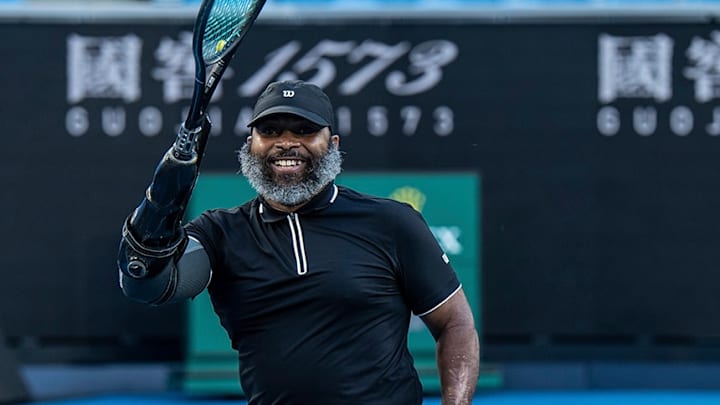
But this comeback story is not like others. This comeback story begins with a man, Kemit-Amon Lewis, waking up in a hospital bed without the limbs he once used to dance, scuba dive, and play this beloved sport of ours. Tennis.
I spoke with Lewis personally to discuss this miraculous comeback; to talk about how tennis has been a process of reclamation in his life and how a moment of individual hardship has become so much more than a hurdle, but an opportunity to pursue something more, something bigger than himself.
Lewis has played tennis his entire life. The first time he picked up a racquet was before he was 10. He played in high school, on Savannah State University’s NCAA Division I team, and on the US Virgin Islands’ Davis Cup Team in 2009. Talking to Lewis, I had flashbacks from my own life as a younger player, practicing with the Malawi national team in Lilongwe on those dusty, red-clay courts.
Before losing his limbs in 2019, Lewis stepped foot on court at least 6-7 times a week. But everything changed overnight.

It was during an evening of celebration that Lewis felt something was amiss. Upon visiting a local clinic in St. Croix, doctors discovered the situation was bad. Really bad. And getting worse. He was immediately taken to an emergency hospital for better care. Lewis was experiencing septic shock, which, in up to half the cases reported, leads to death. As Lewis’s organs shut down, medical staff attempted to get him to a hospital with better resources; otherwise, it was game, set, and match for Lewis.
How could this happen? How could someone so healthy and active become infected with septic shock? Some believe he swam in contaminated waters while scuba diving (Did I forget to mention Lewis is a marine biologist?). No one knows for sure. All that was truly apparent was that Lewis’s life was quickly slipping through his fingers (so to speak).
A hospital in Fort Lauderdale, Florida, agreed to take him. Lewis was flown to Florida unconscious, suffering from multi-system organ failure. He spent the next two weeks in and out of consciousness. Upon waking, Lewis saw the state of his limbs–darkened and shriveled–degenerating right before his eyes. The lack of oxygenated blood to his limbs had caused significant decay. Doctors asked him how he felt about amputation. Lewis considered his future reality. Suffer and survive today. Recover and rally tomorrow. He went through with the amputations.
Doctors cut off his right foot and right hand, and parts of his left foot and left hand.
“The first few months after three days of surgeries were filled with uncertainties,” Lewis explained. “Doctors told me that I would get back to all of the things that I love to do, like tennis, scuba, dance, and that I’d return to my career in the marine sciences, but I wasn’t sure if that would be realized. Not because I didn’t trust in my ability to rebound, I just wasn’t sure that all the tools existed for me to continue to do all the things I love. At the same time, I couldn’t imagine ‘living’ without those things.”

In late 2019, Lewis was discharged from the hospital in Florida nearly two months after falling ill in St. Croix. His rehab journey began right away, even in the midst of a global pandemic. While I was getting fat and letting my hair grow out, Lewis was adjusting to his new life, and the daily mechanics of a body forever changed. He knew it was only a matter of time before his life was back in his own–somewhat different–hands. Getting back to scuba diving, dancing, and tennis was only a matter of time.
Lewis started small. Walking on a new prosthetic leg and doing easy things like playing pickleball (ha!). It wasn’t long before the Hangar Clinic in Florida made a prosthetic that allowed Lewis to hold a paddle and a tennis racquet via a socket system. Lewis began hosting pickleball clinics in South Florida, partnering with Hangar Clinic to introduce those with limb differences to the game. That’s when the big W came a-knocking on his door. Wilson.
The tennis behemoth heard news of Lewis’s journey, and they wanted to help. All thanks to one of Lewis’s friends, Janine, who had helped host a pickleball clinic, noticing his use of both Wilson pickleball paddles and tennis racquets.
Determined that the tennis company and Lewis should be acquainted, Janine helped make the connection. Lewis flew to Chicago to the Wilson headquarters, talked with engineers about his prosthetics, tennis gear, and how the two could work together to enhance his experience on the court. Lewis, like me about a year ago, was made part of the Wilson 360 Advisory Team, and the rest was history.

Beyond expanding Lewis’s tennis outfit, Wilson also helped with other Hangar Clinic pickleball events. Wilson’s support helped grow the clinics from eight people with limb differences to over 40 in the following year.
This was just the beginning.
Since then, Lewis has gone on to compete in Para Standing Tennis tournaments around the world, using tennis as a means of proving to himself and others that not even losing your limbs should stop you from pursuing what you love.
Recently, Lewis competed in the Para Standing Tennis (PST) exhibition during the Australian Open’s All Abilities Day at Margaret Court Arena in Melbourne. Participating in Para Standing Tennis tournaments, as well as becoming a regional lead for North America for the organization, has been a massive turning point (a break-point, if you will) for Lewis.
“Honestly, tennis has become therapeutic in so many ways,” Lewis said. “There’s the whole vibe you get from stepping on the court, constructing points, using geometry to create winners, being active, etc. Additionally, working to build my tennis prosthesis with my prosthetist, connecting with the team at Wilson, competing at international para standing tennis tournaments, and further building my tribe has been so much food for my soul. Tennis is already the healthiest sport in the world. And I guess if 90% of tennis is mental… I’ll gladly give this sport credit for what it has done for my mental health.”

By now you might be wondering: What is Para Standing Tennis?
Otherwise known as adaptive standing tennis, Para Standing Tennis is tennis for adaptive athletes who play without a wheelchair. While adaptive standing tennis dates back as far as the 1930s, its appearance on mainstream channels is just now getting a foot in the door, or, should I say, a prosthetic.
I asked PST President, Nicky Maxwell, a simple question: What does the world need to know about Para Standing Tennis, and what is the ultimate goal of the association?
“Para-Standing Tennis offers a dedicated form of the game for the 90% of people with physical disabilities who do not use a wheelchair,” Maxwell stated. “We are growing fast and are represented in over 50 countries around the world, in part because the sport is so easy for coaches and clubs to implement – we use the same courts, balls, and rackets as mainstream tennis. Our goal is to earn a place alongside wheelchair tennis at the Paralympic Games and Grand Slams, bringing together this remarkable community along the way.”
The PST association has received support from tennis groups around the world, including the ITF, LTA, and the USTA. The organization has garnered much support and, according to its members, it seems like this is just the beginning.
Is Para Standing Tennis different from regular tennis? The short answer: No.

The Para Standing Tennis association plays tennis on a regular, full-sized tennis court and functions through four distinct classifications, PST 1-4. PST classification 1 and 2 use one bounce and are designed for unilateral upper limb amputee athletes (PST 1), and unilateral below-knee amputee and mild cerebral palsy athletes (PST 2).
PST 3 and PST 4, like wheelchair tennis, use two bounces. PST 3 is designed for athletes with above-knee or bilateral below-knee amputations, bilateral arm impairment, or moderate to severe cerebral palsy. PST 4 is designed for short-stature tennis players or other athletes with similar mobility.
“The Para Standing Tennis community is amazing,” Lewis told me. “How beautiful it is that we, of various disabilities, some congenital, others from some wildly traumatic experience, get the opportunity to step on a tennis court together? To not dwell on circumstance, but celebrate the many ways that drive and adaptation allow us to play tennis at a high level. And to extend that beyond the court; rooting for mutual success in every aspect of our lives. I really love the time that I get to spend together with this group of people that I proudly call family. Oh yeah, the tennis!”
With over 100 PST tennis players worldwide, the Para Standing Tennis association hosts exhibitions and PST-sanctioned tournaments year-round. Currently, Lewis ranks World No. 6 for Men’s PST 2, reaching the semifinals of the Oceania 2026 Para Standing Tennis Championships.

As a tennis player myself, I’ve often wondered how I would continue playing tennis if something tragic were to happen to my body. Selfishly, I asked Lewis how his identity has changed since his body was permanently altered.
“I think my identity since has changed slightly, in a good way. I’m still very driven, but near-death experiences definitely put things into perspective. Nothing’s taken for granted these days – every day and every moment is yet another opportunity to do good in the world, to make myself and the people around me smile. Throughout my life, I’ve always given good energy into everything I did and every interaction I had with people, and in 2019, when I needed good energy myself, the floodgates opened for me. So, it’s very important for me now to continue to give good energy and to surround myself with good energy. Oh, [and] I’m about 10% metal/carbon fiber these days!”
The Para Standing Tennis association is built on the idea that tennis is for everyone. As someone who grew up in Malawi, the sixth poorest country in the world in 2025, where I watched players play barefoot on red clay with racquets from the 90s (shoutout Michael Chang), I couldn’t agree more. Tennis can be… exclusive. Particularly for those who want to play at a high level.
Sometimes, it’s hard to believe that tennis is for everyone, especially those who come from underprivileged environments. It’s why I still send tennis racquets and shoes back home to Malawi, so maybe my coaches or some young players could have half a chance at this game I love so much. And it’s why I’ve come to have such great appreciation for the Para Standing Tennis organization. Lewis told me about his role at PST, highlighting what the organization has done in his life thus far.
“Currently, I’m one of the North America Leads for the International Para Standing Tennis Association. In that role, we focus on spreading awareness and streamlining opportunities for engagement in Canada, the United States, and the Caribbean. We are currently mapping where PST programs exist, supporting local PST tournaments, and continue to explore innovative ways to shine a spotlight on PST; all towards increasing participation. Para Standing Tennis has given a lot to me as I reflect on the opportunities that have been afforded and the family that I’ve been able to build.”

So, what is Lewis up to these days besides travelling the world and hitting tennis balls? His life, according to him, is pretty “normal.” In a McEnroe-esque way, I want to ask him: You cannot be serious!?
But he is serious… He still works in the marine sciences with the National Oceanic and Atmospheric Administration, he dances, spends precious time with his dog, T’Challa, and–of course–he plays tennis any chance he gets. He was recently brought into the High Performance Program at the Junior Tennis Champions Center (JTCC) in College Park, Maryland (home of Frances Tiafoe).
“As a player, I focus on enjoying the competition. It’s crazy to think that if I hadn’t made it through 2019, I wouldn’t have known that PST existed. And while I’ve heard ‘inspiration’ many, many times, I often view my life as normal. Navigating my life now, to me, has become my new normal. What’s the alternative?
Crossword puzzles were never my thing and the world is such an amazing place to explore. There are challenges, yes, but everyone has their own challenges, and what makes life beautiful is that we have opportunities, we create opportunities to not allow challenges to hold us back.”
I will never regret growing up in Malawi, but I will never forget those disheartening mornings and afternoons wishing I had shoes without holes, better racquets, and more opportunities to pursue tennis. Making tennis more accessible to those who may never get the chance to play this beautiful game is something I am extremely passionate about; that considering, what the Para Standing Tennis organization is doing is very important work.
I asked Adam Hills–PST board member, broadcaster, comedian, and tennis player–what he would say about Para Standing Tennis if he only had a few sentences to say anything at all. “The introduction of Para Standing Tennis means that tennis is now one of the most accessible sports on the planet,” Hills said.
“I was born without a right foot and have played tennis all my life, but have never used a wheelchair. Now I can play against people like me - on a level playing field. What we need the most is for more people to know about Para Standing Tennis. Around the world, there are thousands of people with disabilities who either thought tennis wasn’t accessible for them or who have only ever played against able-bodied people. They need to know that there’s a way into the sport if they’re just beginning, and that there’s a quality competition if they’re more experienced. On top of all that, there’s a brilliant, vibrant, global community, ready to welcome them aboard.”

Recently, the International Para Standing Tennis Association (IPSTA) announced that the 2026 IPSTA World Championships will be hosted in Torino, Italy, from June 18–21. The prestigious event will feature over 100 PST tennis players and will be held at the Monviso Sporting Club. The event is not just an opportunity for adaptive athletes to compete, but a moment to spread awareness of the sport in the area and around the world. And yes, Lewis will be there.
Special thanks to Kemit-Amon Lewis for taking the time to speak with me, and to PST board members Nicky Maxwell and Adam Hills for taking the time to answer me via email.
Stay locked into Sports Illustrated's Serve On SI for all of your tennis news from the court and beyond.
 Add us as a preferred source on Google
Samuel Spencer is a multimedia journalist based out of Tampa, Florida. In addition to tennis coverage at Serve ON SI, Spencer is an avid player and former coach. He loves tennis, traveling, and literature. You can reach him at samuellspencer1024@gmail.com.