%22%3E%0A%3Cpath%20d%3D%22M-0.00012207%2027.4428L4.82746%2021.6883C7.76264%2023.9283%2011.1226%2024.8552%2014.2702%2024.8552C15.8923%2024.8552%2016.5875%2024.4303%2016.5875%2023.6965V23.6193C16.5875%2022.8469%2015.7378%2022.4221%2012.8413%2021.8428C6.77781%2020.6069%201.46746%2018.869%201.46746%2013.1724V13.0952C1.46746%207.95862%205.48401%204%2012.9185%204C18.1323%204%2021.975%205.23586%2025.1033%207.70759L20.7006%2013.8097C18.1516%2011.9559%2015.1006%2011.1448%2012.6095%2011.1448C11.2578%2011.1448%2010.6399%2011.6083%2010.6399%2012.2648V12.3421C10.6399%2013.0759%2011.3737%2013.5393%2014.2316%2014.08C21.1447%2015.3545%2025.7599%2017.3628%2025.7599%2022.789V22.8662C25.7599%2028.5434%2021.0868%2032%2013.8454%2032C8.36126%2032%203.43712%2030.4552%20-0.00012207%2027.4428Z%22%20fill%3D%22white%22%2F%3E%0A%3Cpath%20d%3D%22M26.9569%2021.0702V20.9929C26.9569%2014.6978%2031.4755%209.9281%2037.79%209.9281C45.2824%209.9281%2048.739%2015.1419%2048.739%2021.5336C48.739%2021.9971%2048.739%2022.5378%2048.7004%2023.0012H35.1638C35.7817%2024.855%2037.2493%2025.8205%2039.1417%2025.8205C40.7252%2025.8205%2042.0383%2025.0867%2043.4286%2023.6578L48.1404%2027.404C46.0548%2030.1074%2043.081%2031.9998%2038.5431%2031.9998C31.63%2031.9998%2026.9762%2027.6357%2026.9762%2021.0895L26.9569%2021.0702ZM40.7638%2019.1391C40.5707%2017.1309%2039.3735%2015.9722%2037.8286%2015.9722C36.2838%2015.9722%2035.3183%2017.2081%2035.0479%2019.1391H40.7638Z%22%20fill%3D%22white%22%2F%3E%0A%3Cpath%20d%3D%22M50.6707%2010.4298H59.4182V14.678C60.6155%2011.8201%2062.5465%209.9663%2066.0224%2010.1208V19.4091H65.0955C61.3879%2019.4091%2059.4182%2021.456%2059.4182%2026.1291V31.4973H50.6707V10.4298Z%22%20fill%3D%22white%22%2F%3E%0A%3Cpath%20d%3D%22M66.2151%2010.4296H75.3875L78.7861%2020.9923L82.2234%2010.4296H91.2799L82.7447%2031.6516H74.7309L66.2151%2010.4296Z%22%20fill%3D%22white%22%2F%3E%0A%3Cpath%20d%3D%22M90.5847%2021.0702V20.9929C90.5847%2014.6978%2095.1033%209.9281%20101.418%209.9281C108.91%209.9281%20112.367%2015.1419%20112.367%2021.5336C112.367%2021.9971%20112.367%2022.5378%20112.328%2023.0012H98.7916C99.4095%2024.855%20100.877%2025.8205%20102.77%2025.8205C104.353%2025.8205%20105.666%2025.0867%20107.056%2023.6578L111.768%2027.404C109.683%2030.1074%20106.709%2031.9998%20102.171%2031.9998C95.2578%2031.9998%2090.604%2027.6357%2090.604%2021.0895L90.5847%2021.0702ZM104.392%2019.1391C104.199%2017.1309%20103.001%2015.9722%20101.456%2015.9722C99.9116%2015.9722%2098.9461%2017.2081%2098.6757%2019.1391H104.392Z%22%20fill%3D%22white%22%2F%3E%0A%3Cpath%20fill-rule%3D%22evenodd%22%20clip-rule%3D%22evenodd%22%20d%3D%22M122.368%204.36764C128.191%20-1.45588%20137.632%20-1.45588%20143.456%204.36764C149.279%2010.1912%20149.279%2019.6324%20143.456%2025.4559L132.912%2036L122.368%2025.4559C116.544%2019.6324%20116.544%2010.1912%20122.368%204.36764ZM125.009%207.55761C124.948%207.86849%20124.916%208.39718%20124.916%209.14566V10.4189C124.916%2011.1832%20124.948%2011.7198%20125.013%2012.0267C125.078%2012.3317%20125.278%2012.6168%20125.617%2012.8762C125.956%2013.1376%20126.403%2013.3316%20126.958%2013.4623C127.512%2013.593%20128.1%2013.6584%20128.837%2013.6584C129.573%2013.6584%20130.217%2013.591%20130.769%2013.4524C131.322%2013.3158%20131.761%2013.1178%20132.086%2012.8604C132.411%2012.6029%20132.605%2012.3178%20132.666%2012.0069C132.728%2011.6961%20132.759%2011.1674%20132.759%2010.4189V9.14566C132.759%208.38134%20132.728%207.84473%20132.662%207.53781C132.597%207.23287%20132.397%206.94971%20132.058%206.68834C131.72%206.42696%20131.272%206.23291%20130.718%206.10223C130.163%205.97154%20129.536%205.90619%20128.839%205.90619C128.102%205.90619%20127.459%205.97352%20126.906%206.11213C126.352%206.24875%20125.914%206.44677%20125.589%206.70418C125.265%206.9616%20125.071%207.24673%20125.009%207.55761ZM130.276%2024.8638C133.876%2024.8638%20135.557%2024.2064%20135.557%2021.862V21.858V21.3155C135.557%2019.6581%20134.516%2018.971%20131.252%2018.3136C130.278%2018.1136%20129.908%2017.9136%20129.908%2017.3136V16.9414C129.908%2016.6543%20130.177%2016.5117%20130.413%2016.5117C130.749%2016.5117%20130.918%2016.7137%20130.918%2016.9414V18.1136H135.391V17.3988C135.391%2015.4563%20134.347%2014.4266%20130.177%2014.4266C127.15%2014.4266%20124.896%2015.3414%20124.896%2017.3711V17.7433C124.896%2019.5155%20125.805%2020.3155%20129.201%2021.0303C129.28%2021.0472%20129.355%2021.063%20129.427%2021.0781C130.329%2021.2674%20130.647%2021.3341%20130.647%2021.9174V22.2897C130.647%2022.6619%20130.546%2022.8045%20130.142%2022.8045C129.67%2022.8045%20129.637%2022.5471%20129.637%2022.262V21.2897H124.894V21.7471C124.894%2024.149%20126.476%2024.8638%20130.276%2024.8638ZM136.424%2024.5569H140.925V14.7355H136.424V24.5569ZM137.955%2013.5019H140.925V6.06064H138.092V9.411L136.193%206.06064H133.359V13.5019H136.193V10.1199L137.955%2013.5019ZM129.269%2012.152C129.204%2012.2688%20129.055%2012.3262%20128.825%2012.3262L128.827%2012.3282C128.604%2012.3282%20128.459%2012.2767%20128.398%2012.1758C128.336%2012.0748%20128.305%2011.8074%20128.305%2011.3758V7.90068C128.305%207.51852%20128.352%207.28684%20128.445%207.20962C128.538%207.13239%20128.675%207.09279%20128.851%207.09279C129.059%207.09279%20129.198%207.14031%20129.265%207.23734C129.332%207.33239%20129.366%207.55416%20129.366%207.90068V11.3203C129.366%2011.7579%20129.334%2012.0352%20129.269%2012.152Z%22%20fill%3D%22white%22%2F%3E%0A%3C%2Fg%3E%0A%3Cdefs%3E%0A%3CclipPath%20id%3D%22clip0_15160_920%22%3E%0A%3Crect%20width%3D%22148%22%20height%3D%2236%22%20fill%3D%22white%22%2F%3E%0A%3C%2FclipPath%3E%0A%3C%2Fdefs%3E%0A%3C%2Fsvg%3E%0A)
Jason Stacy on Sabalenka, Success and Avoiding Emotional Meltdown
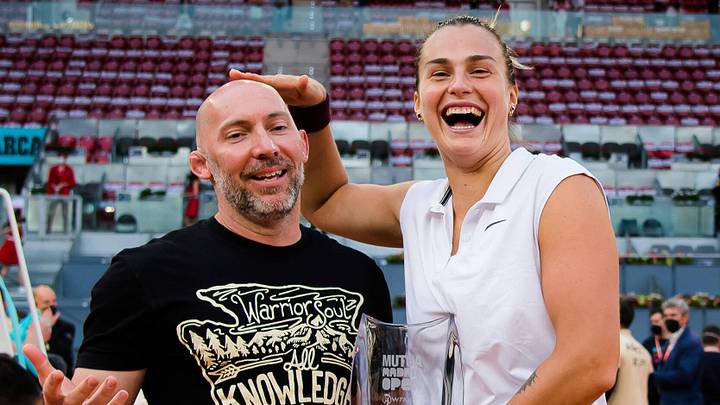
In hindsight, the fact that this video interview began with a painfully prolonged bout of Wi-Fi issues on my end now feels strangely appropriate. Jason Stacy, world-renowned high-performance coach and integral member of Aryna Sabalenka's staff, has built a large part of his distinguished career around how to maintain mental and emotional equanimity in the face of acute stress.
"I always start with breathing," Stacy tells me once a stable internet connection has mercifully been established. "Breath is emotional control. How you're breathing is giving information to your nervous system and your brain as to what's going on."
Sage advice that would have served me well about ten minutes prior, as yet another false start triggered an accompanying spike of anxiety.

Despite the stuttering start to our interview, Stacy remained calm, polite, and almost reassuring throughout, as the call eventually stabilized. It makes sense that he would possess these attributes, having served as the fitness coach for the WTA's World No. 1 for around eight years now - one of the highest-profile and most demanding gigs in the sport.
During this time, Stacy has helped oversee Sabalenka's stunning transformation from a player plagued by well-documented service woes - those so severe they nearly led to her quitting tennis - into one of the finest players of her generation.
From Brink of Quitting to World No. 1

It was in 2022 that the collapse of her serve brought Sabalenka to the brink of walking away, as she revealed in early 2025. After infamously hitting 39 double-faults across just two matches in Adelaide four-and-a-half years ago, she was reduced to tears on court and even resorted to hitting underarm serves in an attempt to land some form of consistent delivery.
But, while certainly at the lowest ebb of her career thus far, how close did Sabalenka actually come to leaving the sport? Was this something that was genuinely being considered, or was it more just an expression of extreme exasperation?
"It was more that she was just spiralling downward," Stacy reveals. "She was a little bit lost, and didn't have the answer to exactly what was happening and how to get it back. She was afraid of losing everything, and afraid that she would never be able to play again at the level she knew she was capable of reaching.
"So, it was a lot of fear. Partly because she just didn't have control of something, and she didn't understand why it was happening. She had all these thoughts in her head, specifically regarding the serve. For example, is it my toss? Is it my arm? Is it my hip? Is it my leg?
"It was essentially a technical issue that became a mental issue. She didn't know what to do. She had this lack of a sense of control. And that lack of control created a higher level of stress, and it just got worse and worse.
"It wasn't her really deciding to quit. It was more that I said to her, 'we're either doing this, or we're stopping. What's the point of this, what are we going to do?'" This fork-in-the-road moment proved to be the nadir of a career that has since tracked sharply upward to the stratospheric levels of dominance Sabalenka now enjoys.

With the help of biomechanics expert Gavin MacMillan, the Belarusian completely took apart and reconstructed her service motion from scratch. It was a technical necessity that wouldn't have worked without Sabalenka also addressing the mental and emotional doubts that had seeped into the cracks of her service fragilities.
For Stacy, Sabalenka rediscovering the confidence in her delivery was as vital as the technical improvements themselves, both of which were vital to the now-World No. 1's renaissance. "I would say they are equal for different reasons," Stacy explains.
"You can have people with very good technique and skill, but that doesn't make them champions. And there are a lot of people with great mindsets, attitudes, and work ethics, but they too don't become champions. I think in that moment with Sabalenka, it was a technical issue that became so deep that it also became a mental weight holding her back.
"Once we got the bio-mechanic in there, we saw such a quick turnaround. We were just missing that one piece of the puzzle, but it was a very important piece. Once we had that piece, we started getting results straight away."
WTA Dominance, but do Mental Fragilities Remain?

These results, over the course of the past four years, have been nothing short of astonishing. Across this period, Sabalenka has redrawn the map in women's tennis, claiming four Grand Slam titles en route to displacing the seemingly irrepressible Iga Swiatek at the summit of the sport and embedding herself as the dominant force on the WTA.
Yet, for all the well-deserved accolades, titles, and a world-leading status, Sabalenka's success in recent years has also been defined by a series of near misses and painful collapses in the latter stages of Grand Slams, most recently in a jaw-dropping implosion to Diana Shnaider in the last eight of the French Open, having served for the match at a set and a break up.
Crucially, this has become a recurring theme at Wimbledon and Roland-Garros, the remaining two majors she is yet to win. Is the pressure of securing these missing trophies - away from the comforts of her favoured hard courts - manifesting its own mental burden on the World No. 1?
"That's hard to say," is Stacy's initial response to this question. "She's been in the final of the French, won titles on clay, so it's not an impossible thing. I would say that it's there a little bit (the pressure of not yet having won these titles), but nothing that would have a big impact on her losing in those moments.
"I think it's also a good reminder that she is human. It's just that some of the losses, it was more about the way she lost. But again, that just gives us information. What we saw last year at the French Open was the same Aryna we used to see on a regular basis years ago. That's who she was. Her emotions would get control of her.
"We've grown since then and learned how to manage this better and better. So now it happens rarely, but we know it can still happen. So it's just more information; we know that there is a deeper layer that hasn't yet fully developed and grown. It's still there."

In the aftermath of that chastening defeat in Paris, a lot of noise was made about Sabalenka's comment in her post-match press conference that she felt "like quitting tennis." It is the second time the Belarusian has made a public statement about her desire to leave the sport.
Yet, did such an off-the-cuff comment really merit the level of shock and scrutiny that much of the press and social media dwellers gave oxygen to?
"I mean, we hadn't spoken. None of us in the team had spoken to her before that moment. She probably should have taken a little bit more time just to kind of settle down a little bit before she went out there.
"But the fact is, you know, it's Aryna. You're always going to know where she stands. She's not going to go out there and give you some media-rehearsed tagline.
"She told you how she was feeling, and like anybody else, if you just had like just a really, really terrible moment in front of so many people and you're just humiliated, you're frustrated, you're angry, you're embarrassed. And then right after, when someone's like, 'hey, tell me what you're feeling', you know? She's authentic."
Energy, Emotions and Environment - Jason Stacy's Three E's

Alongside the considerable demands of coaching a World No. 1, Stacy has still found time to write his own book. In The Pressure Code, Stacy provides his expertise on how to build internal systems in professional athletes strong enough to withstand the greatest of sporting pressures.
Due for general release on September 8 this year, right in the thick of the season's final Grand Slam in New York, The Pressure Code details the 'three E's' of performance that drive every outcome - energy, emotions and environment.
"People think, you know, in this high-performance world, that emotions get the best of you, or emotions are bad. It's like, you're supposed to show up and be stoic and tough, and just grind through," Stacy explains, visibly enthused to return to a topic of which he is evidently a leading authority.
"There's a time and place for that. But the reality is that emotions are not your enemy. It's just information. What you need to need to learn how to do is how to how to interpret that information. And then figure out well, how and why are you filtering this information the way you are? And then just work through that.
"The difficult part is having the discipline to do it when you're right in the middle of it. Take that breath, take a step back, take a big breath for a second, right? Try to relax your shoulders a little bit and kind of name what's happening.
"Like what you did with the WiFi issues, you tried a couple different options, those didn't work. And so you're like, you know what? I'm gonna change my environment. Cause the environment was the issue. So you relocated, changed your environment. You took control of that part because that was an element that you could control."
At risk of betraying my sense of pride in having successfully implemented some of Jason Stacy's core methods for overcoming stressful scenarios, I decide to circle back to Sabalenka to conclude what had been a thoroughly engaging and enjoyable discussion.
Already established as one of the best players of her generation, how far can Sabalenka go towards becoming an all-time great, in Stacy's opinion? Interestingly, there's a thoughtful pause before he responds.

"I mean, she has all those things, the things that you can teach and train. But she also has those 'x factors' that you don't find in everybody. If you're comparing to Serena, for example, or players with 20-plus Slams... I think that'll be tricky. I have trouble answering this question in some ways because she's already done a lot to solidify her name and write herself into the history books.
"It's more about that bigger picture, the family name, and the legacy. How do you want to be remembered, and who you are, not so much how many trophies you got."
It is refreshing to hear a coach of such prominence talk about the greater importance of the holistic impact a player has had, rather than reach for the conventional metric of Grand Slam titles and trophies (of which, it should be noted, Sabalenka is already on a wildly successful trajectory).
It chimes well with Stacy's overarching message that emotional turbulence and challenging setbacks merely serve as vital information for self-improvement. To that end, Sabalenka's legacy - and, to a large degree, Stacy's too - has already been secured, regardless of the future Grand Slam triumphs and failures that are destined to come.
"She has a beautiful story," as Stacy puts it. "You know, people are always going to remember her."
 Add us as a preferred source on Google
Jamie Malachy is a freelance tennis journalist, aiming to provide a unique, nuanced and informative analysis of the sport he loves. He has been documenting tennis since 2019, and writing professionally since 2023. Working in collaboration with Tennis Majors and numerous other sports news outlets, personal highlights include covering six Grand Slam singles finals and the 2024 Paris Olympic Games. You can reach him at: jamiemalachy@gmail.com
Follow JamieMalachy