%22%3E%0A%3Cpath%20d%3D%22M-0.00012207%2027.4428L4.82746%2021.6883C7.76264%2023.9283%2011.1226%2024.8552%2014.2702%2024.8552C15.8923%2024.8552%2016.5875%2024.4303%2016.5875%2023.6965V23.6193C16.5875%2022.8469%2015.7378%2022.4221%2012.8413%2021.8428C6.77781%2020.6069%201.46746%2018.869%201.46746%2013.1724V13.0952C1.46746%207.95862%205.48401%204%2012.9185%204C18.1323%204%2021.975%205.23586%2025.1033%207.70759L20.7006%2013.8097C18.1516%2011.9559%2015.1006%2011.1448%2012.6095%2011.1448C11.2578%2011.1448%2010.6399%2011.6083%2010.6399%2012.2648V12.3421C10.6399%2013.0759%2011.3737%2013.5393%2014.2316%2014.08C21.1447%2015.3545%2025.7599%2017.3628%2025.7599%2022.789V22.8662C25.7599%2028.5434%2021.0868%2032%2013.8454%2032C8.36126%2032%203.43712%2030.4552%20-0.00012207%2027.4428Z%22%20fill%3D%22white%22%2F%3E%0A%3Cpath%20d%3D%22M26.9569%2021.0702V20.9929C26.9569%2014.6978%2031.4755%209.9281%2037.79%209.9281C45.2824%209.9281%2048.739%2015.1419%2048.739%2021.5336C48.739%2021.9971%2048.739%2022.5378%2048.7004%2023.0012H35.1638C35.7817%2024.855%2037.2493%2025.8205%2039.1417%2025.8205C40.7252%2025.8205%2042.0383%2025.0867%2043.4286%2023.6578L48.1404%2027.404C46.0548%2030.1074%2043.081%2031.9998%2038.5431%2031.9998C31.63%2031.9998%2026.9762%2027.6357%2026.9762%2021.0895L26.9569%2021.0702ZM40.7638%2019.1391C40.5707%2017.1309%2039.3735%2015.9722%2037.8286%2015.9722C36.2838%2015.9722%2035.3183%2017.2081%2035.0479%2019.1391H40.7638Z%22%20fill%3D%22white%22%2F%3E%0A%3Cpath%20d%3D%22M50.6707%2010.4298H59.4182V14.678C60.6155%2011.8201%2062.5465%209.9663%2066.0224%2010.1208V19.4091H65.0955C61.3879%2019.4091%2059.4182%2021.456%2059.4182%2026.1291V31.4973H50.6707V10.4298Z%22%20fill%3D%22white%22%2F%3E%0A%3Cpath%20d%3D%22M66.2151%2010.4296H75.3875L78.7861%2020.9923L82.2234%2010.4296H91.2799L82.7447%2031.6516H74.7309L66.2151%2010.4296Z%22%20fill%3D%22white%22%2F%3E%0A%3Cpath%20d%3D%22M90.5847%2021.0702V20.9929C90.5847%2014.6978%2095.1033%209.9281%20101.418%209.9281C108.91%209.9281%20112.367%2015.1419%20112.367%2021.5336C112.367%2021.9971%20112.367%2022.5378%20112.328%2023.0012H98.7916C99.4095%2024.855%20100.877%2025.8205%20102.77%2025.8205C104.353%2025.8205%20105.666%2025.0867%20107.056%2023.6578L111.768%2027.404C109.683%2030.1074%20106.709%2031.9998%20102.171%2031.9998C95.2578%2031.9998%2090.604%2027.6357%2090.604%2021.0895L90.5847%2021.0702ZM104.392%2019.1391C104.199%2017.1309%20103.001%2015.9722%20101.456%2015.9722C99.9116%2015.9722%2098.9461%2017.2081%2098.6757%2019.1391H104.392Z%22%20fill%3D%22white%22%2F%3E%0A%3Cpath%20fill-rule%3D%22evenodd%22%20clip-rule%3D%22evenodd%22%20d%3D%22M122.368%204.36764C128.191%20-1.45588%20137.632%20-1.45588%20143.456%204.36764C149.279%2010.1912%20149.279%2019.6324%20143.456%2025.4559L132.912%2036L122.368%2025.4559C116.544%2019.6324%20116.544%2010.1912%20122.368%204.36764ZM125.009%207.55761C124.948%207.86849%20124.916%208.39718%20124.916%209.14566V10.4189C124.916%2011.1832%20124.948%2011.7198%20125.013%2012.0267C125.078%2012.3317%20125.278%2012.6168%20125.617%2012.8762C125.956%2013.1376%20126.403%2013.3316%20126.958%2013.4623C127.512%2013.593%20128.1%2013.6584%20128.837%2013.6584C129.573%2013.6584%20130.217%2013.591%20130.769%2013.4524C131.322%2013.3158%20131.761%2013.1178%20132.086%2012.8604C132.411%2012.6029%20132.605%2012.3178%20132.666%2012.0069C132.728%2011.6961%20132.759%2011.1674%20132.759%2010.4189V9.14566C132.759%208.38134%20132.728%207.84473%20132.662%207.53781C132.597%207.23287%20132.397%206.94971%20132.058%206.68834C131.72%206.42696%20131.272%206.23291%20130.718%206.10223C130.163%205.97154%20129.536%205.90619%20128.839%205.90619C128.102%205.90619%20127.459%205.97352%20126.906%206.11213C126.352%206.24875%20125.914%206.44677%20125.589%206.70418C125.265%206.9616%20125.071%207.24673%20125.009%207.55761ZM130.276%2024.8638C133.876%2024.8638%20135.557%2024.2064%20135.557%2021.862V21.858V21.3155C135.557%2019.6581%20134.516%2018.971%20131.252%2018.3136C130.278%2018.1136%20129.908%2017.9136%20129.908%2017.3136V16.9414C129.908%2016.6543%20130.177%2016.5117%20130.413%2016.5117C130.749%2016.5117%20130.918%2016.7137%20130.918%2016.9414V18.1136H135.391V17.3988C135.391%2015.4563%20134.347%2014.4266%20130.177%2014.4266C127.15%2014.4266%20124.896%2015.3414%20124.896%2017.3711V17.7433C124.896%2019.5155%20125.805%2020.3155%20129.201%2021.0303C129.28%2021.0472%20129.355%2021.063%20129.427%2021.0781C130.329%2021.2674%20130.647%2021.3341%20130.647%2021.9174V22.2897C130.647%2022.6619%20130.546%2022.8045%20130.142%2022.8045C129.67%2022.8045%20129.637%2022.5471%20129.637%2022.262V21.2897H124.894V21.7471C124.894%2024.149%20126.476%2024.8638%20130.276%2024.8638ZM136.424%2024.5569H140.925V14.7355H136.424V24.5569ZM137.955%2013.5019H140.925V6.06064H138.092V9.411L136.193%206.06064H133.359V13.5019H136.193V10.1199L137.955%2013.5019ZM129.269%2012.152C129.204%2012.2688%20129.055%2012.3262%20128.825%2012.3262L128.827%2012.3282C128.604%2012.3282%20128.459%2012.2767%20128.398%2012.1758C128.336%2012.0748%20128.305%2011.8074%20128.305%2011.3758V7.90068C128.305%207.51852%20128.352%207.28684%20128.445%207.20962C128.538%207.13239%20128.675%207.09279%20128.851%207.09279C129.059%207.09279%20129.198%207.14031%20129.265%207.23734C129.332%207.33239%20129.366%207.55416%20129.366%207.90068V11.3203C129.366%2011.7579%20129.334%2012.0352%20129.269%2012.152Z%22%20fill%3D%22white%22%2F%3E%0A%3C%2Fg%3E%0A%3Cdefs%3E%0A%3CclipPath%20id%3D%22clip0_15160_920%22%3E%0A%3Crect%20width%3D%22148%22%20height%3D%2236%22%20fill%3D%22white%22%2F%3E%0A%3C%2FclipPath%3E%0A%3C%2Fdefs%3E%0A%3C%2Fsvg%3E%0A)
Sinner and Alcaraz Struggles Bring Men's Tennis to Crossroads
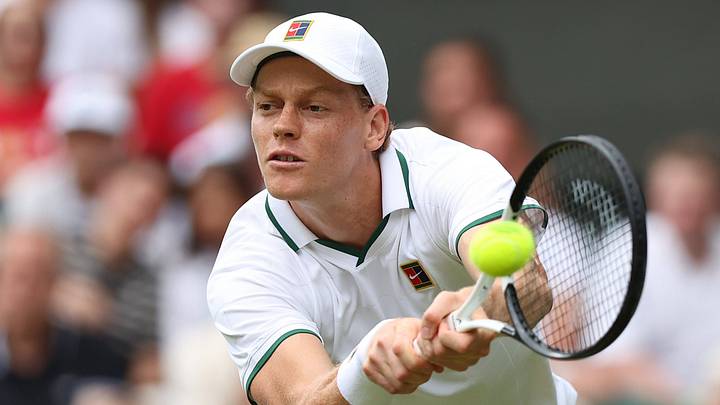
Men's tennis has arrived at a unique juncture.
For the first time since establishing themselves as the dominant pair at the top of the sport, the seemingly infallible Jannik Sinner and Carlos Alcaraz have both had substantial vulnerabilities exposed to the rest of the field.
Such has been their relentless supremacy over the past two-and-a-half years, one of the most common grievances against tennis during this time has been the predictability that this duopoly created.
Prior to this year's French Open, the pair had swept the past nine Grand Slam titles between them, while opening up a yawning chasm in ranking points between themselves and the rest of the ladder. So much so, that the battle for the year-end No. 1 spot has also been a mere two-horse race for the past couple of seasons.

The usual hyperbolic comparisons to the 'Big Three' era of Roger Federer, Rafael Nadal, and Novak Djokovic were, in this case, perfectly justified. Aside from the astonishing numbers the two have been posting in terms of titles and ranking points, both Sinner and Alcaraz have exhibited their own breathtaking brands of tennis, the likes of which have been rivalled only by those three titans of tennis' previous chapter.
Few followers of the sport honestly believed any of this stood much chance of changing across 2026. Yet recent events have altered the complexion of this dynamic considerably.
Before proceeding, it feels necessary at this point to clarify that nothing about Sinner or Alcaraz's quality has been altered. Further to this, the potential height their careers can reach remains stratospheric, and they still hold the favourites tag in any draw they currently appear in.
However, the fundamental question that has been posed ahead of every major tournament over the past 30 months - essentially, who or what could possibly halt the irrepressible advance of these two young men - now, for the first time, has an answer. In each player's case, it is a question of physicality.
Alcaraz and Sinner Have Physical Challenges Exposed

Let's start with Alcaraz. There was no one within the tennis world who didn't wince sharply at the recent news that the Spaniard was to miss this year's Roland-Garros due to a right-wrist injury sustained in Barcelona during the clay-court swing.
But, perhaps out of denial more than anything else, most would have quietly hoped or assumed that he would be back to launch his bid for a third Wimbledon title once the grass-court stretch came around.
That, desperately sadly, never transpired. Wrist injuries are notoriously troublesome for tennis players, and memories of the drastic demise of Dominic Thiem's career due to a persistent right-wrist issue will be cause for concern within Alcaraz's entourage.
There is no evidence at all that he won't make a full and complete recovery, and it remains entirely possible that he will. Yet there is another troubling caveat to the Spaniard's predicament.
The unique, rapid whip that Alcaraz uses to generate pace, spin and power on his forehand has widely been cited as a likely cause or exacerbation of his injury. As well as the problematic nature of the injury itself, it also seems highly plausible that Alcaraz may need to restructure the technique on his forehand in order to avoid this issue becoming chronic.

As for Sinner, he is thankfully currently fighting fit and healthy. Yet, his Achilles heel has been uncovered over the past six months. Namely, a susceptibility to extreme heat.
At the Australian Open at the start of the season, the World No. 1 was hugely fortunate to avoid crashing out in the third round to Eliot Spizzirri, as debilitating body cramps looked set to condemn him to an early exit in Melbourne. Only the closure of the roof on Rod Laver Arena, due to the tournament's heat rules being implemented as the temperature crept close to 40 °C, saved him from complete physical collapse.
Five months later, however, this issue eventually caught up with him, decimating the Italian physically as he crashed out to Juan Manuel Cerundolo in the second round of Roland-Garros - one of the biggest Grand Slam upsets in recent years.
For a sport that largely chases the summer months across the globe during the outdoor seasons, and at a time when extended bouts of extreme heat are becoming alarmingly commonplace in the face of an ongoing global climate crisis, this is a problem for Sinner of comparative significance to that of a recurring injury or underlying health condition.
In short, unless a solution can be found, it seems unlikely that Roland-Garros will be the last time a Grand Slam campaign is derailed for Sinner in this way.
New Opportunites Open Up, But Context is Key

The opportunities this opens up are self-evident, as was seen in Paris this year. Across the fortnight, a litany of exciting names, considered leading candidates to one day challenge the 'Sincaraz' stranglehold, made deep runs in the French capital.
Rafael Jodar, Joao Fonseca and Jakub Mensik all lived up to their early promise at a major for the first time, with only eventual champion Alexander Zverev able to halt Jodar and then Mensik's run in the last eight and semi-finals, respectively.
Meanwhile, Fonseca and Mensik played out a seminal quarter-final of their own, one that didn't feel far below some of Sinner and Alcaraz's electric early encounters.
In order to avoid the risk of overstating any perceived threat to Sinner and Alcaraz's ability to dominate the sport for years to come, however, perhaps some past context could be helpful here.
Between Djokovic's first and second Grand Slam triumphs - both in Australia - came three years of recurrent and extremely hampering physical issues. These frequently led to him breaking down across five-set matches, regularly withdrawing mid-match due to problems such as dizziness, fatigue and breathing difficulties.
Djokovic was able to solve this problem, with the malaise eventually diagnosed as a gluten intolerance, which led the 24-time Grand Slam champion to transform his diet. The rest, of course, is history, with perhaps yet more to be written.
Nadal, meanwhile, endured a catalogue of seemingly constant and recurring injuries, affecting his knees, elbow, forearm, as well as most infamously struggling with Mueller-Weiss syndrome, a degenerative foot condition that plagued the Spaniard throughout his entire career.
The lesson here is, if the passion and desire are bright enough, the talent and work ethic strong enough, then physical struggles can not only be overcome, but actively utilised as a defining hallmark of a player's legacy.

Based on the current evidence, one would have to back both Sinner and Alcaraz in all these areas. Indeed, the Italian - despite a stuttering start to his Wimbledon defence this week - is surely still a strong favourite to land the title in SW19.
Likewise, few in the field will wish to encounter Alcaraz on the Spaniard's return, the prospect of his exuberant energy unleashed once again after several months of being boxed in on the sidelines a truly intimidating one.
Neither of these two generational talents are going anywhere. Yet, with vulnerabilities evident, can the moment be seized by that aspiring contingent looking to crash this duopoly?
Recent chinks to have emerged in the leading pair's previously unbreachable armoury brings men's tennis to an interesting fork in the road.
One path over the following weeks and months leads to more open parity at the summit of the sport, while the other would see the reestablishment of a two-man domination. And this year's Wimbledon Championships could well provide the first fascinating inflexion point.
 Add us as a preferred source on Google
Jamie Malachy is a freelance tennis journalist, aiming to provide a unique, nuanced and informative analysis of the sport he loves. He has been documenting tennis since 2019, and writing professionally since 2023. Working in collaboration with Tennis Majors and numerous other sports news outlets, personal highlights include covering six Grand Slam singles finals and the 2024 Paris Olympic Games. You can reach him at: jamiemalachy@gmail.com
Follow JamieMalachy