
Will Prices Crash? A 2026 Vintage Card Preview
In this story:
Decades ago, parents across America routinely threw away their sons’ baseball card collections. No one imagined that pieces of cardboard with pictures of baseball players would one day carry so much financial value. Those mothers inadvertently helped create the scarcity that defines the vintage baseball card market today.
Vintage baseball cards became rare because they were played with, traded, lost, stuck in bicycle spokes, and thrown out long before anyone viewed them as long-term assets. This stands in sharp contrast to today’s modern sports card market, where scarcity is often manufactured through limited print runs, serial numbering, and an ever-expanding array of parallels.

As the hobby heads into 2026, the distinction between accidental scarcity and manufactured scarcity matters. Accidental scarcity cannot be recreated.
The quantity of vintage baseball cards is mostly settled (only an occasional ungraded high-end collection surfaces over time), while the modern baseball card machine prints out millions of cards each year. Jackie Robinson only has 16 baseball cards from his playing days. According to the American Card Catalog, Shohei Ohtani has over twenty-two thousand cards that have come out since his 2018 rookie season.
Any collectible asset is prone to downturns in the market, but vintage baseball cards (especially iconic ones) have a stronger foundation than most. Vintage cards are one of the safer assets in the hobby. This is one of many key trends in the vintage baseball card world as we enter the new year.
Iconic Vintage Cards Should Hold Up Well, even in a Down Market

The most recent market pullback in late 2022 and 2023 offered a useful stress test for vintage baseball cards. The Card Ladder CL50 index, which tracks prominent sports cards, tumbled 23% in 2022 and another 9% in 2023. Certain high-value modern cards saw massive price drops. For example, a 2003-04 Topps Chrome Refractor LeBron James Rookie Card that once sold for nearly $300,000 declined to below $50,000. Less established modern stars performed even worse than the high-end Lebron James rookies.
Cards tied to figures like Mickey Mantle, Babe Ruth, and Jackie Robinson proved far more resilient than the broader market. The iconic 1951 Bowman Mickey Mantle #253 rookie card in a PSA 6 consistently went up in price during the 2022-23 market correction, going from 38K in early 2022 to 51K in late 2023.
The Babe Ruth 1933 Goudey #144 card in a PSA 3 sold for around 15K during the peak of the card market boom in 2021 and never dipped below 12.5K during the market correction. The iconic 1950 Bowman Jackie Robinson in a PSA 6 consistently sold for around 6K during the market correction and never saw a significant dip.
2025 was a very strong year for the vintage baseball card market. It is possible the strong growth continues in 2026, but some are anticipating a market drawback. If this is the case, classic vintage baseball cards should hold up stronger than their modern counterparts.
Grail Hunting and Consolidation Continue to Prop Up High-End Vintage Cards

Some lower end vintage cards did lose value during the last market correction, but the value did not leave the vintage card market altogether. It consolidated around the most recognizable names and historically significant cards.
Rather than spreading hobby capital across numerous mid-tier cards, many collectors are choosing to consolidate their collections. Collectors sell multiple smaller pieces to pursue a single meaningful acquisition. As more collectors move in this direction, it favors iconic “grail cards.”
Consolidation has become a common way for collectors to acquire the card they always dreamed of having as a kid. Many fathers want to acquire a few special and valuable cards that they can easily leave to their kids as well.
Set Collecting Has Evolved into Grail Hunting

Traditional set collecting has become increasingly difficult in the hobby. Once a hobby cornerstone, set collecting has become less prevalent because of rising costs and countless parallels (in modern sets.) However, that does not mean set collecting has disappeared entirely. Instead, it has evolved.
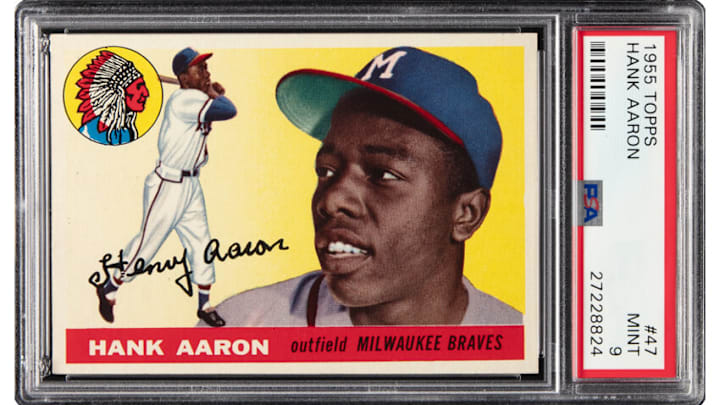
Certain iconic sets continue to carry enormous cultural weight, such as 1933 Goudey, 1948 Bowman, and 1952 Topps. Advanced collectors now pursue highly specific goals such as partial or fully signed versions of those sets. Some only collect Hall of Famers from their favorite sets. Many collect “Topps runs” of legendary players like Mickey Mantle, Willie Mays, and Hank Aaron.
These forms of purpose-driven collecting frequently require significant consolidation, which reinforces the broader trend toward grail-level acquisitions. Set collecting has not vanished, but it has evolved as we enter 2026. It has become more selective and more focused on the highest-end vintage cards.
Increasing Demand for Vintage On-Card Autographs

Signed vintage baseball cards occupy a unique position within the market by adding another layer of scarcity to an already finite supply. Unlike modern autographs, many vintage on-card signatures were obtained informally decades ago. They were acquired during a time when an autograph on a baseball card was strongly discouraged within the hobby. Collectors believed an autograph was ruining a baseball card, not enhancing it.
As a result of the stigma attached to autographed baseball cards in the past, signed vintage baseball cards are extremely rare. 1,394 1950 Jackie Robinson #22 cards have been graded by PSA, but only 9 signed copies of the card have been graded and authenticated. 6,453 1956 Topps Ted Williams cards have been graded by PSA, but only 16 signed copies of this card have been graded and authenticated by the same company.
Despite the extreme rarity of these signed vintage cards, they are usually less expensive than a high-grade unsigned copy of the same card. Many vintage collectors still have the old-school mindset that autographs and baseball cards should be kept separate.
That being said, the prices of rare, signed vintage cards continue to go up. This trend should continue in 2026. Autographed cards continue to play a huge role in the modern sports card world (a dual signed Michael Jordan/Kobe Bryant card broke the record for most expensive trading card ever in 2025), and that influence should continue to make its way into the vintage card market in 2026.
A Shifting Grading Landscape in Vintage
Another trend worth watching in 2026 is the evolving role of grading companies within the vintage baseball card universe. For years, SGC carved out a clear niche among vintage collectors, offering fast turnaround times and a presentation that complemented older cards. Last year, around 25% of all SGC submissions were vintage cards. (Less than 10% of PSA submissions were in the vintage category).
SGC was popular among vintage baseball card collectors in large part because of their faster turnaround times. The turnaround time at SGC has gotten longer, even though they have been receiving less submissions. This has created an opportunity for a company like CGC to create a niche in the vintage baseball card market. CGC acquired James Spence Authentication (JSA) in 2024. JSA is known for its autograph authentication expertise.
PSA remains the dominant grading company in the market, and cards graded by PSA continue to command a noticeable premium relative to other slabs. That dynamic has created persistent price gaps between comparable vintage cards graded by PSA and those encapsulated by Beckett, SGC, CGC, and other grading companies.
In some cases, those gaps reflect brand preference rather than meaningful differences in the cards themselves. Savvy collectors are able to find excellent deals on vintage cards that are slabbed by less popular grading companies.
Looking Ahead

As the hobby moves into 2026, recent market behavior and evolving collector habits point to the same conclusion: iconic vintage cards continue to stand apart from the rest of the hobby. Their appeal is rooted not in novelty or speculation, but in history and scarcity that cannot be replicated.
A common argument against vintage baseball cards is that fewer collectors remain who actually saw many of the game’s early stars play. History suggests otherwise. Cards of players such as Ty Cobb, Babe Ruth, and Lou Gehrig have continued to appreciate despite the fact that firsthand memory of their careers has long faded. In a hobby increasingly shaped by volume and change, vintage remains defined by scarcity and staying power.
TOP TRENDING COLLECTIBLES ARTICLES:
 Add us as a preferred source on Google
David is a collector based in Georgia and a lifelong fan of the New York Yankees, New York Giants, and New York Knicks. He is an avid sports card collector with a strong passion for vintage baseball cards and vintage on-card autographs. David enjoys obtaining autographs through the mail and loves connecting with other knowledgeable collectors to discuss the history and evolution of the hobby. He also previously wrote about the New York Giants for GMENHQ.com