
Five Things We Learned After Arkansas Had 'Teeth Kicked In' At Texas
In this story:
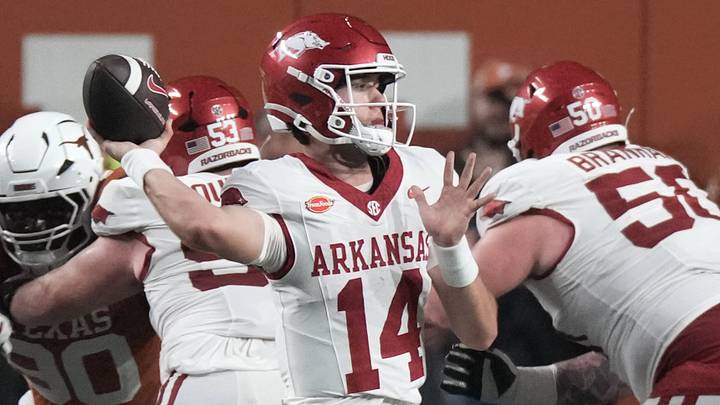
AUSTIN — Arkansas arrived in Austin with a recent victory worth building on. It left with a much clearer view of how far the building process still has to go. Texas won 45-3, handing the Razorbacks their seventh loss and ending their ability to reach six victories during the regular season.
The Longhorns were better. That was evident early. The more useful evaluation is how the gap became so large, why Arkansas could move the ball without scoring and what Saturday revealed about the program’s next decisions. Here are five things we learned.
South Carolina Was a Breakthrough, Not a New Baseline
Arkansas’ 34-6 victory over South Carolina happened. Nothing about Saturday changes that. It also did not establish that the Razorbacks had permanently corrected their recurring problems. Against the Gamecocks, Arkansas committed no turnovers, forced four and allowed one sack. Against Texas, the Razorbacks threw two interceptions, generated no takeaway and surrendered three sacks.
The quality of the opponent matters. So does the absence of LaNorris Sellers from South Carolina’s lineup. The lesson is not that the previous victory was meaningless. It is that Arkansas has not yet demonstrated it can reproduce the underlying habits consistently enough against more demanding opposition. A breakthrough becomes a standard through repetition. Texas showed that Arkansas is not there.
Total Yardage Can Tell a Comforting but Incomplete Story
Arkansas gained 363 yards. Texas gained 448. An 85-yard difference does not explain a 42-point margin without examining how the possessions ended. The Razorbacks converted three of 14 third downs and two of six fourth downs. They finished with one field goal and no touchdown.
Some production also came after Texas had established control, which limits how much the final total says about the competitive portion of the game. Arkansas could move. It could not consistently turn movement into a useful outcome. That is why pointing to yardage as proof the offense was close would miss the central failure. The scoreboard was not unfair to a secretly effective performance. It reflected what happened when the important downs arrived.
Marshall Productive When Things Didn't Go Right
Marshall caught nine passes for 106 yards. That deserves recognition without a qualifier diminishing every reception. He supplied a dependable target during an afternoon when Arkansas struggled to sustain productive football. His performance also provides something concrete to consider as the program evaluates the roster it wants to build around.




But one receiver’s production cannot carry an entire offense. Marshall’s catches needed support from protection, complementary targets, rushing efficiency and better situational execution. The lesson is not that Arkansas lacks every useful piece. It is that useful pieces are not yet working together consistently enough to change the result. Marshall gave the Razorbacks something. The operation needed to make more of it.
Manning Did Not Need to Be Spectacular to Be Overwhelming
Manning completed 84% of his passes. That figure says more about the afternoon than any attempt to describe him as either an unstoppable star or an overrated name. Arkansas did not make the passing assignment difficult enough.
Texas created manageable opportunities, Manning used them, and the Razorbacks failed to interrupt the rhythm. His two touchdown passes before halftime helped remove most of the uncertainty. The lesson is about Arkansas’ defense, not simply the quarterback it faced.
Against a capable passing offense, limited pressure and available receivers can become devastating even without a series of improbable throws. The Razorbacks needed disruption. They too often allowed efficiency.
Offseason Questions Are About Structure, Not Just Names
Arkansas can pursue better players. It should. Saturday also raised questions that cannot be answered entirely by a transfer announcement. Why do promising possessions keep producing negative plays? Are the available answers clear enough against pressure? Which defensive responsibilities break down when the opponent increases the tempo or creates space?

Those are evaluation questions for the staff. KJ Jackson finished 15 of 28 for 190 yards and an interception. Hank Hendrix made his Arkansas debut, completing six of 10 passes for 63 yards with an interception. Hendrix’s appearance offers tape to review. It does not settle the quarterback position or make a late-game sample a complete projection.
The broader assignment remains building a better environment around whoever plays. Arkansas did not learn Saturday that Texas has talent. It learned how much more connected its own operation needs to become. That is the lesson Silverfield has to carry into the finale—and the decisions that follow.
Sign up to our free newsletter, and follow us on Facebook, X (Twitter), Instagram and subscribe to our YouTube channel for the latest in Razorback news.
 Add us as a preferred source on Google

Wes Pruett covers Arkansas football for Razorbacks on SI, bringing decades of experience around the game and a unique perspective on the Razorbacks' new era under Ryan Silverfield. A longtime analyst, Pruett has extensive knowledge of the Memphis football program and Silverfield's coaching background, schemes and philosophy. His experience provides readers with an inside-the-game perspective on how Arkansas' new staff is building the program and how those concepts translate to the SEC. He has previously published work with Last Word on Sports and 4-Star Sports.
Follow 4starsportswes