
How Much Job Security Does Ryan Silverfield Have at Arkansas?
In this story:
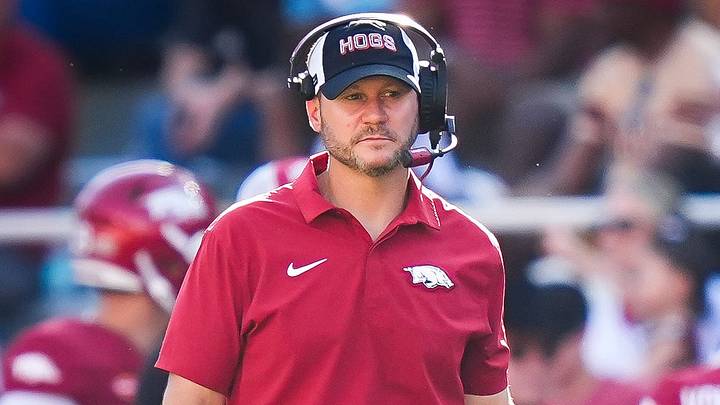
FAYETTEVILLE, Ark. — Ryan Silverfield was not hired to maintain the status quo at Arkansas.
He was brought to Fayetteville to change it.
Nine games into his first season, however, the Razorbacks are still searching for answers. A 26-23 loss at Auburn dropped Arkansas to 3-6 overall and 1-5 in Southeastern Conference play, leaving the program with three games remaining and little room for error.
The frustration surrounding the program is understandable. Arkansas has struggled to turn competitive performances into victories, and another losing season is becoming increasingly difficult to avoid.
Oh no, Ryan Silverfield:
— SEC Mike (@MichaelWBratton) November 8, 2026
“I learned long time ago, close doesn’t matter except for horseshoes or hand grenades.
“But it does when you go back and watch it and we’re that close.”
😂 pic.twitter.com/MyQzF2DfQd
That naturally raises a question among Razorback fans: How much job security does Silverfield actually have?
The answer is more complicated than the record suggests.
Arkansas Made a Significant Investment in Silverfield
When Arkansas hired Silverfield in December 2025, the university made a substantial financial commitment to its new head coach.
Silverfield received a five-year contract worth $33.5 million, with compensation increasing from $6.5 million in 2026 to $6.9 million in 2030. The agreement represented a commitment to building the program around Silverfield rather than making another short-term coaching change.

The contract also provides important financial protection.
If Arkansas terminates Silverfield without cause, the university is responsible for 70% of his remaining compensation. The agreement includes a mitigation provision requiring Silverfield to pursue comparable coaching employment, allowing Arkansas to offset some of its obligation with future compensation.
Unlike former coach Sam Pittman's agreement, Silverfield's contract does not include a performance-based reduction in the buyout tied to his winning percentage.
That distinction matters.
Arkansas cannot simply point to a losing record and expect the financial obligation to disappear. Moving on from Silverfield would require the university to consider a potentially substantial financial commitment while also determining who would lead the next rebuild.
It does not make a coaching change impossible. It does make one an expensive decision.
The Expectations Were Different From a Normal Rebuild
Silverfield inherited a difficult situation.
Arkansas finished the 2025 season 2-10, and the program had struggled to establish consistent success in SEC play. The new coaching staff also faced significant roster turnover, relying heavily on the transfer portal to assemble a competitive team.
The Razorbacks added nearly 40 transfers during the roster rebuild, creating a team that needed to develop chemistry while learning a new coaching staff's systems.
That context matters when evaluating a first-year coach.
“The fans are going to be blown away by the roster we are putting together and the staff we are assembling!” Ryan Silverfield, 11 months ago. https://t.co/0ISWNW9TcD
— Justin Wallace 🐗 (@JustinW35347825) November 10, 2026
However, Silverfield also arrived with an expectation that the program could improve quickly.



During his introductory period, he emphasized that Arkansas had the resources and potential to compete at a high level. He also promised a faster turnaround rather than asking the university and its fans to accept a lengthy rebuilding process.
Silverfield's hiring announcement and the university's financial commitment were central to the program's stated direction.
The challenge is that the results have not matched the urgency surrounding his arrival.
Arkansas has been competitive in stretches, but close losses do not change the standings. The Razorbacks are 3-6, and their remaining schedule offers little opportunity for an easy finish.
What Would Arkansas Have to See to Remain Patient?
There is an important difference between a frustrated fan base and an athletic department losing confidence in its head coach.
Publicly, there has been no confirmation that Arkansas administrators are considering a coaching change. The losses have created legitimate questions, but speculation about Silverfield's future should not be mistaken for evidence of an internal decision.
The more immediate question is what the university needs to see over the remainder of the season.
Arkansas has South Carolina at home Nov. 14, followed by a road trip to Texas on Nov. 21 and a home matchup against LSU on Nov. 28.
The Razorbacks need three consecutive victories to reach bowl eligibility. That is a difficult task considering the quality of the remaining opponents.
New Arkansas head football coach Ryan Silverfield dropped his coaching philosophy in today's press conference:
— Thad Wells (@ThadWells) December 4, 2025
E – Empty the tank
A – Attack the work
R – Respond with toughness
N – Never back down
I – Integrity
T – Together https://t.co/epECW7fzXR pic.twitter.com/A6lbnaE6VL
Still, the final stretch can provide important information about the direction of the program.
Does the team continue to compete when the postseason becomes increasingly unlikely? Can the coaching staff correct the mistakes that have contributed to close losses? Are younger players developing into contributors? Can Silverfield establish a foundation that carries into the offseason?
Those questions extend beyond the final score.
Arkansas also needs to evaluate its roster construction, player retention, recruiting and the staff's ability to develop talent. A coach's first season should be judged with context, but the university also needs evidence that its investment is producing progress.
The Pressure Is Real, But Silverfield's Future Is Not Decided
Silverfield acknowledged Monday that the frustration inside the locker room is growing.
Following the Auburn loss, he said his players were frustrated because they believed opportunities to win were available. He also emphasized that the team continued to show up, work and believe in the direction of the program.
That message is important, but it will eventually need to be supported by results.
Arkansas made a significant commitment when it hired Silverfield. The contract, financial investment in the program and roster overhaul all indicate that the university intended to give him an opportunity to build something sustainable.

One losing season does not automatically erase that commitment.
But the program cannot afford to treat competitiveness as the finish line, either. Arkansas needs to turn close games into wins and demonstrate that the direction of the program is improving.
For now, there is no confirmed indication that Silverfield is facing an immediate job threat. There is, however, a growing expectation that the final three games will provide a clearer picture of what his first season means for the future of Arkansas football.
The university hired Silverfield to change the trajectory of the program. The next step is to show that the change is actually happening.
Sign up to our free newsletter, and follow us on Facebook, X (Twitter), Instagram and subscribe to our YouTube channel for the latest in Razorback news.
 Add us as a preferred source on Google

Jackson Semingson covers all Razorbacks sports for Arkansas on SI. Semingson is majoring in broadcast journalism at the University of Arkansas, and also writes for the university’s student newspaper, The Arkansas Traveler. He is also a former member of the Razorbacks’ club hockey team, bringing experience as both a student journalist and an athlete to his coverage of Arkansas athletics.
Follow gq_jackson23