
Baylor Red-Zone Report: Why Drives Succeeded (or Stalled) and How the Bears Adjust in Week 2
In this story:
As the dust finally settles in the aftermath of the Baylor Bears' 17-16 loss to the Auburn Tigers, the autopsy of Saturday's heartbreaker can begin in earnest. That includes a breakdown of how the Bears' offense performed in the red zone.
As the final score suggests, Baylor did not take many trips inside the opposing 20-yard line this past weekend. The Bears failed to so much as sniff the red zone until the second quarter, and only did so after multiple drives ended in DJ Lagway turnovers.
Yet, those early red-zone trips understandably take a backseat to the discourse surrounding the game's final sequence.
Red-zone offense by the numbers
In total, the Bears made four trips inside the Auburn 20-yard line Saturday. That figure doesn't include a near-red-zone trip near the beginning of the second quarter that resulted in sophomore Rhett Armstrong's missed field goal from 42 yards out.
In the drives that actually reached the red zone, the Bears offense performed adequately but not spectacularly. The unit produced touchdowns on two of those series and a successful field goal on a third (total red-zone scoring rate of 75%).
Of course, those numbers come with a massive caveat. Lagway suffered an ankle injury early in the game on a scramble, and his mobility appeared compromised the rest of the day.
DJ Lagway tried to hurdle the defender but Auburn punched it out to force the fumble 😳 pic.twitter.com/uT7hzal0LC
— ESPN College Football (@ESPNCFB) September 5, 2026
Lagway didn't miss time, but he sported a massive wrap over his right foot and ankle for the remainder of the contest. Because of that development and Baylor's struggles to open rushing lanes for the running backs, Lagway finished with 54 total pass attempts, the highest single-game mark of his collegiate career.
The injury also contextualizes Lagway's production inside the red zone. Officially, he connected on just 2 of 6 passes on plays inside the Auburn 20, one of which resulted in a turnover on downs. However, those two completions occurred in the end zone, including his back-shoulder throw to Louis Brown IV.
2️⃣ + 4️⃣ = 6️⃣ 🙌@DerekLagway 🤝 @Louis4Brown
— Baylor Football (@BUFootball) September 5, 2026
📺 ABC pic.twitter.com/4utalK446v
Red-zone turning point
The outcome of the game pivoted on the final few moments of regulation.
Facing fourth-and-goal from the 5, Baylor ran a play-action pick play for Gavin Freeman. The picks leave Freeman open in the flat, and the run action buys Lagway enough time to find him and bring the game within a point.
DJ LAGWAY TO GAVIN FREEMAN TDpic.twitter.com/iU3VZV7NFf
— Pick 6 Pack (@Pick6PackFB) September 5, 2026
Baylor head coach Dave Aranda made the call to go for two and the win in regulation. That decision has more layers than just the decision to keep the offense on the field. On the initial two-point attempt, Auburn sent in defensive lineman Walter Mathis Jr. as a late substitution. The officials held up the play while Mathis lined up, but none of the Tigers' defenders left the field to account for his arrival. This would have given the Bears a free play, but Aranda called a timeout instead.

After the timeout, Baylor offensive coordinator Jake Spavital dialed up a sprint-out designed to get senior tight end Matthew Klopfenstein open in the flat. The rub routes from receivers entangled the necessary defenders, putting Klopfenstein in open space just ahead of the goal line. At that point, Lagway just needs to hit the tight end on the outside shoulder, and the Bears should take the lead.
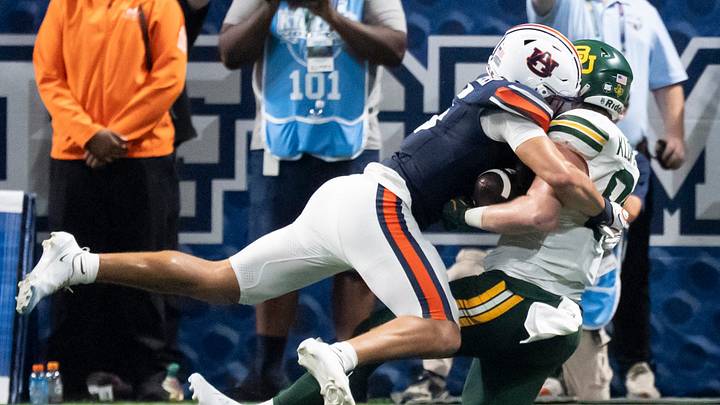
Instead, Lagway places the ball to the wrong shoulder, forcing Klopfenstein to turn inside and slow his momentum. That small difference allows Auburn defensive back Eric Winters to barrel down on Klopfenstein and prevent him from crossing the goal line.
BAYLOR FALLS JUST SHORT OF THE GOAL LINE 😲
— ESPN College Football (@ESPNCFB) September 5, 2026
Auburn wins in the final seconds with a CLUTCH tackle ‼️ pic.twitter.com/JCgjTS1fC6
Adjustments for next week
In at least some ways, the offense shouldn't have as many issues running the ball in the red zone. Auburn features perhaps the best defensive line on the Bears' 2026 regular-season schedule, and the delta between that group and either of Baylor's next few opponents looks considerable. Dawson Pendergrass, who finished Saturday's game with 11 yards on six carries from inside the red zone, will probably do better moving forward.
However, a big part of the red-zone offense -- and the offense in general -- takes a major hit with Lagway's injury. As long as his right ankle compromises his mobility, opponents can take a more straightforward approach to defending Baylor. That could mean more man coverage than the Bears would otherwise encounter, as Lagway won't have the ability to make defenders pay for turning their backs to him.
Sign up for our free newsletter and follow us on X and Facebook for the latest news.
 Add us as a preferred source on Google
Jason B. Hirschhorn is an award-winning sportswriter and member of both the Pro Football Writers of America and the Football Writers Association of America. He is a co-founder of The Leap, a Green Bay Packers newsletter. His work has also appeared at NFL.com, SB Nation, Sports Illustrated, and other major outlets.
Follow by_JBH