
Dave Aranda Tacitly Admits Baylor Football Has Money Problems
In this story:
In the current landscape of big-time college sports, a program's financial resources play a disproportionate role in determining which athletes come to the school and how long they stay. So, while the team with the highest payroll doesn't always emerge victorious, those who spend more will find success more consistently than those who don't.
In recent years, football coaches have engaged with these market dynamics more than ever before. Unlike in previous decades, those running major programs have to actively campaign for money, whether from sponsors, moneyed boosters, or everyday alumni and fans. All schools have outside support, but some can draw significantly more funds than others.
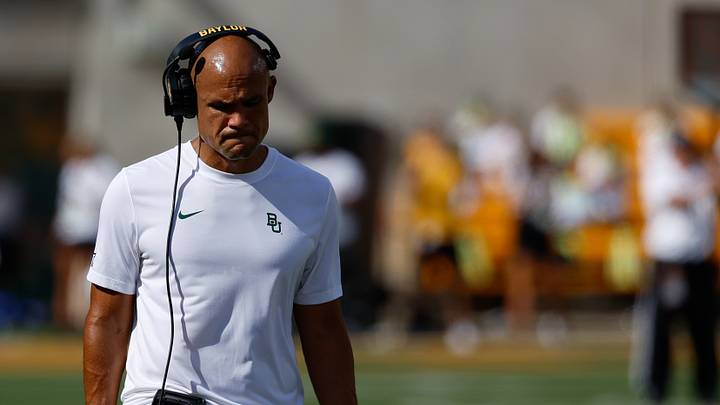
Baylor Bears head coach Dave Aranda understands this difference between the "haves" and "have-nots." Before arriving in Waco, he spent four years as the defensive coordinator for the LSU Tigers, one of the best-resourced programs in the sport. While that stint came in the pre-NIL era, the delta between LSU's resources and all but a handful of other schools helped the team consistently compete at the highest level. The Tigers never won fewer than eight games in any of Aranda's seasons, and they went undefeated on the way to winning the national championship in 2019.
That experience informs how Aranda approaches his current job at Baylor, and based on his recent comments, he understands where the program needs to make strides off the field.
Where Baylor stands in the NIL landscape

Context matters when interpreting a program's financial resources. According to The Athletic's NIL database, the Bears have an estimated roster budget of between $20 million and $23 million this year. At first blush, that might seem like a tremendous amount, and it does rank fourth among all Big 12 schools. However, even at the top end of the reported range, Baylor football's resources trail those of in-state rival Texas Tech by at least $15 million.
And the delta between the Bears and the teams occupying college football's upper crust appears even larger. The last three schools to win national championships -- the Michigan Wolverines, the Ohio State Buckeyes, and the Indiana Hoosiers -- will average somewhere between $40.3 million and $44.7 million in roster budget in 2026. Those figures don't even account for coach salaries or any ancillary expenditures associated with the programs.
Acknowledging money problems
The gap between the Bears and college football's big spenders seems at the forefront of Aranda's mind. During Monday's press conference, he fielded a fairly innocuous question about reducing penalties and spun his answer to address roster spending.
"That toughness thing, man, we've been talking about that since January, and this was all based upon the money that we can spend," Aranda said. "I hate bringing up money, but I think that's where it starts. It totally starts there. You look at the offense in the last two years. We spent a lot of money on that offense, and we're spending a lot of money on this defense right now. And so, I think if you just follow the money, you see where things are at."
Understandably, Aranda has to take a diplomatic approach when discussing Baylor football's funding or else risk alienating those who pump money into his program. As such, while he said the Bears "spent a lot" on the roster, he delineated between where the team invested that money and when. It also seems revealing that he circled back to roster spend as something the team would have to overcome with toughness.
"That doesn't mean that you can't play well if you're not spending, and that doesn't mean that you can't play poorly if you are spending," Aranda said. "I think that's where you start. And so, knowing this is what we're spending and everything else, we're going to have to be tough."
Does Baylor football have untapped resources?

In 2023, Baylor estimated that the school had an alumni base of around 160,000 people. For comparison, that represents less than a quarter of Ohio State's alumni base. Granted, those figures don't account for non-alumni, and the Bears do attract some "sidewalk fans." Still, it stands to reason that their total number of supporters pales in comparison not just to mega programs like the Buckeyes but also to mid-sized schools like Texas Tech (over 273,000).
Already, those figures put Baylor at a disadvantage. But a program can make up for what it lacks in pure fan count with the right megadonor. Texas Tech, famously or infamously, has Cody Campbell funneling money into the school's athletics and funding the push for the Protect College Sports Act.
Baylor football doesn't necessarily need a Campbell-esque figure behind it, but someone who can increase the payroll by a few million annually could make a substantial difference. Look no further than Mississippi State, which reportedly will need more than $4 million just to retain Kamario Taylor beyond 2026.
Certainly, Power Four teams will operate with fewer resources than Baylor in the coming years and still find success. However, the Bears need to stay vigilant when it comes to raising funds for their roster.
Sign up for our free newsletter and follow us on X and Facebook for the latest news.
 Add us as a preferred source on Google
Jason B. Hirschhorn is an award-winning sportswriter and member of both the Pro Football Writers of America and the Football Writers Association of America. He is a co-founder of The Leap, a Green Bay Packers newsletter. His work has also appeared at NFL.com, SB Nation, Sports Illustrated, and other major outlets.
Follow by_JBH