
First Hockey Bracketology of 2026 Shows Potential Issue for Top Seed: Puck Drop
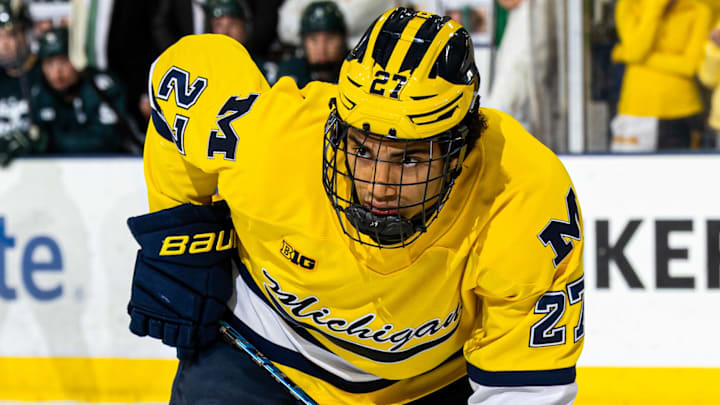
There haven’t been too many games played since our Winter Break projection last month, however there’s been a lot of talk about how geography and attendance might factor more in the selection process as compared to what we’ve seen in the past, so we’re going up see how that could look. For us it’s going to lead to a non-traditional twist.
Also, up until now we’ve credited the team atop the standings with being the eventual conference champion and receiving the automatic bid. This time we’ll do it for both the teams atop the standings and then with the teams ranked higher in the NCAA Percentage Index, although the difference won’t be as much as one might expect.
Confused yet? Just bear with us.
Let’s start with the regional sites. As a reminder, they’re as follows, plus North Dakota is the host school of Frozen Four in Las Vegas. Hosts have to placed in their regional if they make the tournament.
• Albany, N.Y. (Union)
• Loveland, Colo. (Denver)
• Sioux Falls, S.D. (Omaha)
• Worcester, Mass. (Holy Cross)
We’ll do the current division leaders first.
AHA: Bentley
Big Ten: Wisconsin
CCHA: Minnesota State
ECAC: Princeton
Hockey East: Connecticut
NCHC: North Dakota
How many of those conference leaders are also leading their leagues in the NPI Index? Just two, and barely. But more about that in a bit.
The current division leaders in the NPI are ranked this week at No. 36, 3, 14, 12, 15 and 2 respectfully.
It’s 16-team field that will make up the 2026 Division I Men's Ice Hockey Championship, with the Frozen Four set to be played in Las Vegas on April 9-11.
We round out the field with 10 at-large bids, based on NPI: Michigan, Minnesota Duluth, Michigan State, Dartmouth, Western Michigan, Penn State, Denver, Quinnipiac, Cornell, and finally Augustana.
Compared to our last bracketology, in is Princeton and out is Harvard (how important was that last-second goal last week?) Of note, that’s five ECAC teams and just one from Hockey East, the automatic qualifier. The first teams out: Boston College, Harvard and Providence.
We move on to seeding. As we group the teams 1-4, 5-8, 9-12, 13-16, the * indicates the school is hosting so it must play at that site.
1: Michigan, North Dakota, Wisconsin, UMD
2: Michigan State, Dartmouth, Western Michigan, Penn State
3. Denver*, Quinnipiac, Cornell, Princeton
4: Minnesota State, Connecticut, Augustana, Bentley
Time to place teams in the bracket, and pairings, which need to be geographically friendly when possible but avoid first-round conference matchups, and all in a way that doesn't negatively impact the bracket integrity.
Here’s how it would look with just straight brackets (meaning 1 vs. 16, 8 vs. 9, etc.), with seeding in order in each region, and the top teams playing as close to home as possible unless a host school comes into play.
1 Michigan, 2 Dartmouth, 3 Denver*, 4 Bentley
1 UMD, 2 Michigan State, 3 Princeton, 4 Augustana
1 Wisconsin, 2 Penn State, 3 Cornell, 4 Minnesota State
1 North Dakota, 2 Western Michigan, 3 Quinnipiac, 4 Connecticut
Once the initial bracket is set, the location is determined host Denver has to play in the Loveland Regional. More on that implication later on. The other problem is that Cornell and Dartmouth can’t play in the first round, and the only team they can easily switch with is also an ECAC team, Quinnipiac (which is located just a 90-minute drive from Worcester).
The only move is on the 2-seed level, swapping Dartmouth and Penn State.
We’re going to make a final swap among the 4 seeds for attendance purposes, putting Connecticut in Albany and Augustana in Sioux Falls. That gets us our initial projection:
First Bracketology Projection of 2026
Loveland.: 1 Michigan, 2 Dartmouth, 3 Denver*, 4 Bentley
Albany: 1 UMD, 2 Michigan State, 3 Cornell, 4 Connecticut
Worchester: 1 Wisconsin, 2 Penn State, 3 Quinnipiac, 4 Minnesota State
Sioux Falls: 1 North Dakota, 2 Western Michigan, 3 Princeton, 4 Augustana
Now let’s go through the process again and put the teams that have the best NPI ranking as getting the automatic conference bids, which leads to yet another issue. They would be in order of conference: Holy Cross, Michigan, Augustana, Dartmouth, UConn and North Dakota. The at-large teams would be Wisconsin, UMD, Michigan State, Western Michigan, Penn State, Denver, Quinnipiac, Cornell, Princeton and Minnesota State.
The only change is Holy Cross, and if the Crusaders are in the tournament they have to host in Worcester, which would play havoc with bracket integrity as there can’t be two host teams in the same regional. In that scenario, Holy Cross would get moved.
Loveland: 1 Michigan, 2 Dartmouth, 3 Denver*, Connecticut
Albany: 1 UMD, 2 Michigan State, 3 Cornell, 4 Minnesota State
Worchester: 1 Wisconsin, 2 Penn State, 3 Quinnipiac, 4 Holy Cross*
Sioux Falls:: 1 North Dakota, 2 Western Michigan, 3 Princeton, 4 Augustana
In this case, we’ve gone from:
Ideal bracket
1, 8, 9, 16
4, 5, 12, 13
3, 6, 11, 14
2, 7, 10, 15
To this bracket
1, 6, 9, 15
4, 5, 11, 14
3, 8, 10, 16
2, 7, 12, 13
To say bracket integrity has been bent would be an understatement, and more bending could be possible depending on how far the selection committee wanted to go in moving more teams around. However, the real problem with this bracket is that the team getting a raw deal out of it is the one that should be getting the biggest reward for being the top seed, Michigan.
You know how in the College Football Playoff the top-seeded team gets to play the bowl location that's closest, or has the strongest conference tie? That's out the window here. The Wolverines wouldn’t get to play the last team in the tournament, plus they would get sent out West even tough Albany is the closest regional to campus. Specifically, Ann Arbor to Albany is 580 miles, a drive that a lot of fans could make, albeit almost nine hours. Worcester would be an additional three hours, Sioux Falls S.D., is 820 miles (12 hour-drive), and Loveland, Colo., is more than 1,200 miles (18 hours).
So not only would the top-seeded team end up at the most distant regional, but could potentially have to play host Denver in the second round at a high-elevation setting that the players aren’t accustomed to physically, with a spot in the Frozen Four at stake. Quite frankly, that stinks, and Michigan would be justified for having an "Are you kidding me?" response should it happen.
Puck Drop: Thursday, January 8, 2026
• Hall of Fame ironman goaltender Glenn Hall, best known for his streak of 502 consecutive starts, 552 including the Stanley Cup Playoffs, died Wednesday in a Stony Plain, Alberta hospital. He was 94. "Mr. Goalie," who played 10 seasons with the Chicago Blackhawks, finished his NHL career with a record of 407-326-164, a 2.50 goals-against average and 84 shutouts.
• Latvian goalie Linards Feldbergs, who recently made 55 saves against Canada at the World Juniors, committed to Merrimack. Other commitments include D Noah Lagerge to Northeastern (Newfoundland Regiment QMJHL) and D Darels Uljanskis to Connecticut (Flint Firebirds OHL). D Morgan Brady, who had previously been committed to Arizona State, announced he's instead heading to Michigan Tech.
• Utah will become the 32nd NHL team to play in an outdoor game when it hosts the Colorado Avalanche at Rice-Eccles Stadium on the campus of the University of Utah in Salt Lake City in the 2027 Winter Classic. The stadium capacity for football is 51,444. It will be the NHL's 47th outdoor game. For more see Breakaway On SI.
• Former Harvard defenseman Adam Fox, who had just returned from missing 14 games due to an upper-body injury, sustained a lower-body injury in a 3-2 overtime loss to the Utah Mammoth at Madison Square Garden on Monday and was placed on longterm injured reserve. With goaltender Igor Shesterkin also on injured reserve, former UMass goaltender Jonathan Quick, 39, is expected to have a larger role in his absence.
• Former Michigan defenseman Jack Johnson announced his retirement after 19 seasons, 1,228 regular-season games and a Stanley Cup championship. He's accumulated 342 points, 77 goals and 265 assists. the 38-year-old has agreed to become a scout for the Vancouver Canucks.
Trading skates for a clipboard 🖊️
— NHLPA (@NHLPA) January 7, 2026
Best of luck to Jack Johnson, who has announced his retirement from the game after taking on a pro scouting role with the @Canucks. pic.twitter.com/HTzGUYWYP3
Wednesday's Men's College Hockey Scores
No Games Schedule
Wednesday's Women's College Hockey Scores
No Games Scheduled
Games between ranked opponents are bolded. All times are local to where the game is being played.
Thursday's Men's College Hockey Schedule
No Games Scheduled
Thursday's Women's College Hockey Schedule
AHA
RIT at Delaware, 6 p.m. ET
This Date in Hockey History:
January 8, 1944: Hall of Famer Babe Pratt became the first defenseman in NHL history to get six assists in a single game as the Maple Leafs blasted the Brions 12-3.
January 8, 1970: Michigan State right wing Dwayne Norris was born in St. John's, Newfoundland and Labrador
January 8, 1973: Hall of Fame defenseman Larry Robinson played the first of 1,384 games during his 20-year NHL career as Montreal tied the North Stars 3-3.
January 8, 1991: Former Cornell goaltender Brian Hayward notched his eighth, and final, NHL shutout as the Minnesota North Stars won at the New York Islanders 3-0.
January 8, 1992: Former UMD left wing Brett Hull scored his 15th career hat trick and added an assist to extend his goal-scoring streak to 10 straight games as St. Louis defeated the New York Rangers 5-3.
January 8, 2000: John Vanbiesbrouck, who played for Team USA in numerous international tournaments, notched NHL career win No. 350 as Philadelphia defeated Pittsburgh 6-2 to extend its home unbeaten streak to 15.
January 8, 2004: Michigan defenseman Seamus Casey was born in Miami.
January 8, 2008: Former Wisconsin defenseman Chris Chelios became the second-oldest player to play in an NHL game at 45 years and 348 days old. Dominik Hasek, who was 42, got the shutout as Detroit defeated Colorado 1-0.
January 8, 2023: Auston Matthews scored his 20th goal of the season became the third United States-born player to begin his NHL career with seven straight 20-goal seasons, joining Patrick Kane (13) and Jimmy Carson (seven). Toronto won in Philadelphia 6-2.
January 8, 2024: former Michigan defenseman Quinn Hughes became the ninth defenseman in NHL history to record 50-plus points through the first 40 games of a season as the Canucks won at the New York Rangers 6-3. He joined Paul Coffey (eight times), Bobby Orr (six), Erik Karlsson, John Carlson, Brian Leetch, Phil Housley, Al MacInnis and Denis Potvin.
Did You Notice in the NHL ...
Former Boston University player Macklin Celebrini led San Jose's comeback against L.A. ...
WHO ELSE BUT MACKLIN CELEBRINI? 🤯
— NHL (@NHL) January 8, 2026
Unbelievable. pic.twitter.com/3b4Mz4UCkM
... but we don't know what to make of this in St. Louis. Blues coach Jim Montgomery played at Maine.
After the Blackhawks scored their 7th of the game, Jim Montgomery tried to pull Jordan Binnington for Joel Hofer...
— Gino Hard (@GinoHard_) January 8, 2026
But Binnington appeared to refuse to come off the ice, and Hofer was hiding down the tunnel to the Blues' locker room? 😭😅 pic.twitter.com/j2V7q5bze4
Hockey Quote of the Day
“I remember him being super tan. He’s a legend. It was actually really cool for me [to play against him]. He had a moment where he was like, ‘I remember playing against your dad.’ I was like, ‘Yeah … I remember watching you. I kind of hated you."Nick Foligno on Chris Chelios
Check us Out On:
• Twitter/X
• Facebook
• YouTube
• Instagram
• Threads
• Blue Sky
We'll Leave You With This ...
Speaking of Michigan ...
"I don't like green."
— FloHockey (@FloHockey) January 7, 2026
Michael Hage and Porter Martone may be friends most of the year, but Hage made his feelings clear 🫣@umichhockey | @ChicagoSteel #WorldJuniors #IIHF #CollegeHockey #GoBlue pic.twitter.com/UiP9SeNd3Z
 Add us as a preferred source on Google
Christopher Walsh is the founder and publisher of Alabama Crimson Tide On SI, which first published as BamaCentral in 2018, and is also the publisher of the Boston College, Missouri and Vanderbilt sites . He's covered the Crimson Tide since 2004 and is the author of 27 books including “100 Things Crimson Tide Fans Should Know and Do Before They Die” and “Nick Saban vs. College Football.” He's an eight-time honoree of Football Writers Association of America awards and three-time winner of the Herby Kirby Memorial Award, the Alabama Sports Writers Association’s highest writing honor for story of the year. In 2022, he was named one of the 50 Legends of the ASWA. Previous beats include the Green Bay Packers, Arizona Cardinals and Tampa Bay Buccaneers, along with Major League Baseball’s Arizona Diamondbacks. Originally from Minnesota and a graduate of the University of New Hampshire, he currently resides in Tuscaloosa.
Follow BamaCentral