%22%3E%0A%3Cpath%20d%3D%22M0%209.69043H5.34889V25.7008H0V9.69043Z%22%20fill%3D%22white%22%2F%3E%0A%3Cpath%20d%3D%22M7.18359%2013.2135H12.3781V14.948C13.1773%2013.9218%2014.4396%2012.9138%2016.2013%2012.9138C18.8349%2012.9138%2020.4786%2014.6483%2020.4786%2017.4636V25.7003H15.2841V19.1345C15.2841%2018.0629%2014.6393%2017.4454%2013.8674%2017.4454C13.0955%2017.4454%2012.3781%2018.0629%2012.3781%2019.1345V25.7003H7.18359V13.2135Z%22%20fill%3D%22white%22%2F%3E%0A%3Cpath%20d%3D%22M21.6587%2019.5434V19.498C21.6587%2015.5385%2024.038%2012.914%2026.9894%2012.914C28.8874%2012.914%2029.9408%2013.7404%2030.74%2014.6304V9H35.9345V25.7005H30.74V24.1658C29.8954%2025.083%2028.9328%2025.9911%2027.0348%2025.9911C24.0108%2025.9911%2021.6587%2023.3576%2021.6587%2019.5434ZM30.8581%2019.4798V19.4344C30.8581%2018.1994%2029.9681%2017.1913%2028.7784%2017.1913C27.5888%2017.1913%2026.6988%2018.1721%2026.6988%2019.4344V19.4798C26.6988%2020.7421%2027.5888%2021.7229%2028.7784%2021.7229C29.9681%2021.7229%2030.8581%2020.7421%2030.8581%2019.4798Z%22%20fill%3D%22white%22%2F%3E%0A%3Cpath%20d%3D%22M37.5337%209H42.9098V12.3147H37.5337V9ZM37.6245%2013.2137H42.819V25.7005H37.6245V13.2137Z%22%20fill%3D%22white%22%2F%3E%0A%3Cpath%20d%3D%22M44.0259%2022.1496V22.1042C44.0259%2019.6159%2045.8785%2018.2174%2048.7845%2018.2174C49.8379%2018.2174%2051.182%2018.4444%2051.7359%2018.6714V18.4626C51.7359%2017.3183%2051.0276%2016.6554%2049.4293%2016.6554C48.1488%2016.6554%2047.0772%2016.9278%2045.9784%2017.3637L45.0611%2013.9128C46.5051%2013.3679%2048.1488%2012.9956%2050.3192%2012.9956C52.862%2012.9956%2054.5057%2013.5223%2055.6046%2014.6212C56.5399%2015.5565%2056.9123%2016.7734%2056.9123%2018.5806V25.6913H51.7178V24.429C50.8459%2025.3644%2049.6835%2025.9819%2048.1306%2025.9819C45.7332%2025.9819%2044.035%2024.6106%2044.035%2022.1405L44.0259%2022.1496ZM51.7813%2021.078V20.5513C51.4816%2020.4332%2051.0276%2020.3424%2050.5917%2020.3424C49.5655%2020.3424%2048.9934%2020.9599%2048.9934%2021.7409V21.7863C48.9934%2022.5219%2049.5201%2023.0032%2050.183%2023.0032C51.1002%2023.0032%2051.7813%2022.2676%2051.7813%2021.078Z%22%20fill%3D%22white%22%2F%3E%0A%3Cpath%20d%3D%22M58.4653%2013.2135H63.6598V14.948C64.459%2013.9218%2065.7213%2012.9138%2067.4831%2012.9138C70.1167%2012.9138%2071.7604%2014.6483%2071.7604%2017.4636V25.7003H66.5659V19.1345C66.5659%2018.0629%2065.9211%2017.4454%2065.1492%2017.4454C64.3773%2017.4454%2063.6598%2018.0629%2063.6598%2019.1345V25.7003H58.4653V13.2135Z%22%20fill%3D%22white%22%2F%3E%0A%3Cpath%20d%3D%22M72.832%2022.1496V22.1042C72.832%2019.6159%2074.6846%2018.2174%2077.5906%2018.2174C78.6441%2018.2174%2079.9881%2018.4444%2080.5421%2018.6714V18.4626C80.5421%2017.3183%2079.8337%2016.6554%2078.2354%2016.6554C76.9549%2016.6554%2075.8834%2016.9278%2074.7845%2017.3637L73.8673%2013.9128C75.3112%2013.3679%2076.9549%2012.9956%2079.1254%2012.9956C81.6681%2012.9956%2083.3119%2013.5223%2084.4107%2014.6212C85.3461%2015.5565%2085.7184%2016.7734%2085.7184%2018.5806V25.6913H80.5239V24.429C79.6521%2025.3644%2078.4897%2025.9819%2076.9368%2025.9819C74.5393%2025.9819%2072.8411%2024.6106%2072.8411%2022.1405L72.832%2022.1496ZM80.5784%2021.078V20.5513C80.2787%2020.4332%2079.8246%2020.3424%2079.3887%2020.3424C78.3626%2020.3424%2077.7904%2020.9599%2077.7904%2021.7409V21.7863C77.7904%2022.5219%2078.3171%2023.0032%2078.9801%2023.0032C79.8973%2023.0032%2080.5784%2022.2676%2080.5784%2021.078Z%22%20fill%3D%22white%22%2F%3E%0A%3Cpath%20d%3D%22M93.3018%209.69043H98.6506V15.339H103.545V9.69043H108.894V25.7008H103.545V19.9614H98.6506V25.7008H93.3018V9.69043Z%22%20fill%3D%22white%22%2F%3E%0A%3Cpath%20d%3D%22M110.292%2019.4978V19.4524C110.292%2015.9288%20113.217%2012.9138%20117.34%2012.9138C121.462%2012.9138%20124.341%2015.8834%20124.341%2019.407V19.4524C124.341%2022.9759%20121.417%2025.9909%20117.294%2025.9909C113.171%2025.9909%20110.292%2023.0213%20110.292%2019.4978ZM119.356%2019.4978V19.4524C119.356%2018.2173%20118.438%2017.2365%20117.294%2017.2365C116.15%2017.2365%20115.278%2018.2173%20115.278%2019.407V19.4524C115.278%2020.6874%20116.195%2021.6682%20117.34%2021.6682C118.484%2021.6682%20119.356%2020.6874%20119.356%2019.4978Z%22%20fill%3D%22white%22%2F%3E%0A%3Cpath%20d%3D%22M125.204%2019.4978V19.4524C125.204%2015.9288%20128.128%2012.9138%20132.251%2012.9138C136.374%2012.9138%20139.252%2015.8834%20139.252%2019.407V19.4524C139.252%2022.9759%20136.328%2025.9909%20132.205%2025.9909C128.082%2025.9909%20125.204%2023.0213%20125.204%2019.4978ZM134.267%2019.4978V19.4524C134.267%2018.2173%20133.35%2017.2365%20132.205%2017.2365C131.061%2017.2365%20130.189%2018.2173%20130.189%2019.407V19.4524C130.189%2020.6874%20131.106%2021.6682%20132.251%2021.6682C133.395%2021.6682%20134.267%2020.6874%20134.267%2019.4978Z%22%20fill%3D%22white%22%2F%3E%0A%3Cpath%20d%3D%22M139.507%2024.1837L141.269%2021.2323C142.776%2022.1677%20144.474%2022.6308%20145.891%2022.6308C146.39%2022.6308%20146.645%2022.5128%20146.645%2022.2222V22.1768C146.645%2021.9225%20146.418%2021.7681%20145.155%2021.4412C141.995%2020.6602%20140.052%2019.8156%20140.052%2017.2365V17.1911C140.052%2014.4486%20142.249%2012.9138%20145.491%2012.9138C147.553%2012.9138%20149.587%2013.4405%20151.095%2014.3577L149.451%2017.4454C148.125%2016.7098%20146.527%2016.283%20145.473%2016.283C144.974%2016.283%20144.738%2016.4192%20144.738%2016.6735V16.7189C144.738%2016.9732%20145.01%2017.1275%20146.272%2017.4545C149.433%2018.2355%20151.331%2019.0982%20151.331%2021.6591V21.7045C151.331%2024.4289%20149.296%2026%20145.909%2026C143.484%2026%20141.287%2025.3825%20139.507%2024.1928V24.1837Z%22%20fill%3D%22white%22%2F%3E%0A%3Cpath%20d%3D%22M152.448%209H157.824V12.3147H152.448V9ZM152.539%2013.2137H157.733V25.7005H152.539V13.2137Z%22%20fill%3D%22white%22%2F%3E%0A%3Cpath%20d%3D%22M159.041%2019.525V19.4796C159.041%2015.7563%20161.72%2012.9138%20165.471%2012.9138C169.902%2012.9138%20171.964%2016.0015%20171.964%2019.7975C171.964%2020.0699%20171.964%2020.3968%20171.946%2020.6693H163.918C164.281%2021.7681%20165.153%2022.3402%20166.27%2022.3402C167.205%2022.3402%20167.986%2021.9043%20168.813%2021.0598L171.6%2023.2756C170.365%2024.8739%20168.604%2026%20165.906%2026C161.811%2026%20159.041%2023.4118%20159.041%2019.525ZM167.223%2018.3808C167.105%2017.1911%20166.397%2016.5009%20165.489%2016.5009C164.581%2016.5009%20163.999%2017.2365%20163.845%2018.3808H167.232H167.223Z%22%20fill%3D%22white%22%2F%3E%0A%3Cpath%20d%3D%22M173.198%2013.2137H178.393V15.7292C179.101%2014.0401%20180.245%2012.9413%20182.307%2013.0321V18.5444H181.762C179.564%2018.5444%20178.402%2019.7523%20178.402%2022.5221V25.7005H173.207V13.2137H173.198Z%22%20fill%3D%22white%22%2F%3E%0A%3Cpath%20d%3D%22M182.389%2024.1837L184.151%2021.2323C185.658%2022.1677%20187.357%2022.6308%20188.773%2022.6308C189.273%2022.6308%20189.527%2022.5128%20189.527%2022.2222V22.1768C189.527%2021.9225%20189.3%2021.7681%20188.038%2021.4412C184.877%2020.6602%20182.934%2019.8156%20182.934%2017.2365V17.1911C182.934%2014.4486%20185.132%2012.9138%20188.374%2012.9138C190.435%2012.9138%20192.469%2013.4405%20193.977%2014.3577L192.333%2017.4454C191.007%2016.7098%20189.409%2016.283%20188.356%2016.283C187.856%2016.283%20187.62%2016.4192%20187.62%2016.6735V16.7189C187.62%2016.9732%20187.892%2017.1275%20189.155%2017.4545C192.315%2018.2355%20194.213%2019.0982%20194.213%2021.6591V21.7045C194.213%2024.4289%20192.179%2026%20188.791%2026C186.367%2026%20184.169%2025.3825%20182.389%2024.1928V24.1837Z%22%20fill%3D%22white%22%2F%3E%0A%3Cpath%20fill-rule%3D%22evenodd%22%20clip-rule%3D%22evenodd%22%20d%3D%22M203.99%204.36764C209.813%20-1.45588%20219.254%20-1.45588%20225.078%204.36764C230.901%2010.1912%20230.901%2019.6324%20225.078%2025.4559L214.534%2036L203.99%2025.4559C198.166%2019.6324%20198.166%2010.1912%20203.99%204.36764ZM206.631%207.55761C206.57%207.86849%20206.538%208.39718%20206.538%209.14566V10.4189C206.538%2011.1832%20206.57%2011.7198%20206.635%2012.0267C206.7%2012.3317%20206.9%2012.6168%20207.239%2012.8762C207.578%2013.1376%20208.025%2013.3316%20208.58%2013.4623C209.134%2013.593%20209.722%2013.6584%20210.459%2013.6584C211.195%2013.6584%20211.839%2013.591%20212.391%2013.4524C212.944%2013.3158%20213.383%2013.1178%20213.708%2012.8604C214.033%2012.6029%20214.227%2012.3178%20214.288%2012.0069C214.35%2011.6961%20214.381%2011.1674%20214.381%2010.4189V9.14566C214.381%208.38134%20214.35%207.84473%20214.284%207.53781C214.219%207.23287%20214.019%206.94971%20213.68%206.68834C213.342%206.42696%20212.894%206.23291%20212.34%206.10223C211.785%205.97154%20211.158%205.90619%20210.461%205.90619C209.724%205.90619%20209.081%205.97352%20208.528%206.11213C207.974%206.24875%20207.536%206.44677%20207.211%206.70418C206.887%206.9616%20206.693%207.24673%20206.631%207.55761ZM211.898%2024.8638C215.498%2024.8638%20217.179%2024.2064%20217.179%2021.862V21.858V21.3155C217.179%2019.6581%20216.138%2018.971%20212.874%2018.3136C211.9%2018.1136%20211.53%2017.9136%20211.53%2017.3136V16.9414C211.53%2016.6543%20211.799%2016.5117%20212.035%2016.5117C212.372%2016.5117%20212.54%2016.7137%20212.54%2016.9414V18.1136H217.013V17.3988C217.013%2015.4563%20215.969%2014.4266%20211.799%2014.4266C208.772%2014.4266%20206.518%2015.3414%20206.518%2017.3711V17.7433C206.518%2019.5155%20207.427%2020.3155%20210.823%2021.0303C210.902%2021.0472%20210.978%2021.063%20211.049%2021.0781C211.951%2021.2674%20212.269%2021.3341%20212.269%2021.9174V22.2897C212.269%2022.6619%20212.168%2022.8045%20211.764%2022.8045C211.292%2022.8045%20211.259%2022.5471%20211.259%2022.262V21.2897H206.516V21.7471C206.516%2024.149%20208.098%2024.8638%20211.898%2024.8638ZM218.047%2024.5569H222.547V14.7355H218.047V24.5569ZM219.577%2013.5019H222.547V6.06064H219.714V9.411L217.815%206.06064H214.981V13.5019H217.815V10.1199L219.577%2013.5019ZM210.891%2012.152C210.826%2012.2688%20210.677%2012.3262%20210.447%2012.3262L210.449%2012.3282C210.226%2012.3282%20210.081%2012.2767%20210.02%2012.1758C209.958%2012.0748%20209.927%2011.8074%20209.927%2011.3758V7.90068C209.927%207.51852%20209.974%207.28684%20210.067%207.20962C210.16%207.13239%20210.297%207.09279%20210.473%207.09279C210.681%207.09279%20210.82%207.14031%20210.887%207.23734C210.954%207.33239%20210.988%207.55416%20210.988%207.90068V11.3203C210.988%2011.7579%20210.956%2012.0352%20210.891%2012.152Z%22%20fill%3D%22white%22%2F%3E%0A%3C%2Fg%3E%0A%3Cdefs%3E%0A%3CclipPath%20id%3D%22clip0_15185_22842%22%3E%0A%3Crect%20width%3D%22230%22%20height%3D%2236%22%20fill%3D%22white%22%2F%3E%0A%3C%2FclipPath%3E%0A%3C%2Fdefs%3E%0A%3C%2Fsvg%3E%0A)
What Curt Cignetti Said After Indiana Football Beat Miami in National Championship
In this story:
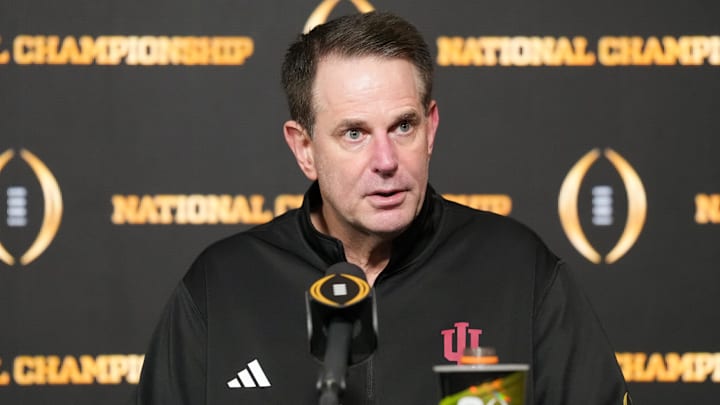
MIAMI — Indiana football coach Curt Cignetti met with the media after the Hoosiers' 27-21 win over Miami in the College Football Playoff National Championship Game on Monday night at Hard Rock Stadium in Miami Gardens, Florida.
Here's what Cignetti told reporters during his postgame press conference. The transcript is courtesy of ASAP Sports.
Opening statement
CURT CIGNETTI: Okay, hard-fought game. Give a lot of credit to Miami. It was a real gut check. We found a way. It's a credit to our guys' resiliency to find a way to get that done.
It's a great thing, Indiana winning the National Championship two years into our tenure. You do it with people and a plan. Can't say enough about our senior leadership and the people we have in the locker room and the people we have on our staff and our strength and conditioning staff, support staff and the commitment we receive from President Whitten and Scott Dolson.
I would like to say our NIL is nowhere near what people think it is, so you can throw that out (laughter), and this team really overcame a lot on the road in a lot of tight games and found a way to get it done, and we're 16-0, and I guess we're 27-2 since Indiana. But we're 16-0, national champions at Indiana University, which I know a lot of people thought was never possible. It probably is one of the greatest sports stories of all time. But it's all because of these guys and the staff.
Proud of them, and it's a great night.
Q. With that nine-minute-to-go-decision field goal, the field goal team went out, you brought them back. What was the thought process there in going for it and the play call?
CURT CIGNETTI: I think we had gone for it on 4th down maybe the series before, too, or maybe it was that series. We finally came up with some ways to give the quarterback a chance to get the ball out of his hand because we were having some protection issues.
That particular play didn't feel really good about kicking a field goal there. The play before they were in the coverage for the quarterback draw, which we put in specifically in the medium package in the low red against that look. We had to block a little different than we normally do, and that was about a 45-minute discussion in the staff room how we were going to call it and do it.
Line did a great job executing, so did the back, and Fernando trucked the linebacker, broke a few tackles.
Let me tell you, Fernando, I know he's great in interviews and comes off as the All-American guy, but he has the heart of a lion when it comes to competition. That guy competes like a warrior. He got really smacked a few times in this game. That one drive we kicked a field goal, there should have been two roughing the quarterbacks and one high hit to the head that weren't called. I'm all for letting them play, but when they cross the line you've got to call them.
Can't say enough about his effort on that play and our team finding a way to get it done.
Q. Coach Cignetti, you're obviously going to follow your dad into the Hall of Fame one day, but this championship moment was the one thing that escaped both of you. I wonder how much you thought about him on a night like tonight.
CURT CIGNETTI: I thought about him after the game when I stuck my two fingers in the air and then the Big Ten Network asked me about him and I said, oh, you're wanting me to get all choked up, right.
When we went from FCS to FBS in Sun Belt, our first game he was in a coma, and we beat that FBS team 48-10 in the opener. My family told him in the hospital that we had won 48-10, and they said he smiled. And then we had a great win against Appalachian State the week after he died down there after they beat A&M. We were down 28-3 in the second quarter, and came back and won.
Hopefully he was watching today. He was a great role model. I was very blessed to have a father like that.
Q. For Coach and Mikail, you guys have had your starters, All-Americans make plays on punt block all year with D'Angelo. Take us through that play and how important it is to have those guys make plays on special teams?
CURT CIGNETTI: I'll start with a short answer. Ponds was a punt block and he blocked a punt. This was actually a return, and Mikail blocked the punt. We didn't have a punt block called. Ndukwe has done it a couple times as well.
MIKAIL KAMARA: Pretty much there's a punt before we were in defensive safe, and I felt like I was kind of close. So the second time I'm just going to shoot my shot. And I just watched the ball, got off the ball as fast as I could and shot my shot, and I heard that double thud.
CURT CIGNETTI: Very fitting that Isaiah Jones would be on the recovery.
Q. In this sport for the past 25 years, it's been done a certain way to get to this point. You recruit top-5 classes, you get a bunch of five stars, you develop them, you win National Championships. What you guys did is something that really has never been done before. You said at the beginning yourself that no one really believed this could happen. What message did you send to the entire sport by doing what you did, and do you think what you guys did changed the way we should analyze this?
CURT CIGNETTI: I think we sent a message, first of all, to society that if you keep your nose to the grindstone and work hard and you've got the right people, anything's possible. In our particular situation in the athletic world, college football has changed quite a bit. The balance of power, also.
But we have the right people on our staff, in the weight room, in the locker room, and we have great senior leadership and togetherness, and we had a really good quarterback that played his best when the chips were down.
If you prepare the right way, which this team did week in, week out, and put it on the field, we met the challenge every single week, and we're 16-0.
Are there eight first-round draft choices on this team? Probably not, no, there aren't. But this team, the whole was greater than the sum of its parts.
Q. Curt, as a follow-up to what you were just asked, how do you think winning a championship will change the way people view and talk about Indiana football?
CURT CIGNETTI: We're national champs. TCU had a great run a few years ago and fell short. I know Indiana's football history has been pretty poor with some good years sprinkled in there. It was because it wasn't an emphasis on football, plain and simple. Basketball school. Coach Knight had great teams.
The emphasis is on football. It's on basketball, too. But you've got to be good in football nowadays. We've got a president that comes from the South that loves football. We've got an AD that is a tremendous fundraiser, people person.
We've got a fan base, the largest alumni base in the country, Indiana University. They're all in. We've got a lot of momentum.
We've just got to keep working at getting better in all phases that influence the program's success, including the things that happen within the program, stay humble and hungry, and work diligently toward improvement, buy into the process.
What the outside public thinks, we don't control. It's a great story, tremendous story. Most people would tell you that are in the know, it's probably one of the greatest stories of all time in terms of a team that most people -- we got it done.
We're going to enjoy this moment, take a day off tomorrow, get back at it Wednesday. A lot of these guys will be gone. I'll miss them. Hope I can stay connected to them throughout the rest of their lives and put the '26 team together.
Q. For Coach, there are seven players left who came with you from James Madison. I'm curious, what has that group meant, and how did it help set the culture?
CURT CIGNETTI: I think the JMU crew which started at 13 in our first season was very instrumental, especially the guys that came in mid-year. I think there were eight or nine of them, I can't remember for sure, maybe 10 or 11, because they understood the program, the culture, and they had that championship attitude. They were able to answer questions for the guys to decide to return and the right guys returned, and the new transfers, too, they could answer their questions and lead, and they were good players.
I think that accelerated our development as a program. There's no question about it. There were seven more left this year, and they all played a very key pivotal role. I'll miss them. Now I'll defer to you.
Q. You just talked about taking a day off and enjoying it that way and then getting back to work. But other than having a Coors Light in that teal chair, you just made history with a 16-0 national champion. How do you let yourself really enjoy this?
CURT CIGNETTI: Good question, because I'll be dealing with underclassmen going to the NFL tomorrow and who knows what else. And if I was smart, I'd probably retire. Then I'd really be a story. But we need the money. (Laughter.) What would I do? What would I do?
I don't know if I'll have a beer in the teal chair. I had one after the game. That's enough for me.
We'll be back at it. I love what I do. I love football. I'm a football guy. I don't have many other things that I do besides family, and in the summer go for a walk with my wife or go away, in February, the old signing date, first day after the old signing date. I'm a film junkie and I like putting a team together and we're going to have a lot of challenges next season.
But I will have a chance to look back at what we got done.
These guys made it happen. Let me tell you, we had some good senior leadership on this team. Nowakowski, Coogan, Fisher, Kamara, Sarratt. We got some underclassmen that are going to be going out, Fernando, could be another one or two.
But the seniors, this team was so close, so close. When you have this much success year in and year out, your teams are always close. But this team was exceptionally close. And I think Fernando had a big part of that, and I think Coogan and Fisher and going on the road with some of those guys -- the Penn State game, what that did for this team, I can't measure, when we were down and out and all the odds were against us, 2nd and 17, running clock, minute 30, and all of a sudden we recomposed and found a way to get that done. That was incredible.
Q. Coach, this is obviously a little bit of a different blueprint from what we've seen in college football based on both your career arc and how this team was assembled. Do you think this opens the door for a different kind of coach to have an opportunity going forward, or maybe some non-traditional hires that we might see in the sport?
CURT CIGNETTI: I think it already has, and you see that in this year's hiring process, but there's a number of guys out there that kind of started out at D-II and worked their way to this position. My career path was certainly unusual, but I think it prepared me for this particular opportunity, and I guess my answer is yes.
Q. You said you had a beer after the game. What was the beer, and was it the best beer of your life?
CURT CIGNETTI: Hoosier beer from Upland Brewery, big brewery up in Indiana. Throw a little bouquet to them. Yeah, this was absolutely the best beer I've ever had in my life, and made me want to have another.
Q. 16 years ago I had the pleasure of asking a native son of West Virginia if he ever envisioned as a young boy winning championships. I ask you as a young boy growing up, did you ever envision winning championships at this level of college football?
CURT CIGNETTI: I knew in third grade I wanted to coach. I've told that story many a time. I wanted to be like a Bear Bryant kind of coach. But when I was waxing staff tables at IUP when school was shut down for the playoffs, I never really thought this was possible. But I just kept working and things happened, and here we are.
Q. You were a successful football coach for 40-plus years before you got your shot at the, quote-unquote, big time. Was it hard not to be bitter about not getting that opportunity, and does it make a moment like this all the more sweeter? Are there lessons people can take away from this?
CURT CIGNETTI: I really wasn't a successful coach for 40-plus years. I got a great break at 23 years old at Rice University, which back then was in the Southwest Conference. We played SMU before they got the death penalty, and I was making good money.
It was one of the top two conferences in the country, but Rice didn't win, and Temple didn't win, and we didn't win at Pitt under Johnny Majors, and people want to hire people from winning programs. We won a little bit under Walt Harris, but we were .500. I learned a lot about quarterback play from him. He was a great quarterback coach. Went to NC State, we won. We had Philip Rivers. And then I spent seven years there.
But when Coach Saban hired me, we were 7-6 our first year at Alabama. We lost to Louisiana Monroe 11th game of the year at home. But the next year we had six first-round draft choices in that recruiting class, and we were 12-0 in the regular season. Lost the SEC game that was one versus two to Tebow and Urban. Next year we played them again, beat them, went 14-0 and won the National Championship.
I really thought after my one year with Nick, I had what I needed to go out -- that tied it together for me because I was a son of a coach who was a Hall-of-Fame head coach.
I was hitting the big 5-0. I didn't want to be a career assistant. I was not a coordinator. I was not on track to get a head coaching job, and I didn't want to be a 60-year-old assistant. I'd seen what those lives look like as a kid.
So I took a chance. Took an unprecedented chance in this business and ended up here. When I took that job, the goal wasn't to end up here, but I did.
The reason I'm sitting here today -- all those things prepared me for this, but the reason I'm sitting here today is because of guys like this, and there's a ton of them in that locker room, and a great coaching staff and a lot of us have been together a long time, a great strength and conditioning staff, a commitment from the president and AD, and then the changing times of athletics. Some of my previous experiences really helped me be ready to manage NIL and transfer portal and those kind of things.
 Add us as a preferred source on Google
Daniel Flick is a senior in the Indiana University Media School and previously covered IU football and men's basketball for the Indiana Daily Student. Daniel also contributes NFL Draft articles for Sports Illustrated, and before joining Indiana Hoosiers ON SI, he spent three years writing about the Atlanta Falcons and traveling around the NFL landscape for On SI. Daniel will cover Indiana sports once more for the 2025-26 season.