%22%3E%0A%3Cpath%20d%3D%22M0%209.69043H5.34889V25.7008H0V9.69043Z%22%20fill%3D%22white%22%2F%3E%0A%3Cpath%20d%3D%22M7.18359%2013.2135H12.3781V14.948C13.1773%2013.9218%2014.4396%2012.9138%2016.2013%2012.9138C18.8349%2012.9138%2020.4786%2014.6483%2020.4786%2017.4636V25.7003H15.2841V19.1345C15.2841%2018.0629%2014.6393%2017.4454%2013.8674%2017.4454C13.0955%2017.4454%2012.3781%2018.0629%2012.3781%2019.1345V25.7003H7.18359V13.2135Z%22%20fill%3D%22white%22%2F%3E%0A%3Cpath%20d%3D%22M21.6587%2019.5434V19.498C21.6587%2015.5385%2024.038%2012.914%2026.9894%2012.914C28.8874%2012.914%2029.9408%2013.7404%2030.74%2014.6304V9H35.9345V25.7005H30.74V24.1658C29.8954%2025.083%2028.9328%2025.9911%2027.0348%2025.9911C24.0108%2025.9911%2021.6587%2023.3576%2021.6587%2019.5434ZM30.8581%2019.4798V19.4344C30.8581%2018.1994%2029.9681%2017.1913%2028.7784%2017.1913C27.5888%2017.1913%2026.6988%2018.1721%2026.6988%2019.4344V19.4798C26.6988%2020.7421%2027.5888%2021.7229%2028.7784%2021.7229C29.9681%2021.7229%2030.8581%2020.7421%2030.8581%2019.4798Z%22%20fill%3D%22white%22%2F%3E%0A%3Cpath%20d%3D%22M37.5337%209H42.9098V12.3147H37.5337V9ZM37.6245%2013.2137H42.819V25.7005H37.6245V13.2137Z%22%20fill%3D%22white%22%2F%3E%0A%3Cpath%20d%3D%22M44.0259%2022.1496V22.1042C44.0259%2019.6159%2045.8785%2018.2174%2048.7845%2018.2174C49.8379%2018.2174%2051.182%2018.4444%2051.7359%2018.6714V18.4626C51.7359%2017.3183%2051.0276%2016.6554%2049.4293%2016.6554C48.1488%2016.6554%2047.0772%2016.9278%2045.9784%2017.3637L45.0611%2013.9128C46.5051%2013.3679%2048.1488%2012.9956%2050.3192%2012.9956C52.862%2012.9956%2054.5057%2013.5223%2055.6046%2014.6212C56.5399%2015.5565%2056.9123%2016.7734%2056.9123%2018.5806V25.6913H51.7178V24.429C50.8459%2025.3644%2049.6835%2025.9819%2048.1306%2025.9819C45.7332%2025.9819%2044.035%2024.6106%2044.035%2022.1405L44.0259%2022.1496ZM51.7813%2021.078V20.5513C51.4816%2020.4332%2051.0276%2020.3424%2050.5917%2020.3424C49.5655%2020.3424%2048.9934%2020.9599%2048.9934%2021.7409V21.7863C48.9934%2022.5219%2049.5201%2023.0032%2050.183%2023.0032C51.1002%2023.0032%2051.7813%2022.2676%2051.7813%2021.078Z%22%20fill%3D%22white%22%2F%3E%0A%3Cpath%20d%3D%22M58.4653%2013.2135H63.6598V14.948C64.459%2013.9218%2065.7213%2012.9138%2067.4831%2012.9138C70.1167%2012.9138%2071.7604%2014.6483%2071.7604%2017.4636V25.7003H66.5659V19.1345C66.5659%2018.0629%2065.9211%2017.4454%2065.1492%2017.4454C64.3773%2017.4454%2063.6598%2018.0629%2063.6598%2019.1345V25.7003H58.4653V13.2135Z%22%20fill%3D%22white%22%2F%3E%0A%3Cpath%20d%3D%22M72.832%2022.1496V22.1042C72.832%2019.6159%2074.6846%2018.2174%2077.5906%2018.2174C78.6441%2018.2174%2079.9881%2018.4444%2080.5421%2018.6714V18.4626C80.5421%2017.3183%2079.8337%2016.6554%2078.2354%2016.6554C76.9549%2016.6554%2075.8834%2016.9278%2074.7845%2017.3637L73.8673%2013.9128C75.3112%2013.3679%2076.9549%2012.9956%2079.1254%2012.9956C81.6681%2012.9956%2083.3119%2013.5223%2084.4107%2014.6212C85.3461%2015.5565%2085.7184%2016.7734%2085.7184%2018.5806V25.6913H80.5239V24.429C79.6521%2025.3644%2078.4897%2025.9819%2076.9368%2025.9819C74.5393%2025.9819%2072.8411%2024.6106%2072.8411%2022.1405L72.832%2022.1496ZM80.5784%2021.078V20.5513C80.2787%2020.4332%2079.8246%2020.3424%2079.3887%2020.3424C78.3626%2020.3424%2077.7904%2020.9599%2077.7904%2021.7409V21.7863C77.7904%2022.5219%2078.3171%2023.0032%2078.9801%2023.0032C79.8973%2023.0032%2080.5784%2022.2676%2080.5784%2021.078Z%22%20fill%3D%22white%22%2F%3E%0A%3Cpath%20d%3D%22M93.3018%209.69043H98.6506V15.339H103.545V9.69043H108.894V25.7008H103.545V19.9614H98.6506V25.7008H93.3018V9.69043Z%22%20fill%3D%22white%22%2F%3E%0A%3Cpath%20d%3D%22M110.292%2019.4978V19.4524C110.292%2015.9288%20113.217%2012.9138%20117.34%2012.9138C121.462%2012.9138%20124.341%2015.8834%20124.341%2019.407V19.4524C124.341%2022.9759%20121.417%2025.9909%20117.294%2025.9909C113.171%2025.9909%20110.292%2023.0213%20110.292%2019.4978ZM119.356%2019.4978V19.4524C119.356%2018.2173%20118.438%2017.2365%20117.294%2017.2365C116.15%2017.2365%20115.278%2018.2173%20115.278%2019.407V19.4524C115.278%2020.6874%20116.195%2021.6682%20117.34%2021.6682C118.484%2021.6682%20119.356%2020.6874%20119.356%2019.4978Z%22%20fill%3D%22white%22%2F%3E%0A%3Cpath%20d%3D%22M125.204%2019.4978V19.4524C125.204%2015.9288%20128.128%2012.9138%20132.251%2012.9138C136.374%2012.9138%20139.252%2015.8834%20139.252%2019.407V19.4524C139.252%2022.9759%20136.328%2025.9909%20132.205%2025.9909C128.082%2025.9909%20125.204%2023.0213%20125.204%2019.4978ZM134.267%2019.4978V19.4524C134.267%2018.2173%20133.35%2017.2365%20132.205%2017.2365C131.061%2017.2365%20130.189%2018.2173%20130.189%2019.407V19.4524C130.189%2020.6874%20131.106%2021.6682%20132.251%2021.6682C133.395%2021.6682%20134.267%2020.6874%20134.267%2019.4978Z%22%20fill%3D%22white%22%2F%3E%0A%3Cpath%20d%3D%22M139.507%2024.1837L141.269%2021.2323C142.776%2022.1677%20144.474%2022.6308%20145.891%2022.6308C146.39%2022.6308%20146.645%2022.5128%20146.645%2022.2222V22.1768C146.645%2021.9225%20146.418%2021.7681%20145.155%2021.4412C141.995%2020.6602%20140.052%2019.8156%20140.052%2017.2365V17.1911C140.052%2014.4486%20142.249%2012.9138%20145.491%2012.9138C147.553%2012.9138%20149.587%2013.4405%20151.095%2014.3577L149.451%2017.4454C148.125%2016.7098%20146.527%2016.283%20145.473%2016.283C144.974%2016.283%20144.738%2016.4192%20144.738%2016.6735V16.7189C144.738%2016.9732%20145.01%2017.1275%20146.272%2017.4545C149.433%2018.2355%20151.331%2019.0982%20151.331%2021.6591V21.7045C151.331%2024.4289%20149.296%2026%20145.909%2026C143.484%2026%20141.287%2025.3825%20139.507%2024.1928V24.1837Z%22%20fill%3D%22white%22%2F%3E%0A%3Cpath%20d%3D%22M152.448%209H157.824V12.3147H152.448V9ZM152.539%2013.2137H157.733V25.7005H152.539V13.2137Z%22%20fill%3D%22white%22%2F%3E%0A%3Cpath%20d%3D%22M159.041%2019.525V19.4796C159.041%2015.7563%20161.72%2012.9138%20165.471%2012.9138C169.902%2012.9138%20171.964%2016.0015%20171.964%2019.7975C171.964%2020.0699%20171.964%2020.3968%20171.946%2020.6693H163.918C164.281%2021.7681%20165.153%2022.3402%20166.27%2022.3402C167.205%2022.3402%20167.986%2021.9043%20168.813%2021.0598L171.6%2023.2756C170.365%2024.8739%20168.604%2026%20165.906%2026C161.811%2026%20159.041%2023.4118%20159.041%2019.525ZM167.223%2018.3808C167.105%2017.1911%20166.397%2016.5009%20165.489%2016.5009C164.581%2016.5009%20163.999%2017.2365%20163.845%2018.3808H167.232H167.223Z%22%20fill%3D%22white%22%2F%3E%0A%3Cpath%20d%3D%22M173.198%2013.2137H178.393V15.7292C179.101%2014.0401%20180.245%2012.9413%20182.307%2013.0321V18.5444H181.762C179.564%2018.5444%20178.402%2019.7523%20178.402%2022.5221V25.7005H173.207V13.2137H173.198Z%22%20fill%3D%22white%22%2F%3E%0A%3Cpath%20d%3D%22M182.389%2024.1837L184.151%2021.2323C185.658%2022.1677%20187.357%2022.6308%20188.773%2022.6308C189.273%2022.6308%20189.527%2022.5128%20189.527%2022.2222V22.1768C189.527%2021.9225%20189.3%2021.7681%20188.038%2021.4412C184.877%2020.6602%20182.934%2019.8156%20182.934%2017.2365V17.1911C182.934%2014.4486%20185.132%2012.9138%20188.374%2012.9138C190.435%2012.9138%20192.469%2013.4405%20193.977%2014.3577L192.333%2017.4454C191.007%2016.7098%20189.409%2016.283%20188.356%2016.283C187.856%2016.283%20187.62%2016.4192%20187.62%2016.6735V16.7189C187.62%2016.9732%20187.892%2017.1275%20189.155%2017.4545C192.315%2018.2355%20194.213%2019.0982%20194.213%2021.6591V21.7045C194.213%2024.4289%20192.179%2026%20188.791%2026C186.367%2026%20184.169%2025.3825%20182.389%2024.1928V24.1837Z%22%20fill%3D%22white%22%2F%3E%0A%3Cpath%20fill-rule%3D%22evenodd%22%20clip-rule%3D%22evenodd%22%20d%3D%22M203.99%204.36764C209.813%20-1.45588%20219.254%20-1.45588%20225.078%204.36764C230.901%2010.1912%20230.901%2019.6324%20225.078%2025.4559L214.534%2036L203.99%2025.4559C198.166%2019.6324%20198.166%2010.1912%20203.99%204.36764ZM206.631%207.55761C206.57%207.86849%20206.538%208.39718%20206.538%209.14566V10.4189C206.538%2011.1832%20206.57%2011.7198%20206.635%2012.0267C206.7%2012.3317%20206.9%2012.6168%20207.239%2012.8762C207.578%2013.1376%20208.025%2013.3316%20208.58%2013.4623C209.134%2013.593%20209.722%2013.6584%20210.459%2013.6584C211.195%2013.6584%20211.839%2013.591%20212.391%2013.4524C212.944%2013.3158%20213.383%2013.1178%20213.708%2012.8604C214.033%2012.6029%20214.227%2012.3178%20214.288%2012.0069C214.35%2011.6961%20214.381%2011.1674%20214.381%2010.4189V9.14566C214.381%208.38134%20214.35%207.84473%20214.284%207.53781C214.219%207.23287%20214.019%206.94971%20213.68%206.68834C213.342%206.42696%20212.894%206.23291%20212.34%206.10223C211.785%205.97154%20211.158%205.90619%20210.461%205.90619C209.724%205.90619%20209.081%205.97352%20208.528%206.11213C207.974%206.24875%20207.536%206.44677%20207.211%206.70418C206.887%206.9616%20206.693%207.24673%20206.631%207.55761ZM211.898%2024.8638C215.498%2024.8638%20217.179%2024.2064%20217.179%2021.862V21.858V21.3155C217.179%2019.6581%20216.138%2018.971%20212.874%2018.3136C211.9%2018.1136%20211.53%2017.9136%20211.53%2017.3136V16.9414C211.53%2016.6543%20211.799%2016.5117%20212.035%2016.5117C212.372%2016.5117%20212.54%2016.7137%20212.54%2016.9414V18.1136H217.013V17.3988C217.013%2015.4563%20215.969%2014.4266%20211.799%2014.4266C208.772%2014.4266%20206.518%2015.3414%20206.518%2017.3711V17.7433C206.518%2019.5155%20207.427%2020.3155%20210.823%2021.0303C210.902%2021.0472%20210.978%2021.063%20211.049%2021.0781C211.951%2021.2674%20212.269%2021.3341%20212.269%2021.9174V22.2897C212.269%2022.6619%20212.168%2022.8045%20211.764%2022.8045C211.292%2022.8045%20211.259%2022.5471%20211.259%2022.262V21.2897H206.516V21.7471C206.516%2024.149%20208.098%2024.8638%20211.898%2024.8638ZM218.047%2024.5569H222.547V14.7355H218.047V24.5569ZM219.577%2013.5019H222.547V6.06064H219.714V9.411L217.815%206.06064H214.981V13.5019H217.815V10.1199L219.577%2013.5019ZM210.891%2012.152C210.826%2012.2688%20210.677%2012.3262%20210.447%2012.3262L210.449%2012.3282C210.226%2012.3282%20210.081%2012.2767%20210.02%2012.1758C209.958%2012.0748%20209.927%2011.8074%20209.927%2011.3758V7.90068C209.927%207.51852%20209.974%207.28684%20210.067%207.20962C210.16%207.13239%20210.297%207.09279%20210.473%207.09279C210.681%207.09279%20210.82%207.14031%20210.887%207.23734C210.954%207.33239%20210.988%207.55416%20210.988%207.90068V11.3203C210.988%2011.7579%20210.956%2012.0352%20210.891%2012.152Z%22%20fill%3D%22white%22%2F%3E%0A%3C%2Fg%3E%0A%3Cdefs%3E%0A%3CclipPath%20id%3D%22clip0_15185_22842%22%3E%0A%3Crect%20width%3D%22230%22%20height%3D%2236%22%20fill%3D%22white%22%2F%3E%0A%3C%2FclipPath%3E%0A%3C%2Fdefs%3E%0A%3C%2Fsvg%3E%0A)
Meet Joey Buttler, Indiana Wrestling's Crazy Man — and All-American Hopeful
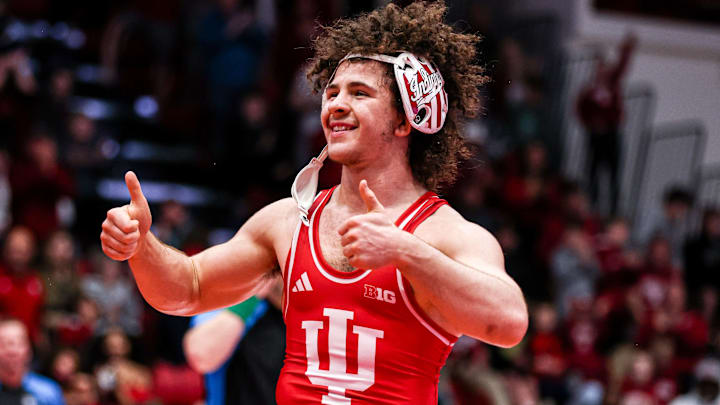
BLOOMINGTON, Ind. — He drinks raw milk — and if you visit his apartment, he’ll make you drink it, too. Just ignore the big, bold letters on the carton that says “NOT FOR HUMAN CONSUMPTION.” He eats cow intestines. He sleeps on the floor, next to a mattress only used by friends. He touches trees for fun and walks around barefoot. The last time he had a haircut, he cried. That was six years ago, maybe seven, but it still traumatizes him.
He owns a Katana. His water is so salty his teammates cringe every time they taste it. One of his most exciting Christmas presents this past year was a sticker that blocks electromagnetic waves from radiating. He attaches the sticker to his phone each night, right around when he turns off his Wi-Fi, to prevent REM sleep disruption.
Joey Buttler is the college version of the Dos Equis guy, the most interesting man in the world.
“I call it weird shit,” his hometown trainer, Brandon Wright, said. “But, like, it's Joey. So, I trust it. I know it's beneficial for the body and for the mind.”
It’s been nearly five years since Buttler discovered, in his mind, these secret health benefits. The 15-year-old from Greenwood, Ind., turned questions from parents and coaches into an exposé, a chance to preach his new gospel. “You've got to start doing this,” he’d tell his friends, classmates, teammates and anybody else who was willing to listen.
Buttler no longer expects you to follow his wild ways. He just wants you to listen, think and open your eyes. Because maybe then, you’ll understand this universe isn’t so bizarre after all. A disciple of health and fitness influencer Liver King, Buttler has always been earthly, and he’s always been different. He’s also, for as long as he’s been wrestling, had to play catch-up.
Wrestling, Indiana coach Angel Escobedo says, is an extremist sport, and Joey Buttler is on the extreme end of the extremist minority. When Buttler found wrestling, he found his comfort zone. He found himself.
And he’s turned this weird little universe into a lifestyle Indiana hopes will deliver its next All-American.
***
It started with a 13-year-old who just wanted to get out of art class.
Buttler had officially closed the book on the first 13 years of his athletic life the night before, when he was cut from the basketball team. He’d long since thrown in the towel on football, baseball and soccer. Buttler enjoyed sports, starting with T-ball as a 4-year-old, but he hadn’t found his fit.
Sitting in Mrs. Bauer’s art class at Clark-Pleasant Middle School, pondering what his next great ambition should be, Buttler found his solution bellowing from the intercom system.
If you are interested in going to the wrestling call-out meeting, go to the cafeteria.
At first, Buttler wasn’t interested. His family has no wrestling background and he’d only tried team sports. But one of his friends stood up and left, and Buttler found it a more intriguing alternative than artwork. Buttler liked the coach’s words, and he liked the students who showed up in the cafeteria. Wrestlers have a unique archetype, and Buttler felt he belonged within it. This sport and these kids, he decided, suited him.
Renee Buttler, Joey’s mom, had reservations. “Maybe wrestling's a little dangerous,” she said. “But okay, we'll give it a try and we'll see.” Soon, she saw Joey lose — often, and convincingly. He went 6-31 in his first season as a seventh grader.
But she also saw him fall in love with the sport. She saw him break free from insecurities. And perhaps most important for a 13-year-old kid on a mission of self-discovery, Renee saw Joey start building a foundation for who he’d ultimately become. Renee kept her three children in the school’s band until they found their niche. Joey, despite his lack of immediate success, ditched the trumpet in eighth grade.
On the mat, he never expected to win. He knew he was years behind his peers, and he thought his ceiling was capped as a middle-of-the-road wrestler. Then he met Brandon Wright.
A two-time national champion at Indiana and a member of the United States’ world wrestling team, Wright became Buttler’s club coach in eighth grade. Wright knew Buttler’s background and how little experience he carried, so the two-time state champion tailored his approach. Wright didn’t sell Buttler on a dream of being an overnight sensation. He told the truth.
“Your story isn't going to be like everyone else's,” Wright told him. “You're not here to win the 14-year-old state championships, this, that and the other. You're here to show people who do start when you start, what you can do if you want to do it.”
The only redeeming quality Buttler had on his first day of training, Wright remembers, was his mindset. He had poor balance, wasn’t strong, wasn’t quick. But he had a hunger. He was willing to suffer.
There may be no better loser than Joey Buttler, whose start to the sport was rooted in loss. If he couldn’t handle losing, he wouldn’t have lasted. So, he absorbed it, thought about ways to improve and cared enough to fix it. Buttler never ran from it. He didn’t miss practice, even the days as an eighth grader when he battled through a compression fracture in his lower back.
Wright knew Buttler’s mind and work ethic would take him far. How far, exactly, Wright didn’t know until two years after he met Buttler. As a sophomore at Whiteland Community High School, Buttler qualified for the Indiana state tournament. To Wright, that showed Buttler had a future as a college wrestler, be it NAIA, Division III or higher.
His stock soared on the way to the Indiana state finals his junior year. Then, the boy who’d grown so numb to losing earlier in his career felt his biggest pain.
Buttler lost his championship match. It was, in his words, one of the coolest times of his life. But it was also one of the most important.
Instead of sulking, Buttler went back to practice the next day. He was upset, angered, sad. But he was more driven than ever. He’d finally caught up to, if not passed, his peers. His alternative methods had led him to glamorous heights. Soon, they’d lead him to Indiana — and before that, another shot at a championship.
***
He’d spend four hours in his room every night, pedaling away on a recumbent bike, sweating for a weight class or two below the one he belonged. He knew it wasn’t right — not sleeping the night before competition, sometimes wrestling while nearing 50 hours without rest — but he thought it was his best ticket to stardom.
To help the time pass faster, Joey Buttler bought a Flo Wrestling subscription and pored through documentaries. While he pedaled, he learned about Kyle Dake, a four-time NCAA champion and Olympic medalist, and the strange habits behind his success. He had a copper wire next to his bed. He walked outside shirtless and barefoot. He did weird exercises, drank filtered water and ate seasonally.
Buttler never stopped to ask himself if any of Dake’s methods were logical.
“In my mind, there was nothing I could have done more in that moment,” Buttler said. “It just made sense. I was just like, ‘Oh, yeah, obviously. That's what you should be doing.’”
The habits became central to his personality. He started looking at foods differently and changed his approach to eating.
Raw milk was the first infatuation to emerge. Renee had questions, but her parents grew up on a farm, and drinking raw milk was common before mass pasteurization. She knew it wouldn’t kill Joey, so long as he got it from the right source.
Buttler gets his milk from Bloomingfoods. It’s in a fridge at the end of Aisle 6, which starts with dog food and ends with ice cream and frozen pizzas. “All praise the Amish, he says. Technically, stores aren’t allowed to sell it for human consumption, so they put labels that say, ‘Treats for Cats & Dogs.’
Buttler is unfazed. He actually thinks it’s one of the tamer things he does.
“Most people's perception of it is like, ‘What? Why do you do it?’” Buttler said. “There's a lot of propaganda in the world, so a lot of people just think that's like the nastiest thing you can do. And it's like, there's a lot worse stuff that you're doing every day probably, way worse than drinking raw milk, right?”
Dietary changes followed. Renee often cooked organ meats and other grass-fed, pasture-raised meals. Joey is part Lebanese and Mediterranean — his grandmother occasionally cooked Kibbeh nayyeh, which is raw meat only available at special stores. But Dake’s methods required more commitment. Nowadays, Buttler tries to cook his meat less and less. Perhaps, he spitballs, he’ll eventually reach a point where he eats meat entirely raw.
Buttler’s stomach can handle things others can’t even comprehend. Before a high school state tournament match, Buttler ate cow intestines. Indiana’s coaches didn’t take the hint.
“People do extreme shit to win. So, I was like, ‘Maybe he's just doing a little bit to win,’” Escobedo said. “But then now I'm like, ‘Oh no, that was just him.’”
Around that same time, Buttler embraced grounding, the art of gaining free electrons and killing inflammation within the body by touching nature. Buttler likes to walk up to trees and put his hands on them at least once a day. He likes to walk barefoot in the grass, because it helps activate the nerves within the foot. When the weather is nice, he prefers going shoeless. It helps foot posture — look at the feet of indigenous tribe members, Buttler says, and you’ll see their feet resemble hands.
Western medicine pushed civilization away from such habits. Buttler is fighting back.
He’s doing the same with water. Before society developed, most water had additional minerals. Now, water is stripped of everything to keep it clean. This had to happen, Buttler said, for humans to exist and live healthily. But he enjoys the salt. When he was in high school, he’d drink 16 pounds of water each day — water-loading after sweating from wrestling — but was always dehydrated and battled headaches. He started adding salt, which gives electrolytes through minerals, and his headaches went away.
He stopped using his bed two years ago. Buttler battles back pain, which he attributes to a trampoline injury from third grade—”some kid tombstone piledrivered me, you know what I mean?”—so he often sleeps on his stomach.
Buttler still owns a mattress, but he never uses it. He begrudgingly uses a pillow. He sleeps on the floor in hotels, too, during road trips, and his travel bag is the biggest on the team. Currently, he sleeps on top of three blankets, but he’s looking into a two-inch quasi-mattress used in Japan, where floor sleeping is more common.
But he doesn’t get on the floor until he turns off the 5G Wi-Fi in his apartment. The radiation it produces isn’t good for human bodies, Buttler says, and has proven to cause cancer in both men and women.
Buttler often gets questions about these things. His answers have won over a few curious individuals. Escobedo has started grounding. Wright has picked up the organs and Wi-Fi blocking. Renee, along with Joey’s younger brother, Michael, drinks raw milk.
The Wi-Fi decision occasionally creates dilemmas. Renee tries not to call her son at night. Buttler has overslept before, Escobedo said, and scared Indiana’s coaching staff.
“You're like, ‘How am I gonna get a hold of this guy?’ It's like you gotta send a pigeon to get him,” Escobedo said. “Like, does he need help? Is he at the hospital? You just never know.”
Unpredictability is as much Buttler’s identity as wrestling, or as his crazy, curly black hair that’s only been trimmed — not cut — in the past six years.
Next year, at the end of his redshirt junior season, Buttler wants to conquer his demons. He hopes he’s in a barber’s chair, poised to shave his head. He’ll do so as long as he’s checked the last box on his to-do list: win an NCAA championship.
“If you went into a coma and you woke up in a year and I was bald,” Buttler said, “you would know that I won.”
***
After Buttler’s loss in the state finals his junior year, Wright made a song: “You think you got what it takes?”
It’s a motivational mantra, something for his young wrestlers to hear before taking the mat. The song is about himself. Wright, too, lost in the state finals. He won it the next year. He had to feel defeat to level up.
Buttler embraced it. His response to his most painful defeat — a 44-0 record and state championship as a senior — solidified his spot as a Division I wrestler. Indiana called, and Buttler decided to stay home. Escobedo knew Buttler was raw, perhaps rawer than his record indicated, but the Hoosiers bet on the work ethic and mentality that beamed during Buttler’s earlier years in the sport.
“He was losing,” Escobedo said, “but he had a great mindset while losing. He was constantly coming back, and constantly getting taken down, constantly getting back up. And you can work with that. Eventually, that's going to turn into something, and it has.”
Buttler redshirted his first year at Indiana, going 9-5 in open competitions, and took a step forward in his second, compiling a 20-13 record while competing in both the 141 and 149-pound weight classes. The end of his 2024-25 season gave Buttler his first introduction to the spotlight.
On the backside of the Big Ten Tournament, far away from the championship side, Buttler jumped over a Michigan State wrestler, then did a back flip, then pinned him. Fans in the stadium gave Buttler a standing ovation. The clip went viral.
Joey Buttler, nothing if not crazy or innovative, routinely jumps over assistant coach Mike Dixon at practice despite a seven-inch height difference. But this one stunned even his closest onlookers.
“It was incredible,” Escobedo said. “We've never seen anything like it.”
In the ensuing summer, Buttler started working closely with Escobedo in one-on-ones. The coach saw daily progress. The lightbulb turned on. A big leap followed. Buttler became a full-time starter in the 2025-26 season, and while he went only 10-14, he secured three ranked wins. He faced tougher competition and sniffed what it would take to be a champion.
Now, Indiana expects elevation. And Buttler expects his final haircut.
“I think maybe I'll win a national title next year,” Buttler said, “and then I might go bald and then I'll never cut it again for, like, the rest of my life. But I don't know. I have to think on it and meditate on it a lot because I don't know if I can see myself getting rid of my hair.”
The hair — and potential cut — is the only topic Buttler remains skeptical about in that statement. Wright believes Buttler has the mental strength and support system to be a champion, and Indiana won’t dim his light, either. Escobedo said he’ll never put self-imposed limitations on his athletes, and Buttler’s shown enough glimpses of greatness to dream big for his final two years.
“I think he's hungrier than ever and the sky's the limit for him,” Escobedo said. “Like, why not him?”
***
The rep, for all intents and purposes, was over. He was pinned on the receiving end of a takedown from one of his Indiana teammates, held against his will and trending toward defeat. To escape would take a crazy man. A man unafraid to meet failure.
Or maybe it doesn’t take a man at all. It takes a weasel. There’s a miniscule weasel population in Bloomington, but there’s at least one on the Indiana wrestling mats: Joey Buttler.
“You can have Joey dead to rights, but he will weasel his way out,” Escobedo said. “You're just like, ‘How did that just happen?’ He could just find a way to sliver his way through. He just weasels out.”
In honor of a Conor McGregor comment from 2017 in which he referred to an opponent as a “f—ing weasel,” Buttler and his high school teammates gave the same affectionate nickname to each other. One day, before practice, Buttler showed his teammates a video of a weasel war dance.
“It's just instigating at a master level,” Buttler said. “They're just trying to rile each other up. And they just start jumping around doing this wild shit.”
Teammates interrupted.
“That's like how you wrestle,” they said. “You're the weasel. You are a weasel.”
The nickname hasn’t followed Buttler to Indiana, but the habits have. Weasels don’t cook their meat or get haircuts or sleep on beds. Neither does Buttler. He’ll forever have that as part of his identity.
But Buttler feels he’s more than a primal being, an obligate carnivore. He’s a life-lesson.
“A lot of people think I do weird, kind of alternative things. I for sure do, but I think those were always trying to help me catch up. I always needed that extra inch because I didn't wrestle for as long as these other kids,” Buttler said. “I think wrestling serves to prove that it doesn't matter. As long as you like it, you're just going to be able to go do it.”
Buttler has dreams beyond championships. He’s a community health major in Indiana’s O’Neill School of Public and Environmental Affairs. He’s starting a herbal tea business and is trying to get his social media page — full of videos highlighting his off-mat lifestyle — off the ground. He wants to get into coaching and help people take control of their health. Wright often jokes Buttler will run for president and get into politics some day.
“We need more Joey Buttler's out here,” Wright said. “Less judgmental, very experimental and willing to help people when they need it.”
This is Joey Buttler, the world’s most interesting man, Bloomington’s deepest thinker and Indiana wrestling’s biggest innovator — with nothing but three blankets and a pillow separating this All-American hopeful from a concrete floor and the dreams that, somehow, someway, keep becoming reality.
 Add us as a preferred source on Google
Daniel Flick is a senior in the Indiana University Media School and previously covered IU football and men's basketball for the Indiana Daily Student. Daniel also contributes NFL Draft articles for Sports Illustrated, and before joining Indiana Hoosiers ON SI, he spent three years writing about the Atlanta Falcons and traveling around the NFL landscape for On SI. Daniel will cover Indiana sports once more for the 2025-26 season.