
Assessing K-State's offense through three games, including positives and where the Wildcats must improve
In this story:
Kansas State has scored 30-plus points in each of its three games, and has averaged nearly 3.9 points per drive, which is a fantastic number. They’re doing what ultimately matters, which is putting points on the board and winning games.
But there are a couple concerning trends that are not sustainable and must improve if the Wildcats are going to reach the level of success they hope to in league play. Let’s start there before we get to the positives.
K-State's offense leads the country in third-down conversion rate at 67.4%. How is that a negative? The rate of success on third down is obviously not the problem. That’s fantastic and a huge credit to quarterback Avery Johnson for making plays in key moments on third down, as well as head coach Collin Klein for dialing up the right plays in these situations.
However, the trend is not sustainable–and yes, I understand a 67% conversion rate is not realistic for any team. The nation’s leader in each of the past two seasons has been just over 56%. K-State is being forced into converting a significant volume of third-and-longs. Over the past two games, the Wildcats have achieved first downs on 20 of 30 (66.7%) third-down situations with the first team offense on the field (this excludes the kneel down to end the game against Tulane). However, 14 of those 20 conversions (70%) came on third-and-5 or longer.
Against Washington State, K-State converted 10-of-15 third downs with the first unit, but the Wildcats needed 6.2 yards on average on those 15 third-down opportunities . K-State’s 10 third-down conversions averaged 6 yards or more against the Cougars.
K-State needed 5 yards or more on nine of 15 third downs against Tulane, and they converted six of them. Again, it’s impressive the Wildcats have overcome these down and distances at such a high rate over the past two weeks, but it’s unsustainable heading into Big 12 play starting next Saturday at Cincinnati.
The Wildcats need to be better on first and second down, and that starts with the offensive line and the ground game. I know it sounds crazy to criticize a running game that’s No. 9 nationally with 269 yards per game on the ground, and ranks No. 10 in the country at 6.7 yards per carry.
But K-State’s running backs have mostly been bottled up the past two weeks outside of just a few explosive runs, including a 75-yard touchdown by Rodney Fields Jr. against Washington State as well as a 35-yard run by Joe Jackson against the Cougars. Fields Jr. and Jackson have combined for 42 carries over the past two games. Thirty-six of those 42 carries (86%) have gone for 4 yards or less, while 27 of the rushes (64%) have achieved 3 yards or less, and 19 (45%) have gone for 2 yards or less.
Against Tulane, the longest run by a K-State running back was 8 yards by Jackson. Seventeen of the 19 attempts by Jackson and Fields Jr. went for 4 yards or under, while 15 of the 19 achieved 3 yards or less. Though running back Jay Harris punched in both opportunities at the 1-yard line in goal-to-go situations against the Green Wave.
Simply put, K-State has to get more consistent production from its backfield and better play from its offensive line to alleviate some of the pressure on its quarterback, as the lack of success on first and second down on the ground is leading to many of these third-and-long situations.
Now, the positive is that when K-State does run the ball well, it tends to result in an explosive play. The Wildcats are fourth nationally with 27 rushes of 10 or more yards, and are tied for No. 2 in the country with 10 rushes of 20-plus yards. According to collegefootballdata.com, K-State is No. 3 in the Big 12 and 15th nationally in rushing explosives.
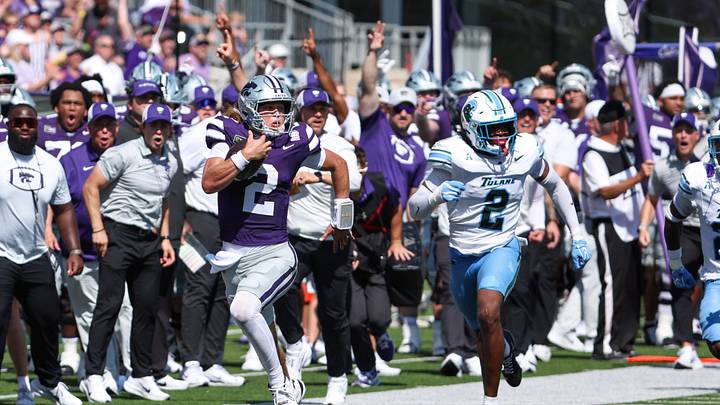
That is largely driven by how good Avery Johnson has been with his legs. The senior quarterback’s 253 yards rushing through three games accounts for 53% of his entire total on the ground during the 2025 season. He rushed for a career-high 152 yards against Tulane, shattering his previous high mark of 110 yards rushing against Arizona in 2024. His 66-yard run against the Green Wave was also a career-best.
Johnson currently leads all quarterbacks nationally with 10.5 yards per carry, while the 253 rushing yards are the second-most nationally among power-four quarterbacks. His five rushes of 20-plus yards are tied for second-most nationally among all players, regardless of position, while his nine rushes of 10-plus yards rank top 20 in the country overall.
Johnson, who now ranks 15th nationally in quarterback rating, was fantastic against Tulane. He became the first quarterback in K-State history to throw for over 200 yards and rush for over 150 yards in a game. That’s a remarkable stat when you think about K-State’s history of talented dual-threat quarterbacks dating back to the 1990s.
K-State fans have been begging Avery Johnson to use his legs more throughout his career. He's now doing that, putting added stress on opposing defenses in not only the run game but in the passing game as he gets out of the pocket and forces defenders to make a decision. But if the Wildcats are going to reach their ceiling, they'll need to be more consistent in the run game overall, which will lead to them getting into more third-and-short situations and more sustainable success long term.
 Add us as a preferred source on Google
K-State grad serving as the co-host of 3MAW, a K-State podcast on KC Sports Network. Previously covered K-State as the beat writer for the Manhattan Mercury. KC Sports Network is the premier destination for Kansas City sports fans with podcasts, YouTube and social media content. Stay connected with the latest news and analysis by following KCSN on all social media platforms.
Follow kstate_kcsn