
K-State's run defense exposed in loss at Cincinnati; how bad is it and can the Wildcats correct the issue?
In this story:
One of the biggest question marks with the K-State defense heading into the 2026 season was its ability to stop the run. It appears we now have the answer to that, and it’s not one any Wildcat fan will like.
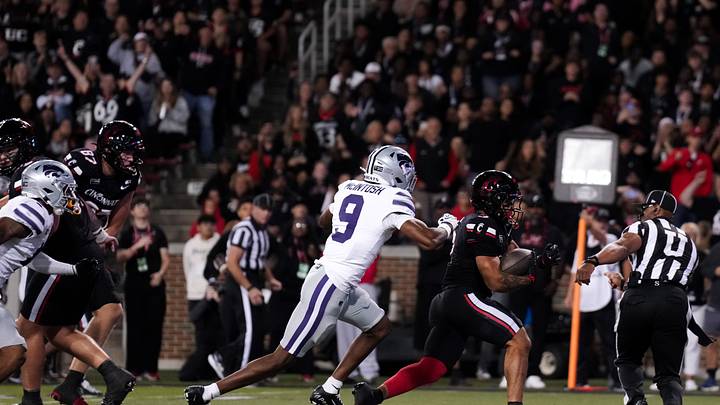
K-State’s run defense was exposed Saturday night at Cincinnati. The Wildcats allowed 271 yards rushing–the second-most given up by a K-State defense since the start of the 2021 season. The Bearcats averaged 7.1 yards per carry, tying for the second-most allowed by a K-State defense since the start of 2021.
The concern going into the Cincinnati game was whether K-State could hold up against arguably the best offensive line it will face this season. The Bearcats were top 10 nationally with 5.7 yards per rush last season. They returned three starters upfront who had earned all-conference honors at some point in their careers, including 2026 preseason All Big 12 First-Team selections in guard Evan Tengesdahl and left tackle Joe Cotton.
That concern was validated throughout the night at Nippert Stadium. The running lanes were massive. K-State was pushed around upfront, the linebackers’ run fits were often poor, and the secondary took bad angles on numerous occasions.
Gi’Bran Payne, who entered this season with 221 yards on 56 carries (3.9 yards per rush) during his first three seasons at Notre Dame, led the Bearcats with 126 yards on 16 carries. Cole Tabb, who had rushed for 575 yards on 141 carries (4 yards per rush), during his first two years at Stanford, had 11 rushes for 124 yards and 11.3 yards per rush against K-State.
Big plays were once again a problem. Cincinnati had nine rushes of 10 or more yards, including three carries of 30-plus yards. Eighteen of the Bearcats’ 37 designed rushes gained at least 5 yards, while 12 gained 8 or more yards.
Over the last two games, Tulane and Cincinnati have combined for 16 rushes of 10 or more yards against K-State. The Wildcats have allowed 25 rushes of 10 or more yards on the season, tied for 128th nationally out of 138 FBS teams. K-State ranks 137th out of 138 FBS teams in rushing explosives given up, are 136th nationally in second-level yards allowed, and are 124th in the country and last in the Big 12 in open-field yards given up. K-State’s defensive line has been credited with 3.04 line yards per carry, a mark that ranks 15th in the Big 12 and 92nd nationally.
Cincinnati’s ability to run the ball effectively opened up the passing game during the rare moments the Bearcats elected to throw on Saturday. Cincinnati quarterback JC French IV was 8-of-13 passing for 165 yards, an average of 12.7 yards per pass. The Bearcats connected on passes of 64 yards, 39 yards and 32 yards.
K-State’s offense ran 80 plays to Cincinnati’s 51, yet only had 11 more yards of total offense. Cincinnati averaged over 8.5 yards per play, the most given up by a K-State defense since the snow game against Iowa State in 2023, when the Cyclones averaged 13.9 yards per play on just 35 offensive snaps. The 8.5 yards per play were the fourth-most allowed by a K-State defense since the start of the 2019 season, excluding the 2020 pandemic season (Iowa State 13.9 yards per play in 2023; Oklahoma 9.4 yards per play in 2019 and Alabama 9.0 yards per play in the Sugar Bowl in 2022).
Cincinnati punted on its first three drives of the game while averaging under 4.8 yards per play. Over the ensuing six drives, Cincinnati scored 31 points (5.2 points per drive) and had 375 yards of offense on 35 plays (10.7 yards per play). K-State was fortunate it wasn’t worse as the Bearcats appeared on the verge of making it 38 points during a six-drive stretch before a fumble in the Red Zone allowed the Wildcats to stay in the game.
The book is now out on K-State. Teams will look to run the ball against the Wildcats. If they are unable to fix it, their best asset—their ability to pressure the quarterback— will also be limited.
First-year defensive coordinator Jordan Peterson and his staff have a lot of work to do over the ensuing bye week. It won’t get any easier. K-State’s first opponent on deck after the bye is Houston on Oct. 10. Houston could test the K-State defense even more than Cincinnati did. The Cougars are 12th in the country with 248 yards per game on the ground and rank 11th nationally with 6.1 yards per carry. They have a three-headed attack with dual-threat quarterback Connor Weigman, who ran for over 800 non-sack yards in 2025, as well as talented running backs Makhi Hughes and Re’Shaun Stanford, who is a home-run hitter.
And if you sell out to stop the run, the Cougars have the ability to beat you with their passing attack, led by preseason First Team All-Big 12 wide receiver Amare Thomas.
We’ll see if the coaches are able to correct the issue, or if this is a personnel problem that will be difficult to solve during the remainder of the 2026 season.
 Add us as a preferred source on Google
K-State grad serving as the co-host of 3MAW, a K-State podcast on KC Sports Network. Previously covered K-State as the beat writer for the Manhattan Mercury. KC Sports Network is the premier destination for Kansas City sports fans with podcasts, YouTube and social media content. Stay connected with the latest news and analysis by following KCSN on all social media platforms.
Follow kstate_kcsn