
The NCAA eligibility rule changes and what it means for K-State football looking forward
In this story:
The NCAA approved an age-based eligibility model on Tuesday, establishing a single five-year eligibility period tied to age and college enrollment. The new rule eliminates redshirts, including medical hardships, as well as eligibility extension waivers that have become prevalent in college athletics in recent years.
Student athletes whose eligibility was exhausted at the end of the 2025-26 academic year do not qualify for an extra year, which will presumably lead to numerous legal appeals from athletes who wish to gain one more year of eligibility.
The transition to the age-based rule will depend on the student-athlete’s status and enrollment timeline. Current student-athletes who did not exhaust their eligibility or seasons of competition in the 2025-26 academic year will receive the better outcome under either the previous rules or the new age-based rule. Schools will be responsible for evaluating each current student-athlete’s circumstances and applying the rule that serves each individual best.
What this change means for K-State football looking ahead:
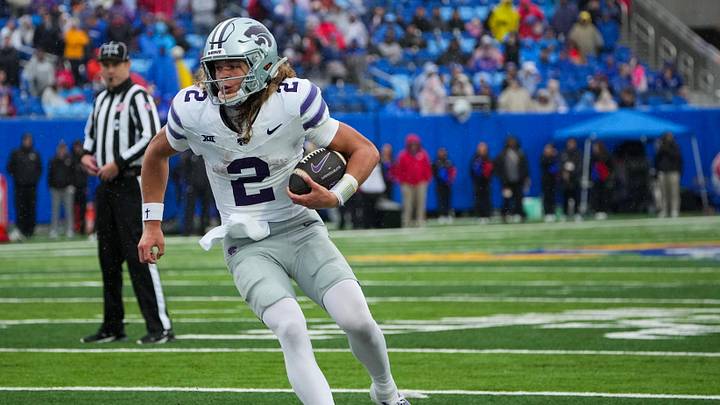
Forty players on the K-State football roster now have an additional year of eligibility added to their clock, which we will break down in-depth below, including a comprehensive table at the end of this article highlighting all of the players who benefit from this change. The headliner is quarterback Avery Johnson, who will now have the option to return to play college football for the 2027-28 season. That is because Johnson has not redshirted at any point in his career and is heading into his fourth season of competition.
Two of Johnson's top weapons whose eligibility was set to expire after the 2026-27 season also now have the option to return in 2027-28. K-State wide receiver Jaron Tibbs, who spent two seasons at Purdue and did not redshirt, led the Wildcats with 47 receptions in 2025 and now has two years of eligibility remaining should he exercise his option to utilize the added year.
Wide receiver Joshua Manning, who transferred to K-State this offseason, did not redshirt during his first three seasons at Missouri and now has two years of eligibility remaining.
A fourth player whose eligibility was set to expire following the 2026-27 season is talented safety transfer Ja'son Prevard. Prevard spent his first two seasons at Morgan State and did not redshirt before transferring to Virginia for the 2025 season, where he was an Honorable Mention All-ACC selection.
The four listed above are most notable as their careers were set to conclude following the upcoming season. However, there are a number of other players on the K-State roster who will have the option for another year of eligibility such as starting cornerback Zashon Rich, who has not redshirted during his two seasons in Manhattan and now has three years of eligibility remaining instead of two.
Tight end Linkon Cure did not redshirt as a true freshman last season and now has four years of eligibility remaining should he wish to use it. Incoming junior college transfers Derrick Salley Jr., a 6-foot-3, 234-pound receiver, and corner Michael Graham Jr., will have three years of eligility remaining instead of two.
Elijah Hill, a 6-foot-1, 245-pound defensive end, also now has four years remaining instead of three. Hill was a significant addition to the Wildcats' defensive line this offseason after leading Conference USA with nine sacks as a true freshman at Kennesaw State in 2025. He was named First Team All-Conference USA.
Perhaps the Wildats' biggest addition in the transfer portal this offseason was defensive end Wendell Gregory. The 6-foot-3, 265-pound Oklahoma State transfer was one of the most coveted defenders in the entire transfer portal after recording 12 tackles for loss as a true freshman. Gregory now has four years of eligibility remaining, though the likelihood of him using all four of those years is presumably slim given he is an NFL prospect.
While I mentioned medical hardships will no longer exist under the new NCAA rules, exceptions to that are current players who have already received a medical redshirt or are expected to. Offensive tackle George Fitzpatrick, who missed all of last season due to injury, would presumably receive a medical waiver still and have two years remaining instead of one.
All incoming true freshmen for the Wildcats for the 2026-27 season, as well as all freshmen who meet the age requirements moving forward, will have five years to play five. As noted earlier, there are 40 players on the K-State roster who have not yet redshirted, and benefit from this rule change.
Below is a comprehensive list of players on the current K-State roster who now have an extra year added to their eligibility clock
Player | Position | Eligibility remaining |
|---|---|---|
Avery Johnson | Quarterback | 2 |
Joshua Manning | Wide receiver | 2 |
Jaron Tibbs | Wide receiver | 2 |
Ja'son Prevard | Safety | 2 |
Zashon Rich | Cornerback | 3 |
Michael Graham Jr. | Cornerback | 3 |
Derrick Salley Jr. | Wide receiver | 3 |
Charlie Adams | Offensive guard | 3 |
Luis Rodriguez | Placekicker | 3 |
Jordan Jensen | Offensive guard | 3 |
Eli Jackson | Defensive tackle | 3 |
Linkon Cure | Tight end | 4 |
Wendell Gregory | Defensive end | 4 |
Elijah Hill | Defensive end | 4 |
Chase Duarte | Offensive guard | 4 |
Logan Bartley | Safety | 4 |
Adonis Moise | Wide receiver | 4 |
Weston Polk | Linebacker | 4 |
Oliver Miller | Offensive tackle | 5 |
Keegan Collins | Offensive tackle | 5 |
Bennett Fraser | Offensive tackle | 5 |
Lamarcus Barber | Offensive guard | 5 |
Tucker Ashford | Defensive end | 5 |
DJ Ackerson Jr. | Linebacker | 5 |
Adrian Bekibele | Defensive tackle | 5 |
Garrick Dixon | Cornerback | 5 |
Kingston Hall | Defensive tackle | 5 |
Carnell Jackson Jr. | Defensive tackle | 5 |
Jackson Hollie | Defensive end | 5 |
Blake Jay | Safety | 5 |
Kaprice Keith | Wide receiver | 5 |
Max Lovett | Wide receiver | 5 |
Nash Morrison | Wide receiver | 5 |
Julius Wilson | Wide receiver | 5 |
Nick McClellan | Cornerback | 5 |
Josiah Vilmael | Cornerback | 5 |
LJ McGhee | Running back | 5 |
Tanner West | Running back | 5 |
Lawson McGraw | Tight end | 5 |
Arley Morrell | Tight end | 5 |
 Add us as a preferred source on Google
K-State grad serving as the co-host of 3MAW, a K-State podcast on KC Sports Network. Previously covered K-State as the beat writer for the Manhattan Mercury. KC Sports Network is the premier destination for Kansas City sports fans with podcasts, YouTube and social media content. Stay connected with the latest news and analysis by following KCSN on all social media platforms.
Follow kstate_kcsn