
The Two Position Groups With Most Questions for Michigan State
In this story:
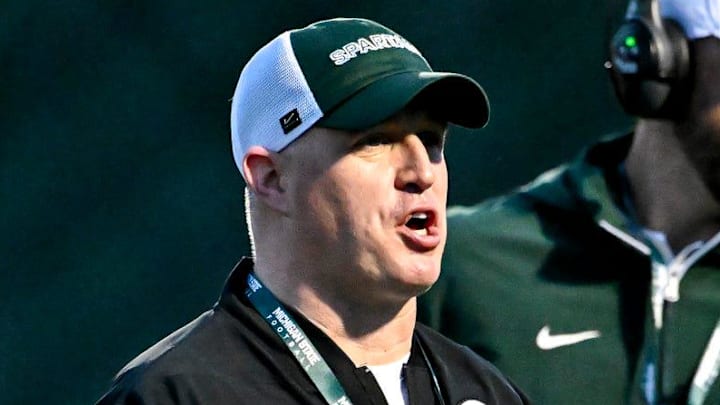
Pat Fitzgerald and Michigan State football have wrapped up spring practice and are turning their attention to summer workouts. The transition underway in East Lansing is as comprehensive as any the program has seen in years.
Fitzgerald has had to rebuild virtually everything, from the coaching staff to the roster, in a condensed timeline. Next season will be a foundational year focused on establishing culture, installing systems, and identifying which players can carry the program forward. Keeping veterans like linebacker Jordan Hall and wide receiver Chrishon McCray in East Lansing has helped provide some continuity amid the upheaval.

Michigan State was one of the more active programs in the transfer portal, bringing in 31 players across both sides of the ball. But activity in the portal does not guarantee answers, and two position groups in particular carry more uncertainty than any other heading into next season.
Offense: Offensive Line

Michigan State did send one offensive lineman to the NFL Draft, with center Matt Gulbin selected in the sixth round by the Washington Commanders. But the unit as a whole struggled throughout the season, and Fitzgerald made it clear from early in his tenure that an overhaul was necessary.
The result is an almost entirely new offensive line. Fitzgerald went into the portal and identified several players with strong individual resumes. Trent Fraley arrives as the top-rated center in the FCS. Ben Murawski was regarded as one of the better run-blocking guards in college football at UConn. Robert Wright Jr. started every game last season without drawing a single penalty, a level of discipline that stands out at any level.

The credentials are there. The question is whether those credentials translate when this group lines up together for the first time. Individual success at previous programs does not guarantee cohesion, and offensive line play is perhaps the most unit-dependent position group in football.
New offensive line coach Nick Tabacca faces the challenge of blending players from different systems and backgrounds into a functional, coordinated unit before the season opener. How quickly that chemistry develops will go a long way toward determining how competitive Michigan State's offense can be in year one under Fitzgerald.
Defense: Defensive Line

The defensive line was one of the most glaring weaknesses on last season's roster. No player recorded more than 2.5 sacks on the year, a number that was shared among defensive linemen Jalen Thompson and Quindarius Dunnigan, and linebacker Jordan Hall. Getting the team sack lead from a middle linebacker underscored just how little pressure the defensive line was able to generate.
The offseason brought significant turnover at the position. Thompson entered the transfer portal, and Dunnigan declared for the NFL Draft, leaving Hall as the only holdover with meaningful production. Fitzgerald brought in reinforcements, but none arrived with the profile of a proven difference-maker at the Big Ten level.

Carlos Hazelwood from Toledo and Trey Lisle bring upside and developmental potential. Keahnist Thompson and Eli Coenen are upperclassmen who could contribute immediately and provide the kind of experience the unit needs while the younger pieces develop.
It is a group built on potential and depth rather than established production, which is a reasonable approach for a program in the early stages of a rebuild, but it leaves real questions about how the Spartans will generate consistent pass-rush pressure against Big Ten offensive lines.
 Add us as a preferred source on Google
Luke Joseph is a graduate of Michigan State University with a degree in journalism. Drawing on his extensive knowledge of sports and commitment to storytelling, he serves as a general sports reporter On SI, covering the NFL and college athletics with insight and expertise.