%22%3E%0A%3Cpath%20d%3D%22M0%200.683105H4.9762L10.6354%207.70833V0.683105H15.9043V16.5874H11.1843L5.28112%209.2451V16.5874H0.0121963V0.683105H0Z%22%20fill%3D%22white%22%2F%3E%0A%3Cpath%20d%3D%22M17.2964%2010.4526V10.4038C17.2964%206.69607%2019.9552%203.87866%2023.6752%203.87866C28.0781%203.87866%2030.1272%206.94%2030.1272%2010.7209C30.1272%2010.9893%2030.1272%2011.3064%2030.1028%2011.5869H22.1262C22.4921%2012.6724%2023.3581%2013.2456%2024.468%2013.2456C25.3949%2013.2456%2026.1755%2012.8188%2026.9927%2011.9772L29.7613%2014.1848C28.5294%2015.7703%2026.7853%2016.8924%2024.1021%2016.8924C20.0406%2016.8924%2017.2842%2014.3189%2017.2842%2010.4648L17.2964%2010.4526ZM25.4315%209.31833C25.3217%208.13527%2024.6143%207.45226%2023.6996%207.45226C22.7848%207.45226%2022.2238%208.18405%2022.0652%209.31833H25.4315Z%22%20fill%3D%22white%22%2F%3E%0A%3Cpath%20d%3D%22M36.5166%2015.1847V16.5873H31.3574V0H36.5166V5.708C37.3581%204.79325%2038.3095%203.89071%2040.1999%203.89071C43.2003%203.89071%2045.542%206.50078%2045.542%2010.2939V10.3427C45.542%2014.27%2043.1759%2016.8923%2040.2487%2016.8923C38.3583%2016.8923%2037.3215%2016.0751%2036.5166%2015.1847ZM40.5414%2010.4037V10.3549C40.5414%209.11084%2039.6511%208.13512%2038.468%208.13512C37.285%208.13512%2036.3946%209.11084%2036.3946%2010.3549V10.4037C36.3946%2011.6355%2037.285%2012.6357%2038.468%2012.6357C39.6511%2012.6357%2040.5414%2011.6599%2040.5414%2010.4037Z%22%20fill%3D%22white%22%2F%3E%0A%3Cpath%20d%3D%22M46.8086%204.1835H51.9677V6.68379C52.6751%205.00067%2053.8094%203.91517%2055.8585%204.00055V9.47681H55.3096C53.1264%209.47681%2051.9677%2010.6843%2051.9677%2013.4285V16.5874H46.8086V4.1835Z%22%20fill%3D%22white%22%2F%3E%0A%3Cpath%20d%3D%22M55.789%2013.0623V13.0135C55.789%2010.5376%2057.6307%209.14717%2060.5091%209.14717C61.558%209.14717%2062.8996%209.3789%2063.4363%209.59844V9.3911C63.4363%208.25682%2062.7289%207.5982%2061.1433%207.5982C59.8749%207.5982%2058.8016%207.86653%2057.7161%208.3056L56.8014%204.87837C58.2284%204.32952%2059.8749%203.96362%2062.0215%203.96362C64.5462%203.96362%2066.1805%204.48808%2067.266%205.57357C68.193%206.50051%2068.5589%207.70797%2068.5589%209.50087V16.5627H63.3997V15.3064C62.5337%2016.2334%2061.3751%2016.8554%2059.8261%2016.8554C57.4356%2016.8554%2055.7646%2015.4894%2055.7646%2013.0379L55.789%2013.0623ZM63.4973%2012.0012V11.4767C63.2046%2011.3669%2062.7533%2011.2694%2062.3142%2011.2694C61.2897%2011.2694%2060.7287%2011.8792%2060.7287%2012.6598V12.7086C60.7287%2013.4404%2061.2531%2013.916%2061.9117%2013.916C62.8265%2013.916%2063.4973%2013.1842%2063.4973%2012.0134V12.0012Z%22%20fill%3D%22white%22%2F%3E%0A%3Cpath%20d%3D%22M69.2422%2015.0876L70.9863%2012.1604C72.4865%2013.0873%2074.1696%2013.5508%2075.5722%2013.5508C76.0723%2013.5508%2076.3162%2013.441%2076.3162%2013.1483V13.0995C76.3162%2012.8556%2076.0844%2012.697%2074.8404%2012.3677C71.7059%2011.5993%2069.7788%2010.7578%2069.7788%208.18431V8.13552C69.7788%205.40349%2071.962%203.89111%2075.1819%203.89111C77.2309%203.89111%2079.2434%204.41556%2080.7435%205.31811L79.1092%208.39165C77.792%207.65985%2076.2064%207.23297%2075.1575%207.23297C74.6574%207.23297%2074.4257%207.36714%2074.4257%207.62326V7.67205C74.4257%207.91598%2074.694%208.07454%2075.9503%208.40384C79.0848%209.17223%2080.9753%2010.0382%2080.9753%2012.5873V12.6361C80.9753%2015.3437%2078.9506%2016.9049%2075.5844%2016.9049C73.1817%2016.9049%2070.9985%2016.295%2069.2178%2015.112L69.2422%2015.0876Z%22%20fill%3D%22white%22%2F%3E%0A%3Cpath%20d%3D%22M82.144%200H87.3032V8.00095L89.962%204.18343H95.5725L91.6818%209.23281L95.6334%2016.5995H90.1084L88.3155%2013.1967L87.291%2014.5139V16.5995H82.1318V0.0121969L82.144%200Z%22%20fill%3D%22white%22%2F%3E%0A%3Cpath%20d%3D%22M95.4873%2013.0623V13.0135C95.4873%2010.5376%2097.329%209.14717%20100.207%209.14717C101.256%209.14717%20102.598%209.3789%20103.135%209.59844V9.3911C103.135%208.25682%20102.427%207.5982%20100.842%207.5982C99.5731%207.5982%2098.4998%207.86653%2097.4143%208.3056L96.4996%204.87837C97.9266%204.32952%2099.5731%203.96362%20101.72%203.96362C104.244%203.96362%20105.879%204.48808%20106.964%205.57357C107.891%206.50051%20108.257%207.70797%20108.257%209.50087V16.5627H103.098V15.3064C102.232%2016.2334%20101.073%2016.8554%2099.5244%2016.8554C97.1338%2016.8554%2095.4629%2015.4894%2095.4629%2013.0379L95.4873%2013.0623ZM103.196%2012.0012V11.4767C102.903%2011.3669%20102.452%2011.2694%20102.012%2011.2694C100.988%2011.2694%20100.427%2011.8792%20100.427%2012.6598V12.7086C100.427%2013.4404%20100.951%2013.916%20101.61%2013.916C102.525%2013.916%20103.196%2013.1842%20103.196%2012.0134V12.0012Z%22%20fill%3D%22white%22%2F%3E%0A%3Cpath%20d%3D%22M0.0121992%2027.7428V27.6941C0.0121992%2022.9496%203.71996%2019.4004%208.46443%2019.4004C11.9648%2019.4004%2014.331%2021.1079%2015.6726%2023.535L11.2818%2026.1085C10.6964%2024.9742%209.85483%2024.1814%208.39124%2024.1814C6.59834%2024.1814%205.41528%2025.7548%205.41528%2027.6575V27.7063C5.41528%2029.7797%206.64713%2031.2311%208.39124%2031.2311C9.89142%2031.2311%2010.733%2030.4139%2011.3916%2029.2308L15.7702%2031.7067C14.4285%2034.0729%2012.2088%2035.9999%208.24489%2035.9999C3.84192%2035.9999%200%2032.6825%200%2027.755L0.0121992%2027.7428Z%22%20fill%3D%22white%22%2F%3E%0A%3Cpath%20d%3D%22M16.1475%2029.4871V29.4383C16.1475%2025.9379%2019.0503%2022.9375%2023.1483%2022.9375C27.2464%2022.9375%2030.1003%2025.8891%2030.1003%2029.3895V29.4383C30.1003%2032.9387%2027.1976%2035.939%2023.0995%2035.939C19.0015%2035.939%2016.1475%2032.9875%2016.1475%2029.4871ZM25.1363%2029.4871V29.4383C25.1363%2028.2064%2024.2216%2027.2307%2023.0873%2027.2307C21.953%2027.2307%2021.0871%2028.2064%2021.0871%2029.3895V29.4383C21.0871%2030.6701%2021.9896%2031.6459%2023.1361%2031.6459C24.2826%2031.6459%2025.1363%2030.6701%2025.1363%2029.4871Z%22%20fill%3D%22white%22%2F%3E%0A%3Cpath%20d%3D%22M31.3447%2023.2421H36.5039V25.7424C37.2113%2024.0593%2038.3456%2022.9738%2040.3946%2023.0591V28.5354H39.8457C37.6626%2028.5354%2036.5039%2029.7429%2036.5039%2032.4871V35.646H31.3447V23.2421Z%22%20fill%3D%22white%22%2F%3E%0A%3Cpath%20d%3D%22M41.3584%2023.2424H46.5175V24.9743C47.3103%2023.9498%2048.5666%2022.9497%2050.3107%2022.9497C52.9207%2022.9497%2054.5551%2024.6816%2054.5551%2027.4746V35.6585H49.3959V29.1334C49.3959%2028.0723%2048.7617%2027.4502%2047.9933%2027.4502C47.225%2027.4502%2046.5175%2028.0601%2046.5175%2029.1334V35.6585H41.3584V23.2546V23.2424Z%22%20fill%3D%22white%22%2F%3E%0A%3Cpath%20d%3D%22M56.1177%2019.0586H61.2768V24.9008C62.0696%2023.8762%2063.3258%2022.9493%2065.07%2022.9493C67.68%2022.9493%2069.3144%2024.6812%2069.3144%2027.4742V35.6581H64.1552V29.133C64.1552%2028.0719%2063.521%2027.4498%2062.7404%2027.4498C61.9598%2027.4498%2061.2646%2028.0597%2061.2646%2029.133V35.6581H56.1055V19.0708L56.1177%2019.0586Z%22%20fill%3D%22white%22%2F%3E%0A%3Cpath%20d%3D%22M70.7656%2031.4256V23.2417H75.9248V29.7669C75.9248%2030.8402%2076.559%2031.45%2077.3396%2031.45C78.1202%2031.45%2078.8154%2030.8402%2078.8154%2029.7669V23.2417H83.9745V35.6456H78.8154V33.9869C78.0226%2035.0114%2076.7663%2035.9383%2075.0222%2035.9383C72.4122%2035.9383%2070.7778%2034.2064%2070.7778%2031.4134L70.7656%2031.4256Z%22%20fill%3D%22white%22%2F%3E%0A%3Cpath%20d%3D%22M84.7178%2034.1462L86.4619%2031.219C87.9621%2032.1459%2089.6452%2032.6094%2091.0478%2032.6094C91.5478%2032.6094%2091.804%2032.4996%2091.804%2032.2069V32.1581C91.804%2031.9142%2091.5722%2031.7556%2090.3282%2031.4263C87.1937%2030.6579%2085.2666%2029.8164%2085.2666%2027.2429V27.1941C85.2666%2024.4621%2087.4498%2022.9497%2090.6697%2022.9497C92.7187%2022.9497%2094.7311%2023.4742%2096.2313%2024.3767L94.597%2027.4502C93.2798%2026.7184%2091.6942%2026.2916%2090.6453%2026.2916C90.1453%2026.2916%2089.9135%2026.4257%2089.9135%2026.6819V26.7306C89.9135%2026.9746%2090.1818%2027.1331%2091.4381%2027.4624C94.5726%2028.2308%2096.4631%2029.0968%2096.4631%2031.6459V31.6947C96.4631%2034.4023%2094.4384%2035.9635%2091.0844%2035.9635C88.6816%2035.9635%2086.4985%2035.3536%2084.7178%2034.1706V34.1462Z%22%20fill%3D%22white%22%2F%3E%0A%3Cpath%20d%3D%22M97.6225%2019.0586H102.782V27.0595L105.441%2023.242H111.051L107.16%2028.2914L111.112%2035.6581H105.587L103.794%2032.2553L102.769%2033.5725V35.6581H97.6104V19.0708L97.6225%2019.0586Z%22%20fill%3D%22white%22%2F%3E%0A%3Cpath%20d%3D%22M110.493%2029.5115V29.4627C110.493%2025.7549%20113.152%2022.9375%20116.871%2022.9375C121.274%2022.9375%20123.323%2025.9988%20123.323%2029.7798C123.323%2030.0481%20123.323%2030.3652%20123.299%2030.6457H115.323C115.688%2031.7312%20116.554%2032.3045%20117.664%2032.3045C118.591%2032.3045%20119.372%2031.8776%20120.189%2031.036L122.958%2033.2436C121.726%2034.8292%20119.982%2035.9512%20117.298%2035.9512C113.237%2035.9512%20110.48%2033.3778%20110.48%2029.5236L110.493%2029.5115ZM118.628%2028.3772C118.518%2027.1941%20117.811%2026.5111%20116.896%2026.5111C116.03%2026.5111%20115.42%2027.2429%20115.262%2028.3772H118.628Z%22%20fill%3D%22white%22%2F%3E%0A%3Cpath%20d%3D%22M124.553%2023.2421H129.712V25.7424C130.419%2024.0593%20131.554%2022.9738%20133.603%2023.0591V28.5354H133.054C130.871%2028.5354%20129.712%2029.7429%20129.712%2032.4871V35.646H124.553V23.2421Z%22%20fill%3D%22white%22%2F%3E%0A%3Cpath%20d%3D%22M133.689%2034.1462L135.434%2031.219C136.934%2032.1459%20138.617%2032.6094%20140.019%2032.6094C140.52%2032.6094%20140.776%2032.4996%20140.776%2032.2069V32.1581C140.776%2031.9142%20140.544%2031.7556%20139.3%2031.4263C136.165%2030.6579%20134.238%2029.8164%20134.238%2027.2429V27.1941C134.238%2024.4621%20136.421%2022.9497%20139.641%2022.9497C141.69%2022.9497%20143.703%2023.4742%20145.203%2024.3767L143.569%2027.4502C142.251%2026.7184%20140.666%2026.2916%20139.617%2026.2916C139.117%2026.2916%20138.885%2026.4257%20138.885%2026.6819V26.7306C138.885%2026.9746%20139.154%2027.1331%20140.41%2027.4624C143.544%2028.2308%20145.435%2029.0968%20145.435%2031.6459V31.6947C145.435%2034.4023%20143.41%2035.9635%20140.056%2035.9635C137.653%2035.9635%20135.47%2035.3536%20133.689%2034.1706V34.1462Z%22%20fill%3D%22white%22%2F%3E%0A%3Cpath%20fill-rule%3D%22evenodd%22%20clip-rule%3D%22evenodd%22%20d%3D%22M155.368%204.36764C161.191%20-1.45588%20170.632%20-1.45588%20176.456%204.36764C182.279%2010.1912%20182.279%2019.6324%20176.456%2025.4559L165.912%2036L155.368%2025.4559C149.544%2019.6324%20149.544%2010.1912%20155.368%204.36764ZM158.009%207.55761C157.948%207.86849%20157.916%208.39718%20157.916%209.14566V10.4189C157.916%2011.1832%20157.948%2011.7198%20158.013%2012.0267C158.078%2012.3317%20158.278%2012.6168%20158.617%2012.8762C158.956%2013.1376%20159.403%2013.3316%20159.958%2013.4623C160.512%2013.593%20161.1%2013.6584%20161.837%2013.6584C162.573%2013.6584%20163.217%2013.591%20163.769%2013.4524C164.322%2013.3158%20164.761%2013.1178%20165.086%2012.8604C165.411%2012.6029%20165.605%2012.3178%20165.666%2012.0069C165.728%2011.6961%20165.759%2011.1674%20165.759%2010.4189V9.14566C165.759%208.38134%20165.728%207.84473%20165.662%207.53781C165.597%207.23287%20165.397%206.94971%20165.058%206.68834C164.72%206.42696%20164.272%206.23291%20163.718%206.10223C163.163%205.97154%20162.536%205.90619%20161.839%205.90619C161.102%205.90619%20160.459%205.97352%20159.906%206.11213C159.352%206.24875%20158.914%206.44677%20158.589%206.70418C158.265%206.9616%20158.071%207.24673%20158.009%207.55761ZM163.276%2024.8638C166.876%2024.8638%20168.557%2024.2064%20168.557%2021.862V21.858V21.3155C168.557%2019.6581%20167.516%2018.971%20164.252%2018.3136C163.278%2018.1136%20162.908%2017.9136%20162.908%2017.3136V16.9414C162.908%2016.6543%20163.177%2016.5117%20163.413%2016.5117C163.749%2016.5117%20163.918%2016.7137%20163.918%2016.9414V18.1136H168.391V17.3988C168.391%2015.4563%20167.347%2014.4266%20163.177%2014.4266C160.15%2014.4266%20157.896%2015.3414%20157.896%2017.3711V17.7433C157.896%2019.5155%20158.805%2020.3155%20162.201%2021.0303C162.28%2021.0472%20162.355%2021.063%20162.427%2021.0781C163.329%2021.2674%20163.647%2021.3341%20163.647%2021.9174V22.2897C163.647%2022.6619%20163.546%2022.8045%20163.142%2022.8045C162.67%2022.8045%20162.637%2022.5471%20162.637%2022.262V21.2897H157.894V21.7471C157.894%2024.149%20159.476%2024.8638%20163.276%2024.8638ZM169.424%2024.5569H173.925V14.7355H169.424V24.5569ZM170.955%2013.5019H173.925V6.06064H171.092V9.411L169.193%206.06064H166.359V13.5019H169.193V10.1199L170.955%2013.5019ZM162.269%2012.152C162.204%2012.2688%20162.055%2012.3262%20161.825%2012.3262L161.827%2012.3282C161.604%2012.3282%20161.459%2012.2767%20161.398%2012.1758C161.336%2012.0748%20161.305%2011.8074%20161.305%2011.3758V7.90068C161.305%207.51852%20161.352%207.28684%20161.445%207.20962C161.538%207.13239%20161.675%207.09279%20161.851%207.09279C162.059%207.09279%20162.198%207.14031%20162.265%207.23734C162.332%207.33239%20162.366%207.55416%20162.366%207.90068V11.3203C162.366%2011.7579%20162.334%2012.0352%20162.269%2012.152Z%22%20fill%3D%22white%22%2F%3E%0A%3C%2Fg%3E%0A%3Cdefs%3E%0A%3CclipPath%20id%3D%22clip0_15191_23649%22%3E%0A%3Crect%20width%3D%22181%22%20height%3D%2236%22%20fill%3D%22white%22%2F%3E%0A%3C%2FclipPath%3E%0A%3C%2Fdefs%3E%0A%3C%2Fsvg%3E%0A)
The In-State Stars Nebraska Couldn’t Keep
In this story:
Former Omaha Central football coach William Reed heard all the whispers – that he took money from Hayden Fry, that he had a vested interest in Iowa City, that he loathed all things scarlet and cream. “It bothered me a lot,” Reed said way back in 1987. By then, Reed had seen more of his former players (five) go to Iowa than Nebraska (four).
“People don’t realize that Sean Ridley and Larry Station are the only kids Nebraska offered scholarships to and then stuck with it who went to Iowa.” Reed defended.
The rumor mill spun so badly out of control that both Tom Osborne and then-Iowa Offensive Coordinator Bill Snyder (later of Kansas State renown) went to the press to defend Reed.
Such is life when you’re a Nebraska high school coach that sends players to schools besides NU.
Because in Nebraska, losing your own – especially to the wrong neighbors – never stays a simple footnote. It becomes a referendum on the program.
There’s a parade of Nebraskans the Huskers did not deign to offer and lived to regret their evaluation. These are the Nebraskans they clearly wanted and failed to land. I’ve likely overlooked a name or two. And with apologies to Gale Sayers, I’m going to keep it to the last 50 years.
Let’s dig in.
DE Marty Kobza, Arkansas (1981)
Lou Holtz, as you’ll see throughout this list, was a real pain in the neck for Tom Osborne and company in the eighties and nineties. He planted his flag in the state when he lured Marty Kobza – the 1981 Nebraska High School Athlete of the Year – from Schuyler, Nebraska, to Fayetteville, Arkansas in 1981. Even better as a track and field star, Kobza owned the state record for shotput for 44 years before Omaha Central’s Ike Ackerman broke it last spring.
Nebraska factored into his list of finalists, but it ultimately came down to UCLA and the Razorbacks. “Marty wanted to leave the state and broaden his experience,” Kobza’s high school coach, Gene Hunting, said at the time of his signing. “In Arkansas, the climate is warmer than Nebraska so their outdoor throwing season is considerably longer there than it is here.”
At Arkansas, Kobza and Holtz sparred over his commitment to football over track. After Holtz went back on his promise to let Kobza skip spring practice to focus on track in 1983, Kobza quit football for good.
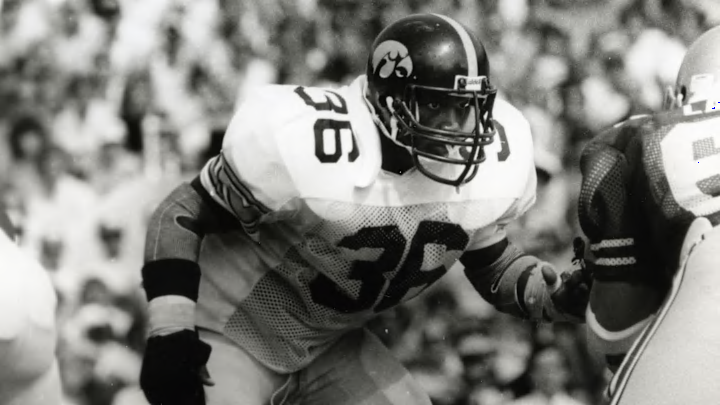
LB Larry Station, Iowa (1982)
Husker fans of a certain vintage still remember the shockwaves across the state when Station declined an offer from the Huskers to play for Hayden Fry. While he wasn’t the first to do it, he was the biggest star since Sayers to leave the state.
“Larry Station going to Iowa hurt,” Osborne said when reflecting on his biggest recruiting misses.
Why the Hawkeyes? “There’s a good chance I can step in right away and play (at Iowa),” Station said at the time. “At Nebraska, it would take a lot longer to fit in.”
Years later, Station would admit it took a big “leap of faith” in going to Iowa City, but his relationship with their coaches was strong.
Nebraska was at least the second choice, right? Actually, Iowa was. The Air Force Academy – who lost his application – was his dream.
Station was first team All-Big Ten three years running and finished as a Butkus and Lombardi Award finalist his senior year. He didn’t pan out in the NFL due to injury. But when he returns to visit his alma mater, he still sees his name displayed largely in Kinnick Stadium.
DE Sean Ridley, Iowa (1985)
Ridley was a consensus Top 100 prospect nationally at EDGE. Parade and USA Today labeled him an All-American. At one point, Max Emfinger even labeled him the second-best player in the country. He narrowed down his considerable list to Iowa, NU, UCLA, LSU and Texas. Ultimately, the draw of Iowa was too much – Larry Station had shown how successful Omaha kids could be in black and gold.
The pain of losing Ridley, compounded by the still-fresh wound of failing to land Station, was a big blow to the state’s pride and morale. For many, it felt like confirmation that the border was no longer a protective moat.
At Iowa, Ridley was hampered by injury but served as a backup defensive end in 1987, ending the season with 29 tackles. But as he was on the precipice of starting, he was ruled academically ineligible before the 1988 season and never played for them again. He wrapped up his career having lettered just once.
For Husker fans, the sting wasn’t what Ridley became as much as it was what he represented at the time: another prized Omaha recruit crossing the river. Sometimes the hurt comes not from production, but from perception.
DT Junior Bryant, Notre Dame (1989)

In 1989, Edward “Junior” Bryant capped his prep career by winning the Bobby Dodd Lineman of the Year Award, given by the Atlanta Touchdown Club. Ranked the 13th best DL nationally by SuperPrep, he had offers from USC, UCLA, Penn State – and a spot reserved in Nebraska’s class alongside Trev Alberts, Will Shields, and Derek Brown.
Instead, he followed the green glow radiating from South Bend. The Fighting Irish were fresh off their 11th national title, and Bryant became the latest stop in an Omaha-to-Notre Dame pipeline that quietly took shape in the 1980s. The “40-year decision” and the pull of a Catholic education — Bryant was a Creighton Prep product — carried real weight.
Bryant played early as a freshman in South Bend and was a key contributor as an upperclassman. Despite going undrafted, he carved out six years with the San Francisco 49ers until injuries forced him into retirement.
He’d be the last Nebraskan to spurn the Huskers until four years later, when a certain quarterback from Wood River broke Tom Osborne’s heart by opting for Stanford.
“You can count on almost one hand the (Nebraska) players we've recruited heavily who we haven't gotten,” Coach Osborne said while defending the loss of Scott Frost. “It’s been four years since we’ve lost a player in the state of Nebraska.”
He was right at the time. But Bryant’s decision was an early reminder that, even at the height of Nebraska’s dynasty, the walls around the state weren’t impenetrable.
WR Ty Goode, Notre Dame (1994)
Ty Goode was a top 100 national recruit from Lincoln Southeast with designs on playing wide receiver in college, something that made the hometown Huskers decidedly unappealing. Having spent his life in Lincoln, he opted for Lou Holtz’s Notre Dame, having never visited nor even strongly considered attending Nebraska. “You have to move on,” Goode said of his desire to leave home.
At 6-0 and 175 pounds, Goode moved to corner in South Bend and spent most of his career buried on the depth chart. He did have a heroic interception to seal the win against West Virginia in 1997 and started some in 1998 as a 5th-year senior. He capped his career having snagged two interceptions total.
You do have to wonder if, given the chance to do it all over again, he’d have instead chosen to play on three national championship squads in his hometown.
OL Tim Ridder, Notre Dame (1995)
A three-sport athlete from Omaha, Tim Ridder was a standout on the gridiron as a 6-foot-7-inch prototype at offensive tackle. He, along with Ahman Green, gave the state two Top 100 players in ’95. Fortunately for Ridder, Green signing with NU and the first national title in two decades lessened the resentment his defection to ND might normally have wrought. “Most Nebraska fans have shown me a lot of class,” Ridder said after committing. Like Junior Bryant before him, the Jesuit foundation of Creighton Prep and its academic reputation created a natural link to the prestigious Golden Dome, allowing him to ignore the pull of home in what was a tight race.
“There’s no second guesses,” Ridder said during his freshman season in South Bend. “I’m getting the best education in the country, and I have the best line coach in the country.”
At Notre Dame, Ridder’s versatility served him well, seeing time at tackle and tight end before settling in as a starter at guard. He spent three seasons in the pros – primarily on the practice squad – before a knee injury forced him away from the game and toward a successful career in education.
OL Harland Gunn, Miami (2007)

A four-star recruit in the 2007 class, Harland Gunn became the latest Omaha Central grad to leave the state when he committed to Larry Coker’s Miami program in March 2006, enamored with the swagger of ‘The U’ and NFL-caliber competition. A tackle for Joe McMenamin’s varsity squad, he moved to guard in Coral Gables, where he started 30 games. He went undrafted in 2012 but enjoyed a cup of coffee with five different franchises.
OL Trevor Robinson, Notre Dame (2008)

Robinson came up in a loaded 2008 class for in-state talent. A top 100 blue-chipper, he wasn’t even the highest-rated lineman in Nebraska – that distinction went to Baker Steinkuhler. Like Baker, Robinson committed to Coach Bill Callahan early in the cycle. Unlike Baker, he reconsidered. His flip to Notre Dame sparked message board debates about the value of a Nebraska degree versus one from South Bend.
On the field in South Bend, Robinson quickly showed why he was such a coveted prospect, starting three games as a true freshman. The 6-5 300-pounder was a fixture from then on, starting at right guard the next three years. An undrafted free agent post-college, he bounced around the NFL but never got any real traction on the field.
He would’ve been a welcome addition to any Husker outfit of the Pelini era.
TE Jared Bubak, Arizona State (2016)
The top-rated player in Nebraska his senior year at Lincoln Christian, he committed to NU in the Pelini era but decamped to Arizona State in the summer of 2015. He failed to make his mark there, appearing in just 17 games in four years. He later transferred to Nebraska but was just as anonymous in Lincoln as he was in Tempe.
ATH Xavier Watts, Notre Dame (2020)

Of all the homegrown talents to leave the state in recent years, none haunt the Husker faithful quite like Xavier Watts. While there’s debate as to which position Scott Frost wanted him at – Watts was a receiver at Omaha Burke – there’s no debate as to why he didn’t stay.
"My top three was Notre Dame, Nebraska, and Michigan,” Watts said on the Varsity House Podcast. “I wanted to go to Nebraska – I’m going to say it right now – but they weren't very good, so I couldn't do that." The final decision went down to Michigan and Notre Dame.
At Notre Dame, Watts navigated both a coaching change and a position change as he transitioned to safety. In the defensive secondary, he flourished, twice winning consensus All-American honors. After leading the nation in interceptions and winning the 2023 Bronko Nagurski Trophy, he capped his career as a captain and played in the National Championship game against Ohio State. In 2025, he was a third-round NFL draft pick.
Watts wasn’t just a lost recruit – he was the most visible symptom of a program that had lost the gravity required to keep its own stars at home.
DB Avante Dickerson, Oregon (2021)

Avante was a small but supremely athletic defensive back out of Omaha Westside, ranked the second-best cornerback in the country by ESPN. He never seemed that interested in staying home, though, surprising many by committing to PJ Fleck and the Minnesota Gophers in April 2020.
He later switched his pledge to the Ducks of Oregon just a week before Signing Day. There, he played some as a true freshman before redshirting in 2022. He departed Oregon for Utah State, where he started in 2023 but only appeared in nine games in 2024. His odyssey ended at Arkansas State last fall, where he garnered Honorable Mention All-Sun Belt honors.
LB Devon Jackson, Oregon (2022), TE Kaden Helms, Oklahoma (2022), OL Deshawn Woods, Wyoming (2022), and ATH Micah Riley-Ducker, Auburn (2022)

Jackson, Helms, Woods and Riley were a unique quartet in that they were the four highest-ranked Nebraska natives in their class and not one gave Nebraska a real sniff, a rarity in any generation. But such was the state of things in 2021 after a 3-9 season under Scott Frost. "Winning is the best recruiting tool," the beleaguered coach said, suggesting that losing elite local talent was a direct reflection of the team's record.
Jackson has been the lone success of the group, getting ample playing time in Eugene. He looks ready to start again in his final season. Helms, meanwhile, struggled to find his footing at Oklahoma and will give it a final go at Minnesota this fall. Woods took a detour to JUCO but will play for Rich Rodriguez in West Virginia come August. Ducker transferred to Texas A&M after catching a grand total of three balls in his career.
TE Benjamin Brahmer, Iowa State (2023)

Brahmer was the first commitment of the 2023 class but reneged when Scott Frost was let go. Newly hired coach Matt Rhule made overtures to reel him back in but by then his bond with Matt Campbell and Iowa State was too strong.
In Ames, Brahmer became a star, catching 75 passes in three years. He had his best season in 2025, scoring six touchdowns while averaging 12-plus yards per catch. The towering tight end will play for Campbell in College Station next fall.
TE Chase Loftin, Florida State (2025)

In a state that’s garnered a reputation for producing stalwart tight ends, Loftin became just the latest to leave it when he committed to Florida State over Nebraska, Missouri and others in June of 2024. Matt Rhule and his staff played from behind, having to start a relationship later in the process after coming aboard in 2023. FSU had already sunk its talons in by that point.
The number two player in the state for 2025 waffled some as the Seminoles struggled mightily through a 2-10 season. The Huskers even got him back on campus for a visit. But ultimately, Loftin reaffirmed his commitment to Mike Norvell’s program. He caught one ball in his first season in Tallahassee.
Others that don’t quite fit the criteria:
OL Dean Davis, Colorado (1984): He got a late offer in the 1984 cycle but had already made a commitment to Colorado and chose to keep it.
RB Sherman Williams, Iowa State (1989): Williams was offered but only as a wingback. He got as far as number two on the Iowa State depth chart.
OL Quentin Neujahr, Kansas State (1989): His only offers were from Wyoming and Kansas State – NU’s offer was to walk on. He ended up playing in the NFL.
DB Ja’Maine Billups, Iowa State (2000): Billups wanted to play running back. ISU was willing to let him, NU wasn’t. He had a bowl-winning punt return TD in 2000 and ultimately moved to defensive back. He was the Cyclones leading tackler in 2003.
OL Seth Olsen, Iowa (2004): Olsen was a stalwart guard for the Hawkeyes but was never coveted by Bill Callahan the way he was by Frank Solich.
DL Harrison Phillips, Stanford (2014): Pelini and company didn’t know what to do with a nose tackle given their 4-3 front. He got a relatively late offer but knew it was the Stanford Cardinal that really valued him. He was an All-American for them.
TE Noah Fant (2015): Fant received lukewarm interest from NU and fell for Iowa instead. The Huskers rue that decision.
DB Darion Jones, Iowa (2026): Nebraska dragged their feet on an offer and subsequently lost the battle to Iowa. Jones moved up significantly in the rankings to end the cycle.
 Add us as a preferred source on Google
Chris Fort joined Nebraska Cornhuskers on SI in 2024, where he focuses on providing insights, analysis, and retrospectives on Husker football. Before his role at On SI, Chris worked as a news journalist for JMP Radio Group, where he honed his skills in storytelling and reporting. His background in journalism equips him with a keen eye for detail and a passion for sports coverage. With a commitment to delivering in-depth analysis, Chris brings a unique perspective to the Nebraska football scene. His work reflects a deep understanding of the sport and a dedication to engaging readers with compelling narratives about the Cornhuskers. Outside of writing, Chris enjoys exploring new media trends and staying connected to the evolving landscape of sports journalism.
Follow christopherfort