
A Look at Some of the Heisman’s Most-Lopsided Races, and How Jeremiah Smith Could Fit In
In this story:
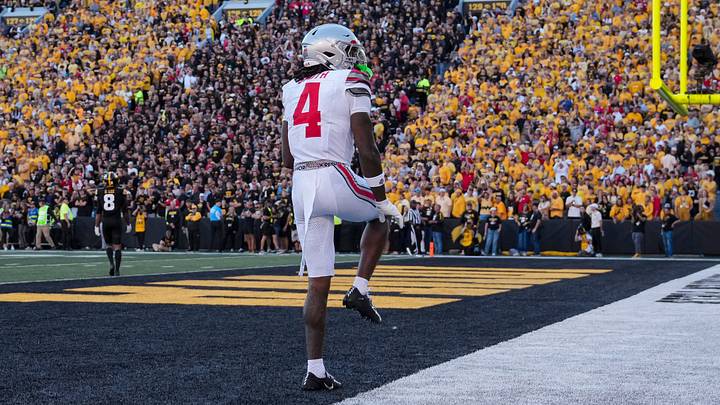
As the Ohio State Buckeyes brace for the second half of their season -- possibly without star quarterback Julian Sayin for the rest of the way -- Jeremiah Smith is still the top bet to take the Heisman Trophy.
How Sayin’s injury could eventually affect Smith’s chances is yet to be determined, but by playing to the level he has been doing so up until now with a backup quarterback would certainly solidify Smith’s case for the sport’s most coveted award. And why wouldn’t Smith not become even a bigger focal point for the offense with true freshman Luke Fahey at quarterback. Everyone knows good things happen when you throw the football to No. 4.
That means that the 2026 Heisman race could still end up among the trophy’s largest landslide wins, as many were expecting before Sayin’s injury.
Having said that, here’s a look at some of the most one-sided Heisman races from past years, based solely on first-place vote differential. Should Smith end his 2026 campaign the same he has started it, there’s no doubt he should end somewhere on this list:
1993, Charlie Ward
Ward led FSU to its first ever National Championship, but before defeating Nebraska 18-16 in the Orange Bowl, he took home 740 first place votes for the Heisman, leaving David Palmer as the runner-up in first place votes with just 16 for a still unfathomable 46.25-1 ratio.
2019, Joe Burrow
Burrow’s 2019 campaign might still be the golden standard at the quarterback position, resulting in LSU’s fourth National Championship. But like his performance on the field, his Heisman voting records still stand, including 841 first place votes to Chase Young’s 20 in second place (fourth in total voting) for a whopping 42.05-1 ratio, and a 1,846 point margin over Jalen Hurts, who finished second in voting.
Desmond Howard, 1991
The electrifying Howard was awarded 661 first place votes which represented a steep 22.07-1 ratio over Steve Emtman’s 29 first place votes that year. Casey Weldon would finish second in points despite just 19 first place votes.
Vinny Testaverde, 1986
The Hurricanes’ quarterback received 678 first place votes, while a D1-AA two-way player from Holy Cross, Gordon Lockbaum, shockingly came in second with 32 for a 21.19-1 ratio. However, Paul Palmer came in second in points with just 28.
Troy Smith, 2006
The Buckeyes most recent Heisman winner outpaced his runner-up (Darren McFadden) in first place votes by 801 to 45, for a 17.8-1 ratio that’s still pretty incredible. Like so many names on this list, Smith’s campaign also ended with a National Championship for his program.
O.J. Simpson, 1968
During this time, the number of Heisman voters had ballooned up to 1,200, with Simpson receiving 855 out of the 1,042 returned that year which still stands as an absolute record. Second among first-place votes was Leroy Keyes, who received 49 for a 17.45-1 ratio.
Ricky Williams, 1998
Williams’ second consecutive 2,000+ rushing-yard season in ‘98 earned him 714 first-place votes, enough to cover a 17.41-1 ratio over Michael Bishop who came in second with 41.
Marcus Mariota, 2014
Mariota outpaced every other Heisman finalist with 788 first place votes, while Amari Cooper, who wasn’t runner up in points, came in second with 49 first place votes for a 16.08-1 ratio. Melvin Gordon came in second on points, but with only 37 first place votes.
Dick Kazmeier, 1951
Back in 1951, Princeton’s halfback scored the biggest landslide win of the awards early years by capturing 506 first place votes to Hank Lauricella’s 45 as the runner up, for an 11.24-1 ratio that still sounds incredible for the era.
 Add us as a preferred source on Google

Rafael brings more than two decades worth of experience writing all things football.
Follow RafaZamoranoNFL