%22%3E%0A%3Cpath%20d%3D%22M0%2018.4539V18.4148C0%2014.0013%203.63064%2010.4783%208.31819%2010.4783C13.0057%2010.4783%2016.5972%2013.9523%2016.5972%2018.3659V18.405C16.5972%2022.8185%2012.9666%2026.3318%208.27904%2026.3318C3.5915%2026.3318%200%2022.8577%200%2018.4442V18.4539ZM11.4791%2018.4539V18.4148C11.4791%2016.6142%2010.2363%2014.9799%208.28883%2014.9799C6.3414%2014.9799%205.1377%2016.5848%205.1377%2018.3659V18.405C5.1377%2020.2057%206.38054%2021.8399%208.32798%2021.8399C10.2754%2021.8399%2011.4791%2020.235%2011.4791%2018.4539Z%22%20fill%3D%22white%22%2F%3E%0A%3Cpath%20d%3D%22M17.9575%2010.1553H22.8897V17.808L25.4341%2014.1578H30.7969L27.0782%2018.9823L30.8556%2026.0185H25.5711L23.8586%2022.7598L22.88%2024.0222V26.0185H17.9478V10.1553H17.9575Z%22%20fill%3D%22white%22%2F%3E%0A%3Cpath%20d%3D%22M31.4232%2010.1553H36.3554V26.0185H31.4232V10.1553Z%22%20fill%3D%22white%22%2F%3E%0A%3Cpath%20d%3D%22M37.5101%2022.6522V22.6131C37.5101%2020.2448%2039.2716%2018.9237%2042.0313%2018.9237C43.0295%2018.9237%2044.3115%2019.139%2044.8301%2019.3543V19.1586C44.8301%2018.0723%2044.1549%2017.446%2042.638%2017.446C41.4246%2017.446%2040.397%2017.7102%2039.3597%2018.1212L38.4887%2014.8429C39.8588%2014.3242%2041.4246%2013.9719%2043.4894%2013.9719C45.8968%2013.9719%2047.4626%2014.471%2048.5097%2015.5181C49.4002%2016.4087%2049.7525%2017.5634%2049.7525%2019.276V26.0382H44.8203V24.8443C43.9983%2025.7348%2042.8827%2026.322%2041.405%2026.322C39.1248%2026.322%2037.5199%2025.0204%2037.5199%2022.6718L37.5101%2022.6522ZM44.8791%2021.6247V21.1256C44.5953%2021.0179%2044.1647%2020.9298%2043.7537%2020.9298C42.7751%2020.9298%2042.2368%2021.517%2042.2368%2022.251V22.2901C42.2368%2022.9849%2042.7359%2023.4449%2043.3622%2023.4449C44.2332%2023.4449%2044.8791%2022.7501%2044.8791%2021.6149V21.6247Z%22%20fill%3D%22white%22%2F%3E%0A%3Cpath%20d%3D%22M51.2205%2010.1553H56.1527V15.7431C56.916%2014.7645%2058.1099%2013.874%2059.7833%2013.874C62.2788%2013.874%2063.8445%2015.5278%2063.8445%2018.1995V26.0185H58.9123V19.7848C58.9123%2018.767%2058.3056%2018.1799%2057.5619%2018.1799C56.8181%2018.1799%2056.1527%2018.767%2056.1527%2019.7848V26.0185H51.2205V10.1553Z%22%20fill%3D%22white%22%2F%3E%0A%3Cpath%20d%3D%22M64.9601%2020.1273V20.0882C64.9601%2016.7414%2067.7394%2013.874%2071.6538%2013.874C75.5683%2013.874%2078.2986%2016.7022%2078.2986%2020.0491V20.0882C78.2986%2023.435%2075.5194%2026.3024%2071.6049%2026.3024C67.6905%2026.3024%2064.9601%2023.4742%2064.9601%2020.1273ZM73.5621%2020.1273V20.0882C73.5621%2018.9139%2072.6912%2017.9842%2071.6049%2017.9842C70.5187%2017.9842%2069.6966%2018.9237%2069.6966%2020.0491V20.0882C69.6966%2021.2625%2070.5676%2022.1922%2071.6538%2022.1922C72.7401%2022.1922%2073.5621%2021.2625%2073.5621%2020.1273Z%22%20fill%3D%22white%22%2F%3E%0A%3Cpath%20d%3D%22M79.5023%2014.1478H84.4345V15.7332C85.1978%2014.7545%2086.3917%2013.864%2088.0162%2013.864C89.6407%2013.864%2090.864%2014.5588%2091.5197%2015.8212C92.5178%2014.6958%2093.7117%2013.864%2095.5417%2013.864C98.0861%2013.864%2099.6519%2015.5179%2099.6519%2018.1895V26.0086H94.7197V19.7259C94.7197%2018.7277%2094.1325%2018.1601%2093.4182%2018.1601C92.7038%2018.1601%2092.0481%2018.7277%2092.0481%2019.7259V26.0086H87.1159V19.7259C87.1159%2018.7277%2086.5287%2018.1601%2085.8144%2018.1601C85.1%2018.1601%2084.4443%2018.7277%2084.4443%2019.7259V26.0086H79.5121V14.1478H79.5023Z%22%20fill%3D%22white%22%2F%3E%0A%3Cpath%20d%3D%22M100.67%2022.6522V22.6131C100.67%2020.2448%20102.431%2018.9237%20105.191%2018.9237C106.189%2018.9237%20107.471%2019.139%20107.99%2019.3543V19.1586C107.99%2018.0723%20107.314%2017.446%20105.798%2017.446C104.584%2017.446%20103.557%2017.7102%20102.519%2018.1212L101.648%2014.8429C103.018%2014.3242%20104.584%2013.9719%20106.649%2013.9719C109.056%2013.9719%20110.622%2014.471%20111.669%2015.5181C112.56%2016.4087%20112.912%2017.5634%20112.912%2019.276V26.0382H107.98V24.8443C107.158%2025.7348%20106.042%2026.322%20104.565%2026.322C102.284%2026.322%20100.679%2025.0204%20100.679%2022.6718L100.67%2022.6522ZM108.029%2021.6247V21.1256C107.745%2021.0179%20107.314%2020.9298%20106.903%2020.9298C105.925%2020.9298%20105.387%2021.517%20105.387%2022.251V22.2901C105.387%2022.9849%20105.886%2023.4449%20106.512%2023.4449C107.383%2023.4449%20108.029%2022.7501%20108.029%2021.6149V21.6247Z%22%20fill%3D%22white%22%2F%3E%0A%3Cpath%20d%3D%22M118.852%2023.7383L121.573%2020.4991C123.227%2021.7615%20125.115%2022.2802%20126.896%2022.2802C127.807%2022.2802%20128.198%2022.0453%20128.198%2021.6245V21.5854C128.198%2021.1548%20127.718%2020.9102%20126.094%2020.5872C122.679%2019.8924%20119.684%2018.9138%20119.684%2015.6942V15.655C119.684%2012.7681%20121.945%2010.5271%20126.143%2010.5271C129.079%2010.5271%20131.251%2011.2219%20133.013%2012.6115L130.537%2016.0465C129.098%2014.9993%20127.386%2014.5492%20125.977%2014.5492C125.213%2014.5492%20124.871%2014.8134%20124.871%2015.1755V15.2146C124.871%2015.6257%20125.282%2015.8899%20126.887%2016.1933C130.772%2016.9076%20133.385%2018.0428%20133.385%2021.1059V21.145C133.385%2024.3353%20130.752%2026.2925%20126.671%2026.2925C123.589%2026.2925%20120.809%2025.4216%20118.872%2023.7286L118.852%2023.7383Z%22%20fill%3D%22white%22%2F%3E%0A%3Cpath%20d%3D%22M134.128%2020.1273V20.0882C134.128%2016.7414%20136.908%2013.874%20140.822%2013.874C144.736%2013.874%20147.477%2016.7022%20147.477%2020.0491V20.0882C147.477%2023.435%20144.697%2026.3024%20140.783%2026.3024C136.868%2026.3024%20134.138%2023.4742%20134.138%2020.1273H134.128ZM142.74%2020.1273V20.0882C142.74%2018.9139%20141.869%2017.9842%20140.783%2017.9842C139.697%2017.9842%20138.875%2018.9237%20138.875%2020.0491V20.0882C138.875%2021.2625%20139.746%2022.1922%20140.832%2022.1922C141.918%2022.1922%20142.74%2021.2625%20142.74%2020.1273Z%22%20fill%3D%22white%22%2F%3E%0A%3Cpath%20d%3D%22M148.299%2020.1273V20.0882C148.299%2016.7414%20151.078%2013.874%20154.992%2013.874C158.907%2013.874%20161.637%2016.7022%20161.637%2020.0491V20.0882C161.637%2023.435%20158.858%2026.3024%20154.943%2026.3024C151.029%2026.3024%20148.299%2023.4742%20148.299%2020.1273ZM156.901%2020.1273V20.0882C156.901%2018.9139%20156.03%2017.9842%20154.943%2017.9842C153.857%2017.9842%20153.035%2018.9237%20153.035%2020.0491V20.0882C153.035%2021.2625%20153.906%2022.1922%20154.992%2022.1922C156.079%2022.1922%20156.901%2021.2625%20156.901%2020.1273Z%22%20fill%3D%22white%22%2F%3E%0A%3Cpath%20d%3D%22M162.841%2014.1478H167.773V15.8017C168.536%2014.8231%20169.73%2013.864%20171.404%2013.864C173.899%2013.864%20175.465%2015.5179%20175.465%2018.1895V26.0086H170.533V19.7748C170.533%2018.7571%20169.926%2018.1699%20169.182%2018.1699C168.438%2018.1699%20167.773%2018.7571%20167.773%2019.7748V26.0086H162.841V14.1478Z%22%20fill%3D%22white%22%2F%3E%0A%3Cpath%20d%3D%22M176.571%2020.1469V20.1078C176.571%2016.5652%20179.115%2013.874%20182.677%2013.874C186.895%2013.874%20188.852%2016.8099%20188.852%2020.4111C188.852%2020.6754%20188.852%2020.9787%20188.833%2021.2332H181.209C181.562%2022.2803%20182.384%2022.8185%20183.45%2022.8185C184.341%2022.8185%20185.085%2022.4075%20185.858%2021.605L188.51%2023.7091C187.335%2025.2259%20185.662%2026.2926%20183.098%2026.2926C179.213%2026.2926%20176.58%2023.8363%20176.58%2020.1469H176.571ZM184.351%2019.0607C184.243%2017.9353%20183.568%2017.2796%20182.697%2017.2796C181.875%2017.2796%20181.288%2017.9744%20181.131%2019.0607H184.351Z%22%20fill%3D%22white%22%2F%3E%0A%3Cpath%20d%3D%22M190.027%2014.1481H194.959V16.5359C195.634%2014.931%20196.72%2013.8839%20198.678%2013.972V19.2075H198.159C196.074%2019.2075%20194.969%2020.3623%20194.969%2022.985V26.0089H190.036V14.1481H190.027Z%22%20fill%3D%22white%22%2F%3E%0A%3Cpath%20d%3D%22M198.756%2024.58L200.429%2021.7812C201.868%2022.6717%20203.473%2023.1023%20204.823%2023.1023C205.303%2023.1023%20205.538%2022.9947%20205.538%2022.7109V22.6717C205.538%2022.4369%20205.322%2022.2803%20204.128%2021.9769C201.134%2021.2332%20199.284%2020.4307%20199.284%2017.9744V17.9353C199.284%2015.3322%20201.369%2013.874%20204.451%2013.874C206.408%2013.874%20208.336%2014.3731%20209.775%2015.2441L208.209%2018.1799C206.947%2017.4851%20205.43%2017.0741%20204.432%2017.0741C203.952%2017.0741%20203.737%2017.2013%20203.737%2017.446V17.4851C203.737%2017.72%20204.001%2017.8765%20205.195%2018.1799C208.19%2018.9237%20210%2019.7457%20210%2022.1824V22.2216C210%2024.8051%20208.062%2026.3024%20204.852%2026.3024C202.553%2026.3024%20200.459%2025.7152%20198.766%2024.5898L198.756%2024.58Z%22%20fill%3D%22white%22%2F%3E%0A%3Cpath%20fill-rule%3D%22evenodd%22%20clip-rule%3D%22evenodd%22%20d%3D%22M219.368%204.36764C225.191%20-1.45588%20234.632%20-1.45588%20240.456%204.36764C246.279%2010.1912%20246.279%2019.6324%20240.456%2025.4559L229.912%2036L219.368%2025.4559C213.544%2019.6324%20213.544%2010.1912%20219.368%204.36764ZM222.009%207.55761C221.948%207.86849%20221.916%208.39718%20221.916%209.14566V10.4189C221.916%2011.1832%20221.948%2011.7198%20222.013%2012.0267C222.078%2012.3317%20222.278%2012.6168%20222.617%2012.8762C222.956%2013.1376%20223.403%2013.3316%20223.958%2013.4623C224.512%2013.593%20225.1%2013.6584%20225.837%2013.6584C226.573%2013.6584%20227.217%2013.591%20227.769%2013.4524C228.322%2013.3158%20228.761%2013.1178%20229.086%2012.8604C229.411%2012.6029%20229.605%2012.3178%20229.666%2012.0069C229.728%2011.6961%20229.759%2011.1674%20229.759%2010.4189V9.14566C229.759%208.38134%20229.728%207.84473%20229.662%207.53781C229.597%207.23287%20229.397%206.94971%20229.058%206.68834C228.72%206.42696%20228.272%206.23291%20227.718%206.10223C227.163%205.97154%20226.536%205.90619%20225.839%205.90619C225.102%205.90619%20224.459%205.97352%20223.906%206.11213C223.352%206.24875%20222.914%206.44677%20222.589%206.70418C222.265%206.9616%20222.071%207.24673%20222.009%207.55761ZM227.276%2024.8638C230.876%2024.8638%20232.557%2024.2064%20232.557%2021.862V21.858V21.3155C232.557%2019.6581%20231.516%2018.971%20228.252%2018.3136C227.278%2018.1136%20226.908%2017.9136%20226.908%2017.3136V16.9414C226.908%2016.6543%20227.177%2016.5117%20227.413%2016.5117C227.749%2016.5117%20227.918%2016.7137%20227.918%2016.9414V18.1136H232.391V17.3988C232.391%2015.4563%20231.347%2014.4266%20227.177%2014.4266C224.15%2014.4266%20221.896%2015.3414%20221.896%2017.3711V17.7433C221.896%2019.5155%20222.805%2020.3155%20226.201%2021.0303C226.28%2021.0472%20226.355%2021.063%20226.427%2021.0781C227.329%2021.2674%20227.647%2021.3341%20227.647%2021.9174V22.2897C227.647%2022.6619%20227.546%2022.8045%20227.142%2022.8045C226.67%2022.8045%20226.637%2022.5471%20226.637%2022.262V21.2897H221.894V21.7471C221.894%2024.149%20223.476%2024.8638%20227.276%2024.8638ZM233.424%2024.5569H237.925V14.7355H233.424V24.5569ZM234.955%2013.5019H237.925V6.06064H235.092V9.411L233.193%206.06064H230.359V13.5019H233.193V10.1199L234.955%2013.5019ZM226.269%2012.152C226.204%2012.2688%20226.055%2012.3262%20225.825%2012.3262L225.827%2012.3282C225.604%2012.3282%20225.459%2012.2767%20225.398%2012.1758C225.336%2012.0748%20225.305%2011.8074%20225.305%2011.3758V7.90068C225.305%207.51852%20225.352%207.28684%20225.445%207.20962C225.538%207.13239%20225.675%207.09279%20225.851%207.09279C226.059%207.09279%20226.198%207.14031%20226.265%207.23734C226.332%207.33239%20226.366%207.55416%20226.366%207.90068V11.3203C226.366%2011.7579%20226.334%2012.0352%20226.269%2012.152Z%22%20fill%3D%22white%22%2F%3E%0A%3C%2Fg%3E%0A%3Cdefs%3E%0A%3CclipPath%20id%3D%22clip0_15181_22447%22%3E%0A%3Crect%20width%3D%22245%22%20height%3D%2236%22%20fill%3D%22white%22%2F%3E%0A%3C%2FclipPath%3E%0A%3C%2Fdefs%3E%0A%3C%2Fsvg%3E%0A)
Oklahoma's Owen Heinecke Granted Injunction vs. NCAA for Additional Season of Eligibility
In this story:
NORMAN — Oklahoma linebacker Owen Heinecke was granted a temporary injunction allowing him to return to another season with the Sooners, Cleveland County District Judge Thad Balkman ruled Thursday.
Balkman’s ruling came after around four hours of testimony and arguments in Balkman’s courtroom.
Balkman agreed with the NCAA’s attorneys that judges must be hesitant to overturn the organization’s rulings, but Balkman briefly referenced the Trinidad Chambliss ruling and said the NCAA “failed to consider the totality” of Heinecke’s circumstances and Heinecke was not “treated in good faith.”
Balkman said Heinecke would suffer “irreparable harm” is an injunction was not granted.
Balkman granted Heinecke an injunction to play in 2026 and prohibited the NCAA from taking action against Heinecke or the University of Oklahoma because of Heinecke’s being allowed to play.
After the ruling, OU coach Brent Venables called Heinecke.
"Let's do it, Coach. How exciting is that. .. Coach I'm ready to get to it," Heinecke said to Venables.
The NCAA can appeal, though there’s a chance that appeal wouldn’t be heard until during or after the 2026 season.
A key point of Heinecke’s case centered around the case of Nalani Lyde, a volleyball and basketball player who transferred from Charlotte to George Mason and then to Providence.
Lyde finished her eligibility in the just-completed 2025-26 basketball season.
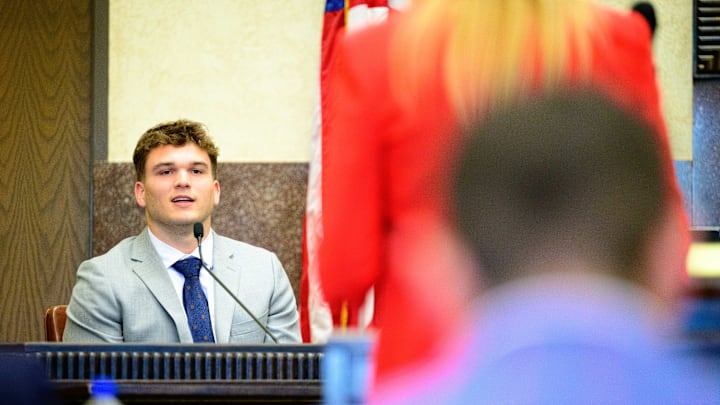
Three hours into the hearing, Heinecke took the stand.
Wearing a gray suit, Heinecke testified about his experience at Tulsa’s Bishop Kelley High School and his recruitment.
Heinecke’s lawyers showed photos of Heinecke as a child, wearing Oklahoma gear despite going up in Houston before moving back to Oklahoma.
They showed a photo of Heinecke, his face painted with an OU logo, at the 2011 Insight Bowl, where the Sooners played Iowa.
“To play Division I football, especially at the University of Oklahoma, is a lifelong dream,” Heinecke said.
Heinecke said playing another season in crimson and cream was important to him.
“To go down as, I don’t want to say a Sooner legend but to have a legacy at OU is something that’s really important to me,” Heinecke said.

Heinecke testified about discussions he had with then-Ohio State analyst Matt Guerrieri about walking on with the Buckeyes’ football team while playing lacrosse at the school.
Heinecke often looked over at Balkman while testifying.
He testified about injuries he suffered during high school, at Ohio State and during his first season at OU in 2022.
After a 90-minute lunch break, the hearing resumed with Heinecke still on the stand.
Heinecke testified that he played the season under the belief that he had a medical hardship year that would’ve given him another season of eligibility until after the end of the regular season.
Nate Dreiling, the Sooners’ inside linebackers coach, called Heinecke into his office in the days following OU’s win over LSU and informed him he would not be allowed to compete for another season.
Heinecke testified he decided to play in the Senior Bowl as he expected to have his appeal denied by the NCAA. That denial, which Heinecke’s lawyers said was automatic, came before the Senior Bowl was played.
Heinecke was asked about his football recruitment by NCAA attorney Taylor Askew.
He told Askew he had talked to Oklahoma State, Duke and Northwestern but he hadn’t been offered either a scholarship spot or a spot as a preferred walk-on with any of those schools.
After Heinecke’s testimony ended, his attorneys rested their case, as did the NCAA’s attorneys without calling any witnesses.
“The day after tomorrow is the OU spring game and Owen Heinecke should be on the field preparing with his team to play in that game,” Mary Cooper said in her closing statement on Heinecke’s behalf.
Heinecke was the last of five witnesses called by his attorneys.
The hearing began around 8:30 a.m. in the second-floor courtroom, with opening statements.
Heinecke’s attorney, Michael Lauderdale, outlined Heinecke’s case for eligibility, repeatedly coming back to Heinecke’s “less than 15 minutes” for Ohio State across across three games in the spring of 2022 costing him a season of eligibility.
“When you boil this case down, it turns on one thing—time,” Lauderdale said.”… Owen Heinecke would like more time. The NCAA doesn’t want him to have more time.”
While the NCAA’s attorneys argued Heinecke had an opportunity to play football at a service academy, Division II school or to walk on at another Division I school, Lauderdale called Heinecke’s decision to go to Ohio State to play lacrosse as a “Hobson’s Choice,” where there was only an illusion of choice.
While Heinecke’s side had several witnesses in hand to testify—including OU coach Brent Venables, general manager Jim Nagy—the NCAA relied strictly on the NCAA bylaws.
“These cases are not fun,” Askew said in his opening statement. “It’s not. The NCAA is going to stipulate that he’s an outstanding young man. … None of this is in dispute. That’s not the issue.”
Askew said Heinecke’s case was not a complicated one, unlike the Alston case that has transformed college athletics or Diego Pavia’s case for additional eligibility.
Venables was the first witness to take the stand, outlining his experience as a player and as a coach.
Woody Glass, who served as OU football’s chief of staff under Venables, conducted the direct examination.
“I feel like I have a PhD in dealing with 18-24 year olds,” Venables said.
Venables testified about recruiting and evaluating players during the COVID-19 pandemic.
Venables was asked about Danny Stutsman’s 2024 NIL payment to OU walk-ins that was matched by Walk-Ons Sports Bistreaux. The restaurant chain also awarded Heinecke a scholarship, picking Heinecke with input from Venables.
It was a long way from where Heinecke started out at OU, where he walked on in the summer of 2022.
Glass asked Venables where Heinecke was on the depth chart then.
“Whatever is the last spot,” Venables said, drawing a laugh from the gallery and attorneys. “I’ve been there.”
After not playing that season, Heinecke became a special teams staple over the next two seasons before breaking out last season.
He became one of the Sooners’ top defenders, and broke into the starting lineup for the final five games.
Askew’s cross examination focused on whether having Heinecke in the Sooners’ roster in 2026 would take away opportunities from other players, and on roster confirmations in the wake of the COVID-19 pandemic.
“Not everybody’s capable of winning the Butkus Award, Owen is,” Venables said “If he continues to take those steps forward.”
Venables called his decision to offer Heinecke a spot as a preferred walk-on a “leap of faith,” largely based on the success of Heinecke’s uncle, Cory, a walk-on who became a starter for the Sooners as a defensive lineman during Venables’ first tenure with the Sooners.
Heinecke’s high school coach at Bishop Kelley, JJ Tappana, took the stand next.
“Owen was a dude,” Tappana said in describing Heinecke as a high school player.
Tappana was asked about Heinecke’s recruitment, and about how the pandemic affected Heinecke’s opportunities.
Tappana outlined texts from Oklahoma State and Duke assistants, in particular, outlining their need to see Heinecke play in person in order to offer scholarships.
Cooper asked Tappana if Heinecke had the same opportunity as other prospects.
“To be recruited? No,” Tappana said.
Tappana testified about additional requirements of playing at a service academy based on former Bishop Kelley players who had played for the academies, and that Division II coaches expressed that they wouldn’t recruit Heinecke because they believed he would play at the Division I level.
“All I can tell you is Owen is a dude, who didn’t get recruited, COViD happened and that’s it,” Tappana said, adding that Heinecke was the best player he ever coached.
On cross examination, Tappana was asked about the timeline for Heinecke’s commitment to play lacrosse at Ohio State. Heinecke committed to the Buckeyes in November of his senior season.
Tappana said Heinecke’s ability to gain exposure in lacrosse was different, because the sport isn’t governed by the Oklahoma Secondary School Activities Association.
Askew questioned Tappana about whether or not college football programs signed players in the wake of the pandemic.
Tappana pushed back, saying the opportunities were limited as established players were given an extra year of eligibility.
“Some of those kids that would have been recruited joined a fraternity and did keg stands,” Tappana said, drawing a laugh. “Owen didn’t do that.”
Oklahoma compliance director Brady Newville took the stand next, outlining the process for requesting an eligibility waiver from the NCAA and the appeals process.
Lauderdale asked about the importance of precedent in the NCAA waiver process, noting that one such case that has similar circumstances to Heinecke’s was not in the database.
Newville, who called the case in question “incredibly identical,” said he believed the NCAA left the case out of the databases “because it would set bad precedent.”
Citing the case of Lyde, Lauderdale introduced evidence that both Lyde’s and Heinecke’s waiver claims were based on the same NCAA bylaw and Newville testified that Lyde’s waiver was subject to a different standard of review than Heinecke’s.
“Yes, they are admitting that they can depart (from the guidelines) whenever they want,” Newville said. “… That’s not fair.”
Shortly thereafter, with the hearing nearing two hours in, Balkman called for a 15-minute break.
When the hearing resumed, Newville was asked whether he believed Heinecke’s waiver should’ve been granted, and was asked again about the Lyde case.
“To me, it’s conclusive, Owen’s case and the Lyde decision are practically identical,” Neville said “I don’t see how you could rule differently.”
Newville was asked about former OU Dean of Law, Andrew Coats, who was one of the attorneys who was a part of the landmark Supreme Court case NCAA vs. University of Oklahoma Board of Regents that changed the television landscape for college athletics — in particular college football.
Newville was asked what Coats said about the NCAA when discussing the case in Newville took during his time at OU Law.
“Never Concede Anything Anytime,” Newville said.
Nagy was called to the stand next, outlining his experience as an NFL scout and as the director of the Senior Bowl before joining OU.
“Elite human performance is what we’re looking for,” Nagy said.
Nagy was asked about Heinecke’s status as a “tweener” as a high school prospect, stuck between being recruited as a linebacker and a safety, and the importance of in-person evaluation of such players.
He also testified to the chaos created by the pandemic and players who would’ve otherwise been in the draft class returning to college for an additional season, and the trickle-down effect that had on high school recruiting—and in particular players like Heinecke whose role at the next level was more nebulous than players that were clear four- and five-star prospects.
Nagy then testified about the difference an additional season at OU could mean for Heinecke’s NFL prospects.
“It might sound a certain way but for NFL scouts that momentum starts building in the summer,” Nagy said, pointing out that Heinecke didn’t really break out until late in the 2025 season.
Nagy said in the last eight drafts, one linebacker was picked who played less than five percent of his team’s defensive snaps in his next-to-last season of college football. If Heinecke were drafted, he would be the second.
“I think he has a lot to gain by coming back,” Nagy said.
Nagy was asked about the “irreparable harm” of Heinecke’s request for an injunction being denied.
Nagy said Heinecke’s legacy at OU would be greatly enhanced with another season, as well as helping his NFL Draft stock.
“He’s as OU through and through as any kid we have in the program,” Nagy said.
Askew then asked Nagy about linebackers Kip Lewis and Cole Sullivan and whether or not their playing time would be affected if Heinecke were to return.
Nagy said it wouldn’t necessarily impact their playing time, noting that the Sooners heavily rotated at th position and that Sullivan had the ability to play another position that could keep him on the field alongside Heinecke and Lewis.
Cooper spent much of her closing statement hammering on the NCAA’s recent filing regarding the Lyde ruling and that the organization didn’t call any witnesses to corroborate that filing, which included the assertion that OU hadn’t submitted medical records showing Heinecke couldn’t have competed during the 2021 football season.
“I know this is nothing to the NCAA. This is this kid’s (lifelong dream),” Cooper said, pointing to Heinecke.
Sign up to our free newsletter and follow us on Facebook and X for the latest news.
While Venables left after testifying, Nagy remained in the gallery throughout the hearing, accompanied in the front row by athletic director Roger Denny and sitting next to Heinecke’s parents.
Askew’s closing argument centered on the assertion the NCAA consistently applied its guidelines across the cases and that the application of the standards wasn’t “arbitrary and capricious.”
“I get it,” Askew said. “These are emotional cases. They are. … But emphasis and emotions and argument doesn’t change words in a piece of paper: it doesn’t change facts.”
After closing arguments, Balkman told the sides he would take 15-20 minutes to review his notes before making a ruling.
Heinecke came over to shake Askew’s hand after closing ceremonies.
Balkman returned to the courtroom just more than 20 minutes later.
 Add us as a preferred source on Google
Ryan Aber has been covering Oklahoma football for more than a decade continuously and since 1999 overall. Ryan was the OU beat writer for The Oklahoman from 2013-2025, covering the transition from Bob Stoops to Lincoln Riley to Brent Venables. He covered OU men's basketball's run to the Final Four in 2016 and numerous national championships for the Sooners' women's gymnastics and softball programs. Prior to taking on the Sooners beat, Ryan covered high schools, the Oklahoma City RedHawks and Oklahoma City Barons for the newspaper from 2006-13. He spent two seasons covering Arkansas football for the Morning News of Northwest Arkansas before returning to his hometown of Oklahoma City. Ryan also worked at the Southwest Times Record in Fort Smith, Arkansas, and the Muskogee Phoenix. At the Phoenix, he covered OU's national championship run in 2000. Ryan is a graduate of Putnam City North High School in Oklahoma City and Northeastern State University in Tahlequah.