
Relitigating Penn State Coach Matt Campbell's Curious Halftime Decision at Washington
In this story:
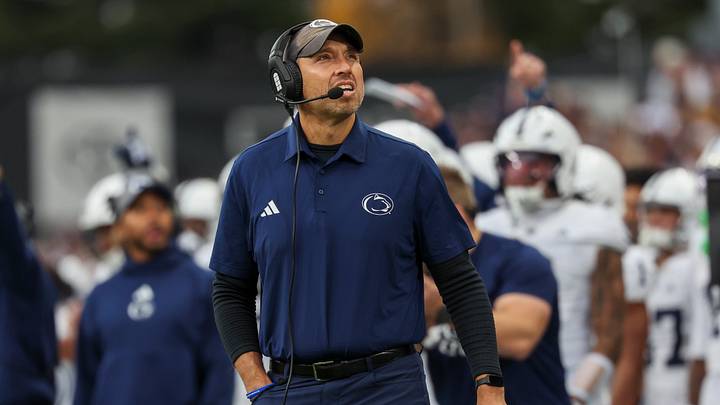
Penn State coach Matt Campbell wanted to talk about his end-of-half decisions at Washington three days later. He even sounded eager to tell his side.
"Let's get into it," Campbell said with a smile during his weekly press conference.
Campbell followed that with an informative answer during which he broke down the situation, defended his decisions and made a case that sitting on the ball and three timeouts was the proper move. He was in a better position to do that, since the Nittany Lions beat Washington 28-25.
Or more accurately, held on. The Huskies scored 19 unanswered points in the second half, turning the Nittany Lions pale until their final, game-clinching drive. Which Campbell could not have foreseen, thus making his decision (and explanation) to abandon his 2-minute offense after a 1-yard loss illuminating.
That, coupled with Penn State's loss to Wisconsin in September, were signs of what to expect from Campbell on gamedays. And not necessarily positive signs, at least from an aggressive coaching. So as Campbell said, let's get into it.
Penn State's situation at Washington
"Let's get into it."
— Mark Wogenrich (@MarkWogenrich) November 11, 2026
Penn State coach Matt Campbell was eager to explain his view of the end-of-half scenario at Washington when asked by @audsnyder4.
🎥Penn State Athletics pic.twitter.com/tdVmW5QMIB
Penn State had the ball at its own 15-yard line with 1:49 on the clock, a 28-6 lead and three timeouts on the board. "They had three timeouts, too," Campbell quickly reminded of the Huskies.
It was the perfect opportunity to run a 2-minute offense, potentially take a four-possession and, with the ball to start the second half, close out the Huskies. Penn State got off to a promising start, as Carson Hansen ran for 10 yards and a first down on the series' second play.
Then Washington sacked quarterback Rocco Becht, albeit for just a one-yard loss, and threw Penn State off schedule. Instead of taking a timeout to collect his offense, Campbell let the clock run, snapping the ball on second down with 15 seconds left. At that point, Campbell was comfortable taking a 22-point lead and three timeouts into halftime.
"The last thing I wanted to do is go three-and-out and give them the ball back," Campbell said. "We got our first first down, but we took a negative play. We took a sack, made it second-and-11.
"From my end, we had the momentum [in the game]. To me, the last thing that I wanted to do — we weren't still in a great field -position standpoint, probably would have taken one more first down — [was give Washington the ball back]. If we would have had a positive completion there, I probably would have taken the timeout.
"I think my bigger fear was us having to punt the ball back. Number one, punting the ball in that situation, something poor could happen. Number two, we were getting the ball coming out in the second half. I just didn't want to make a mistake there."
'That's a really fair question'



The last part of that answer was the most telling: "I just didn't want to make a mistake there." Campbell coached with that ethos through the entire second half of the Nittany Lions' 24-20 loss to Wisconsin in September.
Penn State led 17-0 in the first half, and held a 10-point lead in the fourth quarter, during which Campbell said he coached "not to screw it up." He did the same thing in before halftime at Washington.
When Becht was sacked, Penn State still 53 seconds left on the clock and all three timeouts. Calling one would not have led to a certain punting mistake. Campbell could have reset his offense and attempted one more play.
Second-and-11 is basically no different than second-and-10 in that situation, receiver Chase Sowell thought he was "unguardable" and Washington appeared comfortable using man-to-man coverage against him. There was still an opportunity.
Instead, Campbell prioritized the negative plays that could happen instead of pursuing a positive play that also could happen. Which suggested a situational discomfort that his offense could make the big play. Or worse, that Becht might make a mistake.
After the game, Campbell praised Becht for his "veteranness" and "poise" and wanted to see more of that from the outside. "Hopefully the writing on the quarterback will be a lot better today than maybe it has been," the head coach said.
But in that moment at least, Campbell didn't appear wholly comfortable letting his veteran quarterback continue running a 2-minute drill. Nor did he appear comfortable putting his defense on the field against a Washington offense with three timeouts, even though it had held the Huskies to six points.
"Again, I think it's a really fair question," Campbell said. "We talked about it after the game. If you don't take the negative play there, then I probably don't put ourselves in that situation. But with the negative play, I just felt like it was risky with the lead that we had and us getting the ball back [to start the second half]."
Campbell and his staff have shown some successfully aggressive tendencies in other areas, notably on fourth down. Penn State leads the Big Ten, and ranks first nationally among FBS teams, in fourth-down success rate (14-for-18, or 77.8 percent). The Nittany Lions went 2-for-3 on fourth down at Washington, missing only on a failed hook-and-ladder in the second half.
But Campbell also can be an old-school, defense-and-field-position coach, which works at Iowa or in the pre-portal era. Against faster teams with more offensive talent spread across the country, that's going to find trouble.
It already has, at home against Wisconsin this season. After the Washington game, here's what Campbell said he learned from that loss.
"Don't sit back, right, and just assume it's going to happen," he said. "I put that [loss] as much on anybody else as me, and so I thought the biggest thing for me is trying to help our guys regain their poise. We don't just want them to have poise. Go lead them to have some poise and help them get through it."
Campbell could have used that advice on himself at the end of the first half against Washington.

Sign up to our free Penn State Nittany Lions newsletter, follow us on social media and add Penn State on SI as a Preferred Source on Google.
 Add us as a preferred source on Google

Mark Wogenrich is the editor and publisher of Penn State on SI, the site for Nittany Lions sports on the Sports Illustrated network. He has covered Penn State sports for more than two decades across three coaching staffs, three Rose Bowls and one College Football Playoff appearance.
Follow MarkWogenrich