
Josh Henson's Flexibility, Improvement as a Play-Caller Paying Off For Purdue
In this story:
Many names get mentioned when talking about Purdue's offensive improvement this season. The conversation usually begins with the play of quarterback Ryan Browne and includes the addition of running back Fame Ijeboi. The wide receivers, tight ends and offensive line all get major nods for their significant contributions through the first six games.
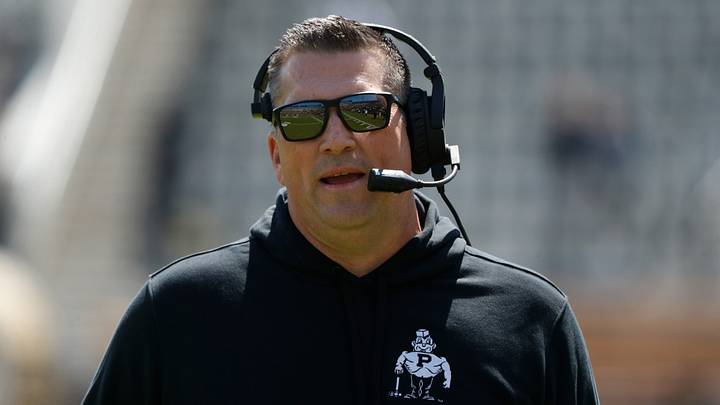
But behind the scenes, offensive coordinator Josh Henson is the one cooking up Purdue's success. Now in his second year as the Boilermakers' play-caller, he's taken tremendous strides from last season, and his growth has led the offense to play its best football since 2022.
Purdue's offense isn't setting the pace in college football this season, but it's been effective. The Boilermakers are averaging 32.2 points and 415.5 yards per game. Both those numbers rank eighth in the Big Ten. They're also throwing for 282.0 yards per contest, which sits fourth in the conference.
Several factors contribute to Purdue's improved offensive efficiency this season. Browne has completed 68.9% of his passes and has nine touchdowns with only one interception. The Boilermakers have a reliable ball-carrier in Ijeboi, who has already accounted for 549 yards and nine touchdowns in six games.
It seems like every week a new receiver is making plays. We've seen Chauncey Magwood, Asaad Wasseem, Tra'Mar Harris, De'Nylon Morrissette and Xavier Townsend all show their potential. Tight end George Burhenn has been effective in the passing game.
What we've seen from Henson this season is a bolder, more trustworthy style of play-calling. Perhaps that comes from working with Browne for a full season. The improved offensive line probably opens up the playbook a little more. Having players at skill positions who are reliable turns short-yardage designs into explosive plays.
Last year, Henson was essentially new to play-calling. Years had passed since he was the one calling the shots when he was named the offensive coordinator at Purdue ahead of the 2025 season. Not only was it the first time in a decade that he'd worn the toque, but he didn't have the best ingredients at his disposal.
That changed in the offseason. Now, with a full year under his belt and a much better collection of talent in the offense, we're seeing just how effective Henson can be as Purdue's offensive play-caller.
Not the same game plan every week

Perhaps the greatest strength of Henson's play-calling this season is his flexibility. Throughout the first six games, we've seen Purdue operate in multiple ways offensively, adjusting to its strengths and taking advantage of the defense's weaknesses.
In Purdue's Big Ten opener against UCLA, the Bruins had no answer for the passing attack. Although the Boilermakers would have liked to have a steadier presence on the ground inside the Rose Bowl that night, Henson relied on the arm of Browne and the skill of the receivers to score points.
Browne threw for 378 yards and three touchdowns that night. Both Wasseem and Townsend racked up more than 100 receiving yards in a 52-38 loss to the Bruins.
Fast forward to Saturday's game against Minnesota, and Henson altered his strategy to feed Ijeboi, a running back hungry to prove a point against his former team. He rushed for 195 yards and three touchdowns while the Boilers steamrolled the Gophers 41-13.
As a team, Purdue rushed for 305 yards and four touchdowns. It was the first time the Boilermakers rushed for 300 yards in a game since a 23-15 loss to Northwestern in November 2023.
Sometimes, offensive coordinators get stubborn with their approach. They don't just want to win, but they want to win with their style of offense. Henson doesn't seem to carry that same burden. He's been putting Purdue in position to win games, implementing whatever strategy gives them the best chance to do that.
An early blunder and a make-up call

On Sept. 12, the Purdue offense had the ball 1st-and-goal at the Wake Forest 8-yard line. The Boilermakers trailed 23-20 with 63 seconds to play. A touchdown would have probably ended the game, ending a Power Four losing streak that stretched across two full seasons.
Ijeboi had a huge afternoon, rushing for 114 yards and three touchdowns in the contest. Henson ran plays on back-to-back downs, getting the ball to the 5-yard line. Then, on 3rd-and-goal, he allowed Browne the opportunity to throw the football. Nobody was open, and the quarterback scrambled for just two yards.
The Boilers settled for a field goal to force overtime, a game they ultimately lost 38-36.
After that game, Henson admitted that he might have been a little too conservative in that moment. If given the opportunity to do it again, he likely would have called a pass play on 2nd-and-goal, giving Browne another chance to make a play.
Henson learned from that moment a few weeks later when Purdue traveled to Illinois. The Boilers owned a 16-10 advantage in the fourth quarter and had just picked up a first down on a 12-yard catch by Harris. On the next play, Henson dialed up a deep pass play that worked to perfection.
Browne threw the ball to Magwood, who made a ridiculous catch inside the Illini red zone. It was a 31-yard catch to get the ball to the 1-yard line. Two plays later, Antonio Harris punched the ball across the goal line, and Purdue took a 24-10 lead and picked up its first Big Ten win since 2023.
Head coach Barry Odom gave his offensive coordinator all the credit after that victory. A few days after that game, Henson made a comment that sounded like music to everyone's ears in West Lafayette.
"I wasn't going to lose that game by not being aggressive."
Success on third down and in the red zone

Two percentages have stood out for Purdue's offense this season: 45.3% and 93.3%. Those are the conversion rates for the Boilermakers on third down and inside the red zone, respectively.
Purdue's third-down percentage ranks third in the Big Ten, a pleasant surprise through six games. The 93.3 red-zone mark is near the top, as well. What's more impressive about that is that the offense has made 30 trips into scoring territory, second-best figure in the league.
Odom and Henson have both acknowledged that the Boilers have settled for too many field goals in those situations this year. Purdue's touchdown percentage is just 60%, ranking 14th in the Big Ten.
Progress was made on Saturday against Minnesota, though. Purdue got into the red zone six times and scored on all six trips. Five of those were touchdowns.
When it comes to winning in the Big Ten, converting on third-down situations and scoring touchdowns in the red zone are critical keys. Purdue has turned those weaknesses into strengths under Henson's guidance.
Get top Boilermakers stories, expert analysis, and can't-miss moments straight to your inbox for free by signing up for the Purdue Boilermakers on SI newsletter!
 Add us as a preferred source on Google
Dustin Schutte is the publisher of Purdue Boilermakers on SI and has spent more than a decade working in sports journalism. His career began in 2013, when he covered Big Ten football. He remained in that role for eight years before working at On SI to cover the Boilermakers. Dustin graduated from Manchester University in Indiana in 2010, where he played for the men's tennis team.
Follow SchutteDustin