
Projecting Vanderbilt Baseball’s Lineup and Rotation Ahead of Opening Weekend
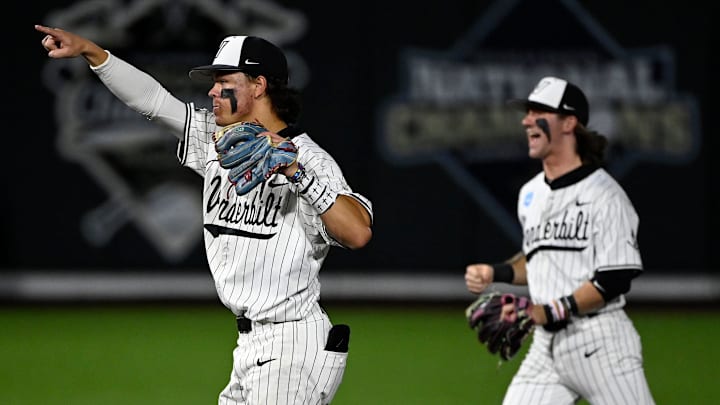
Vanderbilt baseball opens its season on Friday at the Shriners Children’s College Showdown, taking the field at Globe Life Field in Arlington, Texas. After a winter of training and a preseason slate disrupted by snow, the Commodores are finally approaching game action — and with it, some long-awaited clarity on what the lineup and rotation will look like.
“Versatile” has long been a defining word of Tim Corbin’s Vanderbilt teams, but this group feels especially flexible defensively — a sentiment Corbin echoed last week when asked about the roster. With ongoing position battles at first base, shortstop, center field, and at least two unsettled rotation spots, Vanderbilt enters the season with a multitude of lineup and pitching permutations.
As roles crystalize over the season’s first few weeks, some early assumptions are bound to change. Still, based on what I’ve seen and heard through winter workouts and preseason scrimmages, here’s my best guess at the lineup and rotation that ultimately takes shape by the time SEC play arrives.
**Note: The blurbs below are updated versions of those from my fall roster projection.
Catcher: Colin Barczi
Barczi returns as a junior and slots in as the clear backstop for the Commodores after starting 52 games last year, slashing .253/.307/.439 with 8 home runs and 39 RBIs. Barczi is a steady presence defensively and has all the physical tools of an everyday hitter — with the small caveat that he doesn’t get to his pull-side raw power enough in-game. He’ll look to solidify his stronghold on the catching position this spring by emerging as a true middle-of-the-order bat — one that could elevate his draft stock as he approaches eligibility.
First Base: Max Jensen
A four-year starter for the Big Red, Max Jensen was hitting .284 with a .430 on-base percentage and showing legitimate power at the plate before an ACL tear ended his 2025 season — and opened the door for another year of eligibility. Jensen has looked sharp in scrimmages, and his advanced hit tool and plate discipline should translate well into SEC competition. Jensen holds the edge over Cal State Fullerton transfer Carter Johnstone and sophomore Tommy Goodin with his strong glove and advanced approach.
Second Base: Mike Mancini
Mancini is an X-factor for Corbin’s 2026 lineup. The former JMU standout started 47 games last season, hitting .269 with 4 home runs and 24 RBIs while working his way back from a hamate bone injury that sapped his power for much of the year. Now fully healthy and noticeably stronger after adding weight in the offseason, Mancini looks closer to the player who slugged 15 home runs for the Dukes in 2024. His fall performance, highlighted by a long home run against Utah, was a sign of the power he could bring to the lineup. If he continues to pair his steady defense and on-base ability with renewed power from the left side, Mancini could emerge as one of Vanderbilt's breakout stars. The right field wall coming in 15 feet will only help the lefty bat.
Shortstop: Ryker Waite
The departure of four-year program stalwart Jonathan Vastine leaves a sizeable void at the shortstop position for Corbin to fill. Though Rigdon and Johnston have taken reps there this spring, sophomore Ryker Waite is my pick to emerge as the everyday starter. Waite is a glove-first infielder who enjoyed a mini-breakout in the Cape Cod League over the summer, slashing .287/.409/.417 with an .826 OPS across 108 plate appearances en route to earning All-Star honors. Waite’s natural bat-to-ball skills and quick hands on defense fit perfectly into Vanderbilt’s preferred archetype, and his range and sure-handedness make him an ideal candidate to succeed Vastine. A shuffle that moves Johnston to short and shifts Rigdon or Carter Johnstone to third remains possible, though that alignment would weaken Vanderbilt defensively at both spots without a clear offensive payoff. Waite’s ability to impact the baseball could surprise people, and I wouldn’t be surprised to see him develop into a gap-to-gap hitter with occasional home run pop.
Third Base: Brodie Johnston
Johnston returns after a breakout freshman campaign in which he launched 15 home runs and posted an .831 OPS across 56 games. A guarantee to slot into the middle of the order, Johnston brings elite raw power and the potential to be one of the SEC’s top run producers. The only real question is whether he’ll remain at his natural third base position — where he thrived defensively, earning SEC All-Defense honors — or slide over to shortstop to fill the void left by Vastine. Johnston’s power is unmatched on this roster, but he’ll need to sharpen his plate discipline and improve his swing decisions if he wants to avoid exploitation from SEC pitching. The Tennessee native walked in less than 5% of his plate appearances last season and struck out in over 30%, and his 39.4% chase rate was in the first percentile of all college hitters. Even so, his bat speed and contact quality make him the power anchor this offense needs.
Left Field: Rustan Rigdon
An infielder by trade, Rigdon spent much of last season in left field out of necessity and impressed throughout. The sophomore also emerged as Corbin’s leadoff hitter during the back half of last season thanks to his plate discipline, on-base ability, and speed on the basepaths. Rigdon's 19.5 BB% and mere 16.3% chase rate were both near the top in the country and led to a .431 OBP despite just a .259 avg. last season. With his balanced, contact-oriented approach, Rigdon is the stylistic counterpoint to his freshman-year roommate and power-hitting counterpart Johnston. Rigdon can play all around the diamond — and likely will at points this season— but he’s most needed in the outfield under the current roster construction. He’s an option in center field as well, though the next guy spent more time there this winter.
Center Field: Braden Holcomb
Center field looms as the biggest question mark on Vanderbilt's 2026 roster, with the only true defensive options being true freshmen Collin Brightwell and Cade Sears. Despite not fitting the traditional center-fielder build, Holcomb appears to be Corbin’s best option to succeed RJ Austin. The junior said this spring that his wide receiver background makes center field feel more natural the corners, and while he may not match Austin’s or Brightwell’s range, average defense in center paired with his bat would make him one of the most valuable players on the roster. The right-handed slugger ranked in the 95th percentile nationally in average exit velocity in 2025, with both his barrel rate and xwOBA sitting well above average as well. If he can improve his contact rate even marginally, he has a chance to emerge as one of the SEC’s most productive hitters.
Right Field: Logan Johnstone
A transfer from Washington State, Johnstone brings plus corner-outfield defense and one of the most advanced hit tools on Vanderbilt’s 2026 roster. The left-handed hitter hit .337 with a 1.010 OPS last season, adding 9 home runs and 40 RBIs while being named to the All-Mountain West First Team. Now reunited with his brother Carter, the elder Johnstone brings both experience and poise to the Commodores’ clubhouse. While he’s played center field in the past, his defense is far superior on the corners. Johnstone profiles as a steady contributor who rarely whiffs or chase, and his impact will hinge on maintaining the polished approach that defined his success out West.
DH: Mack Whitcomb
Whitcomb comes over from Tennessee Tech after a monster 2025 campaign in which he hit .360 with a 1.134 OPS and 15 home runs while being named the Ohio Valley Conference Player of the Year. A true power bat with max exit velocities over 110 mph, Whitcomb projects as Vanderbilt’s primary designated hitter while also serving as an option behind the plate to spell Barczi in midweeks. The slugger’s profile is a true fit for the DH role — a position the Commodores have struggled to maximize in recent seasons. If Whitcomb can translate even some of his offensive production to the SEC, he has the potential to form a strong power tandem with Johnston in the middle of the order.
SP1: Austin Nye
Nye is the only starting spot truly set in stone for Corbin and pitching coach Scott Brown. The right-hander broke out as a freshman last season, excelling in a midweek role with a 3.55 ERA and 58 strikeouts across 50.2 innings pitched. By season’s end, Nye was touching 97 mph on the radar gun with his four-seam fastball while pairing it with a tight slider, big curveball, and a deceptive changeup that neutralized left-handed hitters. Athletic and projectable on the mound, Nye has the command, composure and stuff of an SEC ace, and he’s a strong bet to emerge in that role in 2026.
SP2: Connor Fennell
Fennell and Nye are very different pitcher archetypes, but they both excelled in starting roles last season. Fennell thrives on deception, utilizing a funky low-slot delivery to generate a flat vertical-approach fastball that excels at the top of the zone, despite topping out in the low 90s. The former Dayton transfer emerged as a starting option last season, posting a 2.53 ERA across 17 games and 7 starts. Now with a strong chance to reclaim his weekend starting spot, Fennell pairs his deceptive fastball with a slow curveball, well-located changeup, and sweeping slider. His funky delivery, rapid tempo, and confidence on the mound make him a nightmare for opposing hitters, and his contrasting style from Nye could make the pair a formidable one-two punch atop the Commodores’ 2026 rotation.
SP3: Nate Taylor
This is where things get dicey. While Nye is a near sure bet for Friday night and Fennell isn’t too far behind on Saturday’s, the next two rotation spots remain wide open, with seven or eight viable candidates in the mix. I strongly considered Shorey and Kranzler here but ultimately went with the pitcher who simply has the better stuff. A Georgia transfer, Taylor started three games in the Cape Cod League over the summer, pitching to a 2.93 ERA and 0.91 WHIP across 15.1 innings of work. Taylor features the liveliest fastball of Vanderbilt’s realistic options, sitting in the mid-to-high 90s, pairing it with a strong sweeper and an improved changeup to boot. His command is sharp, but Taylor is still a high-variance pick, and he could also slide into a back-of-the-bullpen role. Harnessing his stuff into length and weak-contact outs — and perhaps adding a pitch or two to his mix —will be key for his chances to emerge as Vanderbilt’s third weekend starter.
Midweek Starter: Matthew Shorey
The midweek starter is always one of the hardest roles to project, and this season feels even more uncertain than usual. I initially penciled in the highly touted Aiden Stillman, but I haven’t seen enough yet to be confident he’s fully stretched out and ready to start games. Shorey, by contrast, offers a more proven profile. He logged 13.2 innings for Vanderbilt last season, striking out 12 while walking just four, then followed that with an impressive summer on the Cape, where he posted a 2.37 ERA across 30.1 innings and five starts. A low-slot left-hander, Shorey brings a different look to the mound and profiles as a reliable option to soak up midweek innings.
Freshman Tyler Baird may also force his way into the conversation, particularly in weeks with Tuesday–Wednesday series. Baird put together an extremely impressive fall and shows an innate ability to get hitters out, featuring one of the smoothest deliveries on the staff and an advanced feel for spinning his breaking balls. Command will ultimately determine whether he emerges in the midweek role, but among the freshmen, he appears the most game-ready option. While the then-freshman Nye filled this role at times last season, Corbin would likely prefer the more experienced Shorey — assuming Vanderbilt can afford to pull the lefty from weekend relief duties.
Closer: Luke Guth
With Sawyer Hawks being departing to join the Arizona Diamondbacks organization, the Commodores are also looking for a new closer in the spring, and Guth stands out as the clear choice. The junior was dominant in a middle relief role last season, posting a 0.93 ERA with 22 strikeouts and 7 walks without allowing a single home run. Guth is an athletic right-hander with a plus fastball and a proven ability to get hitters out at the highest level. While his stuff isn’t as electric as England Bryan and his delivery not as deceptive as Miller Green’s, Guth’s strong command and pitch mix make him the best reliever out of Brown’s bullpen. If Guth struggles, watch out for impressive freshman Wyatt Nadeau to carve out an important role in high-leverage situations.
Vanderbilt opens its season Friday at 3 p.m. CT against TCU.
 Add us as a preferred source on Google
Dylan Tovitz is a sophomore at Vanderbilt University, originally from Livingston, New Jersey. In addition to writing for Vanderbilt on SI, he serves as a deputy sports editor for the Vanderbilt Hustler and co-produces and hosts ‘Dores Unlocked, a weekly video show about Commodore sports. Outside the newsroom, he is a campus tour guide and an avid New York sports fan with a particular passion for baseball. He also enjoys listening to country and classic rock music and staying active through tennis and baseball.
Follow dtovitz