
Vanderbilt Baseball's Historical Past Feels More Distant Than Ever After 19-Year Regional Streak's Ending
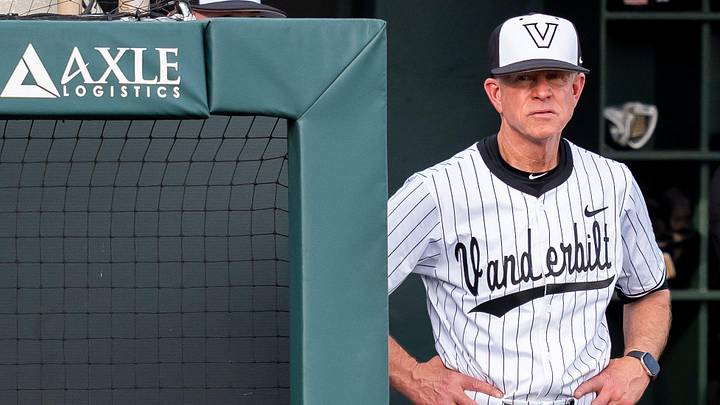
HOOVER—For a second, everyone inside Hawkins Field was left to stand in place while the somber tune of an organ hummed over the playing surface and Hawkins Field. The sound in itself was beautiful and graceful, but it represented the setting of a fight–a mental one for each Vanderbilt coach and player that tasked them with keeping a number of crippling realities at bay.
Vanderbilt still had two games guaranteed ahead of it at that point, but the temptation to label this national anthem as the obituary on this gone-haywire Vanderbilt season ahead of its final home game was compelling. The sound was there and the feel of a funeral preceding was there, at least.
In the moment, Tim Corbin’s team was alive. It was fighting for its life each day, though, and knew that it would have to pull a rabbit out of its hat in order to keep it that way for long. The best coping mechanism for this program was to fall back on its process-oriented nature. One game at a time. Playoff baseball.
Considering the whole picture would’ve been crippling to most if this Vanderbilt baseball team took a second to stop and think about it. If it had any chance to succeed, it had to drown out the idea that it was on the verge of becoming the program’s least successful team in the past 20 years. It had to drown out the idea that it could be the team that ended college baseball’s longest regional streak and fell below the program’s intense standards.
Corbin did his best to insulate this group from the magnitude of those potential problems, but he could only do so much.
“Of course,” Vanderbilt shortstop Ryker Waite said in regard to the idea that the regional streak put on the pressure. “We want to do this for Corbs, do this for the program. He puts so much into this. He’s the best of all time, and we love playing for him. We don’t want to be done.”

On Wednesday, though, Vanderbilt was done after a 8-3 loss to Florida in the SEC Tournament. It’s the outcome that it earned in a season of inconsistency and general underperformance, but it was jarring nonetheless.
Vanderbilt had made a name out of deep Hoover runs under Corbin’s watch. He’s the all-time wins leader in this tournament and has won four league titles here. A year ago, he left this park for the final time after holding a championship trophy.
This time, he shook every media member’s hand and let out a “thanks, gang” for their coverage as he left his press conference. Corbin never declared it to be over when he met the media, but he said the quiet part out loud without saying anything in the moments after he took the podium.
Vanderbilt’s players did the same thing in the moments following Corbin’s postgame speech–which lasted 2:31. Braden Holcomb stood at the rail of the dugout taking it all in for a few minutes. So did Chris Maldonado. They set the tone for this Vanderbilt team to take it all in for a second and think about where this all went wrong.
Vanderbilt baseball has to know that it’s not going to the NCAA Tournament. It’s not really up for interpretation anymore. It would take a generous eye and a strong consideration of the Vanderbilt brand to consider it for the tournament. This group had its chances, and it blew it. This Vanderbilt baseball season is likely over, unceremoniously, without an NCAA Tournament berth.
As a result, its legacy will be defined by its walk off the field on Wednesday and all that it left on the table. It’s not a legacy of pitiful play, but it’s one that brings into question whether this program can still do what it once did with the way that it’s currently operating. Corbin made it clear on Wednesday that he’s in this for the long haul, but he can’t be naive enough to believe that there’s no changes to be made here.
“I don't look at it and go ‘oh, my gosh.’ I just look at it and say ‘I'm going to figure this sh** out, some way, somehow,’” Corbin said. “I love where college baseball is. I love where this conference is. I just look at it as ‘okay, we've got some good players coming back, but we need to better ourselves.’”
Corbin’s messaging is necessary at this point, but the public contingent pressing him on why he hasn’t already figured this out should be validated in their opinions. This program has bottomed out to a degree that doesn’t mean its a trainwreck, but validates the idea that it getting back to the standard in short order will be a challenge.
Vanderbilt finished the 2026 season with a 33-25 record, an RPI that all but eliminates it from NCAA Tournament contention and an eerie exit in Hoover that was never unexpected. This program still hasn’t made a super regional since 2021. Corbin has never had to pull the program out of something this dramatic, though.
This was the year in which programs like Vanderbilt, Louisville and LSU–other ones that have some values that align with Vanderbilt does and have college baseball royalty as their head coaches–were finally caught up to fully by the endlessly-changing nature of college athletics. None of them will be in the NCAA Tournament. It’s jarring to say that about the other two, but more jarring to say that about Vanderbilt.
Corbin wants to build a culture, he wants to retain players and he wants to use the portal to supplement what he has. It’s not as if he’s been entirely abrasive to doing that, but this was enough to question whether he’s done enough. It’s nowhere near enough to declare that he shouldn’t get to go out on his terms or that he can’t reconcile this, but it’s enough to get through to him that he may need to approach this differently–and the realization appeared to hit him enough for him to hire a general manager of sorts.
This is the type of season around this place that makes you question everything.
“We've been very consistent for a long period of time, and we'll always be measured against those years that we were at the top. And that's okay,” Corbin said from the podium at the Hoover Met. “There's nothing wrong with that. But that's the challenge for the program; is getting back to that point.”

Corbin indicated Saturday that he had some level of hope in his team finding a way to pull a rabbit out of its hat in this place because of its previous history here and how the ballpark fits his program. He couldn’t have been surprised at the eventual outcome that awaited his program, though.
For this program to make a deep run in Hoover this season like it did a season ago, it would’ve been more of a result of lightning in the bottle than the result of logical baseball things. Vanderbilt just didn’t have enough pitching. Its lineup is good enough to win a tournament like this, but finding a way it was going to cover all the innings that it had to cover in order to make a deep run in a place like this was going to be difficult at best.
Vanderbilt finished No. 12 in the SEC in ERA with a 5.23 mark, was second to last in doubles given up, second in triples given up and always had a rotation spot or two open because of its lack of real starting pitching options. The injury excuse was real for this Vanderbilt team. It did have Austin Nye out for a long stretch, and if it had him it likely would’ve made a regional, but it still should’ve had a more effective staff than it ultimately did.
Corbin and pitching coach Scott Brown missed on the portal additions that they felt would aid their pitching staff and were forced to throw a number of freshman arms that they didn’t envision pitching all that much in the preseason in high-leverage spots. Vanderbilt freshman right hander Tyler Baird was always going to have some sort of role, but the idea that he started for this program in the second game of the SEC Tournament was a microcosm of its struggles on the mound.
This program found itself playing in the NCAA Tournament as its No. 1 overall seed a year ago because it always appeared to have more pitching than whoever it was facing, particularly on Sundays. That team’s offense wasn’t nearly as explosive or productive as this group’s, but it didn’t have to press because Vanderbilt seemingly always had enough arms to raise its floor.
Not this Vanderbilt team, though. This one didn’t have enough reliable arms. This one didn’t recruit enough transfer arms to supplement the core of returning ones that it already had on the roster and didn’t evaluate the transfer arms that it did get well enough. It often relied on freshmen to punch above their weight. It relied on a number of returners to be more consistent than they’d proven that they can be.
This Vanderbilt didn’t do the things that Vanderbilt generally does well enough to put together successful seasons. It had a dynamic offense and some real defensive promise, but it wasn’t good enough as a whole. It was a few innings away from having 20 league wins, but it couldn’t close in big spots as many times as it needed to. It knew how to win, but it let too many crucial games slip past it.

As a result, Corbin’s internal audit of the program will be painful. That’s what happens when a streak like this ends. Corbin hopes that the general public will realize how difficult what this program did was, but the general public appears to hope that he will take introspection beyond that in order to figure this out. He’ll likely have to make some painful decisions if he’s truly going to get this program to where it once was.
For now, though, he’s going to have to sit in the depths that come with his reality–one that is likely NCAA Tournament-less for the first time since George W. Bush was president, Corbin was in his third year, David Price was a freshman and YouTube launched.
The streak is likely dead, and each member of Corbin’s program will have to live with that.
“Consistency is really tough,” Corbin said. “And sometimes, streaks are streaks are streaks. That's what they are. But sometimes when you don't go, a lot of times people start to understand, whoa, that really was tough. That was difficult to do.”
Follow us onTwitter/X,Facebook,YouTube,Instagram,ThreadsandBlue Skyfor the latest news.
 Add us as a preferred source on Google
_(1)-b3e453dfe426b2dd4b83a12540ebdb37.jpeg "Joey Dwyer")
Joey Dwyer is the lead writer on Vanderbilt Commodores On SI. He found his first love in college sports at nearby Lipscomb University and decided to make a career of telling its best stories. He got his start doing a Notre Dame basketball podcast from his basement as a 14-year-old during COVID and has since aimed to make that 14-year-old proud. Dwyer has covered Vanderbilt sports for three years and previously worked for 247 Sports and Rivals. He contributes to Seth Davis' Hoops HQ, Basket Under Review and Mainstreet Nashville.
Follow joey_dwy