
Could Diego Pavia’s Draft Stock Be Hurt or Helped by His Age, Experience?
In this story:
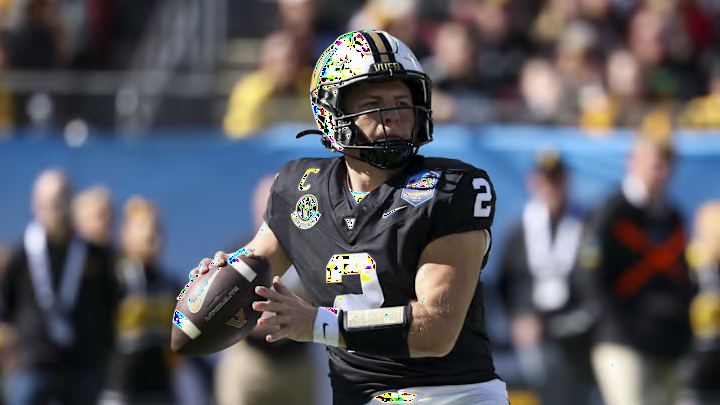
INDIANAPOLIS — In many ways, Diego Pavia is one of one as an NFL draft prospect.
Including his time at the JUCO level, Pavia has 1,555 career pass attempts to his name, while the anticipated top two quarterbacks in the draft class — Fernando Mendoza and Ty Simpson— have combined for 1,533. He’s older than three of the league’s starting quarterbacks from 2025, including Drake Maye.
But he also brings along plenty of character questions, which came to a peak with the infamous social media post he made after losing out on the Heisman Trophy.
His rugged play style is also not one with a clear transition to the league. A 6-foot, 207-pound bowling-ball runner isn’t exactly a common prototype in the league, nonetheless for a developmental backup.
This week, Pavia will make one of his final arguments to the NFL teams, working out and interviewing at the NFL Scouting Combine.
In press conferences Tuesday, a common theme for questions directed at general managers involved how the transfer portal and additional eligibility has changed scouting. Especially at the quarterback position, where growth in the cerebral aspect of the game is so vital.
“You have to have an understanding of where they've been — who coached them at the previous school, who's coaching them now, scheme players that are around them,” Pittsburgh Steelers general manager Omar Kahn said of how the portal has changed the evaluation of quarterbacks. “There's a lot of different factors.”
While some quarterbacks who transferred multiple times in their career have questions regarding how much they can actually thoroughly develop in one system, Pavia does have the benefit that the last four years of his collegiate career were all spent with the same offensive playcaller, Tim Beck. He grew steadily through those four years, with an adjustment from jumping to the SEC level in 2024.
That culminated in him completing 70.6% of his 378 pass attempts for 3,539 yards, 29 touchdowns and eight interceptions in 2025. He also rushed for 862 yards and 10 touchdowns on 167 rushing attempts on the year.
Though Pavia is on the older end, some teams see the benefit that experience can provide. He has 49 starts under his belt.
“I think one of the areas where it's probably helped is you've seen some players play a lot of football,” Houston Texans general manager Nick Caserio said. “They're more prepared to come into our league and potentially make a contribution. You have some players, 45, 50, 60, games played. The more you play, the more you do something, the better you're gonna get. So it kind of works both ways.”
Pavia became an early leader of players pursuing more eligibility, winning a lawsuit against the NCAA that granted all JUCO players an additional year of eligibility in 2025.
Team executives and decision makers seem to have differing view points on how to factor in the fact that a player transferred, decided to stay in college for an additional year, or how they navigated the NIL space.
A consensus that’s been reached though is that it’s changed the players’ approach to the business side.
“One thing that's happened is these guys are much more transactional, much more educated about the business part of this game,” Green Bay Packers general manager Brian Gutekunst said. “And they're so used to whatever their season is done, taking a step back and looking at what's best for them, and whether that's currently where they're at, or whether they should move on to another opportunity, which is their choice. Once they get here (the NFL), it's not necessarily their choice anymore.”
While Pavia had essentially become a seasoned veteran in college football by the time he was granted an additional year of eligibility, him choosing to benefit from another year of NIL instead of opting to go to the league has become a growing trend across college football, especially for underclassmen.
It’s a trend the NFL is still adjusting to. For most teams, it seems they approach each players’ situation on an individual level.
“We don't penalize a player because, okay, he received X amount of dollars in NIL,” Caserio said. “It's what's the rationale? What's the understanding? Our job is to understand it, not to pass judgment. … We're talking to players, 24, 25, 26 years old, and then it's like, ‘Well, are they too far along? You're not gonna be able to develop them. And you're like, worried about the second contract.’ We don't care for any of that. Like, what's the player? What's their profile? How does he fit? Is this a player that we think is gonna be an asset to our program?”
Frankly, Pavia has a lot going against him as a prospect. The same traits that could be seen as a benefit to his draft profile could also be seen as a negative. How he handles this week in Indianapolis, both with workouts and in interviews, could play a significant role in determining his future.
Vanderbilt Commodores On SI:
 Add us as a preferred source on Google