
What the Data Says About Vanderbilt’s CFP Case After Being Left Out by the Committee
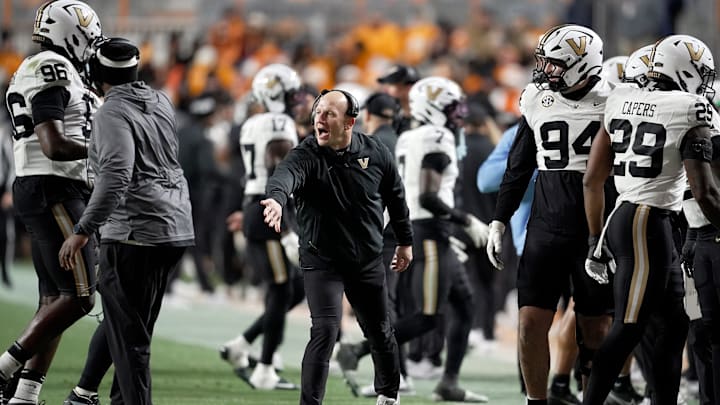
Vanderbilt was dealt a gut punch that resonated far beyond the walls of McGugin Athletic Center on Sunday when it not only missed out on the College Football Playoff, but was slotted all the way down at No. 14 in the final rankings. In a year defined by résumé hair-splitting, the Commodores didn’t just fall short — they were the fourth team left outside the Playoff.
That final ranking felt particularly jarring given the season Vanderbilt just capped off. Finishing their best campaign in program history with a rival win over Tennessee at Neyland Stadium, the Commodores finished 10-2 in the SEC — a benchmark that, in most seasons, would be the equivalent of a golden ticket.
Yet this year’s landscape has shaken up as anything but traditional. A nationwide glut of one- and two-loss contenders created a traffic jam the Committee had to sift through, and when they did so, Vanderbilt was the team squeezed out.
There’s certainly a very fair argument that Vanderbilt’s résumé wasn't one of the 10 best in the country. In fact, I’m not sure I would have put the Commodores in if the choice were mine. But that’s the entire point: It’s not supposed to come down to one person’s view, or even a room full of athletic directors relying on shifting, subjective criteria. The fact that it is makes the rankings an opinion-based blend of vague principles such as strength of schedule, head-to-head competition, comparative outcomes of common opponents, and “other relevant factors such as unavailability of key players and coaches.”
And that’s where the story begins to shift. All week, Vanderbilt’s college football playoff marketing campaign has urged the committee to remove bias and trust data. A pamphlet sent out to the media marketing Vanderbilt’s CFP case was headlined by the words “direct, data-driven, no spin, just the facts.”
Vanderbilt put together a full document laying out their case for the College Football Playoff pic.twitter.com/1ehpB3m4dv
— Bussin' With The Boys (@BussinWTB) December 2, 2025
“We’re here because we’ve got a really good football team,” Lea said on Monday. “This is not about narratives and stories, it’s about [the] statistics and the data that supports [that this] is a really good football team. I believe, with every strand of my being, [this team] deserves a chance to compete for a national championship.”
Yes, Vanderbilt has a Heisman Trophy Candidate and arguably the most fun player in the country as its signal caller in Diego Pavia. Surely that should only help its case. But that’s not the point here. Stripping away subjectivity and storylines, what does the data actually say? Does it favor Vanderbilt? And would a committee made up of strictly computers and data have Vanderbilt playing in the postseason?
“Data” can mean a lot of things, and there are unlimited ways to measure what constitutes a top-10 team. But Bill Connelly — a pioneer in the Football Analytics space and analyst for ESPN — has broken it down in a simple and sensible way.
To understand his rankings, we need to understand four key metrics that he blends together.
SP+
Connelly is the inventor and proprietor of SP+, a metric designed to track overall team efficiency and presented in the form of adjusted points per game. SP+ is not a résumé metric, but instead a predictive measure of team success broken down into five categories: efficiency, explosiveness, field position, finishing drives, and turnovers.
FPI
FPI, short for Football Power Index, is very similar to SP+ as a predictive measure of team strength and efficiency. It captures “best” teams, but it’s less useful at determining the most deserving ones.
Résumé SP+
Since SP+ is more of a measure of team strength than actual résumé success, it shouldn’t have too much weight in Playoff talk. After all, the goal is to find the most deserving teams, not necessarily just the best ones. Otherwise, there would be little point in even playing the regular season games.
To combat this issue, Connelly created Résumé SP+, a metric that compares each team’s scoring margin to what an average top five team would be expected to produce against a given opponent. Thus, this number is a lot more descriptive and rewarding of results than SP+ is.
Strength of Record
Strength of Record(SOR) looks at the exact schedule a team faced and calculates the probability that an average top-25 would match that record. So, if Vanderbilt had a 20% SOR, it would mean an average top 25 team would have a 20% chance of reaching that same record. While Résumé SP+ factors in margin of victory, SOR focuses solely on win/loss.
Now that we understand what these metrics mean, we can circle back to Connelly. The analyst posted a model on X Sunday morning that combined these four key metrics — weighing Résumé SP+ and SOR at 40 percent each and FPI and SP+ at 10 percent each — to create a rock solid ranking of the most deserving CFP teams. Here’s the result.
Bill Connelly's Model
1. Indiana
2. Ohio State
3. Oregon
4, Texas Tech
5. Georgia
6. Texas A&M
7. Ole Miss
8. Notre Dame
9. Miami-FL
10. Vanderbilt
11. Oklahoma
12. Utah
13. BYU
14. Alabama
15. USC
16. Texas
17. James Madison
18. Michigan
19. Iowa
20. USF
21. Missouri
22. Arizona
23. North Texas
24. Tennessee
25. Washington
Vanderbilt comes in at No. 10, which would put them squarely in the at-large playoff tier. It’s ranked ahead of Oklahoma, BYU, Alabama, and Texas — four teams the committee placed above the Commodores. Among all playoff contending teams, Vanderbilt was the team hurt most by the committee, with the data having them four full spots ahead of where they were actually placed.
So, head coach Clark Lea, athletic director Candice Storey Lee, and Chancellor Daniel Diermeier were right to lean into the numbers — at least, according to Connelly. When you strip away the noise, remove the helmets and logos, and evaluate through the lens that Vanderbilt asked everyone to consider, the picture becomes a lot clearer.
Across four of the most widely respected, analytically sound college football metrics, the Commodores graded out as a top-10 résumé in the nation. Connelly’s blended model, grounded in true season accomplishment, placed Vanderbilt exactly where its 10-2 SEC record suggested it belonged: at the center of the playoff conversation, not outside it.
This isn’t to say that Vanderbilt should have been a guaranteed playoff team. Reasonable people, and reasonable models, can disagree on the margins. But the gap between Vanderbilt's data-validated résumé and its No. 14 ranking seems too wide to chalk up to simple interpretation. It points to a deeper issue with the committee system, and raises questions about how subjectivity still defines the sport’s most important selection process.
Other sports have figured out how to adapt to the data. College Football has not. And, right now, teams like Vanderbilt are bearing the brunt of it.
 Add us as a preferred source on Google
Dylan Tovitz is a sophomore at Vanderbilt University, originally from Livingston, New Jersey. In addition to writing for Vanderbilt on SI, he serves as a deputy sports editor for the Vanderbilt Hustler and co-produces and hosts ‘Dores Unlocked, a weekly video show about Commodore sports. Outside the newsroom, he is a campus tour guide and an avid New York sports fan with a particular passion for baseball. He also enjoys listening to country and classic rock music and staying active through tennis and baseball.
Follow dtovitz