
History of the SEC: Mississippi State Bulldogs
In this story:
It’s never been known as a football powerhouse, but don’t tell that to fans of Mississippi State, who have proven to be as resilient as, well, an undeterred Bulldog.
No program in the Southeastern Conference has had such a roller-coaster history, and while the baseball team has enjoyed enormous success — providing the likes of Will Clark, Rafael Palmeiro and Buck Showalter, and winning the 2021 national championship — the football program has been continually searching for an identity and re-inventing itself. Still, Mississippi State is seemingly always tough and has never been a team to take lightly.
“Football doesn’t build character,” coach Darrell Royal (1954-55) said. “It eliminates weak ones.”
The first football game at then-Mississippi A&M College took place between the faculty and students on Thanksgiving Day 1892. The teachers won 4-0.
The first intercollegiate game was played on Nov. 16, 1895, a 21-0 loss to Southwestern Baptist (now Union University). Beforehand, coach/captain W.M. Mathews chose maroon and white as the team’s colors, which for the most part have remained with some minor alterations. Seventeen players made up the roster, and a second game was played, against the Memphis Athletic Club, a 16-0 loss.
After the student body raised roughly $300 to hire J.B. Hildebrand as the school’s first full-time coach, Mississippi A&M scheduled both its first home game and first meeting with nearby Alabama (just 90 miles away), losing both. Due to an epidemic of yellow fever followed by the Spanish-American Civil War, football didn’t return until 1901, thanks, in part, to the lobbying of Irwin Dancy Sessums, a military science instructor who gained the approval of college president John Crumton Hardy.
Finally, two days after playing Christian Brothers College in Memphis to a scoreless tie, the program, under the direction of L.B. Harvey, recorded its first victory on October 28, 1901, fittingly in the inaugural meeting against longstanding rival Ole Miss, 17-0, in Starkville. Harvey was also credited with recording the first points in Mississippi A&M history.
The 1901 team finished 2-2-1, and with Sessions appointed chairman of the faculty athletic committee, football’s place on campus was firmly established. Two years later, under the direction of Dan Martin, the “Boss Team” finished 3-0-2 and outscored opponents 71-6.
In 1905, the school’s first football facility opened and was named in honor of Hardy, with its inaugural game a 44-0 victory against Howard. The season also saw the program’s first forward pass, Ham McGeorge to Spike Gully against Alabama, one year before the play was officially legalized.
Fred Furman was hired as the school’s first full-time coach and athletic director in 1907, and enjoyed a 6-3 season that featured back-to-back wins against Union and Mercer, outscoring them a combined 155-0. But the biggest highlight was a 15-0 victory against Ole Miss, and A&M won the following meeting as well, 44-6.
W.D. Chadwick became one of the few Northerners to coach the Aggies in 1909, and in five seasons never had a losing record (29-12-2 overall), while collecting 27 shutouts. The 1910 team gave up only six points though its first eight games, including a 48-0 drubbing of Tennessee and 82-0 against Howard, before losing to Ole Miss 30-0 to finish 7-2.
Led by Morley Jennings, the 1911 team again won seven games, tied Alabama (6-6) and lost close games to Auburn (11-5) and Tulane (5-4) before defeating Ole Miss 6-0. On Jan. 1, 1912, A&M had the distinction of playing outside of the United States when it defeated Club Atletico de Cuba in Havana, 12-0.
Chadwick’s last full season, before he started concentrating on his duties as athletic director, was 1913, when the Aggies finished 6-1-1. Assistant E.C. Hayes replaced him and had similar success during his three-plus season, posting a 21-9-2 record that included a 65-0 victory against Ole Miss in Tupelo in 1915. Led by C.R. “Dudy” Noble, the Aggies yielded more than 19 points only once under Hayes, a 25-0 loss to Auburn in 1915.
Again a medical epidemic and war affected football, but this time A&M didn’t suspend play. Under the direction of Sid Robinson, the Aggies posted an impressive 6-1 record in 1917, with the lone loss 13-6 against Auburn in Birmingham, Ala. Again, they defeated rival Ole Miss, by a convincing 41-14 score.
After the armistice in 1918, Robinson came back from serving in Naval aviation to guide two more wins against Ole Miss, 34-0 and 14-0, during the only season the rivals would play twice. It was the same result in 1919, 33-0, improving A&M to 6-0 by outscoring opponents 152-13. But after losing 7-0 to Auburn and 14-6 to Alabama, both in Birmingham, Robinson left for Mississippi College with a .750 winning percentage, still the second-best in A&M history.
New Athletic Field opened in 1914, only to be renamed Scott Field in 1920, in honor of Magruder Scott, an Olympic sprinter and one of the school’s first football standouts. Additions and renovations in 1928, 1936 and 1948 brought capacity up to 35,000. Thanks to alumni and booster Floyd Davis Wade Sr., the latest renovation costing $30 million increased seating up to 55,082 in 2000. Thus, the name was changed to Davis Wade Stadium at Scott Field, and it’s the second oldest on-campus stadium in Division I football.
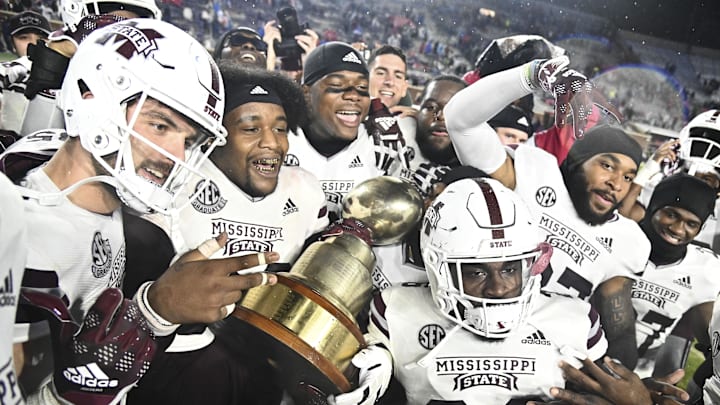
Ohio State’s F.J. Holtkamp was the first of five coaches to head the program in the 1920s, and when A&M finished 3-4-2 under Noble again in 1922 it marked the first losing season since 1908. However, the most notable coach of the decade was future Hall of Fame Bernie Bierman, who brought his “Minnesota Shift” offense to the SEC for two seasons. His last game in 1926 was truly memorable, but not because of the coach. When Ole Miss snapped its 13-game losing streak to rival A&M, 7-6 in Starkville, visiting fans rushed the field and went for the home goalposts, but were rebuffed with the end result a melee. Before the teams met again, the student bodies decided that in an effort to avoid a repeat incident the rivals would play for a trophy. Thus, the “Golden Egg” football-shaped trophy was created, with the annual regular season-ending game later simply called the Egg Bowl.
Other changes were at hand. When the school’s name changed from Mississippi A&M to Mississippi State College in 1932, the nickname switched to the Maroons in reference to the team’s uniform color. It wasn’t until the school obtained university status in 1961 that the official nickname was changed to Bulldogs. However, the maroon uniforms remained a constant, except in 1938, when coach Spike Nelson put his players in gold, which went over so well that neither he nor the uniforms returned in 1939.
When Mississippi State became one of the 13 charters members of the SEC, the football program was struggling, both on and off the field. Limited finances and facilities put the team at a disadvantage, and between 1928 and 1933, including its first year in the new SEC, the Maroons didn’t win more than three games in any season. They lost their first four conference games, by a combined score of 78-7, before finally defeating Sewanee 26-13, which was the most points it tallied in any game during that time period.
Enter college president George Duke Humphrey, who was hired in 1934 and made football a priority. In addition to expanding Scott Field to accompany 26,000 fans, one of his first moves was to hire Major Ralph I. Sasse, a former cavalry officer, as head coach. It didn’t take long to see a difference on the field.
Two weeks into the 1935 season, visiting Mississippi State played Vanderbilt tough, but lost 14-9. A pair of games after that, the Maroons won in Tuscaloosa, beating Alabama 20-7. Mississippi State was 5-1 when it traveled to West Poin to face Army, where Sasse had both served and previously coached. MSU hung around against the heavily-favored home team and in the final minute trailed only 7-6. Quarterback Pee Wee Armstrong threw a 65-yard touchdown pass to Fred Waters, with the 13-7 outcome still considered one of the program’s biggest victories.
Despite playing eight games on the road, the Maroons finished 8-3, with a 14-6 loss at Ole Miss serving as a minor disappointment. Nevertheless, the momentum carried over into the 1936 season, when Mississippi State posted seven shutouts and sustained only two narrow losses, 7-0 at Alabama and 12-0 at LSU, but received its first bowl invitation, to play Duquesne in the Orange Bowl.
Ike Pickle, who later set a bowl record with an 82-yard punt, opened the scoring with a 10-yard touchdown run, and Armstrong connected with Waters for a 40-yard touchdown. But in the final moments of the game, the Dukes’ Boyd Brumbaugh threw up a desperation pass that end Ernie Hefferlie caught to score a 72-yard touchdown and pull off a 13-12 victory. According to a local newspaper, the 9,210 people in attendance “went wild.”
The 1937 season wasn’t as kind to the Maroons, or Sasse, who was still serving military assignments. Shortly after falling in a stairway, the coach surprisingly resigned with three games remaining. With the staff staying on to finish the 5-4-1 season, Sasse’s brief tenure left its mark, with the yearbook proclaiming: “If ever a man gave his all for State, Sasse was that man.”
On the advice of Tennessee’s legendary coach Robert Neyland, Mississippi State hired Allyn McKeen in 1939, and again the change was both obvious and immediate. Although picked to finish 11th in the conference, the Maroons opened the season with three shutouts before losing 7-0 to both Auburn and Alabama. Undeterred, Mississippi State won at Ole Miss, 18-6, and at 8-2 was on the doorstep of its first national ranking.
Despite a difficult schedule that featured five ranked opponents, it came the following season when four opponents failed to score and just two reached double digits. With an early-season tie against Auburn serving as the lone blemish, Mississippi State closed the schedule with wins against Ole Miss (19-0) and at No. 17 Alabama (13-0), and returned to the Orange Bowl to play No. 13 Georgetown. This time, there would be no last-minute heartache.
Led by Buddy Elrod and Hunter Cohern, line play ruled the day for the “Maroon Machine.” Tackle John Tripson recovered a blocked punt in the end zone for an early lead, and when the offenses were only able to trade touchdowns, Mississippi State held on for a 14-7 victory. In addition to an undefeated season (10-0-1), but no SEC championship thanks to 10-0 Tennessee, the Maroons finished ranked ninth. Elrod was the school’s first consensus All-American and McKeen was named SEC Coach of the Year.
McKeen’s machine continued to make history over the next two years. Although a 21-game unbeaten streak came to an end in 1941, the Maroons finally secured the first, and only, elusive conference title by finishing the season 8-1-1 overall and 4-0-1 in conference play, including shutouts against Florida (6-0), Alabama (14-0), LSU (0-0) and No. 14 Ole Miss. A 38-yard end-around by quarterback Jennings Moats sealed both the title and a 6-0 victory against the Rebels. Mississippi State was No. 16 after winning at San Francisco, 26-13, on Dec. 6, but with the bombing of Pearl Harbor the following day the team was temporarily stranded on the West Coast and didn’t play in a bowl game.
Despite the advent of World War II, Mississippi State played the 1942 season and posted an impressive 8-2 record, with only early-season losses at No. 4 Alabama (21-6) and LSU (16-6). After winning seven-straight, including 34-13 against Ole Miss, for a No. 18 finish, the program shut down for a year like many others in the SEC.
When play resumed in 1944, the Maroons picked up where they left off, winning their first six games before stumbling at Alabama (19-0) and at Ole Miss (13-8). For the first time, Mississippi State had a Heisman Trophy candidate in freshman back Tim “Shorty” McWilliams, who finished 10th in voting, but the departure of assistant coaches Bowden Wyatt and Murray Warmath began to be felt.
The Maroons didn’t live up to expectations in 1945, finishing 6-3, with a season-ending 55-13 loss at No. 3 Alabama, which finished 9-0 and went on to beat Southern California in the Rose Bowl. Likewise, a loss for No. 19 MSU at Alabama at the end of the 1946 season left a bad taste, despite an 8-2 record and a 20-0 victory against Ole Miss. Fans started to wonder if McKeen was stuck in the past while other teams had converted to the modern wing-T offensive scheme.
Although Mississippi State started the 1947 season 6-1, it lost 21-6 at LSU and then 33-14 at home to No. 15 Ole Miss for a 7-3 record. When he lost to No. 16 Ole Miss again in 1948, 34-7, MSU fired McKeen. His winning percentage .764 (65-19-3) has yet to be equaled at the school, and no one has come close to challenging his three-year record of 26-3-2 from 1939-41.
“Some of the school’s greatest wins came during the 1939 season, but I have to go with the 1940 team as my best,” McKeen said.
McKeen eventually died in 1978, before he was elected into the College Football Hall of Fame. When his widow, Susan, was notified of the honor in 1991, the family said it "made her very happy." She died the next day.
Without McKeen in 1949, the Maroons finished 0-8-1 and were outscored 224-38. Despite the poor showing, back Harper Davis became the first player in Mississippi State history to be selected in the first round of the NFL Draft, by the Chicago Bears.
The program would have only six winning seasons and one bowl bid between 1949 and 1972, but at the same time was home to some of college football’s most interesting characters.
For example, Arthur “Slick” Morton, only lasted three seasons, but in 1950 engineered a 7-0 victory against No. 1 Tennessee and coached All-American fullback Joe Fortunato in 1950. He’s also the founder of the annual Mississippi High School All-Star Game.
In 1952, Murray Warmath, who went on to win the 1960 national championship at Minnesota, was hired and immediately led the Maroon to 5-4 and 5-2-3 seasons. Although he never beat Ole Miss (going 0-1-1), quarterback Jackie Parker set the SEC single-season scoring record with 120 points, thanks in part to an amazing performance against Auburn. MSU accumulated 49 points in the first three quarters, of which Parker had a hand in 42. He had touchdown runs of 34, 11 and 6 yards, and passes of 27 and 11 yards, to go with six extra points before watching the fourth quarter from the sideline. A year later in 1953, he was named an All-American.
Assistant coach Royal left the Maroons to coach in Canada, but when Warmath moved on, athletic director Noble called Royal back. With All-Americans Hal Easterwood and Scott Suber blocking for Art Davis, Mississippi State went 6-4 in both 1954 and 1995, but failed to score a point against Ole Miss (losing 14-0 and 26-0).
Royal was also known for being a human quote machine, and spewed forth some of football’s finest philosophy, including:
• “Luck is what happens when preparation meets opportunity.”
• “You can’t be aggressive and confused at the same time.”
• “Treat turnovers like a copperhead in the bedclothes; avoid them at all costs.”
• “When good things have happened over a period of years, and you expect good things to happen again, that’s tradition.”
• “Never try to fool a player. You can’t kid a kid.”
• “You’ve got to be in position for luck to happen. Luck doesn’t go around looking for a stumblebum.”
• “On game day, I’m as nervous as a pig in a packing plant.”
Similar to his predecessor, Royal left after two seasons and went on to win a national championship at another school, this time Texas.
The School
Location: Starkville, Mississippi.
Founded: 1878.
Enrollment: 23,150.
Nickname: Bulldogs.
Colors: Maroon and white.
Mascot: Bully.
Stadium: Davis Wade Stadium at Scot Field (61,337).
Assistant Wade Walker was promoted in 1956 and again to athletic director in 1961 despite having only one winning season, 6-2-1 in 1957. But it was a pretty memorable season, with wins at Alabama (25-13) and at LSU (14-6) before tying Ole Miss (7-7) to finish No. 14.
Mississippi State “University” (the name changed in 1958) wouldn’t have another winning season until 1963, under coach Paul Davis. Behind All-American Pat Watson and fellow linemate Tommy Neville, the Bulldogs pulled out a tie at Florida (9-9) and won at Tennessee (7-0) before losing back-to-back games at Memphis State (17-10) and at No. 7 Alabama (20-19). Unlike previous teams, they rebounded to win close games against Auburn (13-10) and LSU (7-6) and tied Ole Miss 10-10 to earn the school’s third bowl invitation.
In eight-degree weather, and 17-mph winds in Philadelphia, MSU took a page from its brief postseason history to pull out a 16-12 victory against North Carolina State in the Liberty Bowl. End Mike McGuire blocked a punt and lineman Tommy Inman returned it 11 yards for a touchdown, and quarterback Sonny Fisher scored a 3-yard touchdown to provide a lead that would hold up. Despite 11 penalties for 122 yards, the Bulldogs had an advantage of 275-176 in rushing yards. When Davis emerged from a Plexiglas canopy, which along with heaters were used to protect the players and coaches, MSU was No. 11 in the country.
“The defense did a good job all day, especially considering the conditions,” Davis said. “We had a stronger line.”
In 1966, university president William Giles made what many fans considered to be a colossal mistake when he fired both athletic director Walker and coach Davis on Dec. 10, football signing day for recruits. Paul Shira was hired to pick up the pieces, but it would take years for the program to recover. Even with end Sammy Milner, linebacker D.D. Lewis, and Tommy Pharr setting school passing records, the Bulldogs finished 1-9 in 1967, 0-8-2 in 1968 (though one of the ties was 17-17 at Ole Miss), and 3-7 in 1969. Despite the record, Bryant said about Lewis, “no doubt about it, the best linebacker in the country.”
“Football is a lot like engineering,” Shira said. “If you work long and hard enough you can come up with the answer to the problem.”
In 1970, flanker David Smith set an MSU record with 215 receiving yards on 12 passes from Joe Reed to lead a 20-16 victory against Texas Tech. Also notable during the 6-5 season, which included a 19-14 upset of Ole Miss, was MSU’s first black player, defensive back Frank Dowsing, who was named an All-American in 1972. That was the same year Shira handed over the coaching duties to assistant Bob Tyler, whose controversial coaching reign could be called anything but boring.
Although Tyler had never played football and had graduated from rival Ole Miss, he did improve the program. Despite quarterback Rockey Felker having an injury-plagued 1973 season, and the Bulldogs lost their last four games, the 4-5-2 campaign included a wins against No. 16 Florida (33-12), Florida State (37-12) and Louisville (18-7).
With Felker and halfback Walter Packer leading the veer offense, and All-American tackle Jimmy Webb keying the defense, Mississippi State finished the 1974 regular season with eight wins, its best showing since 1946. Against Memphis State, the Bulldogs drove 98 yards in the last two minutes to pull out a 29-28 victory, and they concluded the schedule with a 7-6 victory against LSU and 31-13 pounding of Ole Miss.
No. 18 Mississippi State was invited to just its fourth bowl game, against North Carolina — coached by MSU graduate Bill Dooley — in foggy conditions at the ironically-named Sun Bowl. Terry Vitrano scored a 55-yard touchdown on the first snap of the game and went on to accumulate 164 rushing yards on 20 carries, including a game-winning 2-yard touchdown run in the fourth quarter. Packer added 183 rushing yards on 24 attempts and scored two touchdowns, but again the victory came as the result of a late drive, with the final score 26-24.
“This team was a lot better than we expected in a lot of ways,” Tyler said. “I think we’re a year ahead. We established unity in our program that usually takes two seasons to establish. I’ve never been more confident or enthusiastic about the future than I am right now.”
Despite six Bulldogs being named to various All-SEC teams, the following 1975 season didn’t meet expectations. After early losses to Georgia and Florida, Mississippi State won four straight games only to have the season derailed by No. 6 Alabama (21-10), Auburn (21-21) and Ole Miss (13-7).
Or so fans thought. Actually, it would soon be much worse than the 6-4-1 record. In 1976, the National Collegiate Athletic Association issued penalties and probation for rules violations. The school fought the ruling in court, but eventually lost, resulting in all but two of the program’s 20 victories between 1975 and 1977, being forfeited.
Particularly painful to fans was the 1976 season being turned from a 9-2 finish to 0-11. Safety Stan Black was named and All-American, and linebacker Ray Costict (who had a school-record 29 tackles in a 14-7 victory against Kentucky) and nose guard Harvey Hull had helped lead the Bulldogs to a No. 20 finish.
By 1977, the strain showed on the field. The team had only five wins in 1977 (all forfeited) and six the subsequent year, with victories against No. 15 Florida State (55-27) and No. 17 LSU (16-14) before a 27-7 loss to Ole Miss. When Tyler refused to give up his athletic director duties to concentrate on coaching, school president James McComas fired him.
LSU’s Carl Maddox was brought in as athletic director and former Texas A&M coach Emory Ballard, who had invented the wishbone offense, was hired to turn the program around. After a 3-8 season in 1979, things started to click for the Bulldogs, who found themselves 6-2 and hosting reigning national champion Alabama, which was No. 1 and riding a 28-game winning streak.
Led by linebackers Johnie Cooks and Glen Collins, MSU didn’t buckle and had a 6-3 lead in the final minute when Alabama drove deep into Bulldog territory. With freshman defensive end Billy Jackson recovering a fumble at the 3 with six seconds remaining, the goal-line stand held for Mississippi State’s first victory against the Crimson Tide since 1957. In many ways, it surpassed the 1935 Army game in terms of prominent victories, and is still proudly celebrated in Starkville.
While Georgia went on to win the national championship, Mississippi State received an invitation to represent the conference against Nebraska at the Sun Bowl. Although option quarterback Jon Bond and the offense had set numerous schools records that season, Tom Osborne’s defense limited him to minus-8 yards rushing en route to a convincing 31-17 victory for the Cornhuskers. The Bulldogs finished No. 19.
“I’m proud of our team and the season we had,” Ballard said. “We just flat out gave Nebraska too many opportunities. Our defense played well enough to win. Looking at what we have, we will be back next year.”
Ballard’s prediction was close. Led by linemen Kent Hull and Jacobs Trophy winner Wayne Harris, Mississippi State got off to a 6-1 start despite a schedule that featured five ranked teams, including No. 13 Miami (a 14-10 victory) during the 1981 season. After a 21-17 victory at Auburn, MSU held its highest ranking ever at No. 7, but the following two weeks stumbled at No. 8 Alabama (13-10) and No. 19 Southern Miss (7-6), before losing 21-17 to Ole Miss. Nevertheless, the Bulldogs still received a bowl invitation, marking the first time in school history they would play in back-to-back postseason games.
“The whole defensive unit played extremely well,” Ballard said after the 10-0 victory. “We didn’t ring the bell quite enough on offense, but we did move the ball down the field a good bit.”
The Program
National Championships: None.
SEC Championship (1): 1941.
Bowl appearances: 26 (15-11).
First season: 1895.
College Football Hall of Fame (5):Bernie Bierman, 1925-26; coach, inducted 1955; D.D. Lewis, 1965-67, linebacker, 2001; Allyn McKeen, 1939-48; coach, 1991; Jackie Parker, 1952-53, quarterback, 1976; Darrell Royal, 1954-55, coach, 1983.
Heisman Winners: None.
National Honors: Jonathan Banks, Jim Thorpe Award (best defensive back), 2012.
Consensus First-Team All-Americans: Jimmy Webb, DE, 1974; Fred Smoot, DB, 2000; Emmanuel Forbes, DB, 2022.
First-Team Academic All-Americans (CoSIDA): Jackie Parker, B, 1953; Ron Bennett, E, 1956; Frank Dowsing, DB, 1972; Jimmy Webb, DE, 1973; Will Coltharp, DE, 1976; Stacy Russell, DB, 1989; Scott Westerfield, K, 2000, Austin Williams, WR, 2020; Austin Williams, WR, 2021; Austin Williams, WR, 2022.
First-round NFL draftees: 20.
Retired Jerseys: None.
Ring of Honor
Johnie Cooks, linebacker, 1979-1982, 2011 induction
DD Lewis, linebacker, 1965-1967, 2011
Jackie Parker, quarterback, 1952-1953, 2011
Jack Cristil, announcer, 1953-2011, 2011
Kent Hull, center, 1979-1982,2012
Tom "Shorty" McWilliams, halfback, 1944, 1946-1948, 2014
Joe Fortunato, linebacker, 1950-1952, 2017
Art Davis, halfback, 1952-1955, 2018
Walt Harris, cornerback, 1992-1995, 2018
Cooks was named SEC Defensive Player of the Year. In 45 games during his collegiate career, he made 392 tackles. The following spring, he was the second-overall pick in the National Football League draft by the Baltimore Colts and went on to play 10 more years. Collins went 26th overall to the Cincinnati Bengals. In 1983 running back Michael Haddix was the eighth pick by the Philadelphia Eagles.
However, it was another peak for the roller-coaster program. From 1982 to 1990, the Bulldogs had just one winning season, 6-5 in 1986, and didn’t qualify for any bowl games. When Ballard couldn’t match his postseason success, he was fired after the 1985 season and replaced by former player Felker, who at the time was the youngest head coach in the country. After winning his first game, 24-17 at Syracuse, he pulled off a memorable 27-3 upset at defending SEC champion Tennessee en route to winning six of his first seven games and No. 13 ranking. But with 42,700 fans packed into Scott Field, Mississippi State lost both to No. 7 Auburn (35-6) and No. 8 Alabama (38-3), to plunge into a winless final month.
Felker finished 4-7 in 1987 and 1-10 in 1988, but after some solid recruiting posted 5-6 seasons in 1989 and 1990. Three straight losses to Ole Miss proved to be his downfall, much to the dismay of the MSU faithful, who didn’t support the firing.
President Donald Zacharias and athletic director Larry Templeton looked to former Alabama player Jackie Sherrill, who, following a two-year layoff after coaching at Pittsburgh and Texas A&M, was ready to get back into football. Once again, the Bulldogs were led by a controversial coach who was anything but boring.
“Is coaching at Mississippi State tougher than coaching at Florida? Yes,” Sherrill once said. “Tougher than Tennessee? Yes. Tougher than Alabama? Yes. But nobody made me take the job at Mississippi State and nobody is making me stay there. I’ve made the decision that his my last rodeo and it is.”
That confidence, in combination with a strong group of assistant coaches, put MSU back on track. In only Sherrill’s second game, the Bulldogs upset No. 13 Texas, 13-6. After solid wins against LSU (28-19) and Ole Miss (24-9) in the first Egg Bowl played on campus since 1972, Mississippi State was paired against Air Force in the Liberty Bowl. But it was unable to stop the potent running attack, which amassed 318 yards on 69 carries, compared to just two passes attempted, resulting in a 38-15 victory for the Falcons.
Prior to the 1992 season opener against the Texas Longhorns, Sherrill captured the attention of his players, and the nation, when he showed his team on the practice field how a bull is castrated.
“The whole story came up when I asked our players what a steer was and none of them knew what a steer was,” Sherrill said “People say (the Texas mascot) is a longhorn steer. Is that a bull, or is he a steer?”
Despite the uproar regarding Wild Willie, MSU upset Texas again, 28-10, after which Sherrill issued a formal apology.
The ’92 squad had the potential to be one of the best teams Mississippi State ever had, and spent most of the season ranked in the Top 25. When quarterback Sleepy Robinson was injured in a 30-6 victory against No. 13 Florida — which was played before the largest home-opening crowd (38,886) in Scott Field history and on national television — along with other key injuries, it may have been a death blow that didn’t take hold until mid-November. The Bulldogs lost 30-21 to eventual national champion Alabama, 17-10 at Ole Miss and squandered a two-touchdown lead before losing 21-17 to North Carolina in the Peach Bowl. MSU finished 7-5, ranked No. 23.
After re-tooling in 1993, Mississippi State returned to the Peach Bowl in 1994. With Derrick Taite passing for a school-record 466 yards against Tulane, a 66-22 victory, the No. 16 Bulldogs were 8-3, with two of their losses against No. 6 Alabama (29-25) and No. 9 Auburn (42-18). Despite Tim Rogers’ five field goals and safety Andrew Bennett’s blocked punt in the end zone for a safety, the Bulldogs were rebuffed by North Carolina State, 28-24. No. 24 MSU finished 8-4.
MSU’s “100 Years of Football” was celebrated in 1995, but it was rebuilding time again as the Bulldogs finished just 3-8. The following year saw two more victories, including wins against No. 8 Alabama (17-16) and Ole Miss (17-0) in a rainstorm. However, the NCAA came calling again and due to recruiting violations the program was issued scholarship penalties effective 1997.
After upsetting No. 11 Auburn 20-0 and Alabama 32-20, Mississippi State found itself atop the Western Division standings and ranked fifteenth. But after losing to Arkansas, 17-7, the 1997 season came down to one game, with the winner of the Egg Bowl heading to a bowl game, and the losing team staying home. The Bulldogs had a 14-7 lead in the final minutes, when Ole Miss drove the field, scored a touchdown and converted a two-point conversion for the victory. Despite the 7-4 finish, it’s considered one of the most disappointing losses in MSU history.
The Coaches
W.M. Matthews, 1895, 0-2; J.B. Hildebrand, 1896, 0-4; L.B. Harvey, 1901, 2-2-1; L. Gwinn, 1902, 1-4-1; Dan Martin, 1903-06, 10-11-3; Fred Furman, 1907-08, 9-7; W.D. Chadwick, 1909-13, 29-12-2; E.C. Hayes, 1914-16, 15-8-2; Sid Robinson, 1917-19, 15-5; Fred Holtkamp, 1920-21, 9-7-1; C.R. (Dudy) Noble, 1922, 3-4-2; Earl Able, 1923-24, 10-6-2; Bernie Bierman, 1925-26, 8-8-1; J.W. Hancock, 1927-29, 8-12-4; Chris Cagle, 1930, 2-7; Ray Dauber, 1931-32, 5-11; Ross McKechnie, 1933-34, 7-12-1; Ralph Sasse, 1935-37, 20-10-2; Emerson (Spike) Nelson, 1938, 4-6; Allyn McKeen, 1939-48, 65-19-3; Arthur (Slick) Morton, 1949-51, 8-18-1; Murray Warmath, 1952-53, 10-6-3; Darrell Royal, 1954-55, 12-8; Wade Walker, 1956-61, 23-32-2; Paul Davis, 1962-66, 20-28-2; Charley Shira, 1967-72, 16-45-2; Bob Tyler, 1973-78, 21-44-2; Emory Bellard, 1979-85, 37-42; Rockey Felker, 1986-90, 21-34; Jackie Sherrill, 1991-2003, 75-75-2; Sylvester Croom, 2004-08,21-38; Dan Mullen, 2009-17, 69-46; Greg Knox 2017, 2023 (interim) 2-1; Joe Moorhead, 2018-19, 14-12; Mike Leach 2020-22 19-16; Zach Arnett 2022-23 5-6; Jeff Lebby 2024 2-10.
National Coach of the Year: None.
SEC Coach of the Year, AP: Paul Davis 1963; Charlie Shira 1970; Sylvester Croom 2007; Dan Mullen 2014. Coaches: Allyn McKeen 1940; Wade Walker 1957; Sylvester Croom 2007.
SEC Championships: Allyn McKeen 1.
National Championships: None
While still recovering from the NCAA reprimand, the Bulldogs went on a late-season run in 1998 with victories against Alabama (26-14), No. 9 Arkansas (22-21) and Ole Miss (28-6), to earn its first SEC Western Division title. Against the Tide, senior J.J. Johnson set school records for rushing (237) and all-purpose yards (312), and he went on to become the first MSU player to ever rush for 1,000 or more yards in two straight years.
Against Tennessee in the SEC Championship Game, MSU led 14-10 in the fourth quarter before the Volunteers, who went on to win the national championship, pulled out a 24-14 victory. Mississippi State received its first invitation in 60 years to play in a New Year’s Day bowl against Texas in the Cotton Bowl, but led by Heisman Trophy winner Ricky Williams, the Longhorns treated MSU like the Bulldogs did Wild Willie. The running back had 203 rushing yards and scored two touchdowns, while quarterback Major Applewhite passed for 225 yards and three touchdowns as Texas snapped a seven-game losing streak against Sherrill, 38-11.
MSU wasn’t able to defend its division title in 1999, but did pull off the school’s second 10-win season. Led by its stingy defense, the Bulldogs got off to an 8-0 start, climbing to No. 8 when they lost back-to-back games against No. 11 Alabama (19-7) and Arkansas (14-9), but redeemed themselves with a 23-20 win against Ole Miss.
Despite giving up a season-high 391 yards, of which 301 came on the arm of quarterback Brandon Streeter, Mississippi State defeated Clemson 17-7 in the Peach Bowl. Robert Bean blocked his seventh kick, Pig Prather’s 45-yard kickoff return set up a field goal and quarterback Wayne Madkin ran in one score and threw for another. Voters placed the 10-2 Bulldogs thirteenth.
Mississippi State made an unprecedented third straight postseason appearance in 2000, thanks in part to back-to-back wins against No. 3 Florida (47-35) and No. 15 Auburn (17-10), but lost two overtime games (45-38 at LSU and 17-10 vs. Arkansas _ which snapped a 16-game home winning streak) and to Ole Miss 45-30. The Bulldogs faced Texas A&M at the Independence Bowl in a game that was as wild as the driving snowstorm blanketing Shreveport, La.
Even though Donte Walker had 143 rushing yards and three touchdowns, and Willie Blade made 16 tackles, they were countered by 193 rushing yards by Aggies fullback Ja’Mar Toombs, and the game had to be settled in overtime. Blade blocked his second point-after attempt, Julius Griffith returned it for a two-point conversion and Madkin ran in a 6-yard touchdown for a 43-41 victory in “Snow Bowl 2000.”
For No. 24 MSU (8-4), Dicenzo Miller became the Bulldogs’ fifth career 1,000-yard rusher, Madkin their all-time leading passer (6,336 yards), and Sherrill the school’s all-time winningest coach. But, similar to Tyler, Sherrill’s legacy was completed with a cloud hanging over the program, when the Bulldogs finished 3-8, 3-9 and 2-10 from 2001 to 2003, and more NCAA penalties looming on the horizon.
On Dec. 1, 2003, Mississippi State reinvented both itself and the conference when former Alabama All-American center Sylvester Croom became the SEC’s first black head football coach. Although his first campaign resulted in a 3-8 record, a 38-31 victory against No. 20 Florida gave him an immediate signature win, with the Gators subsequently firing coach Ron Zook.
“I’m the first African-American coach in the SEC,” said Croom, “but there ain’t but one color that matters here, and that color is maroon.”
The Records
Rushing yards, game: 258 yards Nick Fitzgerald at Ole Miss, Nov. 26, 2016 (14 carries).
Rushing yards, season: 1,391, Anthony Dixon, 2009 (257 carries).
Rushing yards, career: 3,994, Anthony Dixon, 2006-09 (910 carries).
Passing yards, game: 623, K.J. Costello at LSU, Sept. 26, 2020 (36 of 60).
Passing yards, season: 4,739, Will Rogers, 2021 (505 of 683).
Passing yards, career: 12,315, Will Rogers, 2020-2023 (1301 of 1876).
Receiving yards, game: 256, Lideatrick Griffin vs. South Carolina, Sept. 23 2023 (seven receptions).
Receiving yards, season: 1,046, Makai Polk, 2021 (105 receptions).
Receiving yards, career: 2,528, Fred Ross, 2013-16 (199 receptions).
Points, game: 42, Harry McArthur vs. Cumberland, Oct. 10, 1914 (seven touchdowns).
Points, season: 120, Jackie Parker, 1952 (16 touchdowns, 24 PATs); Vic Ballard, 2010 (20 touchdowns).
Points, career: 276, Nick Fitzgerald, 2015-18 (46 touchdowns).
Croom was in Starkville for just five seasons, during which he notched two Egg Bowl wins and had one winning season when he led the Bulldogs to the 2007 Liberty Bowl, where they defeated UCF to finish 8-5. Two of his biggest wins came against his alma mater. In 2006, he was up against the person who edged him for the Crimson Tide coaching job three years previous, Mike Shula, and pulled off the 26-14 victory. It was the beginning of the end for Shula in Tuscaloosa , who was fired a couple of weeks later and eventually replaced by Nick Saban.
With both teams in the same division, the SEC West, they squared off again a year later and Croom's Bulldogs, benefitting by some favorable timing as Alabama had some key starters suspended by the textbook disbursement scandal, came out on top again, this time at home, 17-12. It was the only time Mississippi State managed to pull off a win against Saban at Alabama.
Dan Mullen cam extremely close a couple of times, though. In 2014, the former Florida offensive coordinator had Mississippi State at No. 1 in the AP Top 25 for the first time in school history, and in the same spot for the first College Football Playoff rankings, when it had to play at No. 5 Alabama. However, quarterback Dak Prescott was picked off three times in the red zone as the Crimson Tide pulled out the 25-20 victory.
In 2017, No. 16 Mississippi State appeared to be on the verge of breaking through, when Jalen Hurts through a last-minute 26-yard touchdown pass to freshman DeVonta Smith to give No. 2 Alabama the dramatic 31-24 victory in Starkville.
"It hurts," quarterback Nick Fitzgerald said. "It doesn't matter who we lost to or how much we lost by, we lost a game we should have won."
The outcome was almost a foreshadow. Two months later, Smith made the jaw-dropping overtime second-and-26 41-yard touchdown catch against Georgia in the National Championship Game.
Mullen was never able to capture a division title, but his teams never finished at the bottom of the standings despite being regularly picked for last in the preseason polls. It was a point of pride for him for a while, but clearly weighed on over the years until Florida hired him away in 2017. Even though he was only in Starkville for nine seasons, Mullen's 69 wins were second among all Mississippi State coaches (nehind Sherril's 75).
The Bulldogs thought they might have the guy who could top that when they hired the colorful Mike Leach in 2020, but the creator of the prolific 'Air Raid' offense tragically died of complications from a heart condition in 2022. The "Pirate," who told his players to "Swing Your Sword," and wrote a book with the same title, was 61.
“Coach Mike Leach cast a tremendous shadow not just over Mississippi State University, but over the entire college football landscape,” MSU president Mark E. Keenum said in a statement. “His innovative ‘Air Raid’ offense changed the game. Mike’s keen intellect and unvarnished candor made him one of the nation’s true coaching legends. His passing brings great sadness to our university, to the Southeastern Conference, and to all who loved college football. I will miss Mike’s profound curiosity, his honesty, and his wide-open approach to pursuing excellence in all things.”
This is the 14th part of an extended series about the history of SEC football. Some of the material was used in the book "Where Football is King," by Christopher Walsh. For more, check out Mississippi State On SI.
Passion, Tradition and Pride: Why the SEC says 'It Just Means More'
Conference of Champions? SEC Covets Title, Reputation
The History of the Southeastern Conference
Alabama Crimson Tide
Auburn Tigers
Florida Gators
Georgia Bulldogs
LSU Tigers
Ole Miss Rebels
South Carolina Gamecocks
Tennessee Volunteers
Texas Longhorns
Vanderbilt Commodores
Three things that stand out about Mississippi State football:
1. The Cowbells

Even though all artificial noisemakers were banned by the SEC in 1974, Bulldog fans have been ringing them since the 1940s and still do openly (though “officially” only during non-conference and bowl game). According to legend, the tradition started when a cow wandered on to the field during a game Mississippi State won. Bulldogs fans also see it as defying Ole Miss’ smugness.
2. The Bulldog

Though the nickname wasn’t officially changed until 1961, references go back to 1905. Coach Ralph Sasse, on “orders” from his team, went to Memphis in 1935 to select a bulldog to be the official game mascot and MSU promptly defeated Alabama 20-7. A litter-mate became the first mascot named “Bully,” and when a campus bus accidentally ended his eligibility he was buried under the bench at the 50-yard line of Scott Field.
3. The Egg Bowl

The rivalry doesn't get the national attention it deserves especially since the fans of these schools do not get along at all. The trophy came in the aftermath of the 1926 meeting, when Ole Miss fans rushed the field in Starkville and tried to tear down the goalposts following a tight 7-6 victory to snap a 13-game losing streak int he series. Mississippi State fans didn't appreciate that and decided to defend the field and goalposts (reportedly with rboken chairs), resulting in numerous fights.
 Add us as a preferred source on Google
Christopher Walsh is the founder and publisher of Alabama Crimson Tide On SI, which first published as BamaCentral in 2018, and is also the publisher of the Boston College, Missouri and Vanderbilt sites . He's covered the Crimson Tide since 2004 and is the author of 27 books including “100 Things Crimson Tide Fans Should Know and Do Before They Die” and “Nick Saban vs. College Football.” He's an eight-time honoree of Football Writers Association of America awards and three-time winner of the Herby Kirby Memorial Award, the Alabama Sports Writers Association’s highest writing honor for story of the year. In 2022, he was named one of the 50 Legends of the ASWA. Previous beats include the Green Bay Packers, Arizona Cardinals and Tampa Bay Buccaneers, along with Major League Baseball’s Arizona Diamondbacks. Originally from Minnesota and a graduate of the University of New Hampshire, he currently resides in Tuscaloosa.
Follow BamaCentral