
Midseason Running Backs Report Card: What Grade Do The Tailbacks Receive?
In this story:
Through the first half of the 2025 season, the Hokies’ ground game hasn’t been explosive enough to carry the offense outright, yet it’s been steady enough to keep things at a solid floor during an uneven year. The unit’s performance hasn't been substandard, but inconsistency, injuries and an ever-shifting offensive identity have kept it from breaking through as a true strength.
At their best, the Virginia Tech (2-5, 1-2 ACC) tailback room has shown flashes of balance: tough interior running, surprising burst and occasionally, the ability to grind out drives when the passing game stalls. But at their worst, they’ve been limited by health concerns, lack of rhythm and an offensive line that’s still finding its stride amid injuries to the unit. The result? A middle-of-the-road performance that lands the group a B- from me at the season's rough midpoint.
LET’S. PLAY. SOME. FOOTBALL. #ThisIsHome pic.twitter.com/a0VCanCRRC
— Virginia Tech Football (@HokiesFB) October 11, 2025
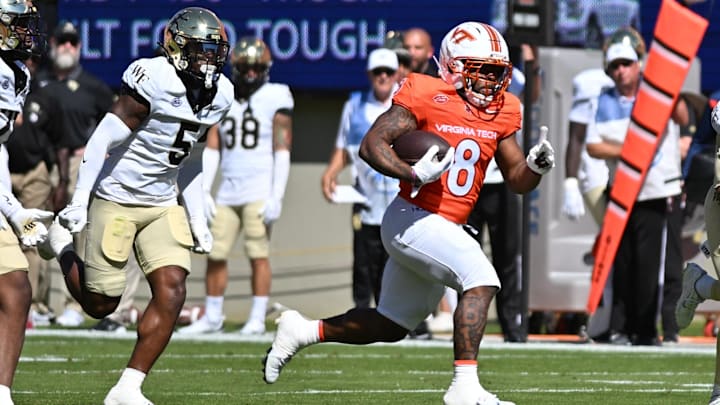
The conversation around Virginia Tech’s backfield begins with Terion Stewart, the team’s most dynamic and a proven runner when healthy. Stewart entered the year as one of Tech’s most important offensive weapons, a back capable of turning short-yardage runs into chain-moving bursts. His blend of physicality and patience has been on display in spurts — particularly in games where the Hokies have found early success establishing the run.
But that “when healthy” qualifier has been one of the stories of the season. Stewart’s availability has been sporadic, and the offense has felt the drop-off when he’s sidelined. His absence shifts the burden to a rotation that lacks his top-end gear and versatility. When on the field, Stewart remains one of Tech’s few players who can dictate defensive attention, yet his body hasn’t allowed him to do it consistently enough to define the offense.
The pleasant surprise of the unit has been Marcellous Hawkins, a player who climbed from Division II Central Missouri to become the de facto RB1 to start the season. His late-camp surge was partially aided by nagging injury issues for Stewart, but he earned the starting job, nonetheless.
Hawkins has provided the kind of stability the Hokies have lacked in previous seasons. He runs with decisiveness, keeps his pads low and finds extra yards after contact. While he doesn’t possess Stewart’s breakaway speed, he’s demonstrated the durability and toughness to handle an three-down workload. That’s been invaluable as the offense has tried to settle into a rhythm, particularly in the stretch of games where balance has been hard to come by.
Outside of the victory over NC State, where the Hokies established their ground game with authority, the distribution between the tailbacks and the receivers has often been dictated by availability rather than design.
When both are active, Tech’s run game has the potential to be multi-dimensional. Stewart’s shiftiness complements Hawkins’ straight-line efficiency, and the two form a dependable one-two punch when at 100%. But injuries and inconsistency have prevented that from taking hold. The offense, in turn, has leaned more heavily on Kyron Drones’ mobility than initially intended. It's a reflection not of the backs’ lack of effort, but of the need for someone to keep drives alive.
The foundation is there, but the execution hasn’t been consistent enough to elevate the group above a “solid" tier.
Through seven games, Virginia Tech’s running backs have been reliable, but not redefining. Hawkins has proven himself as a legitimate contributor, while Stewart remains the heartbeat of the unit when available. The Hokies haven’t been able to build their offense around the run game alone, but it’s provided enough stability to keep them competitive in most contests.
The second half of the season will tell whether the backs can move from being “steady contributors” to true difference-makers. If Stewart can stay healthy and Hawkins continues his upward trend, the Hokies could find the kind of backfield balance that’s eluded them so far. For now, though, the grade reflects what they’ve been: not bad, not great, but certainly intriguing — a B- effort from a unit still waiting to hit its full stride.
More Virginia Tech Football News:
 Add us as a preferred source on Google
Hughes serves as Virginia Tech On SI's lead editor, a position that he has held since July 2025. Hughes is a junior at Virginia Tech majoring in sports media and analytics. He also serves as the open-wheel correspondent for the motorsports outlet Steering Wheel Nation, where he has written on Formula 1, the NTT IndyCar Series, the NASCAR Cup Series and the NASCAR CRAFTSMAN Truck Series. Hughes has previously authored bylines in 3304 Sports, Virginia Tech's multimedia student journalism outlet.
Follow thomashughes_05