
Way-Too-Early 2026 Preseason ACC Football Power Rankings: Where Do The Hokies Clock In?
In this story:
There's still roughly two and a half months separating us from the season kicking off, but how does everyone in the ACC — including Virginia Tech — shape up in my way-too-early power rankings? Here's my current rankings:
Boston College is set to roll the dice on Division II transfer Mason McKenzie out of Saginaw Valley State. The move could pay dividends, but it's fair to question whether the Eagles have surrounded him with enough offensive talent to elevate the unit significantly. Boston College should improve on last season's 2-10 (1-7 ACC) record, though I think expectations likely need to remain measured.
Stanford enters 2026 under new head coach Tavita Pritchard, who returns to his alma mater after spending the last three seasons as the quarterbacks coach for the Washington Commanders. Pritchard, a former Cardinal quarterback and offensive coordinator, was brought back by general manager Andrew Luck to help guide a program searching for stability after years of upheaval.
At quarterback, Stanford is expected to turn to former Michigan Wolverines signal-caller Davis Warren, who transferred to Palo Alto following the 2025 season. Warren completed 64.1% of his passes for 1,199 yards, seven touchdowns and nine interceptions across 10 appearances for Michigan in 2024.
Warren gives the Cardinal an experienced option under center, but questions remain about the supporting cast around him. Pritchard's track record developing quarterbacks — most recently helping mentor NFL Offensive Rookie of the Year Jayden Daniels at Washington — offers reason for optimism, though expecting an immediate turnaround may be unrealistic.
Florida State enters 2026 with a new-look offense (again) after moving on from quarterback Tommy Castellanos, who exhausted his eligibility following the 2025 season and declared for the NFL Draft.
The Seminoles are expected to turn to redshirt senior Ashton Daniels, a transfer who previously started at Stanford before spending 2025 at Auburn. Daniels brings experience and mobility to Mike Norvell's offense, though consistency remains a question after a collegiate career marked by flashes of production and bouts of turnovers. Until Florida State proves it can rediscover any semblance of what it showed in 2023, I think expectations need to be tempered.
North Carolina enters 2026 as one of the ACC's more difficult teams to evaluate. The Tar Heels are still adjusting to life under Bill Belichick, and while the roster has undergone significant change through the transfer portal, there are more questions than answers offensively.
Quarterback Billy Edwards Jr. brings experience after previous stops at Maryland and Wisconsin, but his production has rarely suggested he can elevate an offense on his own. Without a proven difference-maker under center, UNC's ceiling feels limited.
Syracuse enters 2026 with everything still revolving around Steve Angeli, and the range of outcomes is essentially “bowl team vs. total collapse” depending on his health and consistency.
Angeli was electric before his 2025 Achilles injury, throwing for 1,317 yards, 10 touchdowns and two interceptions in just four games while pushing Syracuse to a 3–1 start and a win over Clemson before the offense completely fell apart without him. That contrast is the whole story of this team.
The ceiling is a competitive bowl season and fringe top-25 upside. The backup plan is unproven, and last year showed how quickly the offense can crater without him, with scoring collapsing once he went down.
Georgia Tech enters 2026 in a post-star reset year, even after a strong portal haul. The offense now runs through Alberto Mendoza, a dual-threat transfer who stepped in after Haynes King’s departure and looked efficient in limited 2025 action (75% passing, 286 yards, five touchdowns, one interception in spot duty). He’s steady and mobile, but not a proven full-season engine yet.
The bigger stabilizer is the ground game, where Georgia Tech landed Justice Haynes out of the transfer portal to replace Jamal Haynes. He brings star power after averaging over 7 yards per carry at Michigan and looks like an instant bellcow option, though this year still feels like a transition year.
The Wolfpack aren’t rebuilding from scratch, but they are trying to re-anchor an offense that lived almost entirely through CJ Bailey in 2025. Bailey threw for 3,105 yards, 25 touchdowns, and 9 interceptions on 68.8% passing, adding 215 rushing yards and 6 scores, finishing top-tier in the ACC in total production.
That’s the spine of it again. Beyond him, though, the structure shifts.
Hollywood Smothers is gone to Texas after a 939-yard, six-touchdown season on 5.9 yards per carry. the shape of it doesn’t change much: Bailey drives the ceiling, and the defense should keep the floor intact.
Wake Forest enters 2026 with the air of a side no longer content merely to surprise. Jake Dickert’s first season produced a 9–4 record, a bowl victory, and a defense that yielded just 22.1 points per game while allowing only 3.4 yards per rush.
If the Deacons marry their defensive steel to offensive growth, contention may replace aspiration in Winston-Salem, though I think things are still a year away.
The Bears went 7–6 in 2025 and discovered a potential star in quarterback Jaron-Keawe Sagapolutele, who threw for 3,454 yards and 18 touchdowns as a freshman before affirming his return for 2026. Yet the landscape has shifted. New head coach Tosh Lupoi inherits a roster reshaped by portal departures, including leading rusher Kendrick Raphael (left for SMU).
The burden now falls more heavily upon Sagapolutele’s left arm. If Lupoi can forge defensive resilience and uncover a credible ground game, Cal may finally become a contender rather than a curiosity — though as with many ACC teams, it still feels as if the pieces in the proverbial Jenga puzzle aren't all the way together.
Duke enters 2026 confronting the harsh arithmetic of modern success. An ACC title in 2025 elevated the Blue Devils into the sport’s spotlight, but it also made them a portal target. Quarterback Darian Mensah departed for Miami, while star receivers Cooper Barkate and Que’Sean Brown likewise moved on to Miami and Virginia Tech, respectively, stripping away much of the nation’s most productive passing attack.
I believe Head coach Manny Diaz has earned the benefit of belief, yet this season will test his program-building more than his coaching. Duke no longer carries the surprise of an upstart contender. If the Blue Devils uncover answers at quarterback and receiver, they may prove their rise was sustainable.
Last season changed the conversation around Virginia football. Chandler Morris and J’Mari Taylor are gone, leaving the Cavaliers to replace the pillars of an 11-win breakthrough, but the foundation remains intact.
The spotlight falls squarely on Beau Pribula, who arrives after a semi-productive 2025 campaign at Mizzou that was hindered by injury and now inherits the responsibility of keeping the program's momentum alive. He is not Morris, nor does he need to be. If Pribula can provide efficiency, leadership and enough explosive plays to complement a strong supporting cast, Virginia has every chance to remain an ACC factor. The challenge is substantial, but so is the opportunity.
A ranking that places Virginia Tech at No. 6 in this ACC landscape says less about the Hokies than it does about the ceiling of everyone above them.
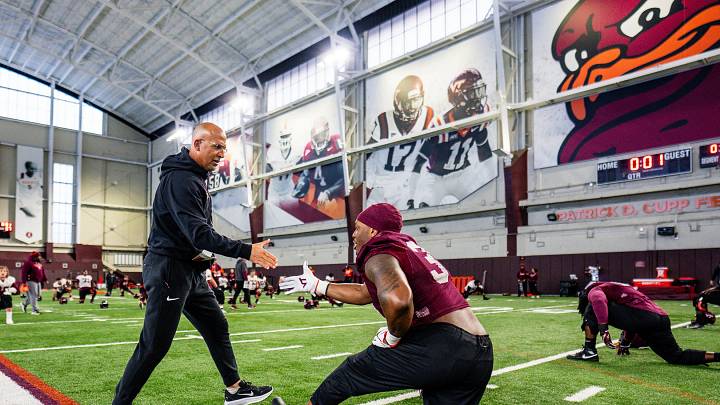
It feels like there is no runaway class this season beyond Miami, only a cluster of teams trying to assemble coherence faster than their rivals can lose it. James Franklin’s arrival in Blacksburg shifts the tone immediately, and I think it'll bring structure and expectation in equal measure.
Ethan Grunkemeyer (1,339 passing yards, eight touchdowns and four interceptions in 2025) steps in as the most stable quarterback situation the program has had in recent years, while Marcellous Hawkins (749 rushing yards, 6.3 yards/carry) and Jeffrey Overton Jr. give the offense a grounding presence in the backfield. If the pieces align, eight wins feels less aspirational than once thought.
Pittsburgh enters the season with a curious mixture of promise and youthful uncertainty, none more emblematic than true freshman quarterback Mason Heintschel. In year one, he threw for 2,354 yards and 16 touchdowns against eight interceptions, completing 63.6 percent of his passes, numbers that speak both to poise and youth. At times he has looked assured, and at others, raw — the rhythm of a true freshman learning the speed of the game. For Pitt, those ebbs and flows define both their ceiling and their potential frustration.
Clemson now turns the offense to Christopher Vizzina, who enters 2026 with 64 completions on 105 attempts for 596 yards, four touchdowns and one interception in 238 career offensive snaps. He flashed in his first start against SMU, going 29-for-42 for 317 yards and three scores.
Clemson still has the physicality and depth to stay in the ACC hunt, yet its margin depends on whether Vizzina’s timing, ball security and tempo sharpen as the fall unfolds. I think that they will, but it won't be enough to turn the Tigers into ACC champions again.
Louisville feels less like a rising team than a constructed one — tight and intentional. The offense is built around a ground game that bends defenses before they ever get settled, with Isaac Brown setting the tone: 884 yards on 101 carries (8.75 per attempt) and seven touchdowns in nine games, a profile that turns routine downs into looming problems. Keyjuan Brown has been the steadier counterweight, adding 704 yards and six scores of his own when Isaac Brown was injured.
Kevin Jennings has given SMU's offense true shape in his tenure. In 2024, he threw for 3,245 yards with 23 touchdowns and 11 interceptions, adding 354 rushing yards to steady the structure when plays broke down.
The offense moves with rhythm rather than force, averaging 280.1 passing yards per game. SMU’s season, then, is not one of revelation but of consolidation, an attempt to make its recent momentum recurring.
Miami enters 2026 as a roster explicitly rebuilt through the transfer portal, its structure defined as much by arrivals as by returners. The headline addition is QB Darian Mensah (Duke), who threw for 3,973 yards, 34 touchdowns and six interceptions in 2025, immediately reframing the passing game around his accuracy.
Alongside him, fellow Duke transfer Cooper Barkate (72 catches, 1,106 yards, 7 TDs) provides a proven chain-mover at the receiver spot. This year, Miami feels like the program the rest of the ACC field has to measure itself against.
 Add us as a preferred source on Google
Hughes serves as Virginia Tech On SI's lead editor, a position that he has held since July 2025. Hughes is a junior at Virginia Tech majoring in sports media and analytics. He also serves as the open-wheel correspondent for the motorsports outlet Steering Wheel Nation, where he has written on Formula 1, the NTT IndyCar Series, the NASCAR Cup Series and the NASCAR CRAFTSMAN Truck Series. Hughes has previously authored bylines in 3304 Sports, Virginia Tech's multimedia student journalism outlet.
Follow thomashughes_05