
Five questions for the Wisconsin Badgers entering the basketball season
In this story:
MADISON, Wis. - It's time for the University of Wisconsin men's basketball team to begin its journey.
The Badgers overhauled their roster for the second straight season. By design, the eight players added to the roster have a different makeup than last year's 24-win team that had a short stay in the NCAA Tournament. UW’s staff hopes this new mix will spark a program striving for its first conference title in four seasons.
Before the season starts tonight against Denver at the Kohl Center, here are five questions on the 2026-27 Badgers.
The eve of the college basketball season is here. Wisconsin will kick off its 2026-27 campaign at home against Denver tomorrow night. How to watch, listen, and stream the game, the betting line, and some things to know. #Badgers https://t.co/Hw8sSyxwCz
— Benjamin Worgull (@TheBadgerNation) November 1, 2026
Will the chemistry come together?
UW's ability to pick the right players, not the high-priced ones, allows them to remain competitive in today's landscape. They'll test that theory again this season.
Wisconsin is again one of the lower spenders among high-major schools, according to a CBS Sports report, with a roster budget estimated between $10-12 million. However, UW stretched its dollars with a mixture of returners and newcomers.
The staff believed guard John Blackwell would transfer (he landed at Duke) but made locking up frontcourt pieces Austin Rapp and Nolan Winter a priority. The commitment of Rapp and Winter allowed the staff to build around them with eight newcomers of various experience.
The addition of college players Trey Autry, Eian Elmer, and Victory Onuetu gives UW players with critical college experience; Owen Foxwell gives the roster a point guard with heavy international experience, and four freshmen to start developing.
The key is always how everything comes together, a cohesion that other high-profile programs have struggled with after bringing in transfer portal talent. UW's success in that department was mixed last season, notably the inconsistent play that lasted until mid-January.
UW's schedule is light on quality opponents through the first month of the season, so building the roster’s synergy will be critical before a December grind with six of seven games against power-conference teams.

Can this team be better defensively?
Wisconsin went 8-6 last season when allowing opponents to score at least 80 points, a record credited to the Badgers' efficient offense bailing out a defense that never consistently came together. UW's defense ranked 56th nationally in adjusted defensive efficiency, per KenPom, its worst since the 2018-19 season.
Head coach Greg Gard and his staff have said multiple times in the preseason that regaining that defensive identity is imperative to the program's success, which was why UW targeted the players it did in the portal, namely adding a shot-blocking presence in Onuetu and the quick hands of Elmer.
In UW's final exhibition tune-up against Oklahoma State, Elmer registered three of the team's eight steals. UW also stopped the guard’s dribble penetration by rotating into gaps and deflecting passes, cut off the perimeter shot (5-for-24) and created 22 turnovers to nine assists.
“We were proactive defensively rather than being reactive,” Gard said. “Watching their first two games, I thought we were going to have a hard time containing the penetration. I thought we did a pretty good job for the most part.”
UW's defense improved as competition increased from Division 2 to Horizon League to the Big 12 in the preseason. It's a step in the right direction, but the Badgers have to be stronger defensively to sustain success this season.
Is Eian Elmer the next transfer portal jackpot?
Wisconsin has seen a transfer elevate his game and the program for three consecutive seasons, including point guard Nick Boyd becoming the first UW player to average 20+ points per game (20.7 ppg) since Michael Finley in 1995.
Elmer will have every opportunity to be that next guy after being a vital piece to Miami (OH). The 6-6 junior started every game, averaged 12.7 points, and led the team in three-point percentage (42.9) and rebounds (5.9). His defensive performance rating was second-best on the RedHawks, per EvanMiya.com, boosted by his 42 steals and 23 blocks.
Elmer can defend multiple positions because of his size, but there's no debate he was brought in to shine in an offense that lost their top two scorers.

Can Janicki rebound?
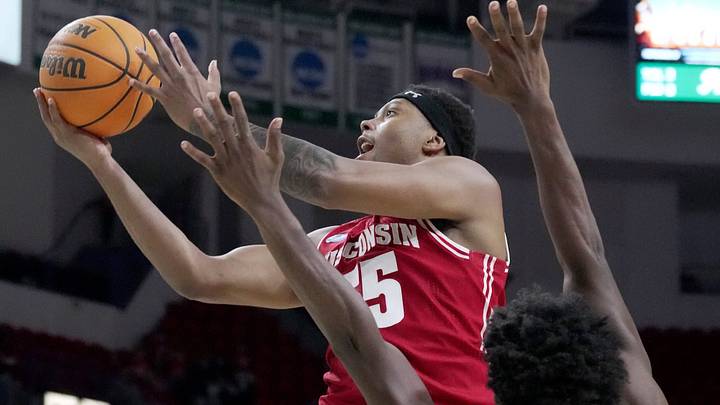
UW likely knows what it's getting from 80 percent of the starting lineup it used in exhibition play (production and leadership from Winter and Elmer, rim protection from Onuetu, and sound facilitating and playmaking from Owen Foxwell). However, Jack Janicki’s production is the biggest question mark.
The third-year guard has experience (his 63 games as a Badger are second behind Winter). Still, his second year was a disappointment well before a February wrist injury ended his season. Janicki shot 32.3 percent overall and 27.7 percent from three (both the lowest among players averaging double-digit minutes), while he had the fewest free-throw attempts of any rotation player (five).
Janicki scored five points against Parkside but was scoreless in 12 minutes against Green Bay and 14 minutes against Oklahoma State. It's the complete opposite of a high school career that saw him eclipse 2,000 points.
While Janicki fills an under-the-radar role with his defense, knowledge, and ability to understand switches, the program needs more offense from him. The staff has earmarked Janicki (along with second-year guards Hayden Jones and Zach Kinziger) as players expected to leap forward this season. Regaining confidence in his shot will go a long way to meeting those goals.
Will Wisconsin break its NCAA Tournament hex?
It's a question that won't be talked about for close to four months, but some fans will judge Wisconsin’s season by whether it can advance past the opening weekend of the tournament for the first time in 11 seasons.
Wisconsin has built a roster around Winter with size and experience that it feels creates more versatility than past seasons. UW still wants to shoot threes and free throws while pushing the tempo and stretching the floor, but the Badgers built a roster that should be stronger defensively and taller in the frontcourt to be more active around the rim.
In theory, Wisconsin can match up against different sizes and styles, which is a huge boost in a tournament-like setting. Whether they can do it is a question that we'll need to wait the longest to answer.
 Add us as a preferred source on Google

Benjamin Worgull has covered Wisconsin men's basketball since 2004, having previously written for Rivals, USA Today, 247sports, Fox Sports, the Associated Press, the Janesville Gazette, and the Wisconsin State Journal.
Follow TheBadgerNation