%22%3E%0A%3Cpath%20d%3D%22M0%204.9397H7.3484V12.6932H14.0649V4.9397H21.4133V26.912H14.0649V19.037H7.3484V26.912H0V4.9397Z%22%20fill%3D%22white%22%2F%3E%0A%3Cpath%20d%3D%22M23.6572%204H31.0299V8.55326H23.6572V4ZM23.7788%209.77664H30.9003V26.9121H23.7788V9.77664Z%22%20fill%3D%22white%22%2F%3E%0A%3Cpath%20d%3D%22M32.7241%2029.861L34.9197%2025.5589C36.8317%2026.5635%2038.7519%2027.1955%2041.1014%2027.1955C43.7669%2027.1955%2045.1848%2025.8101%2045.1848%2023.4281V22.9258C44.2125%2024.0276%2042.6084%2025.2834%2040.2264%2025.2834C35.8028%2025.2834%2032.6025%2022.1399%2032.6025%2017.4084V17.3436C32.6025%2012.5392%2035.8676%209.37134%2039.8213%209.37134C42.3329%209.37134%2043.8074%2010.3112%2045.0632%2011.5994V9.77643H52.1848V22.5855C52.1848%2025.7533%2051.5285%2027.9246%2049.9568%2029.4883C48.4174%2031.0277%2046.0679%2031.9999%2042.2357%2031.9999C38.4035%2031.9999%2035.4868%2031.2464%2032.7241%2029.8691V29.861ZM45.2172%2017.3679V17.3031C45.2172%2015.8285%2044.091%2014.6376%2042.3572%2014.6376C40.6234%2014.6376%2039.4972%2015.8609%2039.4972%2017.3679V17.4327C39.4972%2018.9073%2040.6234%2020.0658%2042.3572%2020.0658C44.091%2020.0658%2045.2172%2018.8748%2045.2172%2017.3679Z%22%20fill%3D%22white%22%2F%3E%0A%3Cpath%20d%3D%22M54.3145%204H61.436V12.0695C62.5379%2010.6597%2064.2636%209.37155%2066.6779%209.37155C70.2914%209.37155%2072.5437%2011.7535%2072.5437%2015.6181V26.9202H65.4221V17.9109C65.4221%2016.4364%2064.5471%2015.5857%2063.4777%2015.5857C62.4082%2015.5857%2061.436%2016.4364%2061.436%2017.9109V26.9202H54.3145V4Z%22%20fill%3D%22white%22%2F%3E%0A%3Cpath%20d%3D%22M80.8983%2023.6146L84.8196%2018.9398C87.2016%2020.7627%2089.9319%2021.5162%2092.5083%2021.5162C93.8289%2021.5162%2094.388%2021.1678%2094.388%2020.5764V20.5116C94.388%2019.8796%2093.6993%2019.5393%2091.3417%2019.0694C86.4157%2018.0648%2082.0812%2016.6551%2082.0812%2012.0046V11.9398C82.0812%207.76732%2085.3463%204.53467%2091.4065%204.53467C95.6437%204.53467%2098.7792%205.5393%20101.323%207.54857L97.7421%2012.5069C95.6681%2011%2093.1889%2010.3437%2091.1472%2010.3437C90.0454%2010.3437%2089.543%2010.7245%2089.543%2011.2511V11.3159C89.543%2011.9155%2090.1426%2012.2882%2092.4597%2012.7257C98.0743%2013.7627%20101.842%2015.3912%20101.842%2019.8148V19.8796C101.842%2024.4977%2098.0419%2027.3172%2092.1437%2027.3172C87.6877%2027.3172%2083.6692%2026.0614%2080.874%2023.6146H80.8983Z%22%20fill%3D%22white%22%2F%3E%0A%3Cpath%20d%3D%22M102.838%2018.4374V18.3726C102.838%2013.5682%20106.605%209.39575%20112.187%209.39575C115.955%209.39575%20118.62%2011.3402%20119.941%2014.1354L114.829%2017.0196C114.229%2015.9178%20113.476%2015.2939%20112.317%2015.2939C110.81%2015.2939%20109.684%2016.6145%20109.684%2018.3078V18.3726C109.684%2020.1631%20110.81%2021.4513%20112.228%2021.4513C113.484%2021.4513%20114.205%2020.8194%20114.893%2019.7256L120.071%2022.6747C118.531%2025.5347%20115.931%2027.3495%20111.847%2027.3495C106.638%2027.3495%20102.838%2023.2338%20102.838%2018.4374Z%22%20fill%3D%22white%22%2F%3E%0A%3Cpath%20d%3D%22M121.164%204H128.286V12.0695C129.387%2010.6597%20131.113%209.37155%20133.528%209.37155C137.141%209.37155%20139.393%2011.7535%20139.393%2015.6181V26.9202H132.272V17.9109C132.272%2016.4364%20131.397%2015.5857%20130.327%2015.5857C129.258%2015.5857%20128.286%2016.4364%20128.286%2017.9109V26.9202H121.164V4Z%22%20fill%3D%22white%22%2F%3E%0A%3Cpath%20d%3D%22M140.867%2018.405V18.3402C140.867%2013.5033%20144.886%209.36328%20150.533%209.36328C156.18%209.36328%20160.142%2013.4466%20160.142%2018.2753V18.3402C160.142%2023.177%20156.123%2027.317%20150.476%2027.317C144.829%2027.317%20140.867%2023.2337%20140.867%2018.405ZM153.295%2018.405V18.3402C153.295%2016.6469%20152.04%2015.2939%20150.468%2015.2939C148.896%2015.2939%20147.705%2016.6469%20147.705%2018.2753V18.3402C147.705%2020.0335%20148.961%2021.3865%20150.533%2021.3865C152.104%2021.3865%20153.295%2020.0335%20153.295%2018.405Z%22%20fill%3D%22white%22%2F%3E%0A%3Cpath%20d%3D%22M161.203%2018.405V18.3402C161.203%2013.5033%20165.222%209.36328%20170.869%209.36328C176.516%209.36328%20180.477%2013.4466%20180.477%2018.2753V18.3402C180.477%2023.177%20176.459%2027.317%20170.812%2027.317C165.165%2027.317%20161.203%2023.2337%20161.203%2018.405ZM173.631%2018.405V18.3402C173.631%2016.6469%20172.376%2015.2939%20170.804%2015.2939C169.232%2015.2939%20168.041%2016.6469%20168.041%2018.2753V18.3402C168.041%2020.0335%20169.297%2021.3865%20170.869%2021.3865C172.44%2021.3865%20173.631%2020.0335%20173.631%2018.405Z%22%20fill%3D%22white%22%2F%3E%0A%3Cpath%20d%3D%22M182.139%204H189.26V26.9121H182.139V4Z%22%20fill%3D%22white%22%2F%3E%0A%3Cpath%20fill-rule%3D%22evenodd%22%20clip-rule%3D%22evenodd%22%20d%3D%22M199.368%204.36764C205.191%20-1.45588%20214.632%20-1.45588%20220.456%204.36764C226.279%2010.1912%20226.279%2019.6324%20220.456%2025.4559L209.912%2036L199.368%2025.4559C193.544%2019.6324%20193.544%2010.1912%20199.368%204.36764ZM202.009%207.55761C201.948%207.86849%20201.916%208.39718%20201.916%209.14566V10.4189C201.916%2011.1832%20201.948%2011.7198%20202.013%2012.0267C202.078%2012.3317%20202.278%2012.6168%20202.617%2012.8762C202.956%2013.1376%20203.403%2013.3316%20203.958%2013.4623C204.512%2013.593%20205.1%2013.6583%20205.837%2013.6583C206.573%2013.6583%20207.217%2013.591%20207.769%2013.4524C208.322%2013.3158%20208.761%2013.1178%20209.086%2012.8604C209.411%2012.6029%20209.605%2012.3178%20209.666%2012.0069C209.728%2011.6961%20209.759%2011.1674%20209.759%2010.4189V9.14566C209.759%208.38134%20209.728%207.84473%20209.662%207.53781C209.597%207.23287%20209.397%206.94972%20209.058%206.68834C208.72%206.42696%20208.272%206.23291%20207.718%206.10223C207.163%205.97154%20206.536%205.90619%20205.839%205.90619C205.102%205.90619%20204.459%205.97352%20203.906%206.11213C203.352%206.24875%20202.914%206.44677%20202.589%206.70418C202.265%206.9616%20202.071%207.24673%20202.009%207.55761ZM207.276%2024.8638C210.876%2024.8638%20212.557%2024.2064%20212.557%2021.862V21.858V21.3155C212.557%2019.6581%20211.516%2018.971%20208.252%2018.3136C207.278%2018.1136%20206.908%2017.9136%20206.908%2017.3136V16.9414C206.908%2016.6543%20207.177%2016.5117%20207.413%2016.5117C207.749%2016.5117%20207.918%2016.7137%20207.918%2016.9414V18.1136H212.391V17.3988C212.391%2015.4563%20211.347%2014.4266%20207.177%2014.4266C204.15%2014.4266%20201.896%2015.3414%20201.896%2017.3711V17.7433C201.896%2019.5155%20202.805%2020.3155%20206.201%2021.0303C206.28%2021.0472%20206.355%2021.063%20206.427%2021.0781C207.329%2021.2674%20207.647%2021.3341%20207.647%2021.9174V22.2897C207.647%2022.6619%20207.546%2022.8045%20207.142%2022.8045C206.67%2022.8045%20206.637%2022.5471%20206.637%2022.262V21.2897H201.894V21.7471C201.894%2024.149%20203.476%2024.8638%20207.276%2024.8638ZM213.424%2024.5569H217.925V14.7355H213.424V24.5569ZM214.955%2013.5019H217.925V6.06064H215.092V9.411L213.193%206.06064H210.359V13.5019H213.193V10.1199L214.955%2013.5019ZM206.269%2012.152C206.204%2012.2688%20206.055%2012.3262%20205.825%2012.3262L205.827%2012.3282C205.604%2012.3282%20205.459%2012.2767%20205.398%2012.1757C205.336%2012.0748%20205.305%2011.8074%20205.305%2011.3758V7.90068C205.305%207.51852%20205.352%207.28684%20205.445%207.20962C205.538%207.13239%20205.675%207.09279%20205.851%207.09279C206.059%207.09279%20206.198%207.14031%20206.265%207.23734C206.332%207.33239%20206.366%207.55416%20206.366%207.90068V11.3203C206.366%2011.7579%20206.334%2012.0352%20206.269%2012.152Z%22%20fill%3D%22white%22%2F%3E%0A%3C%2Fg%3E%0A%3Cdefs%3E%0A%3CclipPath%20id%3D%22clip0_15247_3714%22%3E%0A%3Crect%20width%3D%22225%22%20height%3D%2236%22%20fill%3D%22white%22%2F%3E%0A%3C%2FclipPath%3E%0A%3C%2Fdefs%3E%0A%3C%2Fsvg%3E%0A)
Confessions of a Former IMG Academy Tennis Star
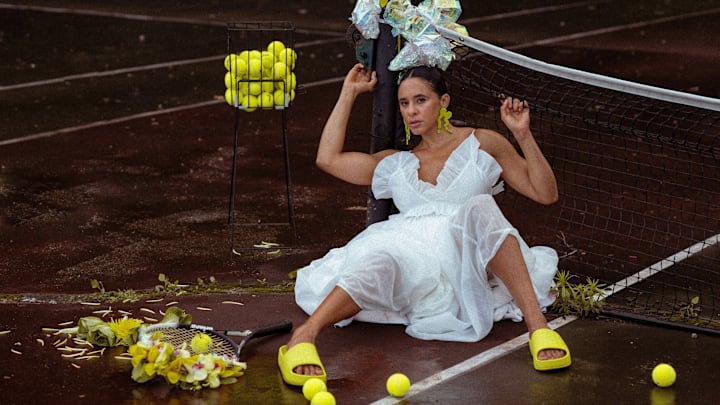
When it comes to shining bright on the big stage of life, it has naturally been love, set, match for Jennifer Magley.
Roots in a Competitive Family
The sports world can be a surprisingly small, but that's where Magley has become a force to be reckoned with. Her family history in athletics is firmly rooted as the oldest daughter of a former Cleveland Cavaliers draft selection, while her grandfather once fought on the same boxing card as "the Brown Bomber", Joe Louis.
From Athlete to Industry Leader
When she's not personally serving up forehand smashes as an on-camera host, social media contributor, and high-energy master of ceremonies, the former pro athlete and NCAA Division I head coach at Florida Gulf Coast University is busy working in professional sports as the Chief Brand Officer of The Basketball League and Basketball Super League.
A Life on Big Stages
Equally stunning and "super dupa fly", she's shared stages with WWE, the United Nations Global Film Festival, and most recently at the sports tech conference with Peak, in addition to being featured with the likes of People Magazine, ESPN, CNN, USA Today, REVOLT, and Forbes. Oh by the way, Magley is always quick to volley her two young sons, husband, family, and friends with unlimited love.
The Foundation of the Grind
So where did that grind come from? What about the professional drive and lifestyle that's sustained her from her teenage tennis playing days, to currently with her quest to appear on 100 stages within one year? For her, it started on the courts at IMG Academy in Bradenton, Florida. Graciously, Jennifer Magley connected with High School on SI to discuss her rich experiences at IMG, her pro aspirations, learning from legendary coach, Bob Davis, winning a national title at Florida, her propensity for motherhood and her career, being ducked by the Pat McAfee Show for a year, and her parting words of advice for future young tennis players in search of their own big stage.

"If you're a teenager chasing something — fall in love with the attempt. Fall in love with the no's," Magley told High School On SI.
"Because every one of them means you're still in the game. And staying in the game is the whole thing."

Q&A with Jennifer Magley
Before we talk about the life lessons you learned from your time playing high school tennis at IMG Academy, can you take me back to when you first picked up a tennis racket and began winning youth tournaments. When did you know you were good and had a talent for the sport?
My Dad is a former NBA player who refused to stop playing basketball after his pro career. As the oldest, my mom said he had to take me to the park. I was apparently too distracting — talking too much, bothering everyone — so he handed me an adult-sized racquet, pointed at a wall, and said come back when you have 20 in a row. He also claims the first thing he ever said to me when I was born was, "Can you say Wimbledon?" My father never lets facts ruin a good story, so I have no idea if that's true. Here's what I do know: I am not naturally talented at anything. Tennis included. What I figured out young is that I could improve exponentially through repetition. When I started beating players years older than me at 10, I thought — okay, maybe something's here. But I was never confident in talent. The only thing I was certain of was that nobody I knew would outwork me.
By the time you were a teenager you were earning national sportsmanship awards, winning championships, and traveling internationally to compete alongside names like Monica Seles and Mary Jo Fernandez. Did you feel pressure at that time on that kind of stage? And if so, how did you use that on the court?
To this day, that trip to Japan with the Sony Team — traveling alongside Mark McCormack, the founder of IMG, with Monica Seles — is one of the most memorable and pressure-packed moments of my life. I competed internationally for the USTA Junior Team. I thought I knew what big felt like. Then I walked out and saw that crowd. Noise makers. Giant flags. A level of energy I had never encountered. I froze completely. Not nerves — I mean my body genuinely forgot how to play tennis. Muscle memory just... left. What I took from it was this: anchor yourself to what you know for certain. For me that was my work ethic and the fact that my family's love wasn't contingent on the scoreboard. I couldn't control the crowd. I could control what I'd already put in. That mental reset became the tool I returned to every time the stakes got higher — and they did get higher.
How did training at IMG Academy make you a better athlete and student?
IMG was a pro factory — young athletes from every corner of the world, all there for one reason. It confirmed something I needed to learn the hard way: somewhere, someone was training while I slept. That wasn't motivational talk. I saw it. I felt it in the results. Training eight hours a day meant traditional school wasn't an option, so I did correspondence courses — self-directed, no teacher standing over me, no classroom accountability. Looking back, that was its own education. You learn to structure yourself when no one is doing it for you. But the biggest thing IMG gave me wasn't a technique or a ranking. It was an understanding that sport is a global game, and "making it" requires so many things going right simultaneously — talent, timing, health, resources, mentality. I stopped thinking of the grind as a mindset and started living it as a lifestyle. There's a difference, and IMG is where I learned it.
You had the privilege of being coached by the legendary Bob Davis. What comes to mind when you reflect on his coaching and your time with him?
When I think of Uncle Bob, I think of a man who (unbeknownst to me at the time) cleaned boats on the side to keep my scholarship funded. Bob Davis was a friend and contemporary of Arthur Ashe. In 1992 he founded Black Dynamics, a nonprofit dedicated to identifying top melanated tennis talent and bringing them to IMG on scholarship — building a new generation of professional players from the ground up. He believed in that mission enough to sacrifice for it quietly, without fanfare. He had plenty of coaching wisdom for me on the court. But his greatest lesson was never spoken — it was lived. When your heart is fully committed to a goal, you push every chip to the center of the table. No hedging. No half-measures. Uncle Bob didn't just teach me that. He showed me what it looked like in real life, a belief in me that I'm still growing into.

Was it a no-brainer that you would go on to play college tennis at Florida? What was the “recruiting” process like for you at that time?
It was the opposite of a no-brainer. Being on scholarship at IMG from 13 meant the big programs assumed I was going pro straight out of high school. I wasn't — I'm the oldest of four kids and didn't have a major sponsor lined up. So we called the University of Florida.The head coach came down, watched me play, and offered a full scholarship on the spot. That was the entire recruiting process. One call, one visit, done. What happened next still doesn't feel real when I say it out loud: we won the NCAA Division I Championship my freshman year. And before I left, I was ranked No. 1 in the nation. This was before NIL, so the prestige looked different — Title IX funding meant we flew on private planes and got weekly massages, which felt extraordinary at the time. I graduated early and turned pro before my senior season even started. Florida gave me what I needed and I was ready for what came next.
You were rated No. 93 in singles nationally following your freshman season of college. No. 19 as a sophomore, No. 5 as a junior year, and even ranked No. 1 singles in the Intercollegiate Tennis Association as a Senior Did you have professional aspirations to play WTA? Was it hard to walk away from pursuing that dream?
My north star was always the WTA. That was the dream from the beginning. My pro career started like a storybook — I won the first tournament I entered and carried real momentum into my second year, climbing the rankings. But the reality of Tour life was something nobody had prepared me for. You only get paid when you win. I was traveling alone on a razor-thin budget, and quietly, my confidence in whether this was truly the life I wanted was eroding. Then in Hawaii, I went for a forehand and heard something snap in my ankle. And my first feeling — before the pain, before the panic — was relief. I've sat with that for a long time. The injury gave me an exit that the truth hadn't yet given me the courage to take. I was done with tennis. Not because of the ankle. I was done before Hawaii. The snap just made it easier to say. There's a point in every sport where you've given so much that the sport starts taking instead. When that shift happens, you feel it in your bones — sometimes literally. That's when you know it's time to walk away. Recognizing that isn't a weakness. It's wisdom.
You are now a mother yourself with two young student-athletes at home. In addition you hold down your career role as CBO with TBL and BSL, along with your consistently vast speaking engagements. Let alone the other irons you surely have in the fire. What’s the key to making it all work for you?
Selective failure. That's the honest answer. I cannot do all the things. Knowing that — truly accepting it instead of just saying it — is actually liberating. There are days the floor is not getting vacuumed. There are days I'm fully present with my sons and completely behind on everything else. I stopped trying to win on every front simultaneously and started deciding deliberately which front gets me today. Becoming a mother rewired how I define achievement. It used to look like rankings and titles. Now it looks like being available — really available — to our sons. That’s what ambition looks like now. And through all of it, my definition of winning has evolved into something I can actually sustain: taking action in the face of uncertainty. Staying curious. Accepting the outcome regardless. That's the real sport. And it never really ends.
One of those ventures played out last year with your viral yearlong attempt to get on The Pat McAfee Show (sadly to no avail), while this year the new goal is to appear on 100 stages. How have both of these events helped shape and guide you over the last 18-24 months?
The last thing anyone expects a middle-aged Midwestern mom to do is try to land on the biggest bro sports show in the world. That's exactly why we did it. From November 2024 through 2025, Season One of our documentary franchise — Stooge Quest — was a full-year campaign to get on The Pat McAfee Show on ESPN. We went all out. A t-shirt cannon. A drone capturing the footage. Yard signs across Indianapolis. 677 pieces of original content in total. Pranks, stunts, spectacle. We let ourselves be completely ridiculous in pursuit of something real.
Pat's team never responded. And I'm genuinely grateful they let us cook for a year with a sense of humor about it — because what came out of the attempt was bigger than the goal. I was hired to do standup comedy. I hosted the Microsoft Excel World Championships on ESPN in Las Vegas. A short-form documentary about Stooge Quest is now heading to the film festival circuit. And I fell completely in love with 365-day storytelling. So now we're in Season Two: Stage Quest — 100 stages in 365 days. So far that's included a Druski audition, St. Elmo Shrimp Cocktail Competition Champ, NYC Fashion Week, and competitive cow milking at the State Fair this summer. The stages keep getting wilder and better.
But here's what I know: since I was three years old I have shown up every day for my dream. The compulsive daily improvement that tennis demanded didn't leave me when I left tennis. It just found a new form. From chasing a ranking to owning a media franchise currently filming Season Three — it's the same muscle. I've just been training it my whole life.
Any words of wisdom for those young high school tennis players and teenagers chasing their own dreams?
Fall in love with failing. People will tell you failure has purpose, that it builds character, that it's secretly a gift. Maybe. I'm not fully convinced of any of that. What I am convinced of is this: failure is a statistical guarantee of eventual success. They cannot all be no's. If you keep showing up — genuinely, consistently, without quitting — the math eventually works in your favor. I heard a snap in my ankle in Hawaii and felt relief. I spent a year trying to get on a sports show and never got an answer. I've had more losses than I can count on and off the court. None of them were final. Not one. So if you're a teenager chasing something — fall in love with the attempt. Fall in love with the no's. Not because they're secretly yes's in disguise, but because every one of them means you're still in the game. And staying in the game is the whole thing.
 Add us as a preferred source on Google
Wendell Maxey has worked as a featured sports writer since 2004 with his stories and interviews on professional, college, and high school sports appearing on ESPN.com, NBA.com, SLAM Magazine/SLAMOnline, FoxSports.com, and USA Today, among other national newspapers and publications. Along with covering the NBA, Maxey spent four years as an international writer in Europe, scouted and recruited professional basketball players for Nürnberg Falcons/ Nürnberger BC, and also gained experience coaching high school and middle school basketball in Germany, and the United States. A published author, Maxey’s work has been featured in five books including "Called For Traveling: 20 Years of Sports Writing from The NBA, To Europe, and Back Again" released in 2026. In 2025, Wendell joined High School On SI to provide national coverage as a contributing writer.
Follow w_maxey