%22%3E%0A%3Cpath%20d%3D%22M0%205.37646H8.15061L17.4195%2016.8819V5.37646H26.0647V31.4412H18.3227L8.64523%2019.4196V31.4412H0V5.37646Z%22%20fill%3D%22white%22%2F%3E%0A%3Cpath%20d%3D%22M29.2041%205.37649H43.8064C47.4193%205.37649%2049.6989%206.1937%2051.2258%207.72059C52.1505%208.64533%2052.8172%2010.0002%2052.8172%2011.7851V11.8497C52.8172%2014.9465%2050.9462%2016.8389%2048.172%2017.8067C51.5269%2018.7744%2053.6774%2020.5594%2053.6774%2024.1293V24.1938C53.6774%2028.3659%2050.258%2031.4197%2043.6558%2031.4197H29.2041V5.35498V5.37649ZM44.258%2013.7637C44.258%2012.6024%2043.3333%2011.9787%2041.4623%2011.9787H37.6988V15.6346H41.5053C43.3763%2015.6346%2044.258%2015.011%2044.258%2013.8497V13.7852V13.7637ZM42.0859%2020.9895H37.6988V24.8605H42.0644C43.9569%2024.8605%2044.9247%2024.0863%2044.9247%2022.968V22.9035C44.9247%2021.7852%2043.9999%2021.011%2042.0859%2021.011V20.9895Z%22%20fill%3D%22white%22%2F%3E%0A%3Cpath%20d%3D%22M64.8174%205.18286H73.4627L84.452%2031.4411H74.9896L73.6132%2027.9357H64.4949L63.1615%2031.4411H53.8496L64.8389%205.18286H64.8174ZM71.4412%2021.7636L69.054%2015.441L66.6669%2021.7636H71.4412Z%22%20fill%3D%22white%22%2F%3E%0A%3Cpath%20d%3D%22M95.2695%205.37646H105.248C115.592%205.37646%20120.775%2010.4733%20120.775%2018.1938V18.2583C120.775%2025.9788%20115.485%2031.4412%20104.947%2031.4412H95.2695V5.37646ZM104.001%2012.9679V23.8497H105.463C109.442%2023.8497%20112.022%2022.2153%20112.022%2018.4518V18.3873C112.022%2014.6239%20109.463%2012.9894%20105.463%2012.9894H104.001V12.9679Z%22%20fill%3D%22white%22%2F%3E%0A%3Cpath%20d%3D%22M123.098%2011.1182H131.549V15.2258C132.711%2012.4731%20134.56%2010.6881%20137.915%2010.8387V19.8065H137.012C133.442%2019.8065%20131.528%2021.785%20131.528%2026.2797V31.4625H123.076V11.1182H123.098Z%22%20fill%3D%22white%22%2F%3E%0A%3Cpath%20d%3D%22M137.808%2025.6772V25.6127C137.808%2021.5482%20140.818%2019.2901%20145.55%2019.2901C147.27%2019.2901%20149.464%2019.6557%20150.345%2020.0428V19.6987C150.345%2017.8277%20149.184%2016.7524%20146.582%2016.7524C144.496%2016.7524%20142.754%2017.204%20140.969%2017.9137L139.485%2012.3008C141.829%2011.3975%20144.517%2010.8169%20148.044%2010.8169C152.173%2010.8169%20154.862%2011.6771%20156.646%2013.4621C158.173%2014.989%20158.776%2016.9675%20158.776%2019.9137V31.5052H150.324V29.4622C148.904%2030.9891%20147.012%2031.9999%20144.474%2031.9999C140.56%2031.9999%20137.808%2029.7633%20137.808%2025.7417V25.6772ZM150.431%2023.9138V23.0536C149.937%2022.86%20149.206%2022.7095%20148.496%2022.7095C146.818%2022.7095%20145.894%2023.7202%20145.894%2024.9891V25.0536C145.894%2026.2364%20146.754%2027.0321%20147.829%2027.0321C149.313%2027.0321%20150.431%2025.8493%20150.431%2023.9138Z%22%20fill%3D%22white%22%2F%3E%0A%3Cpath%20d%3D%22M162.883%2017.6345H160.496V11.1183H162.883C162.926%208.96778%20163.442%207.20433%20164.711%205.9355C166.088%204.55915%20167.872%204%20170.668%204C173.163%204%20174.69%204.21506%20175.851%204.55914V9.84951C175.034%209.65596%20174.217%209.54843%20173.141%209.54843C171.83%209.54843%20171.163%2010.0646%20171.163%2011.1829V11.3334H175.851V17.6345H171.335V31.4411H162.883V17.6345Z%22%20fill%3D%22white%22%2F%3E%0A%3Cpath%20d%3D%22M178.883%2024.6238V17.613H176.496V11.0968H178.883V6H187.335V11.0968H192.023V17.613H187.335V22.7528C187.335%2024.2797%20188.045%2024.8389%20189.378%2024.8389C190.152%2024.8389%20191.055%2024.6238%20191.937%2024.2152V30.7314C190.604%2031.4411%20188.582%2031.8927%20186.539%2031.8927C181.55%2031.8927%20178.862%2029.5916%20178.862%2024.6238H178.883Z%22%20fill%3D%22white%22%2F%3E%0A%3Cpath%20fill-rule%3D%22evenodd%22%20clip-rule%3D%22evenodd%22%20d%3D%22M201.368%204.36764C207.191%20-1.45588%20216.632%20-1.45588%20222.456%204.36764C228.279%2010.1912%20228.279%2019.6324%20222.456%2025.4559L211.912%2036L201.368%2025.4559C195.544%2019.6324%20195.544%2010.1912%20201.368%204.36764ZM204.009%207.55761C203.948%207.86849%20203.916%208.39718%20203.916%209.14566V10.4189C203.916%2011.1832%20203.948%2011.7198%20204.013%2012.0267C204.078%2012.3317%20204.278%2012.6168%20204.617%2012.8762C204.956%2013.1376%20205.403%2013.3316%20205.958%2013.4623C206.512%2013.593%20207.1%2013.6583%20207.837%2013.6583C208.573%2013.6583%20209.217%2013.591%20209.769%2013.4524C210.322%2013.3158%20210.761%2013.1178%20211.086%2012.8604C211.411%2012.6029%20211.605%2012.3178%20211.666%2012.0069C211.728%2011.6961%20211.759%2011.1674%20211.759%2010.4189V9.14566C211.759%208.38134%20211.728%207.84473%20211.662%207.53781C211.597%207.23287%20211.397%206.94972%20211.058%206.68834C210.72%206.42696%20210.272%206.23291%20209.718%206.10223C209.163%205.97154%20208.536%205.90619%20207.839%205.90619C207.102%205.90619%20206.459%205.97352%20205.906%206.11213C205.352%206.24875%20204.914%206.44677%20204.589%206.70418C204.265%206.9616%20204.071%207.24673%20204.009%207.55761ZM209.276%2024.8638C212.876%2024.8638%20214.557%2024.2064%20214.557%2021.862V21.858V21.3155C214.557%2019.6581%20213.516%2018.971%20210.252%2018.3136C209.278%2018.1136%20208.908%2017.9136%20208.908%2017.3136V16.9414C208.908%2016.6543%20209.177%2016.5117%20209.413%2016.5117C209.749%2016.5117%20209.918%2016.7137%20209.918%2016.9414V18.1136H214.391V17.3988C214.391%2015.4563%20213.347%2014.4266%20209.177%2014.4266C206.15%2014.4266%20203.896%2015.3414%20203.896%2017.3711V17.7433C203.896%2019.5155%20204.805%2020.3155%20208.201%2021.0303C208.28%2021.0472%20208.355%2021.063%20208.427%2021.0781C209.329%2021.2674%20209.647%2021.3341%20209.647%2021.9174V22.2897C209.647%2022.6619%20209.546%2022.8045%20209.142%2022.8045C208.67%2022.8045%20208.637%2022.5471%20208.637%2022.262V21.2897H203.894V21.7471C203.894%2024.149%20205.476%2024.8638%20209.276%2024.8638ZM215.424%2024.5569H219.925V14.7355H215.424V24.5569ZM216.955%2013.5019H219.925V6.06064H217.092V9.411L215.193%206.06064H212.359V13.5019H215.193V10.1199L216.955%2013.5019ZM208.269%2012.152C208.204%2012.2688%20208.055%2012.3262%20207.825%2012.3262L207.827%2012.3282C207.604%2012.3282%20207.459%2012.2767%20207.398%2012.1757C207.336%2012.0748%20207.305%2011.8074%20207.305%2011.3758V7.90068C207.305%207.51852%20207.352%207.28684%20207.445%207.20962C207.538%207.13239%20207.675%207.09279%20207.851%207.09279C208.059%207.09279%20208.198%207.14031%20208.265%207.23734C208.332%207.33239%20208.366%207.55416%20208.366%207.90068V11.3203C208.366%2011.7579%20208.334%2012.0352%20208.269%2012.152Z%22%20fill%3D%22white%22%2F%3E%0A%3C%2Fg%3E%0A%3Cdefs%3E%0A%3CclipPath%20id%3D%22clip0_15247_3640%22%3E%0A%3Crect%20width%3D%22227%22%20height%3D%2236%22%20fill%3D%22white%22%2F%3E%0A%3C%2FclipPath%3E%0A%3C%2Fdefs%3E%0A%3C%2Fsvg%3E%0A)
2025 NBA Draft: The Productive Junior Query
With the National Championship concluding this past Monday and the Florida Gators taking home the title, it's officially NBA Draft season. The 2025 NBA Draft class is expected to be a strong one. However, the introduction of NIL and the transfer portal has made this year's pre-draft seasons one of the most interesting in recent years -- and it's only April 11th. Some prospects -- likely projected late first round or early second round -- have decided to return to school. Why risk being a second round pick or being on a two-way contract when a player can return to school and receive money in the range of $2-4 million dollars, stay in college another year, and still be drafted the following year? One example is Texas Tech star JT Toppin. The projected late first/early second round pick decided to return to school for his junior season at the tune of a reported $4M in NIL money.
With that being said, the projected lottery freshmen and other players likely to be taken in the first round are still declaring, as their draft stocks are fairly secure. For some prospects, being a first round pick, making at least $2.5 million in their first season, and having a roster spot is virtually guaranteed. How will certain players returning impact the overall draft board? Are second round picks going to mostly be players who have exhausted their full college eligibility? What about late first round picks? How large does the gap from guaranteed first round picks to early second round picks grow?
While this draft class will still likely be strong, this increased level of uncertainty highlights the continued need and importance of hitting on draft selections. In order to decrease the level of uncertainty, especially for a second round that will likely be filled with mostly older prospects, it has become increasingly popular to design statistical queries to identify NBA talent.
Throughout the past two years, the creation of The Productive Young Athlete Query, Productive Sophomore Query, Productive Junior Query (as we'll look at today), and the Efficient Tall Freshman Query has helped me bring an increased level of analytics and certainty to my scouting process. Far from an exact science, the beauty of scouting is the uncertainty surrounding it. A field that is difficult and nearly impossible to truly master, adding in a pinch of analytics to the film, intel, and injury history can add to the work of art that is scouting.
Introduction
Before we dive into the statistical analysis, it’s important to define what “stick” means in my study. In this case, I considered a prospect to “stick” if they played at least five seasons in the NBA. Prospects who qualified during the 2020-21 NCAA season met the criteria of “sticking” if they are still in the league, due to the impossibility of them reaching five NBA seasons.
There were 38 juniors throughout the 12 college basketball seasons from 2010-2021 who played at least 40% of their team's minutes, had a Box Plus-Minus of at least +10, and met the minimum athletic threshold of four total dunks. 65.79% (25/38) of those juniors played five-plus years in the NBA or are currently in the NBA.
The purpose of this query is to find juniors with production so impactful that it has the potential to reliably predict NBA talent -- something that's only increasing in importance as uncertainty surrounding second round picks increases. Juniors who meet this criteria are being trusted to play almost a majority of their team's minutes, meet a certain production threshold, and also meet a minimum athletic threshold throughout the season.
Which Players Have "Stuck" in the Past?
Below are the players who met the Productive Junior Query from 2010-2021 and ended up "sticking" in the NBA:
2010: Evan Turner, Jon Leuer, and James Anderson
2011: Draymond Green
2012: C.J. McCollum
2013: Victor Oladipo, Kelly Olynyk, Gorgui Dieng, and Doug McDermott
2014: Delon Wright and Frank Kaminsky
2015: Taurean Prince, Willie Cauley-Stein, Anthony Gill, Justin Anderson, and Gary Payton II
2016: No player who met the criteria "stuck" in the NBA (one player qualified).
2017: No player who met the criteria "stuck" in the NBA (one player qualified).
2018: Mikal Brides, Dean Wade, and Keita Bates-Diop
2019: Brandon Clarke and Grant Williams
2020: Xavier Tillman and Luka Garza
2021: Neemias Queta and Jared Butler
Who met the criteria from the three 2021-24 seasons that we should keep our eyes on?
2021-22 Season
Four players met the criteria in 2021: Oscar Tshiebwe, David Roddy, E.J. Liddell, and Orlando Robinson.
Oscar Tshiebwe has played only 205 minutes for the Jazz this season, but has been dominant in the G League. Last season, the former Kentucky big man was the NBA G League Rookie of the Year and was named to the All-NBA G League First Team in 2024. This season, Tshiebwe averaged 17.1 points, 19 rebounds, 3.2 assists, 2.1 steals, and one block per game in the G League.
Roddy has seen six teams in three seasons in the league. He's averaging 4.5 points in 12.3 minutes per game this season across the Hawks, 76ers, and Rockets.
Liddell was drafted with the 41st pick in the 2022 NBA Draft by the New Orleans Pelicans, but unfortunately suffered a torn ACL during a Summer League game prior to his rookie year. Liddell only played 23 minutes for the Pelicans in his second year, but averaged 17.7 points, 7.8 rebounds, 1.9 blocks, and 0.6 steals on over 50% from the field in 26 G League games. This season, Liddell has been on a two-way contract with the Chicago Bulls but has appeared in 47 minutes of gameplay. He averaged 15.7 points, 6.5 rebounds, 2.4 assists, 0.9 steals, and 2.3 blocks per game in the G League this past season.
After averaging 10.9 minutes per game and appearing in 67 games for the Miami Heat over his first two years in the league, the 7-footer out of Fresno State has played for both the Kings and Raptors this season. He's seen significant playing time for the Raptors -- averaging 20.4 minutes per game for Toronto and appearing in 35 games.
2022-23 Season
Five players met the criteria in 2022: Trayce Jackson-Davis, Zach Edey, Jaylen Clark, Adama Sanogo, and Ryan Kalkbrenner.
To start, Jackson-Davis has been an important rotation player for the Warrirors over his first seasons in the league. He's appeared in 129 games for Golden State, starting 53 of those games, and averaging 16.2 minutes per game played. Edey was selected ninth overall in the 2024 NBA Draft and has been the starting center for 54 of the 65 games he's played for Memphis this season. He's averaging 9.3 points, 8.2 rebounds, 0.5 steals, and 1.3 blocks per game while averaging 21.3 minutes per game. It should be noted that the former Purdue big man also met the criteria for the Productive Sophomore Query during the 2021-22 season, which has a 70% "stick" rate.
After being drafted by the Minnesota Timberwolves with the 53rd pick in the 2023 NBA Draft, Clark sat out his true rookie season before entering the rotation this season. He's appeared in 38 games for the Wolves this season, averaging 13.2 minutes per game.
Sanogo appeared in thirteen games for the Bulls over his first two seasons in the league. He was on a two-way contract this past season, but was waived in February after injuring his knee. The former UConn big had earned a spot in the 2025 NBA G League Up Next Game this past season, averaging 17.7 points, 10.8 rebounds, and 1.3 blocks over 11 games for Windy City.
Ryan Kalkbrenner is a 7-footer for Creighton that has spent five seasons as a Bluejay -- improving each season. He averaged19.2 points, 8.7 rebounds, 0.5 steals, and 2.7 blocks this past season. He also qualified for the Productive Sophomore Query in the 2021-22 season, which has a 70% "stick" rate.
2023-24 Season
Three players qualified for the Productive Junior Query in the 2023-24 season: DaRon Holmes II, Devin Carter, and Jonathan Mogbo.
Holmes was the 22nd overall pick in the 2024 NBA Draft but unfortunately tore his achilles prior to this season. He isreportedly participating in portions of Nuggets practice and gearing up for a strong return in 2025-26. Holmes II also qualified for the Productive Young Athlete query his freshman season, which has a 76% "stick" rate.
Devin Carter was the 13th overall pick in the 2024 NBA Draft. The 6-foot-3 guard missed the beginning of the season due to offseason shoulder surgery, but has since appeared in 34 games for the Kings -- averaging 10.5 minutes per game.
Lastly, Mogbo was the 31st overall pick in the 2024 NBA Draft. The 6-foot-9 big has appeared in 61 games for the Raptors in his rookie season, starting in 16 of those games and averaging 19.9 minutes per game. He's averaging 6.1 points, 4.7 rebounds, 2.1 assists, 0.8 steals, and 0.5 blocks per game.
A player who hit the Productive Junior Query that is in this upcoming draft class to keep an eye on: Ryan Kalkbrenner.
Who qualified this past season?
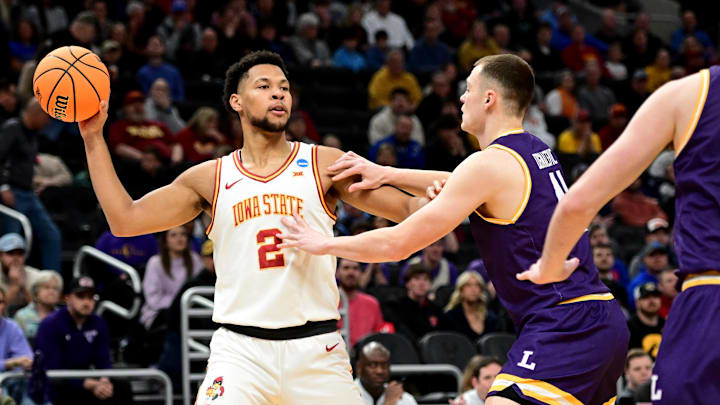
Only one player qualified for the Productive Junior Query this past season: Joshua Jefferson on Iowa State.
The 6-foot-8, 220 pound forward averaged 13 points, 7.4 rebounds, 3.1 assists, 2.1 steals, and 0.7 blocks per game while shooting 69.4% at the rim (147 attempts), 38.6% on non-rim twos (101 attempts), 31% from beyond the arc (58 attempts), and 75.6% from the free throw line (156 attempts).
He also recorded a 8.1 offensive rebound percentage, 19.6 assist percentage, and 7.1 stock percentage this past season.
Overall, Jefferson played as more of a big for Iowa State this past season -- he's a strong post player with some flashes as a driver, flashes of passing from the post, touch at the rim, and statistical indicators of potential for shooting down the line. Additionally, he could improve his positioning in drop coverage at times but is an event creator on that side of the floor. He has some potential as a short roll big but, overall, he's more of a hustle rebounder and mismatch post player. If his driving, passing, and shooting continue to improve, his NBA looks could also increase. He currently projects as an Exhibit 10 player in the G League, but is projected to return to Iowa State next season.
Conclusion: Why is this Useful?
The Productive Junior Query is best used when attempting to identify talent or when weighing the potential risks of drafting a player.
For example, if a college basketball player meets the four criteria during the season, then the player may be worth looking into. Similarly, if you're considering a player with a second round pick who's met the Productive Junior Query, it may be a sense of comfort that 66% of players to hit the same criteria play five-plus seasons in the NBA.
This is especially important to take into account, as only 29% of second round picks from the 1990-2018 NBA Drafts ended up playing at least five NBA seasons with a career 10-24 minutes per game or over 4000 career NBA minutes. Regardless, the PJQ query should be used in conjunction with film, other key statistics, intangibles and medical information when evaluating a prospect.
 Add us as a preferred source on Google
Jordan is a senior at Cornell University where he is an analytics consultant for the men’s basketball team and Co-President of the Cornell ILR Sports Business Society. He has also interned for Sports Aptitude, where he helped interview former front office members and current professional basketball players with the goal of improving the pre-draft process.
Follow JMonacoScouting