%22%3E%0A%3Cpath%20d%3D%22M0%205.37646H8.15061L17.4195%2016.8819V5.37646H26.0647V31.4412H18.3227L8.64523%2019.4196V31.4412H0V5.37646Z%22%20fill%3D%22white%22%2F%3E%0A%3Cpath%20d%3D%22M29.2041%205.37649H43.8064C47.4193%205.37649%2049.6989%206.1937%2051.2258%207.72059C52.1505%208.64533%2052.8172%2010.0002%2052.8172%2011.7851V11.8497C52.8172%2014.9465%2050.9462%2016.8389%2048.172%2017.8067C51.5269%2018.7744%2053.6774%2020.5594%2053.6774%2024.1293V24.1938C53.6774%2028.3659%2050.258%2031.4197%2043.6558%2031.4197H29.2041V5.35498V5.37649ZM44.258%2013.7637C44.258%2012.6024%2043.3333%2011.9787%2041.4623%2011.9787H37.6988V15.6346H41.5053C43.3763%2015.6346%2044.258%2015.011%2044.258%2013.8497V13.7852V13.7637ZM42.0859%2020.9895H37.6988V24.8605H42.0644C43.9569%2024.8605%2044.9247%2024.0863%2044.9247%2022.968V22.9035C44.9247%2021.7852%2043.9999%2021.011%2042.0859%2021.011V20.9895Z%22%20fill%3D%22white%22%2F%3E%0A%3Cpath%20d%3D%22M64.8174%205.18286H73.4627L84.452%2031.4411H74.9896L73.6132%2027.9357H64.4949L63.1615%2031.4411H53.8496L64.8389%205.18286H64.8174ZM71.4412%2021.7636L69.054%2015.441L66.6669%2021.7636H71.4412Z%22%20fill%3D%22white%22%2F%3E%0A%3Cpath%20d%3D%22M95.2695%205.37646H105.248C115.592%205.37646%20120.775%2010.4733%20120.775%2018.1938V18.2583C120.775%2025.9788%20115.485%2031.4412%20104.947%2031.4412H95.2695V5.37646ZM104.001%2012.9679V23.8497H105.463C109.442%2023.8497%20112.022%2022.2153%20112.022%2018.4518V18.3873C112.022%2014.6239%20109.463%2012.9894%20105.463%2012.9894H104.001V12.9679Z%22%20fill%3D%22white%22%2F%3E%0A%3Cpath%20d%3D%22M123.098%2011.1182H131.549V15.2258C132.711%2012.4731%20134.56%2010.6881%20137.915%2010.8387V19.8065H137.012C133.442%2019.8065%20131.528%2021.785%20131.528%2026.2797V31.4625H123.076V11.1182H123.098Z%22%20fill%3D%22white%22%2F%3E%0A%3Cpath%20d%3D%22M137.808%2025.6772V25.6127C137.808%2021.5482%20140.818%2019.2901%20145.55%2019.2901C147.27%2019.2901%20149.464%2019.6557%20150.345%2020.0428V19.6987C150.345%2017.8277%20149.184%2016.7524%20146.582%2016.7524C144.496%2016.7524%20142.754%2017.204%20140.969%2017.9137L139.485%2012.3008C141.829%2011.3975%20144.517%2010.8169%20148.044%2010.8169C152.173%2010.8169%20154.862%2011.6771%20156.646%2013.4621C158.173%2014.989%20158.776%2016.9675%20158.776%2019.9137V31.5052H150.324V29.4622C148.904%2030.9891%20147.012%2031.9999%20144.474%2031.9999C140.56%2031.9999%20137.808%2029.7633%20137.808%2025.7417V25.6772ZM150.431%2023.9138V23.0536C149.937%2022.86%20149.206%2022.7095%20148.496%2022.7095C146.818%2022.7095%20145.894%2023.7202%20145.894%2024.9891V25.0536C145.894%2026.2364%20146.754%2027.0321%20147.829%2027.0321C149.313%2027.0321%20150.431%2025.8493%20150.431%2023.9138Z%22%20fill%3D%22white%22%2F%3E%0A%3Cpath%20d%3D%22M162.883%2017.6345H160.496V11.1183H162.883C162.926%208.96778%20163.442%207.20433%20164.711%205.9355C166.088%204.55915%20167.872%204%20170.668%204C173.163%204%20174.69%204.21506%20175.851%204.55914V9.84951C175.034%209.65596%20174.217%209.54843%20173.141%209.54843C171.83%209.54843%20171.163%2010.0646%20171.163%2011.1829V11.3334H175.851V17.6345H171.335V31.4411H162.883V17.6345Z%22%20fill%3D%22white%22%2F%3E%0A%3Cpath%20d%3D%22M178.883%2024.6238V17.613H176.496V11.0968H178.883V6H187.335V11.0968H192.023V17.613H187.335V22.7528C187.335%2024.2797%20188.045%2024.8389%20189.378%2024.8389C190.152%2024.8389%20191.055%2024.6238%20191.937%2024.2152V30.7314C190.604%2031.4411%20188.582%2031.8927%20186.539%2031.8927C181.55%2031.8927%20178.862%2029.5916%20178.862%2024.6238H178.883Z%22%20fill%3D%22white%22%2F%3E%0A%3Cpath%20fill-rule%3D%22evenodd%22%20clip-rule%3D%22evenodd%22%20d%3D%22M201.368%204.36764C207.191%20-1.45588%20216.632%20-1.45588%20222.456%204.36764C228.279%2010.1912%20228.279%2019.6324%20222.456%2025.4559L211.912%2036L201.368%2025.4559C195.544%2019.6324%20195.544%2010.1912%20201.368%204.36764ZM204.009%207.55761C203.948%207.86849%20203.916%208.39718%20203.916%209.14566V10.4189C203.916%2011.1832%20203.948%2011.7198%20204.013%2012.0267C204.078%2012.3317%20204.278%2012.6168%20204.617%2012.8762C204.956%2013.1376%20205.403%2013.3316%20205.958%2013.4623C206.512%2013.593%20207.1%2013.6583%20207.837%2013.6583C208.573%2013.6583%20209.217%2013.591%20209.769%2013.4524C210.322%2013.3158%20210.761%2013.1178%20211.086%2012.8604C211.411%2012.6029%20211.605%2012.3178%20211.666%2012.0069C211.728%2011.6961%20211.759%2011.1674%20211.759%2010.4189V9.14566C211.759%208.38134%20211.728%207.84473%20211.662%207.53781C211.597%207.23287%20211.397%206.94972%20211.058%206.68834C210.72%206.42696%20210.272%206.23291%20209.718%206.10223C209.163%205.97154%20208.536%205.90619%20207.839%205.90619C207.102%205.90619%20206.459%205.97352%20205.906%206.11213C205.352%206.24875%20204.914%206.44677%20204.589%206.70418C204.265%206.9616%20204.071%207.24673%20204.009%207.55761ZM209.276%2024.8638C212.876%2024.8638%20214.557%2024.2064%20214.557%2021.862V21.858V21.3155C214.557%2019.6581%20213.516%2018.971%20210.252%2018.3136C209.278%2018.1136%20208.908%2017.9136%20208.908%2017.3136V16.9414C208.908%2016.6543%20209.177%2016.5117%20209.413%2016.5117C209.749%2016.5117%20209.918%2016.7137%20209.918%2016.9414V18.1136H214.391V17.3988C214.391%2015.4563%20213.347%2014.4266%20209.177%2014.4266C206.15%2014.4266%20203.896%2015.3414%20203.896%2017.3711V17.7433C203.896%2019.5155%20204.805%2020.3155%20208.201%2021.0303C208.28%2021.0472%20208.355%2021.063%20208.427%2021.0781C209.329%2021.2674%20209.647%2021.3341%20209.647%2021.9174V22.2897C209.647%2022.6619%20209.546%2022.8045%20209.142%2022.8045C208.67%2022.8045%20208.637%2022.5471%20208.637%2022.262V21.2897H203.894V21.7471C203.894%2024.149%20205.476%2024.8638%20209.276%2024.8638ZM215.424%2024.5569H219.925V14.7355H215.424V24.5569ZM216.955%2013.5019H219.925V6.06064H217.092V9.411L215.193%206.06064H212.359V13.5019H215.193V10.1199L216.955%2013.5019ZM208.269%2012.152C208.204%2012.2688%20208.055%2012.3262%20207.825%2012.3262L207.827%2012.3282C207.604%2012.3282%20207.459%2012.2767%20207.398%2012.1757C207.336%2012.0748%20207.305%2011.8074%20207.305%2011.3758V7.90068C207.305%207.51852%20207.352%207.28684%20207.445%207.20962C207.538%207.13239%20207.675%207.09279%20207.851%207.09279C208.059%207.09279%20208.198%207.14031%20208.265%207.23734C208.332%207.33239%20208.366%207.55416%20208.366%207.90068V11.3203C208.366%2011.7579%20208.334%2012.0352%20208.269%2012.152Z%22%20fill%3D%22white%22%2F%3E%0A%3C%2Fg%3E%0A%3Cdefs%3E%0A%3CclipPath%20id%3D%22clip0_15247_3640%22%3E%0A%3Crect%20width%3D%22227%22%20height%3D%2236%22%20fill%3D%22white%22%2F%3E%0A%3C%2FclipPath%3E%0A%3C%2Fdefs%3E%0A%3C%2Fsvg%3E%0A)
NBA Draft Scouting Report: Arizona Guard Brayden Burries
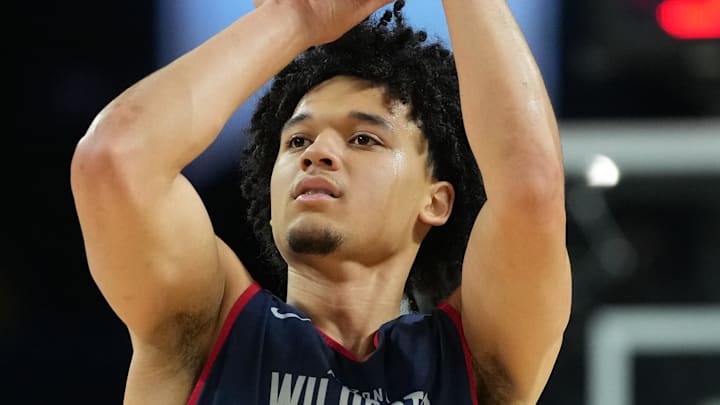
Guard Brayden Burries came out of the gate slow for Arizona, but quickly got up to speed, finishing as one of the best and most impactful freshman players in all of college basketball.
He stands at around 6-foot-4 with a slightly plus wingspan, and was crucial to an Arizona squad that made the Final Four, and was consistently one of the best teams in the nation. He came in as a five-star combo guard ranking No. 9 per RSCI, and led the team in scoring at 16.1 points per game on 49% shooting, adding 4.9 rebounds, 2.4 assists and 1.5 steals per game.
Burries’ major strengths include his complimentary scoring, handling and creation upside, defensive play-making and impact, as well as his positional versatility.
Strengths:
Complimentary Scoring
One of Burries’ top strengths is his ability to score in complimentary ways, not dominating on-ball reps but thriving within the flow of offense and scoring off the ball, and he did this despite leading an elite team in points per game.
Burries averaged 16.1 points per game on the season, shooting 49% from the field, 39% from three and 81% from the free throw line. He finished with a true shooting percentage of 62%, largely functioning as one of the best and most efficient freshman scorers in basketball.
The first thing that jumps out with Burries is his combination of physical and athletic tools. There’s no real singular, standout skill, but his combination of size at 6-foot-4, length with a 6-6 wingspan, obvious strength, open-court speed and ability to play through contact all jump off the page. He can toggle between speed and power, strength and finesse, and is just really hard to deal with in a variety of situations. This combination reared its head the most in Burries’ rim numbers, where he was able to convert 64% of his shots despite a lack of one-of-one athleticism.
Burries scored the bulk of his points in three ways: in transition, as the pick-and-roll handler and spotting up. He scored 202 in the open floor, 169 while handling in the pick-and-roll and 123 spotting up, which accounted for 80% of his points. Two of those obviously lend themselves to more complimentary styles, functioning as a threat in transition and spotting up via other creators.
Burries was at his best out in transition, leveraging all of the aforementioned tools to shoot 58% in total and 1.29 points per possession, earning a ‘very good’ grade per Synergy. He loved pushing the pace, either grabbing and going himself or quickly bolting ahead into space. His A-to-B speed helped him to get out swiftly, but his power and uncontainable driving ability helped him to cap off plays. He shot a blistering 67% on twos — a great mark for a player that’s not a solely above-the-rim athlete — and 33% on transition threes.
In the half-court, Burries was good off the ball simply spotting up. He shot 40% in total, with 3-pointers making up the bigger chunk of his attempts here. He shot 33% on spot-up threes with a clean and projectable shooting stroke, parlaying that into downhill success in shooting 51% on spot-up drives. He has a great feel for when to press the gas and attack, simply take the open shots given or pass out.
The 3-pointer in general was a big weapon for Burries — he shot a great 39% in total, taking a solid 4.6 threes per game. He importantly shot 39% on catch-and-shoot triples — largely unbothered by contests at 38% on guarded and 40% on unguarded on far more contested attempts, pointing to a future as a pluggable floor-spacer.
Arizona was a well-oiled offensive system that didn’t’ prioritize other mode of offense for Burries, but he notable did shoot really well on limited attempts on handoffs and coming off-screen, shooting 46% and 62% from three respectively.
The biggest chunks of Burries’ points were garnered in the exact ways he’ll be used in the NBA, providing positive role player additives alongside the NBA’s best. That's a major strength for Burries, as he’ll be pluggable into so many different systems from the get-go.
Handling and Creation Upside
The other side of Burries’ game earns him his ‘combo guard’ title, with him having the ability to handle the ball and create offense as well. He had just a 23% usage at Arizona, far less than his lead guard counterparts in the 2026 draft.
The standout skill here is Burries’ handling, which not only allows him to really command the floor like a lead guard, but also create offense like one in moderation. His handling — which is highlighted by very efficient and concise moves paired together with impeccable footwork — is far more advanced than your typical combo guard. And when you combine that with all the ways he can create advantages, be it craft, strength or quickness, you get a pretty dangerous on-ball operator. He’s not an explosive vertical or horizontal athlete, but has enough in the tank to create advantages.
While transition play was Burries most prolific offense, the pick-and-roll was his most effective. He scored on 45% of 165 pick-and-roll possessions, grading out ‘excellent’ per Synergy at about one point per possession. Much like the rest of his game, he shaded more toward working inside the arc, but did see a healthy amount of threes taken on these possessions at well. He shot 46% on twos in the pick-and-roll and 42% on threes.
Burries’ overall feel really shone here, with his naturalness for knowing when to attack carrying over to ball screens. He was great about simply recognizing when to press the ‘Go’ button and drive for easy finishes, where his high-off-the-glass finishing was really on display. He could also operate in the middle-ground, keeping players in hostage dribbles, always getting a step deeper in the paint than you’d anticipate. If those options weren’t available, he’d quickly fire triples when the defense didn’t respect his shot.
Burries’ ability to hit shots off-the-dribble was a major cog in his pick-and-roll wheel. He shot an elite 42% on dribble-jumpers in total, slightly more volume than his catch-and-shoot diet, again just pointing to his versatility as a scorer. He shot 44% on dribble-jumper twos and 40% on threes, shying more toward triples. Again, this was largely just him recognizing when the defense was giving him way too much space, and he’d simply sit back and knock down shots.
Burries wasn’t used seriously as an isolation player given Arizona’s system, but he did shoot 67% in total on 13 possessions, with some upside in matchup-attacking.
Burries’ handling and creation ability just further bring into balance his scoring game, which is kind’ve an all encompassing descriptor. He can score on the ball, off the ball, at all three levels. He just had a very balanced diet overall, a perfect amount of rim attempts and threes, with a nice dash of mid-range work.
Burries’ isn’t likely to be used as any sort of lead handler or creator at the NBA level, but he certainly showed enough versatility in this area to add secondary and tertiary impact, with some upside for more down the line.
Defensive Play-Making and Impact
For as good as he was offensively, Burries was equally strong defensively, offering a two-way impactor for the Wildcats.
Burries height at 6-foot-4 and 6-foot-6 wingspan allowed him to guard across both backcourt positions, and his instinctual style and feel for the game led to defensive impact all over. He grabbed 1.5 steals per game on the season to just 0.2 blocks, going for 59 and eight in total across 39 games. He finished with a solid 2.7% steal percentage and a block percentage of 0.7, posting a great defensive box-plus-minus of 5.7 in gelling into Arizona’s strong defensive system. He showed a lot of buy-in on defense, not always guarding the top perimeter option for Arizona, but stepping up to the challenge when asked to, and switching across a variety of matchups constantly.
Burries’ defensive game continues to be highlighted by his feel, competitiveness, edge and his combination of strength and movement skills. His strength is the real separator for him here, helping him to take on bigger matchups, but his lateral mobility is also a major plus, allowing him to cover plenty of options one through three. He’s a very fundamental defender, sitting in his stance really well and using active hands and footwork to stick by defenders. He has really quick reaction time, and is a really good shot-contester, constantly getting hands in shooting zones, despite not blocking shots often.
On the ball, Burries can really put pressure on handlers, jabbing and prodding but moreso just kind’ve walling players off with physicality and making things tough. He has point-of-attack upside, able to fan out, flip his hips and change directions really well. He has claim to being one of the better perimeter defenders in the class, at least among the blue-chip tier, offering real switch-ability, in addition to workable screen navigation on and off-ball.
Off the ball, Burries is really attentive, using his instincts to stunt handlers and jump lanes. He can get caught up in the commotion at times, but again, takes pride on this end of the floor, and it shows in his off-ball prowess.
Burries isn’t likely to be the best defender on the floor at the NBA level, but his baseline of competitiveness, toughness, play-making and instinctual play both on and off-ball paints the picture of an impactful player that teams will be able to rely on in a variety of lineups.
Positional Versatility
All of the things we’ve touched on so far — Burries’ ability to score on or off the ball, shoot, drive, handle, make plays on defense, defend at the point of attack and more — lead to some positional malleability, which is big pro given where the NBA is trending.
Burries is likely going to be best-served as a two-guard in the NBA. But his combination of strengths are going to allow him to moonlight across a variety of different positions. He’ll be able to thrive alongside lead guards with transition and spot-up shooting. He’ll be able to handle the ball and settle offense at any given point, potentially even functioning as a lead at times in high-octane pick-and-roll duos. He’s not majorly plus-sized, but there’s even potential for him to play on the wing, with his offensive skillset blending between positions and his strength and competitiveness allowing him some defensive grace.
And we haven’t yet even touched on Burries’ rebounding and passing, both of which are compliments to his game. His 4.9 rebounds per game with Arizona are very solid positionally, and his 2.4 assists to just 1.5 turnovers point to a floor of ball-moving passing with upside for the flashier stuff. The word that comes to mind with Burries is just polish, there is just a real shine to nearly every area he touches, and I think that showed up in Arizona’s Final Four run, where he was a really pivotal piece.
The 2026 draft’s point guard class is really good, and the vision of Burries as a 6-4 combo guard is slightly less glamorous than others. But there’s also little chance that every single lead guard is going to pan out in a starting or even contributing capacity. And that’s where Burries, who can thrive on or off-ball, defend across multiple positions and slide into so many different scenarios starts to shine.
A lot of these highly-touted, score-first guards of Burries’ mold either learn the hard way that they’re more tailor-made to do little things, or simply don’t figure it out. And Burries just kind’ve has that built in. Choosing Arizona was a telltale sign already, but buying into a less flashy role offensively and immediately getting to work on defense is impressive.
There’s a lot of value in the versatility and impact Burries’ brings.
Areas of Improvement:
Size and Athleticism
It’s pretty tough to poke holes in Brayden Burries’ lone season with Arizona — again, he just displayed a lot of polish and poise across the board. But detractors would look to his size as a reason for passing up on him, as well as mid-tier athleticism that could see his game slowed down some at the NBA level.
There is some level of concern about drafting a 6-foot-4 combo-guard in 2026, especially with the level of talent in the class in general. That’s going to be slightly below average for an off-guard and especially a wing in the modern NBA, and that’s accounting for the fact that he’s a legit 6-foot-4. Meaning how he measures out at the combine could be a swing for many.
On the athleticism front, Burries was solid, posting 17 dunks on the season, though he did miss four, earning a ‘below average’ grade per Synergy. He doesn’t have premier vertical pop, and while his finishing is extremely touch-y and versatile, there are some concerns about NBA-level rim-protectors for under-average vertical athletes. His ground-work is a little better, and his craft makes up the difference, but he’s not highly-elite from a first-step, burst or acceleration standpoint either.
Lastly, in terms of playing off-the-ball, his shooting numbers were good, but not necessarily prolific, with some lulls and low points, such as starting the season off at just 32%, 16-for-49 overall. And on that note, NBA teams can like their two-guards and wings to have really specialized skills alongside stars: elite 3-point shooting, high-end defense, top-tier athleticism. And Burries’ doesn’t necessarily have a truly elite fall-back skill, rather offering a blend of “good” on several fronts.
Age
Lastly, not an area of improvement but moreso an area to consider given it is an unchangeable, but Burries is very old for a true freshman. He’ll be just shy of 21-years-old on draft night 2026, and will actually be 21-years-old starting his first season in the NBA.
For reference, he’s within a few months range of all of Bub Carrington, Ron Holland and Alex Sarr, all 2024 draftees who are finishing up their second complete NBA seasons. And that obviously places Burries older than peers like Kingston Flemings, Darius Acuff Jr., Keaton Wagler, Mikel Brown Jr., and even sophomore guards like Labaron Philon and Christian Anderson.
Still, Burries has done about all he can given his position, buying in to a tough system and thriving en route to the Final Four while doing so.
We’ve seen plenty of older freshman prospects taken recently, and it doesn’t mean that they’re done developing as players. We’ve seen upperclassmen taken that have added tons of skill to their game after lengthy college careers.
Outlook:
Brayden Burries just feels like a needle-mover in the modern iteration of the NBA. A player that can toggle between speed and strength, on and off-ball impact. Highlight-worthy defense or attentiveness off the ball. He’s a good rebounder, passer, and flat out just a good basketball player, one that I think is destined for positive NBA play in some form or fashion.
Age and a lack of elite fall-back skills could lead to a slightly volatile range, though he should end up as a mid-to-late lottery selection.
Burries fits snugly into a lot of rotations given he’s a Swiss Army knife, but the Bucks are in need of talent, especially in the backcourt, and Burries feels like the type of malleable, two-way guard that both the Grizzlies and Thunder like to bet on.
Range: Mid-to-Late Lottery
Role: Two-Way Combo Guard
Impact: Starter, Rotation
Swing Skills: Athleticism, Shooting Consistency
Best Fits: Bucks, Grizzlies, Thunder
 Add us as a preferred source on Google
Derek Parker covers the National Basketball Association, and has brought On SI five seasons of coverage across several different teams. He graduated from the University of Central Oklahoma in 2020, and has experience working in print, video and radio.
Follow DParkOK